~ Summerized Sahih Bukhari > Book of Ablution
CHAPTER 1. No Salat (prayer) is accepted without ablution (i.e. to
remove the small Hadath by – ablution or the big Hadath by taking a bath).
| 1:137: Narrated by Abu Huraira |
| Allah’s Apostle said, “The prayer of a person who does ,Hadath (passes, urine, stool or wind) is not accepted till he performs (repeats) the ablution.” A person from Hadaramout asked Abu Huraira, “What is ‘Hadath’?” Abu Huraira replied, ” ‘Hadath’ means the passing of wind from the anus.” |
CHAPTER 2. The superiority of ablution.
| 1:138: Narrated by Nu’am Al-Mujmir |
| Once I went up the roof of the mosque, along with Abu Huraira. He perform ablution and said, “I heard the Prophet saying, “On the Day of Resurrection, my followers will be called “Al-Ghurr-ul-Muhajjalun” from the trace of ablution and whoever can increase the area of his radiance should do so (i.e. by performing ablution regularly).’ “ |
CHAPTER 3. One should not repeat ablution if in doubt unless and until he is convinced (that he has lost his ablution by having (Hadath).
| 1:139: Narrated by ‘Abbas bin Tamim |
| My uncle asked Allah’s Apostle about a person who imagined to have passed wind during the prayer. Allah’ Apostle replied: “He should not leave his prayers unless he hears sound or smells something.” |
CHAPTER 4. To perform a light ablution.
| 1:140 : Narrated by Kuraib |
| Ibn ‘Abbas said, “The Prophet slept till he snored and then prayed (or probably lay till his breath sounds were heard and then got up and prayed).” Ibn ‘Abbas added: “I stayed overnight in the house of my aunt, Maimuna, the Prophet slept for a part of the night, and late in the night, he got up and performed ablution from a hanging water skin, a light (perfect) ablution and stood up for the prayer. I, too, performed a similar ablution, then I went and stood on his left. He drew me to his right and prayed as much as Allah wished, and again lay and slept till his breath sounds were heard. Later on the Mua’dhdhin (callmaker for the prayer) came to him and informed him that it was time for Prayer. The Prophet went with him for the prayer without performing a new ablution.” (Sufyan said to ‘Amr that some people said, “The eyes of Allah’s Apostle sleep but his heart does not sleep.” ‘Amr replied, “I heard ‘Ubaid bin ‘Umar saying that the dreams of Prophets were Divine Inspiration, and then he recited the verse: ‘I (Abraham) see in a dream, (O my son) that I offer you in sacrifice (to Allah).” (37.102) (See Hadith No. 183) |
CHAPTER 5. The completion (or perfection) of ablution.
| 1:141 : Narrated by Usama bin Zaid |
| Allah’s Apostle proceeded from ‘Arafat till when he reached the mountain pass, he dismounted, urinated and then performed ablution but not a perfect one. I said to him, (“Is it the time for) the prayer, O Allah’s Apostle?” He said, “The (place of) prayer is ahead of you.” He rode till when he reached Al-Muzdalifa, he dismounted and performed ablution and a perfect one, The (call for) Iqama was pronounced and he led the Maghrib prayer. Then everybody made his camel kneel down at its place. Then the Iqama was pronounced for the ‘Isha’ prayer which the Prophet led and no prayer was offered in between the two . prayers (‘Isha’ and Maghrib). |
CHAPTER 6. To wash the face with both hands by a handful of water.
| 1:142 – Narrated by ‘Ata’ bin Yasar |
| Ibn ‘Abbas performed ablution and washed his face (in the following way): He ladled out a handful of water, rinsed his mouth and washed his nose with it by putting in water and then blowing it out. He then, took another handful (of water) and did like this (gesturing) joining both hands, and washed his face, took another handful of water and washed his right forearm. He again took another handful of water and washed his left forearm, and passed wet hands over his head and took another handful of water and poured it over his right foot (up to his ankles) and washed it thoroughly and similarly took another handful of water and washed thoroughly his left foot (up to the ankles) and said, “I saw Allah’s Apostle performing ablution in this way.” |
CHAPTER 7. What to say while going to lavatory (water closet).
| 1:144 – Narrated by Anas |
| Whenever the Prophet went to answer the call of nature, he used to say, “Allah-umma inni a’udhu bika minal khubuthi wal khaba’ith i.e. O Allah, I seek Refuge with You from all offensive and wicked things (evil deeds and evil spirits).” |
CHAPTER 8. Providing water at lavatories (for washing the private parts after answering the call of nature).
| 1:145 Narrated by Ibn ‘Abbas |
| Once the Prophet entered a lavatory and I placed water for his ablution. He asked, “Who placed it?” He was informed accordingly and so he said, “O Allah! Make him (Ibn ‘Abbas) a learned scholar in religion (Islam).” |
CHAPTER 9. While urinating or defecating, never face the Qiblah (except when you are screened by a building or a wall or something like that).
| 1:146 Narrated by Abu Aiyub Al-Ansari |
| Allah’s Apostle said, “If anyone of you goes to an open space for answering the call of nature he should neither face nor turn his back towards the Qibla; he should either face the east or the west.” |
CHAPTER 10. Defecating while sitting over the two bricks.
| 1:147 Narrated by ‘Abdullah bin ‘Umar |
| People say, “Whenever you sit for answering the call of nature, you should not face the Qibla or Bait-ulMaqdis (Jerusalem).” I told them. “Once I went up the roof of our house and I saw Allah’s Apostle answering the call of nature while sitting on two bricks facing Bait-ul-Maqdis (Jerusalem) (but there was a screen covering him. ‘ (FatehAl-Bari, Page 258, Vol. 1). |
CHAPTER 11. The going out of women for answering the call of nature.
| 1:148 Narrated by ‘Aisha |
| The wives of the Prophet used to go to Al-Manasi, a vast open place (near Baqia at Medina) to answer the call of nature at night. ‘Umar used to say to the Prophet “Let your wives be veiled,” but Allah’s Apostle did not do so. One night Sauda bint Zam’a the wife of the Prophet went out at ‘Isha’ time and she was a tall lady. ‘Umar addressed her and said, “I have recognized you, O Sauda.” He said so, as he desired eagerly that the verses of Al-Hijab (the observing of veils by the Muslim women) may be revealed. So Allah revealed the verses of “Al-Hijab” (A complete body cover excluding the eyes). |
CHAPTER 12. To wash the private parts with water after answering the call of nature.
| 1:152 Narrated by Anas bin Malik |
| Whenever Allah’s Apostle went to answer the call of nature, I along with another boy used to accompany him with a tumbler full of water. (Hisham commented, “So that he might wash his private parts with it.)” |
CHAPTER 13. To carry an ‘Anaza – (spear-headed stick) along with the water for washing the private parts after answering the call of nature.
| 1:154 Narrated by Anas bin Malik |
| Whenever Allah’s Apostle went to answer the call of nature, I along with another boy used to carry a tumbler full of water (for cleaning the private parts) and an ‘Anza (spear-headed stuck). |
CHAPTER 14. It is forbidden to clean the private parts with the right hand.
| 1:155 Narrated by Abu Qatada |
| Allah’s Apostle said, “Whenever anyone of you drinks water, he should not breathe in the drinking utensil, and whenever anyone of you goes to a lavatory, he should neither touch his penis nor clean his private parts with his right hand.” |
CHAPTER 15. To clean the private parts with stones.
| 1:157 Narrated by Abu Huraira |
| I followed the Prophet while he was going out to answer the call of nature. He used not to look this way or that. So, when I approached near him he said to me, “Fetch for me some stones for ‘ cleaning the privates parts (or said something similar), and do not bring a bone or a piece of dung.” So I brought the stones in the corner of my garment and placed them by his side and I then went away from him. When he finished (from answering the call of nature) he used, them . |
CHAPTER 16. Do not clean the private parts with dung.
| 1:158 Narrated by ‘Abdullah |
| The Prophet went out to answer the call of nature and asked me to bring three stones. I found two stones and searched for the third but could not find it. So took a dried piece of dung and brought it to him. He took the two stones and threw away the dung and said, “This is a filthy thing.” |
CHAPTER 17. The washing of the body parts (i.e. the parts which are washed in ablution) once only while performing ablution.
| 1:159 Narrated by Ibn ‘Abbas |
| The Prophet performed ablution by washing the body parts only once. |
CHAPTER 18. The washing of the body parts twice while performing ablution.
| 1:160 Narrated by ‘Abdullah bin Zaid |
| The Prophet performed ablution by washing the body parts twice. |
CHAPTER 19. The washing of the parts thrice while performing
ablution.
| 1:161 Narrated by Humran |
| (the slave of ‘Uthman) I saw ‘Uthman bin ‘Affan asking for a tumbler of water (and when it was brought) he poured water over his hands and washed them thrice and then put his right hand in the water container and rinsed his mouth, washed his nose by putting water in it and then blowing it out. then he washed his face and forearms up to the elbows thrice, passed his wet hands over his head and washed his feet up to the ankles thrice. Then he said, “Allah’s Apostle said ‘If anyone Performs ablution like that of mine and offers a two-rak’at prayer during which he does not think of anything else (not related to the present prayer) then his past sins will be forgiven.’ ” After performing the ablution ‘Uthman said, “I am going to tell you a Hadith which I would not have told you, had I not been compelled by a certain Holy Verse (the sub narrator ‘Urwa said: This verse is: “Verily, those who conceal the clear signs and the guidance which we have sent down…)” (2:159). I heard the Prophet saying, ‘If a man performs ablution perfectly and then offers the compulsory congregational prayer, Allah will forgive his sins committed between that (prayer) and the (next) prayer till he offers it. |
CHAPTER 20. The cleaning of the nose by putting water in it and then blowing it out during ablution.
| 1:162 Narrated by Abu Huraira |
| Allah’s Apostle said, “If anyone of you performs ablution he should put water in his nose and then blow it out and whoever cleans his private parts with stones should do so with odd numbers. And whoever wakes up from his sleep should wash his hands before putting them in the water for ablution, because nobody knows where his hands were during sleep.” |
CHAPTER 21. To clean the private parts with odd number of stones.
| 1:163 Narrated by Abu Huraira |
| Allah’s Apostle said, “If anyone of you performs ablution he should put water in his nose and then blow it out and whoever cleans his private parts with stones should do so with odd numbers. And whoever wakes up from his sleep should wash his hands before putting them in the water for ablution, because nobody knows where his hands were during sleep.” |
CHAPTER 22. Washing the feet when one is wearing shoes.
| 1:167 Narrated by ‘Ubaid Ibn Juraij |
| I asked ‘Abdullah bin ‘Umar, “O Abu ‘Abdur-Rahman! I saw you doing four things which I never saw being done by anyone of you companions?” ‘Abdullah bin ‘Umar said, “What are those, O Ibn Juraij?” I said, “I never saw you touching any corner of the Ka’ba except these (two) facing south (Yemen) and I saw you wearing shoes made of tanned leather and dyeing your hair with Hinna; (a kind of dye). I also noticed that whenever you were in Mecca, the people assume lhram on seeing the new moon crescent (1st of Dhul-Hijja) while you did not assume the Ihlal (Ihram)–(Ihram is also called Ihlal which means ‘Loud calling’ because a Muhrim has to recite Talbiya aloud when assuming the state of Ihram)–till the 8th of Dhul-Hijja (Day of Tarwiya). ‘Abdullah replied, “Regarding the corners of Ka’ba, I never saw Allah’s Apostle touching except those facing south (Yemen) and regarding the tanned leather shoes, no doubt I saw Allah’s Apostle wearing non-hairy shoes and he used to perform ablution while wearing the shoes (i.e. wash his feet and then put on the shoes). So I love to wear similar shoes. And about the dyeing of hair with Hinna; no doubt I saw Allah’s Apostle dyeing his hair with it and that is why I like to dye (my hair with it). Regarding Ihlal, I did not see Allah’s Apostle assuming Ihlal till he set out for Hajj (on the 8th of Dhul-Hijja).” |
CHAPTER 23. While performing ablution or taking a bath (one should start) from the right side of the body.
| 1:169 Narrated by ‘Aisha |
| The Prophet used to like to start from the right side on wearing shoes, combing his hair and cleaning or washing himself and on doing anything else. |
CHAPTER 24. To look for water (for ablution) when the time for the Salât (prayer) is due.
| 1:170 Narrated by Anas bin Malik |
| Saw Allah’s Apostle when the ‘Asr prayer was due and the people searched for water to perform ablution but they could not find it. Later on (a pot full of) water for ablution was brought to Allah’s Apostle . He put his hand in that pot and ordered the people to perform ablution from it. I saw the water springing out from underneath his fingers till all of them performed the ablution (it was one of the miracles of the Prophet). |
CHAPTER 25. (What is said regarding) the water with which
human hair has been washed.
| 1:172 Narrated by Anas |
| When Allah’s Apostle got his head shaved, Abu- Talha was the first to take some of his hair. |
CHAPTER 26. If a dog drinks from the utensils of anyone of you.
| 1:173 Narrated by Abu Huraira |
| Allah’s Apostle said, “If a dog drinks from the utensil of anyone of you it is essential to wash it seven times.” |
| 1:174 Narrated by Abu Huraira |
| The Prophet said, “A man saw a dog eating mud from (the severity of) thirst. So, that man took a shoe (and filled it) with water and kept on pouring the water for the dog till it quenched its thirst. So Allah approved of his deed and made him to enter Paradise.” And narrated Hamza bin ‘Abdullah: My father said. “During the lifetime of Allah’s Apostle, the dogs used to urinate, and pass through the mosques (come and go), nevertheless they never used to sprinkle water on it (urine of the dog.)” |
CHAPTER 27. Whosoever considers not to repeat ablution except if something is discharged or passed from either exit (front or back private parts).
| 1:176 Narrated by Abu Huraira |
| Allah’s Apostle said, “A person is considered in prayer as long as he is waiting for the prayer in the mosque as long as he does not do Hadath.” A non-Arab man asked, “O Abu Huraira! What is Hadath?” I replied, “It is the passing of wind (from the anus) (that is one of the types of Hadath).” |
| 1:179 Narrated by Zaid bin Khalid |
| I asked ‘Uthman bin ‘Affan about a person who engaged in intercourse but did no discharge. ‘Uthman replied, “He should perform ablution like the one for ar ordinary prayer but he must wash his penis.” ‘Uthman added, “I heard it from Allah’s Apostle.” I asked ‘Ali Az-Zubair, Talha and Ubai bin Ka’b about it and they, too, gave the same reply. (This order was cancelled later on and taking a bath became necessary for such cases). |
| 1:180 Narrated by Abu Said Al-Khud |
| Allah’s Apostle sent for a Ansari man who came with water dropping from his head. The Prophet said, “Perhaps we have forced you to hurry up, haven’t we?” The Ansari replied, “Yes.” Allah’s Apostle further said, “If you are forced to hurry up (during intercourse) or you do not discharge then ablution is due on you (This order was cancelled later on, i.e. one has to take a bath). |
CHAPTER 28. (What is said regarding) a man who helps his
companion to perform ablution (by pouring water for him).
| 1:182 Narrated by Al-Mughira bin Shu’ba |
| I was in the company of Allah’s Apostle on one of the journeys and he went out to answer the call of nature (and after he finished) I poured water and he performed ablution; he washed his face, forearms and passed his wet hand over his head and over the two Khuff, (leather socks). |
CHAPTER 29. The recitation of Qur’ân or doing other things after
Hadath.
| 1: 183 Narrated by ‘Abdullah bin ‘Abbas |
| That he stayed overnight in the house of Maimuna the wife of the Prophet, his aunt. He added : I lay on the bed (cushion transversally) while Allah’s Apostle and his wife lay in the length-wise direction of the cushion. Allah’s Apostle slept till the middle of the night, either a bit before or a bit after it and then woke up, rubbing the traces of sleep off his face with his hands. He then, recited the last ten verses of Sura Al-Imran, got up and went to a hanging water-skin. He then Performed the ablution from it and it was a perfect ablution, and then stood up to offer the prayer. I, too, got up and did as the Prophet had done. Then I went and stood by his side. He placed his right hand on my head and caught my right ear and twisted it. He prayed two Rakat then two Rakat and two Rakat and then two Rakat and then two Rakat and then two Rakat (separately six times), and finally one Rak’a (the Witr). Then he lay down again in the bed till the Mu’adhdhin came to him where upon the Prophet got up, offered a two light Rakat prayer and went out and led the Fajr prayer. |
CHAPTER 30. To pass wet hands over the whole head during ablution
| 1:185 Narrated by Yahya Al-Mazini |
| A person asked ‘Abdullah bin Zaid who was the grandfather of ‘Amr bin Yahya, “Can you show me how Allah’s Apostle used to perform ablution?” ‘Abdullah bin Zaid replied in the affirmative and asked for water. He poured it on his hands and washed them twice, then he rinsed his mouth thrice and washed his nose with water thrice by putting water in it and blowing it out. He washed his face thrice and after that he washed his forearms up to the elbows twice and then passed his wet hands over his head from its front to its back and vice versa (beginning from the front and taking them to the back of his head up to the nape of the neck and then brought them to the front again from where he had started) and washed his feet (up to the ankles). |
CHAPTER 31. The using of the remaining water after ablution.
| 1:187 Narrated by Abu Juhaifa |
| Allah’s Apostle came to us at noon and water for ablution was brought to him. After he had performed ablution, the remaining water was taken by the people and they started smearing their bodies with it (as a blessed thing). The Prophet offered two Rakat of the Zuhr prayer and then two Rakat of the ‘Asr prayer while an ‘Anza (spear-headed stick) was there (as a Sutra) in front of him. Abu Musa said: The Prophet asked for a tumbler containing water and washed both his hands and face in it and then threw a mouthful of water in the tumbler and said to both of us (Abu Musa and Bilal), “Drink from the tumbler and pour some of its water on your faces and chests.” |
| 1:189 Narrated by As-Sa’ib bin Yazid |
| My aunt took me to the Prophet and said, “O Allah’s Apostle! This son of my sister has got a disease in his legs.” So he passed his hands on my head and prayed for Allah’s blessings for me; then he performed ablution and I drank from the remaining water. I stood behind him and saw the seal of Prophethood between his shoulders, and it was like the “Zir-al-Hijla” (means the button of a small tent, but some said ‘egg of a partridge.’ etc.) |
CHAPTER 32. The performance of ablution by a man along with his wife.
| Narrated Ibn ‘Umar |
| “During the lifetime of Allah’s Messenger men and women used to perform ablution together. |
CHAPTER 33. The sprinkling of remaining water after performing ablution on an unconscious person by the Prophet
| 1:193 Narrated by Jabir |
| Allah’s Apostle came to visit me while I was sick and unconscious. He performed ablution and sprinkled the remaining water on me and I became conscious and said, “O Allah’s Apostle! To whom will my inheritance go as I have neither ascendants nor descendants?” Then the Divine verses regarding Fara’id (inheritance) were revealed. |
CHAPTER 34. To take a bath or perform ablution from a Al-Mikhdab (utensil).
| 1:194 Narrated by Anas |
| It was the time for prayer, and those whose houses were near got up and went to their people (to perform ablution), and there remained some people (sitting). Then a painted stove pot (Mikhdab) containing water was brought to Allah’s Apostles The pot was small, not broad enough for one to spread one’s hand in; yet all the people performed ablution. (The sub narrator said, “We asked Anas, ‘How many persons were you?’ Anas replied ‘We were eighty or more”). (It was one of the miracles of Allah’s Apostle). |
| 1:195 Narrated by Abu Musa |
| Once the Prophet asked for a tumbler containing water. He washed his hands and face in it and also threw a mouthful of water in it. |
| 1:197 Narrated by ‘Aisha |
| When the ailment of the Prophet became aggravated and his disease became severe, he asked his wives to permit him to be nursed (treated) in my house. So they gave him the permission. Then the Prophet came (to my house) with the support of two men, and his legs were dragging on the ground, between ‘Abbas, and another man.” ‘Ubaid-Ullah (the sub narrator) said, “I informed ‘Abdullah bin ‘Abbas of what ‘Aisha said. Ibn ‘Abbas said: ‘Do you know who was the other man?’ I replied in the negative. Ibn ‘Abbas said, ‘He was ‘Ali (bin Abi Talib).” ‘Aisha further said, “When the Prophet came to my house and his sickness became aggravated he ordered us to pour seven skins full of water on him, so that he might give some advice to the people. So he was seated in a Mikhdab (brass tub) belonging to Hafsa, the wife of the Prophet. Then, all of us started pouring water on him from the water skins till he beckoned to us to stop and that we have done (what he wanted us to do). After that he went out to the people.” |
| 1:199 Narrated by Thabit |
| Anas said, “The Prophet asked for water and a tumbler with a broad base and no so deep, containing a small quantity of water, was brought to him whereby he put his fingers in it.” Anas further said, ‘ noticed the water springing out from amongst his fingers.” Anas added, ‘ estimated that the people who performed ablution with it numbered between seventy to eighty.” |
CHAPTER 35. To perform ablution with one Mâdd of water. (Mâdd is practically 2/3 of a kilogram.)
| 1:200 Narrated by Anas |
| The Prophet used to take a bath with one Saor up to five Mudds (1 Sa’= Mudds) of water and used to perform ablution with one Mudd of water. |
CHAPTER 36. To pass wet hands over the Khâffain (two leather socks covering the ankles).
| 1:201 Narrated by ‘Abdullah bin ‘Umar |
| Sa’d bin Abi Waqqas said, “The Prophet passed wet hands over his Khuffs.” ‘Abdullah bin ‘Umar asked Umar about it. ‘Umar replied in the affirmative and added, “Whenever Sa’d narrates a Hadith from the Prophet, there is no need to ask anyone else about it.” |
| 1:203 Narrated by Ja’far bin ‘Amr bin Umaiya Ad-Damri |
| My father said, “I saw the Prophet passing wet hands over his Khuffs.” |
| 1:204 Narrated by Ja’far bin ‘Amr |
| My father said, “I saw the Prophet passing wet hands over his turban and Khuffs (leather socks).” |
CHAPTER 37. If one puts on (KhâfJ) just after performing ablution (there is no need to wash one’s feet again in ablution) (24 hours for non-travellers and three days for travellers).
| 1:205 Narrated by ‘Urwa bin Al-Mughira |
| My father said, “Once I was in the company of the Prophet on a journey and I dashed to take off his Khuffs. He ordered me to leave them as he had put them after performing ablution. So he passed wet hands or them. |
CHAPTER 38. Not repeating ablution after eating mutton and As-Sawiq
| 1:207 Narrated by Ja’far bin ‘Amr bin Umaiya |
| My father said, “I saw Allah’s Apostle taking a piece of (cooked) mutton from the shoulder region and then he was called for prayer. He put his knife down and prayed without repeating ablution.” |
CHAPTER 39. Rinsing one’s mouth (with water) after eating As-Sawiq without repeating ablution.
| 1:208 Narrated by Suwaid bin Al-Nu’man |
| In the year of the conquest of Khaibar I went with Allah’s Apostle till we reached Sahba,’ a place near Khaibar, where Allah’s Apostle offered the ‘Asr prayer and asked for food. Nothing but Sawiq was brought. He ordered it to be moistened with water. He and all of us ate it and the Prophet got up for the evening prayer (Maghrib prayer), rinsed his mouth with water and we did the same, and he then prayed without repeating the ablution. (Sawiq – A kind of mash made of powdered roasted wheat or barley grain (also with sugar and dates). |
| 1:209 Narrated by Maimuna |
| The Prophet ate (a piece of) mutton from the shoulder region and then prayed without repeating the ablution. |
CHAPTER 40. Whether to rinse the mouth after drinking milk.
| 1:210 Narrated by Ibn ‘Abbas |
| Allah’s Apostle drank milk, rinsed his mouth and said, “It has fat.” |
CHAPTER 41. Ablution after sleep. And whoever considers it
unnecessary to repeat ablution after dozing once or twice or after nodding once in slumber.
| 1:211 Narrated by ‘Aisha |
| Allah’s Apostle said, “If anyone of you feels drowsy while praying he should go to bed (sleep) till his slumber is over because in praying while drowsy one does not know whether one is asking for forgiveness or for a bad thing for oneself.” |
| 1:212 Narrated by Anas |
| The Prophet said, “If anyone of you feels drowsy while praying, he should sleep till he understands what he is saying (reciting).” |
CHAPTER 42. To perform ablution even on having no Hadath.
| 1:213 Narrated by ‘Amr bin ‘Amir |
| Anas said, “The Prophet used to perform ablution for every prayer.” I asked Anas, “What you used to do?’ Anas replied, “We used to pray with the same ablution until we break it with Hadath.” |
CHAPTER 43. One of the major sins is not to protect oneself (one’s clothes and body) from one’s urine (i.e. from being soiled with it).
| 1:215 Narrated by Ibn ‘Abbas |
| Once the Prophet, while passing through one of the grave-yards of Medina or Mecca heard the voices of two persons who were being tortured in their graves. The Prophet said, “These two persons are being tortured not for a major sin (to avoid).” The Prophet then added, “Yes! (they are being tortured for a major sin). Indeed, one of them never saved himself from being soiled with his urine while the other used to go about with calumnies (to make enmiy between friends). The Prophet then asked for a green leaf of a date-palm tree, broke it into two pieces and put one on each grave. On being asked why he had done so, he replied, “I hope that their torture might be lessened, till these get dried.” |
CHAPTER 44. What is said regarding washing out urine.
| 1:216 Narrated by Anas bin Malik |
| Whenever the Prophet went to answer the call of nature, I used to bring water with which he used to clean his private parts. |
CHAPTER 45. The Prophet and the people left the bedouin undisturbed till he finished urinating in the mosque.
| 1:219 Narrated by Abu Huraira |
| A Bedouin stood up and started making water in the mosque. The people caught him but the Prophet ordered them to leave him and to pour a bucket or a tumbler of water over the place where he had passed the urine. The Prophet then said, “You have been sent to make things easy and not to make them difficult.” |
CHAPTER 46. The urine of children.
| 1:223 Narrated by Um Qais bint Mihsin |
| I brought my young son, who had not started eating (ordinary food) to Allah’s Apostle who took him and made him sit in his lap. The child urinated on the garment of the Prophet, so he asked for water and poured it over the soiled (area) and did not wash it. |
CHAPTER 47. To pass urine while standing and sitting.
| 1:224 Narrated by Hudhaifa |
| Once the Prophet went to the dumps of some people and passed urine while standing. He then asked for water and so I brought it to him and he performed ablution. |
CHAPTER 48. To make water beside one’s companion while screened by a wall.
| 1:225 Narrated by Hudhaifa’ |
| The Prophet and I walked till we reached the dumps of some people. He stood, as any one of you stands, behind a wall and urinated. I went away, but he beckoned me to come. So I approached him and stood near his back till he finished. |
CHAPTER 49. The washing out of blood.
| 1:227 Narrated by Asma’ |
| A woman came to the Prophet and said, “If anyone of us gets menses in her clothes then what should she do?” He replied, “She should (take hold of the soiled place), rub it and put it in the water and rub it in order to remove the traces of blood and then pour water over it. Then she can pray in it.” |
| 1:228 Narrated by ‘Aisha |
| Fatima bint Abi Hubaish came to the Prophet and said, “O Allah’s Apostle I get persistent bleeding from the uterus and do not become clean. Shall I give up my prayers?” Allah’s Apostle replied, “No, because it is from a blood vessel and not the menses. So when your real menses begins give up your prayers and when it has finished wash off the blood (take a bath) and offer your prayers.” Hisham (the sub narrator) narrated that his father had also said, (the Prophet told her): “Perform ablution for every prayer till the time of the next period comes.” |
CHAPTER 50. The washing out of semen with water and rubbing it off (when it is dry) [and the washing out of what comes out of women (i.e. discharge)].
| 1:229 Narrated by ‘Aisha |
| I used to wash the traces of Janaba (semen) from the clothes of the Prophet and he used to go for prayers while traces of water were still on it (water spots were still visible). |
CHAPTER 51. (What is said) about the urine of camels, sheep and other – animals and about their folds.
| 1:234 Narrated by Abu Qilaba |
| Anas said, “Some people of ‘Ukl or ‘Uraina tribe came to Medina and its climate did not suit them. So the Prophet ordered them to go to the herd of (Milk) camels and to drink their milk and urine (as a medicine). So they went as directed and after they became healthy, they killed the shepherd of the Prophet and drove away all the camels. The news reached the Prophet early in the morning and he sent (men) in their pursuit and they were captured and brought at noon. He then ordered to cut their hands and feet (and it was done), and their eyes were branded with heated pieces of iron, They were put in ‘Al-Harra’ and when they asked for water, no water was given to them.” Abu Qilaba said, “Those people committed theft and murder, became infidels after embracing Islam and fought against Allah and His Apostle .” |
| 1:235 Narrated by Anas |
| Prior to the construction of the mosque, the Prophet offered the prayers at sheep-folds. |
CHAPTER 52. (What is said about) An-Najasat (impure and filthy
things) which fall in cooking butter (Ghee – which is obtained by
evaporating moisture from butter) and water.
| 1:236 Narrated by Maimuna |
| Allah’s Apostle was asked regarding ghee (cooking butter) in which a mouse had fallen. He said, “Take out the mouse and throw away the ghee around it and use the rest.” |
| 1:238 Narrated by Abu Huraira |
| The Prophet said, “A wound which a Muslim receives in Allah’s cause will appear on the Day of Resurrection as it was at the time of infliction; blood will be flowing from the wound and its color will be that of the blood but will smell like musk.” |
CHAPTER 53. Urinating in stagnant water.
| 1:239 Narrated by Abu Huraira |
| Allah’s Apostle said, “We (Muslims) are the last (people to come in the world) but (will be) the foremost (on the Day of Resurrection).” The same narrator told that the Prophet had said, “You should not pass urine in stagnant water which is not flowing then (you may need to) wash in it.” |
CHAPTER 54. If a dead body or a polluted thing is put on the back of a person offering the Salat (prayer), his Salât (prayer) will not be annulled (rejected by Allah).
| 1:241 Narrated by ‘Abdullah bin Mas’ud |
| Once the Prophet was offering prayers at the Ka’ba. Abu Jahl was sitting with some of his companions. One of them said to the others, “Who amongst you will bring the abdominal contents (intestines, etc.) of a camel of Bani so and so and put it on the back of Muhammad, when he prostrates?” The most unfortunate of them got up and brought it. He waited till the Prophet prostrated and then placed it on his back between his shoulders. I was watching but could not do any thing. I wish I had some people with me to hold out against them. They started laughing and falling on one another. Allah’s Apostle was in prostration and he did not lift his head up till Fatima (Prophet’s daughter) came and threw that (camel’s abdominal contents) away from his back. He raised his head and said thrice, “O Allah! Punish Quraish.” So it was hard for Abu Jahl and his companions when the Prophet invoked Allah against them as they had a conviction that the prayers and invocations were accepted in this city (Mecca). The Prophet said, “O Allah! Punish Abu Jahl, ‘Utba bin Rabi’a, Shaiba bin Rabi’a, Al-Walid bin ‘Utba, Umaiya bin Khalaf, and ‘Uqba bin Al Mu’it (and he mentioned the seventh whose name I cannot recall). By Allah in Whose Hands my life is, I saw the dead bodies of those persons who were counted by Allah’s Apostle in the Qalib (one of the wells) of Badr. |
CHAPTER 55. Spitting or blowing out the nose or doing similar action in one’s (own) garment.
| 1:242 Narrated by Anas |
| The Prophet once spat in his clothes. |
CHAPTER 56. Washing blood by a woman off her father’s face.
| 1:244 Narrated by Abu Hazim |
| Sahl bin Sa’d As-Sa’idi, was asked by the people, “With what was the wound of the Prophet treated? Sahl replied, “None remains among the people living who knows that better than I. ‘Ali used to bring water in his shield and Fatima used to wash the blood off his face. Then straw mat was burnt and the wound was filled with it.” |
CHAPTER 57. Siwak (to clean the teeth with Siwâk which is a
tooth-brush in the form of a pencil from the roots of an Arâk tree).
| 1:245 Narrated by Abu Burda |
| My father said, “I came to the Prophet and saw him carrying a Siwak in his hand and cleansing his teeth, saying, ‘U’ U’,” as if he was retching while the Siwak was in his mouth.” |
| 1:246A Narrated by Hudhaifa |
| Whenever the Prophet got up at night, he used to clean his mouth with Siwak. |
CHAPTER 58. To give Siwâk to the oldest person of the group.
| 1:246B : Narrated Ibn ‘Umar |
| The Prophet said, “I dreamt that I was cleaning my teeth with a Siwák and two persons came to me. One of them was older than the other and I gave the Siwák to the younger. I was told that I should give it to the older and so I did.” |
CHAPTER 59. The superiority of a person who sleeps with ablution.
| 1:247 Narrated by Al-Bara ‘bin ‘Azib |
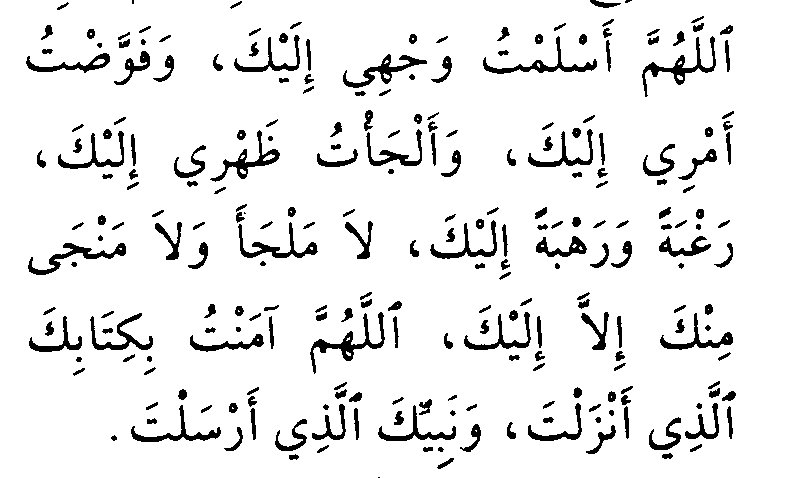
| The Prophet said to me, “Whenever you go to bed perform ablution like that for the prayer, lie or your right side and say, “Allahumma aslamtu wajhi ilaika, wa fauwadtu amri ilaika, wa alja’tu Zahri ilaika raghbatan wa rahbatan ilaika. La Malja’ wa la manja minka illa ilaika. Allahumma amantu bikitabika-l-ladhi anzalta wa bina-biyika-l ladhi arsalta” (O Allah! I surrender to You and entrust all my affairs to You and depend upon You for Your Blessings both with hope and fear of You. There is no fleeing from You, and there is no place of protection and safety except with You O Allah! I believe in Your Book (the Qur’an) which You have revealed and in Your Prophet (Muhammad) whom You have sent). Then if you die on that very night, you will die with faith (i.e. or the religion of Islam). Let the aforesaid words be your last utterance (before sleep).” I repeated it before the Prophet and when I reached “Allahumma amantu bikitabika-l-ladhi anzalta (O Allah I believe in Your Book which You have revealed).” I said, “Wa-rasulika (and your Apostle).” The Prophet said, “No, (but say): ‘Wanabiyika-l-ladhi arsalta (Your Prophet whom You have sent), instead.” |
 Books of Muslims