The Manners Of Visiting The Sick
1) The Virtues Of Visiting The Sick
2) Visiting Sick Children
3) Women Visiting Sick Men
4) Visiting A Person Who Is Unconscious
5) Visiting A Sick Non-Muslim
6) The Best Time To Visit A Sick Person
7) Making The Visit Short
8) Where The Visitor Should Sit
9) Asking The Patient About His Situation And Saying Comforting Words To Him
10) Crying Beside A Sick Person
11) What One Should Say To The Patient, In Terms Of Supplications And Comforting Words
12) Placing One’s Hand Over The Sick Person.
13) Reading Invocations Over The Patient.
14) When A Patient Is In The Final Stages Of Dying, Those Around Him Should Prompt Him To Say The Shahaadah (“I Bear Witness That None Has The Right To Be Worshipped But Allah”);
The Manners Of Visiting The Sick
Al-Baraa Ibn `Aazib (R.A) said, “The Prophet (Pbuh) ordered us with seven [commands] and forbade us from seven [prohibited matters]: he (Pbuh) ordered us to follow funerals (by praying the funeral prayer and then following the corpse until the burial is completed), to visit the sick, to answer (i.e., accept the invitation of) a person who invites [one to partake of a meal, for example], to help the one who is wronged, to fulfill one’s oath, to return greetings of peace, and to do Tashmeet of a person who sneezes [i.e., to say, ‘Yarhamukallah (may Allah have mercy on you),’ when he says, ‘Alhamdulillah (All praise is for Allah),’ right after he sneezes]. And he forbade us from [using] containers (and dishes) made of silver, from [wearing] a gold ring, from [wearing] silk, from Ad-Deebaaj (a kind of silk), from Al-Qissee (a garment that is striped with silk), and from Al-Istabrak (a coarse kind of silk). (This is Bukhaaree’s narration of the Hadeeth, and he doesn’t mention the seventh prohibited matter; Muslim did mention it in his narration: it is Al-Mayaathir, a covering made of silk that is placed over a saddle).” [Muslim, 2066]
The Manners Of Visiting The Sick
1) The Virtues Of Visiting The Sick
A number of narrations have been related concerning the virtues of visiting the sick; here we will mention some of them. Thaubaan (R.A) the freed slave of the Messenger of Allah (Pbuh) related that the Messenger of Allah (Pbuh) said, “Whoever visits a sick person continues to remain in Khurfat of Paradise (‘Khurfah of Paradise’ are the fruits one picks from the date trees of Paradise; here, the Prophet (Pbuh) is likening the greatness of the reward one receives for visiting a sick person to the fruits a dweller of Paradise picks from its trees) until he returns.” [Muslim, 2568]
Jaabir Ibn ‘Abdullah (R.A) reported that he heard the Prophet (Pbuh) say, “Whoever visits a sick person wades in Ar-Rahmah (Mercy), until he sits down, when he is firmly entrenched in it (in Mercy).” [Bukhaaree, 522]
Abu Hurairah (R.A) reported that the Messenger of Allah (Pbuh) said “Verily, Allah ‘Azza (the Possessor of Might and Majesty) will say on the Day of Resurrection, ‘0 son of Adam, I became sick yet you did not visit Me.’ He (Swt) will say, ‘0 my Lord, how can I visit You, and You are the Lord of all that exists?’ He It will say, ‘Did you not know that such and such slave of mine became sick? But you did not visit him. Did you not know that had you visited him, you would have found Me with him… ” [At-Tamheed, 24/273]
And ‘Alee (R.A) reported that he heard the Messenger of Allah (Pbuh) say, “Whoever goes to visit his [sick] Muslim brother is walking in the Khuraafah (a road which lies between two rows of date trees) of Paradise, until he sits down [near his sick brother]. Then, when he sits down, Ar-Rahmah (Mercy) overspreads him. If it is the morning [that he visits him], then 70,000 angels pray over him until the night arrives; and if it is in the night, then 70,000 angels pray over him until the morning arrives.” [Muslim, 2569]
After one hears or reads these Ahadeeth, which mention the great virtues of visiting the sick, one should not be derelict in his brotherly duties. Instead, whenever he finds out that one of his Muslim brothers is sick, he should hurry to him, and thus achieve the Mercy of the Most Beneficent, the Most Merciful. There are other merits to visiting the sick which we have not mentioned – the sick person feeling consoled upon seeing the concern of his brother, the sick person being able to ask his brother for help if he needs it, and the visitor learning a lesson about the transient nature of this life.
2) Visiting Sick Children
Upon visiting a sick child, one serves the same purpose and does the same actions as when he visits a sick man: he supplicates for the sick child, consoles him, and reads Islamically legislated invocations over him; he also receives the rewards that one reaps for visiting a sick adult (as are detailed in the above-mentioned narrations).
Usaamah Ibn Zaid (R.A) said, “A daughter of the Prophet (Pbuh) sent a message to him – meanwhile, he (Usaamah), Sa’ad, and Ubai (R.A) were with the Prophet (Pbuh) [This was the message:] ‘We think that my daughter is in the final stages of dying, so come to us.’ The Prophet (Pbuh) sent greetings of peace to her, saying: ‘Verily, to Allah belongs what He takes and what He gives, and everything [is decreed] with Him for an appointed [time]. So seek your reward from Him and be patient.’ She then sent another message, taking an oath upon him [that he should go to her]. Next, the Prophet (Pbuh) stood, and so we stood [to go to the dying child]. Then the child was raised [and placed] in the lap of the Prophet and his (the baby’s) soul was shaking and was making a trembling sound (indicating that he was about to die). The Prophet’s eyes swelled with tears, and [upon seeing that,] Sa’ad (R.A) said, ‘What is this, 0 Messenger of Allah?’ He (Pbuh) said, “This is mercy, which Allah has placed in the hearts of whomsoever He (Swt) pleases from His slaves. And Allah does not have mercy on anyone from His slaves except for the merciful ones.,,[Muslim, 923]
3) Women Visiting Sick Men
It is permissible for women to visit sick men, even if the men they are visiting are strangers (by strangers, we mean men that are not male relatives that she is allowed to be in seclusion with) to them; however, there are conditions: all parties must be safe from Fitnah (trial and temptation), the woman should be properly veiled, and they must not be alone together. If these conditions are fulfilled, then it is permissible for a woman to visit a sick man and vice versa.
‘Aaisah (R.A) said (her father, Abu Bakr (R.A) related the same), “When the Messenger of Allah arrived at Al-Madeenah, both Abu Bakr and Bilal (R.A) became ill with a strong fever. I entered upon both of them and said, ‘0 my father, how do you find yourself? And 0 Bilal, how do you find yourself? …” And in the narration found with Ahmad, ‘Urwah (R.A) said, “When the Prophet (Pbuh) arrived at Al-Madeenah, his Companions (R.A) fell ill, and each of the following fell ill: Abu Bakr (R.A) ‘Aamir Ibn Fuhairah (R.A) – the freed slave of Abu Bakr (R.A) – and Bilal (R.A) `Aaisha (R.A) sought permission from the Prophet (Pbuh) to visit them, and he (Pbuh) gave her his permission. [When she entered upon them,] she said to Abu Bakr (R.A) ‘How do you find yourself? …”[Bukhaaree, 5654]
Ibn Shihaab related that Abu Umaamah Ibn Sahl Ibn Haneef (R.A) informed him of the following: “A poor woman became sick, and the Messenger of Allah was informed about her sickness. And the Messenger of Allah (Pbuh) would visit the poor and ask after them (i.e., ask how they were doing and whether they needed any help).” [Al-Muwattah, 531] Ibn ‘Abdul-Barr said, “This Hadeeth indicates that it is permissible [for men] to visit women, even if those men are not her Mahrams. But this ruling, in my view, is limited to when the [sick] woman is very aged. If she is not, then no (i.e., men must not visit her), unless they ask how she is doing without looking at her.” [At-Tamheed, 6-255]
4) Visiting A Person Who Is Unconscious
Some people refuse to visit a sick person who is unaware of his surroundings, such as a person who is unconscious for a long period of time or a person who is in a coma. They argue that an unconscious person does not sense those around him; hence there is no real need or benefit of visiting him. They are wrong; no proof from the Shariah supports their claim; in fact, there is an authentic proof that disproves their claim. Jaabir Ibn ‘Abdullah (R.A) said, “I fell ill with a sickness, and the Prophet (Pbuh) and Abu Bakr (R.A) visited me. They both came walking, and they found me to be in a state of unconsciousness. The Prophet (Pbuh) then performed ablution, after which he poured the water he used for his ablution over me. I then came to and found the Prophet (Pbuh) before me. I said, ‘0 Messenger of Allah, what should I do with my wealth? How should I rule concerning my wealth (i.e., to whom should I leave it to)?’ He gave me no answer until the verse of inheritance was revealed.” [Muslim, 1616]
Ibn Hajr said, “The legislation of visiting a sick person does not hinge upon that sick person being conscious of his visitor’s presence. When a visitor comes, there are other benefits: the sick person’s family becomes consoled; blessings are hoped for from the supplications of the visitor; the visitor places his hand on the sick person and wipes it over his body, after having blown on his hand and read verses through which refuge in Allah is sought; and so on.”
5) Visiting A Sick Non-Muslim
Some scholars have disliked the practice of visiting a disbeliever who is sick; they argue that one honors a patient by visiting him and that a Muslim should not confer honor upon a disbeliever. Other scholars have ruled that it is permissible to visit a sick disbeliever if it is at least hoped that he will accept Islam. This latter view is more in harmony with the practice of the Prophet (Pbuh) Anas Ibn Maalik (R.A) said, “A young boy of the Jews would serve the Prophet (Pbuh) and once became sick. The Prophet went to visit him and he (Pbuh), said to him, “Accept Islam,’ and the boy accepted Islam.” [Ahmad, 12381]
Sa’eed Ibn Al-Musayyib related that his father said, “When Abu Taalib was in the final stages of dying, the Messenger of Allah (Pbuh) went to him and said, “Say: None has the right to be worshipped but Allah, a phrase I will use as evidence with Allah on your behalf” [Muslim, 24]
6) The Best Time To Visit A Sick Person
There is no Hadeeth in which the Prophet (Pbuh) mentioned a specific time for visiting the sick. That being the case, it is permissible to visit a sick person at any time during the day or night, as long as they are not burdened or annoyed by the untimeliness of the visit; after all, the main purpose of a visit is to console and comfort the sick, and not to bother them. The best time to visit the sick differs from place to place, era to era. In some societies, it is deemed proper etiquette to visit a sick person during the night, and in other societies, during the day. Since there is no Hadeeth that specifies the best time, one should follow what is considered proper etiquette in the society he lives in. Al-Mirwadhee said, “Accompanying my father, I visited a sick person during the night; this occurred during the month of Ramadan. My father later said to me, ‘During Ramadan, sick people are visited during the night.”‘ Where it is customary for people to take a noon-nap, one should avoid visiting both the sick and the healthy. AlAthram said, “It was once said to Abu ‘Abdullah, ‘So and so is sick’; this took place in the middle of the day during summer. Abu ‘Abdullah answered, ‘This is not a time of visitation.”‘ If, however, in another society it is customary for people to visit one another around noontime, then it is not disliked for the people of that society to visit one another at that time.
7) Making The Visit Short
A visitor should not stay too long with a sick patient, who is mainly preoccupied with his pain and suffering. Staying too long for a visit is burdensome for the sick patient, who needs a lot of rest. It is therefore proper etiquette in Islam to make the visit short. Ibn Taawoos related that his father said, “The best visit is the lightest one (i.e., shortest and least burdensome one).” Al-Aouzaa’ee said, “I once went to Basrah, intending to visit Muhammad Ibn Seereen. [When I reached him,] I found him to be sick…so we would then visit him and remain standing [during the visit] (i.e., we would keep the visits short and not long enough to sit down and get comfortable)…” And, Ash-Sha’bee once said, “A visit from the village idiots is a sharper blow upon the family of the patient than the actual sickness of their relative: they (the village idiots) come at an inappropriate time, and they remain seated [with the patient] for a long time.”
However, it might occur that the patient sincerely wants a visitor to stay for a long time and to visit often; in such a situation, it is better for the visitor to fulfill the wishes of the patient, thus making him feel happy and comforted. Such was the case after Sa’ad Ibn Mu’aadh (R.A) became injured during the Battle of Al-Khandaq. The Prophet (Pbuh) ordered for a tent to be erected in the Masjid, so that the Prophet could have easy access to visit him. [Bukhaaree, 463] And which Companion would not want the Prophet (Pbuh) to remain with him for a long time and to visit him frequently!
8) Where The Visitor Should Sit
It is recommended for the visitor to sit beside the head of the patient, for this was the practice of the Prophet (Pbuh) and of righteous people who came after him. Anas (R.A) said, “A young boy of the Jews who would serve the Prophet (Pbuh) once became sick. The Prophet (Pbuh) went to visit him; he (the Prophet (Pbuh) sat beside his head and said to him, ‘Accept Islam’…” In another narration, Ibn ‘Abbaas (R.A) said, “When the Prophet (Pbuh) would visit a sick person, he (Pbuh) would sit beside his head…” [Bukhaaree, 536] And Ar-Rabee’ Ibn ‘Abdullah said, “I went with Al-Hasan (R.A) to visit Qataadah (R.A) who was ill. Al-Hasan (R.A) sat beside his head, asked him [how he was feeling], and then supplicated for him…” [Bukhaaree 537] By sitting beside the head of the patient, the visitor makes the patient feel a sense of closeness to him; also, among other benefits, the visitor is better situated to place his hand over the sick person and supplicate for him.
9) Asking The Patient About His Situation And Saying Comforting Words To Him
It is from the proper etiquette of visiting a sick person to ask him about his situation and his sickness. In the previously related Hadeeth of ‘Aaisha (R.A) she said, “When the Messenger of Allah arrived at Al-Madeenah, both Abu Bakr and Bilal (R.A) became ill with a strong fever. I entered upon both of them and said, ‘0 my father, how do you find yourself? And 0 Bilal, how do you find yourself? …”
It is also proper etiquette to say comforting words to the patient, such as, “No matter, you will get better, by the will of Allah”; or, “This sickness is not dangerous, and Allah will cure you, Insha Allah (if Allah wills)”; or any similar comforting phrase, as long as the signs of approaching death are not present. The visitor should say comforting words for the sake of the patient, for such words often help, as is well-known through long-standing experience, to quicken the patient’s recovery.
Related Issue: When a patient complains about his illness, he can do so in two ways.
First, he does so from a sense of impatience and annoyance; no doubt, this is disliked, for it indicates the weakness of his Eemaan and his dissatisfaction with Allah’s Divine Preordainment and Decree.
Second, he is not really complaining, but is simply informing others about his situation, without being concerned with what people think, and without being attached to people or hoping from them; to be sure, this is permissible. Al-Qaasim Ibn Muhammad related that ‘Aaisha (R.A) once said, “0, my head.” The Messenger of Allah (Pbuh) then said, “If that were to occur (i.e., ‘Aaisha’s death) while I am still alive, then I would ask [Allah] to forgive you and I would supplicate for you.”
‘Aaisha (R.A) said, “Waa Thukliyaa (Usually said when one’s child dies; here, however, that is not the intended meaning, for people would also say this expression when some affliction or calamity befell them). By Allah, I indeed think that you love for me to die. If that occurred (i.e., her death), you would spend the end of your day (i.e., the night) with one of your wives.” The Prophets (Pbuh) then said, “Rather it is I who says: 0, my head…” [Ahmad, 25380] And in another Hadeeth, Ibn Mas’ood (R.A) said, “I entered upon the Prophet (Pbuh) who was suffering from a high fever. I touched him with my hand and said, ‘Verily, you are suffering from a high fever and are experiencing severe pain.’ He (Pbuh) said, “Yes, to the same degree that two men from among you suffer and experience.”
Ibn Mas’ood (R.A) asked, “You have two rewards [then]?” He (Pbuh) said, “Yes. No Muslim is afflicted with harm from sickness or from anything else, except that Allah makes his sins fall like a tree sheds its leaves.” [Muslim, 2571]
10) Crying Beside A Sick Person
The question of concern here is whether it is permissible or forbidden to cry over a sick person. It appears to us from the action of the Prophet that it is permissible to do so. ‘Abdullah Ibn ‘Umar (R.A) said, “When Sa’ad Ibn ‘Ubaadah (R.A) fell ill, the Prophet, went to visit him; ‘Abdur-Rahmaan Ibn ‘Aouf, Sa’ad Ibn Abee Waqqaas, and ‘Abdullah Ibn Mas’ood (R.A) came along with him. When the Prophet (Pbuh) entered upon him and found him to be amidst the servants of his family, he (Pbuh) asked them, ‘Has he expired?’ They said, ‘No, 0 Messenger of Allah.’ The Prophet (Pbuh) then began to cry, and when the people saw him crying, they too began to cry. He (Pbuh) then said, “Do you not hear that, indeed, Allah does not punish [someone] because of the tears of the eye or because of the sadness of the heart; rather, He punishes or has mercy for this,’ and he pointed to his tongue. And a dead person is punished by his family’s crying over him (scholars disagree about the meaning of this last sentence; some say that this refers to when a family member wails in a loud voice over the deceased; others maintain that this refers to when, before dying, the deceased asks his family to cry over him in order to confer honor upon him; and this practice was common among the Arabs). ‘” [Muslim, 924]
This Hadeeth proves that it is permissible to cry over a sick person; it follows, then, that it is permissible to cry over a dead person, for death is a greater affliction than sickness. However, one must avoid wailing in a loud voice, for doing so is prohibited in Islam.
11) What One Should Say To The Patient, In Terms Of Supplications And Comforting Words
When one visits a sick person, he should be very careful about what he says, for the angels say ‘Aameen (i.e., 0 Allah, answer this supplication)’ for whatever he says. This reality is clearly mentioned in a Hadeeth related by Umm Salamah (R.A) in it, the Messenger of Allah (Pbuh) said, “If you go to a sick person or to the dead, then speak well, for the angels say ‘Aaameen’ to what you say.”
Umm Salamah (R.A) said, “Then, when Abu Salamah died, I went to the Prophet (Pbuh) and said, ‘0 Messenger of Allah, Abu Salamah has indeed died. He (Pbuh) said to me, ‘Say: 0 Allah, forgive me and him, and give to me in his place a good recompense.’
I said that, and Allah gave me in his place one who is better for me than him: Muhammad (i.e., she (R.A) then married the Messenger of Allah (Pbuh)).” [Ahmad, 25958]
It is recommended for the visitor to invoke Allah (Swt) to forgive the patient, to have mercy on him, to grant him health, and to purify him from his sins. And the visitor should say those supplications that the Prophet (Pbuh) said upon visiting the sick; here are some of those supplications:
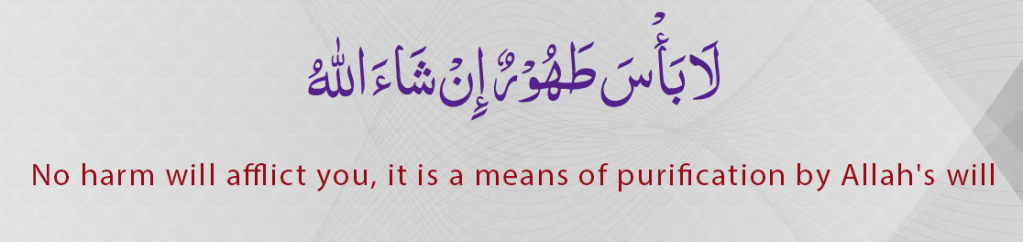
A) “Never mind, may it (the sickness) be a purification, if Allah wills.” Ibn ‘Abbaas (R.A) said, “The Prophet (Pbuh) entered upon a [sick] Bedouin to visit him. And whenever the Prophet (Pbuh) would enter upon a sick person to visit him, he (Pbuh) would say, “Never mind, may it (the sickness) be a purification, if Allah wills.’
So he said to the Bedouin, ‘Never mind, may it (the sickness) be a purification, if Allah wills.’ The Bedouin answered, ‘You said: purification. Certainly not! Rather, it is a fever that is raging or taking its vengeance upon an old man, bringing him to the brink of the graves.’ The Prophet (Pbuh) said, “Then in that case, yes. ” [Bukhaaree, 3616]
The Prophet’s saying, “Never mind” means that sickness atones for sins, so that if a person becomes healthy again, he achieves health and atonement for his sins; but if he does not become healthy, he at least achieves atonement for his sins. Ibn Hajr said, “Among the benefits we take from the Hadeeth is that a patient should accept people’s supplications for him; he should not complain or grumble – as did the Bedouin in the Hadeeth – when others invoke Allah to purify him from his sins.”
B) “0 Allah, cure…so and so.” When Sa’ad Ibn Abee Waqqaas (R.A) became sick, the Messenger of Allah visited him. This is a partial wording of the Hadeeth in which Sa’ad (R.A) gave an account of the visit: “He then placed his hand on his forehead, after which he wiped his hand over my face and stomach. He (R.A) then said, “0 Allah, cure Sa’ad…”
And in Muslim’s narration of the Hadeeth, the Prophet (Pbuh) repeated, “0 Allah, cure Sa’ad,” three times. [Muslim, 1628]
C) “I ask Allah the Supreme, Lord of the magnificent throne to cure you (seven times).” Ibn ‘Abbaas (R.A reported that the Prophets (Pbuh) said, “No person visits a sick person, not coming at the moment of death, and says seven times in his presence, ‘I ask Allah the Supreme, Lord of the magnificent throne to cure you,’ except that Allah cures him from that sickness.'” [Ahmad, 2138]

D) “0 Allah cure your slave, [and] for You may he cause much harm to the enemy [of the Muslims], and may he walk to the prayer.” Ibn ‘Amr (R.A) reported that the Prophet (Pbuh) said, “When a man goes to visit a sick person, then let him say, ‘0 Allah cure your slave, [and] for You may he cause much harm to the enemy [of the Muslims], and may he walk to the prayer.’ [Ahmad, 6564]
Abu Daawood related it with this wording: “Or may he walk for You to a funeral (i.e., to the funeral prayer and to the burial).”
12) Placing One’s Hand Over The Sick Person.
It is recommended for the visitor to place his hand over the body of the sick person and supplicate for him. Since nothing specific is related from the Sunnah, we cannot say for sure whether by placing his hand over the sick person, the visitor does an act that helps to alleviate or remove the patient’s pain. Nonetheless, the visitor should still, in following the practice of the Prophet (Pbuh) place his hand over the patient. Ibn Battaal pointed out that the patient feels a sense of camaraderie and friendship when the visitor places his hand over him, and the latter, especially if he is pious, might help alleviate the patient’s sickness when, along with placing his hand over him, he supplicates for him. It is related in a number of Ahadeeth that the Prophet (Pbuh) placed his noble hand over a sick person; for example, this is mentioned in the previously related Ahadeeth of Sa’ad Ibn Abee Waqqaas “He (Pbuh) then placed his hand on his forehead, after which he wiped his hand over my face and stomach. He (Pbuh) then said, “0 Allah, cure Sa’ad…”‘
And in another Hadeeth, ‘Aaisha (R.A) said, “When the Messenger of Allah (Pbuh) would visit a sick person, he would place his hand on the spot that was hurting. Then he (Pbuh) would say, ‘Bismillah’
13) Reading Invocations Over The Patient.
It is recommended for a visitor to read invocations over the patient, for this was the practice of the Prophet (Pbuh) a pious person should especially do so, for his invocations are more beneficial to the patient than those that are read by person who is not so pious. There is a special term for reading invocations over the sick: Ar-Ruqyaa. The Prophet (Pbuh) would perform Ar-Ruqyaa over sick relatives and Companions, and he (Pbuh) approved of certain invocations used for Ar-Ruqyaa that he heard from some of his Companions. Here are some of them:
A) Ar-Ruqyaa With Al-Mu’awwidhaat The term ‘ Al-Mu’awwidhaat’ refers to the last two Chapters of the Qur’an – “The Daybreak Chapter” and “The Mankind Chapter” – as well as to (according to some scholars) “The Purity Chapter.”
‘Aaisha (R.A) said, “Verily, when anyone from his family became sick, the Prophet (Pbuh) would spit lightly upon him with Al-Mu’awwidhaat (the same practice that a Muslim should perform before going to bed: first, reading the last three Chapters of the Qur’an, then spitting lightly into one’s hand, and then wiping one’s hand over one’s body, except that here, this practice is applied on the patient).” [Muslim, 2192]
B) Ar-Ruqyaa With “Faatihatul Kitaab (The Opening Of The Book, i.e., ‘The Opening Chapter)
In summary of a long Hadeeth, Abu Sa’eed Al-Khudree (R.A) came across a people whose chief fell ill through a venomous bite. Abu Sa’eed (R.A) to performed Ar-Ruqyaa on him with “The Opening Chapter” of the Qur’an. The chief became cured, and as a reward to Abu Sa’eed (R.A) he gave him a number of sheep. Abu Sa’eed (R.A) refused to accept the sheep right away, saying that he first wanting to discuss the matter with the Prophet (Pbuh) to see if he (Pbuh) approved. He (Pbuh) went to the Prophet (Pbuh) and informed him of what happened; he (Pbuh) said, “0 Messenger of Allah, by Allah, I performed Ar-Ruqyaa on him with nothing other than ‘The Opening Of The Book.'” The Prophet (Pbuh) smiled and said, “What made you know that it (“The Opening Chapter”) is Ruqyaa (i.e., that, when read over a sick person, it helps bring about his cure by the will of Allah)?”
The Prophet (Pbuh) then said, “Take from them (i.e., take the sheep), and allot for me a share along with yourselves. ” [Muslim, 2201]
C) Ar-Ruqyaa with, “Remove the severity of the sickness, 0 Lord of mankind, and cure, for You are Ash-Shaafee (the One Who cures). There is no cure save Your cure, a cure that leaves behind no sickness.” ‘Aaisha (R.A) reported that when the Prophet (Pbuh) would go to a sick person or when a sick person would be brought to him, he (Pbuh) would say, “Remove the severity of the sickness, 0 Lord of mankind, and cure, for You are Ash-Shaafee (the One Who cures). There is no cure save Your cure, a cure that leaves behind no sickness.”
Muslim related it thus: “When any person among us fell ill, the Prophet (Pbuh) would wipe over him with his right hand, after which he would say, “Remove the severity of the sickness, 0 Lord of mankind… “‘[Muslim, 2191]

D) Ar-Ruqyaa with, “In the name of Allah do I read invocations over you [, invoking Allah to cure you], [for protection] from everything that harms you, from the evil of every soul or from the eye of the jealous one. May Allah cure you. In the name of Allah do I read invocations over you [, invoking Allah to cure you].” Abu Sa’eed Al-Khudree (R.A) reported that Jibreel (A.S) went to the Prophet (Pbuh) and said, “0 Muhammad, you have fallen ill?” The Prophet (Pbuh) said, “Yes.” Jibreel then said, “In the name of Allah do I read invocations over you [, invoking Allah to cure you], [for protection] from everything that harms you, from the evil of every soul or from the eye of the jealous one. May Allah cure you. In the name of Allah do I read invocations over you [, invoking Allah to cure you].” [Muslim, 2186]

D) Ar-Ruqyaa with, “In the Name of Allah, [with] the soil of our earth and the saliva of some of us – may the ailing among us become cured by the permission of our Lord.” ‘Aaisha (R.A) reported that the Prophet (Pbuh) would say these words to a sick person: “In the Name of Allah, [with] the soil of our earth and the saliva of some of us – may the ailing among us become cured by the permission of our Lord.” [Ahmad, 24096]
An-Nawawee gave this explanation of the invocation: “He would take his own saliva, place it on his index finger, then put his finger on soil. Some of the soil would cling to his finger, and he would then wipe it over the place of injury or sickness. And as he would wipe his hand over the ailing spot, he would say those words. And Allah knows best.”
Related Issue: In Muslim countries, some people now take a bouquet of flowers with them when they visit the sick; usually attached to the flower is a card, upon which they write consoling words. In their minds, the best they could do for the sick is to present flowers to them. First, we must understand that this practice is taken from Christian lands and that the Prophet (Pbuh) forbade us from imitating the Jews and Christians.
Second, the people who apply this practice forsake supplicating for mercy, purification, forgiveness, and health to befall the patient, replacing those supplications with meaningless cliches that they write on a card or that is preprinted on a card. They replace Islamically legislated invocations from the Qur’an and Sunnah with a bouquet of flowers that might wither in a day or two. 0 Allah, guide us to the straight path, and not to the path of those who have earned Your anger, nor of those who went astray.
14) When A Patient Is In The Final Stages Of Dying, Those Around Him Should Prompt Him To Say The Shahaadah (“I Bear Witness That None Has The Right To Be Worshipped But Allah”);
When he dies, they should close his eyes and supplicate for him. As a patient is nearing the final stages of death, it is recommended for those that are present to remind him of Allah’s vast mercy and to avoid making him feel a sense of hopelessness. Jaabir (R.A) said, “Three days before he died, ‘I heard the Prophet (Pbuh) say, “Let no one among you die except that he thinks well of Allah ‘Azza Wa-Jall (the Possessor of Might and Majesty). ” [Ahmad, 13711]
In explaining the Prophet’s saying, “…except that he thinks well of Allah ‘Azza Wa-Jall,” scholars have said, “It means to think that Allah will forgive him and have mercy on him.” [An-Nawawee, 9/17/176] Also, in a gentle and kind manner, they should prompt the dying patient to say the Shahaadah (“None has the right to be worshipped but Allah”). Abu Sa’eed Al-Khudree (R.A) reported that the Messenger of Allah (Pbuh) said, “Prompt the dying ones among you to say, ‘Laa ilaha illallah (None has the right to be worshipped but Allah).” [Muslim, 916]
An-Nawawee said, “The order to prompt the deceased in this manner is the kind of command which indicates that the action being ordered to is recommended (and not compulsory). Scholars agree that it is disliked to prompt the dying patient continuously or too frequently; otherwise, the patient, because of the pain he is already experiencing, might begin to dislike what is being requested of him, and he even might end up saying inappropriate words. Furthermore, if the dying patient says the Shahaadah once, no one should prompt him to say it again unless he says something afterwards, in which case he should be prompted again, so that his last words are ‘Laa ilaha illallah (None has the right to be worshipped but Allah.’ Then, when he dies, it is recommended for those present to close his eyes and supplicate for him. Umm Salamah (R.A) said, “The Messenger of Allah (Pbuh) entered upon Abu Salamah (R.A) whose eyes remained open [after having died], and the Prophet (Pbuh) then closed them. He (Pbuh) then said, “Verily, when the soul is taken, one follows it with his sight.’
People from his family became troubled and afraid, and so he (Pbuh) said, “Do not supplicate upon yourselves (or upon the deceased) except with goodness (with good supplications), for the angels say, ‘Aameen (i.e., 0 Allah, answer this supplication)’ to what you say.’
اللَّهُمَّ اغْفِرْ لأَبِي سَلَمَةَ وَارْفَعْ دَرَجَتَهُ فِي الْمَهْدِيِّينَ وَاخْلُفْهُ فِي عَقِبِهِ فِي الْغَابِرِينَ وَاغْفِرْ لَنَا وَلَهُ يَا رَبَّ الْعَالَمِينَ وَافْسَحْ لَهُ فِي قَبْرِهِ . وَنَوِّرْ لَهُ فِيهِ ”
He (Pbuh) then said, “0 Allah, forgive Abu Salamah and raise his ranking among the guided ones. Make among his progeny those who succeed him and remain. And forgive us and him, 0 Lord of all that exists; and make his grave spacious for him, and illuminate it for him.” [Muslim, 920]
 Books of Muslims