The Etiquettes Of Sleeping
1) Before Going To Sleep, Close (And Lock) Doors And Extinguish The Fire And Lamps
2) Performing Ablution (Wudoo) Before Going To Sleep
3) Dusting Off The Bed Before Lying Down On It
4) Sleep On Your Right Side And Place Your Cheek On Your Right Hand
5) Reciting Something From The Qur’an
6) Reading Certain Supplications And invocations
7) Dreams: What One Should Say And Do Upon Seeing A Nightmare Or A Dream That Pleases Him (One That Has A Good Meaning)
8) It Is Disliked For One To Sleep On His Stomach
9) It Is Disliked To Sleep On A Roof That Does Not Have A Fence Or Wall Or Anything Similar To Prevent One From Falling
10) What One Should Say When He Wakes Up From Sleep
The Manners Of Sleeping
Allah (Swt) said: “And among His Signs is the sleep that you take by night and by day, and your seeking of His Bounty. Verily, in that are indeed signs for a people who listen” (Qur’an 30:23)
Allah (Swt) said: “And have made your sleep as a thing of rest” (Qur’an 78:9)
And Al-Baraa Ibn ‘Aazib (R.A) related that the Messenger of Allah (Pbuh) said, “When you go to your bed, then perform the same ablution that you perform for prayer. Next, lie down on your right side, and then say, ‘0 Allah, I submit my soul unto You, and I entrust my affair unto You…” [Muslim, 2710]
The Etiquettes Of Sleeping
1) Before Going To Sleep, Close (And Lock) Doors And Extinguish The Fire And Lamps
Jaabir Ibn ‘Abdullah (R.A) related that the Messenger of Allah (Pbuh) said, “At night, when you go to sleep, extinguish the lamps and close (lock) the doors…” [Muslim, 2012]
In another narration, the Prophet (Pbuh) said, “Close the doors and extinguish the lamps, for a mouse might drag the wick and set fire upon the people of the house.” [Bukhaaree, 6259]
And in yet another narration, Ibn ‘Umar (R.A) related that the Prophet (Pbuh) said, “Do not leave the fire [to burn] in your homes when you go to sleep.” [Ahmad, 4501]
Do these commands – which are indeed commands since the Prophet (Pbuh) gave them in the imperative – impart a meaning of compulsory, of recommended, or of plain sound advice, which one does not have to follow? Scholars disagree about the answer to this question.
To better understand the question, we need to recognize that the Prophet (Pbuh) explained the reason why he gave his command: fear that the house will burn down, for he (Pbuh) said: “For a mouse might drag the wick and set fire upon the people of the house.”
Al-Qurtubee said, “From these Ahadeeth we conclude that, when a person spends the night alone in a house and when a fire is burning therein (such as in a fireplace), he should extinguish it before going to sleep; or at least he should take the necessary precautions to avoid the spreading of the fire. And if there is a group of people in the same house, then one of them – most worthy for this duty is the last of them to go to sleep – should extinguish the fire. And whosoever is remiss in this duty has acted contrary to the Sunnah and has refrained from applying it.”
The reason for closing doors before going to sleep is mentioned in a Hadeeth that is related by Jaabir (R.A) “Close doors and mention the name of Allah, for indeed, the Shaitaan (Devil) does not open a closed (locked) door.” [Muslim, 2012] Ibn Daqeeq Al-Ted said, “In closing (and locking) the doors to one’s home, one achieves benefits both of the worldly and religious kind: his life and wealth are protected from evildoers and he is protected from the Shaitaan. The Prophet’s saying, “For indeed, the Shaitaan (Devil) does not open a closed (locked) door,” tells us that the reason why he ordered us to close the doors to our homes is to prevent the Shaitaan from mixing with us. The Prophet (Pbuh) specifically pointed out this benefit because, [as opposed to the other worldly benefits], it is one that can only be known through prophethood (revelation)…”
Question: If one takes the necessary precautions to avoid the spreading of a fire in his home, may it then be said that it is permissible for him to leave the fire and lamps on when he goes to sleep?
Answer: If he is safe from harm, then on the surface at least, what he is doing is okay, because the reason mentioned in the Hadeeth is no longer relevant to his situation. This is because the Prophet (Pbuh) not only gave an order, which by itself must be applied, but he also mentioned the reason why he gave it: so that a mouse does not set fire upon the people of a house. If that reason is no longer relevant – i.e., one doesn’t fear that happening because he takes necessary precautions – then the prohibition is no longer in effect.
2) Performing Ablution (Wudoo) Before Going To Sleep
Al-Baraa Ibn ‘Aazib (R.A) reported that the Prophet (Pbuh) said, “When you go to your bed to sleep], then perform the same ablution that you perform for prayer…” [Muslim, 2710]
When one goes to sleep, it is recommended and not obligatory to first perform ablution. Ahmad’s narration of the Hadeeth supports this ruling: “When you retire to your bed, while you are in a state of purity…” [Ahmad, 18089]
So if you are already in a state of purity, you do not have to perform ablution over again; the point is for one to go to sleep upon a state of purity, so that if he does die that night, he dies upon that state. Furthermore, when one is upon a state of purity as he goes to sleep, his dreams will be more truthful and the Shaitaan will be less able to harm him or frighten him during his sleep.
3) Dusting Off The Bed Before Lying Down On It
It is from the Prophet’s Sunnah that, before lying down on his bed to go to sleep, he (Pbuh) would dust off his mattress with the side of his lower garment three times. Abu Hurairah (R.A) reported that the Prophet (Pbuh) said, “When one of you retires to his bed, then let him dust off his bed with the side of his lower garment, for indeed, he does not know what came on it after he left it [the last time]…”
Another narration of the Hadeeth is worded thus: “When one of you goes to his bed, then let him dust it off three times with the side of his garment…” Muslim related the Hadeeth with this wording: “Then let him take his lower garment, and with it, dust off his bed; and let him mention Allah’s name, for indeed, he does not know what came on his bed after he last left it.” And finally, At-Tirmidhee related it with this wording: “When one of you stands up from his bed and then later returns to it, then let him dust it off…” [Muslim, 2714]
From these narrations, we learn a number of benefits and rulings. First, it is recommended to dust off a mattress before lying down on it to go to sleep. Second, one should dust the mattress off three times. Third, as one is dusting it off, one should mention Allah’s name. Fourth, when one is already on his bed but then gets up, it is recommended for him to dust it off another time when he returns; why one should dust it off a second time is explained in one of the aforementioned narrations: “For indeed, one of you does not know what came on it after he [last] left it.” Finally, one should use the inside of his lower garment. Though scholars have given different opinions in the matter, the Prophet (Pbuh) did not specifically mention the wisdom behind using the lower garment as opposed to one’s hands or upper garment, for example. But as always in the Shariah, the application of any given ruling that is legislated in the Qur’an or Sunnah does not hinge upon our knowledge of the wisdom behind that ruling. So whenever a Hadeeth is authentically related, we must apply the ruling it imparts, even if we don’t know the wisdom behind it. It is a question of submission, a fundamental basis in the religion that we must all adhere to.
4) Sleep On Your Right Side And Place Your Cheek On Your Right Hand
AI-Baraa Ibn ‘Aazib (R.A) related that the Prophet (Pbuh) said, “When you go to your bed, then perform the same ablution that you perform for prayer, and then lie down on your right side…”
In another Hadeeth, Hudhaifah (R.A) said, “When the Prophet (Pbuh) would go to his bed at night, he would place his hand underneath his cheek…” And the following is from Ahmad’s narration of the Hadeeth: “When he would retire to his bed, he would place his right hand under his cheek…” [Ahmad, 22733]
Two benefits of sleeping on one’s right side are that it helps a person wake up with energy and that, when compared to sleeping on one’s left side, less weight is put on the heart.
5) Reciting Something From The Qur’an
It was from the Prophet’s guidance that he would not go to sleep until he first read something from the Qur’an. When a Muslim recites the Qur’an before going to sleep, he becomes protected from Shaitaan and his dreams become truer in their meanings. In regards to this issue, many narrations are related from the Prophet (Pbuh) here, we will mention some of those narrations and certain of the verses and chapters that one should read before going to sleep:
A) Recitation of the throne verse (Aayatul-Kursee):
We learn about the importance of reading the Throne Verse before going to sleep from the well-known narrative of Abu Hurairah (R.A); it relates how, on three consecutive nights, he caught a thief stealing from Zakaat wealth. When Abu Hurairah (R.A) decided on the third night to take the man prisoner and escort him to the Prophet (Pbuh) the man said, “Let me teach you words, through which Allah will cause benefit to befall you.” Abu Hurairah (R.A) asked, “And what are they?” He said, “When you retire to your bed, then recite the Throne Verse (Aayatul-Kursee): “Allah! Laa ilaha ill Huwa (none has the right to be worshipped but He), the Ever Living, the One Who sustains and protects all that exists” (Qur’an 2:255), until you complete the verse; for indeed, you will [in consequence] continue to have a protector over you from Allah, and no Shaitaan (devil) will come near you until the morning.” Abu Hurairah (R.A) later related, “And so I let him go, and in the morning, the Messenger of Allah (Pbuh) said to me, “What did your prisoner do last night?’
I said, ‘0 Messenger of Allah, he claimed that he would teach me words, through which Allah would cause benefit to befall me.’ He (Pbuh) said, What were they?’
I said, ‘He said to me: when you retire to your bed, then recite the Throne Verse from its beginning until you complete the Verse: “Allah! Laa ilaha ill Huwa (none has the right to be worshipped but He), the Ever Living, the One Who sustains and protects all that exists) (Qur’an 2:255). ‘And he said to me: You will continue to have a protector over you from Allah, and no Shaitaan will come near you until the morning – and they (the Companions (R.A)) were more ardent than anyone else in [doing] good.’ The Prophet (Pbuh) then said, “Verily, he told you the truth, though he is a liar. 0 Abu Hurairah, do you know who was speaking to you for the last three nights?”
Abu Hurairah (R.A) answered, “No.” The Prophet, said, “That was Shaitaan.” [Fathul-Baaree, 4:569]
B) Recitation of “the purity” Chapter and Al-Mu’ awwadhatain (a title that refers to both “the daybreak” Chapter and “mankind” Chapter)
Every night when he would go to sleep, the Prophet would recite these three chapters of the Qur’an: “The Purity” Chapter, “The Daybreak” Chapter, and “Mankind” Chapter – the three last chapters (Soorahs) of the Qur’an. After reciting them, he would then blow into his hands; the word for ‘blow’ in ‘Aaisha’s narration is Nafth. Nafth is lesser in degree than spitting, which always involves saliva, and so it resembles blowing more closely than anything else, perhaps with a small amount of spittle; however, it has also been said that Nafth is the same thing as spitting. Whatever the case may be, the Prophet, would blow into his hands, and then wipe his hands over as much of his body as he was able to, and then he would repeat the process two more times. The following is the Hadeeth which describes this practice; in it, ‘Aaisha (R.A) the Mother of the Believers, said, “When the Prophet (Pbuh) would retire to his bed every night, he would gather his hands together and then blow into them. Then he (Pbuh) would read in them, “Say (0 Muhammad (Pbuh)): “He is Allah, the One”, “Say: “I seek refuge with (Allah) the Lord of the day-break), and “Say: “I seek refuge with (Allah) the Lord of mankind”.
Then he (Pbuh) would wipe them over as much of his body as he was able to, beginning with them over his head, his face, and the front part of his body. He (Pbuh) did that three times.” [Bukhaaree, 5017] ‘Aaisha (R.A) pointed out that the Prophet (Pbuh) would perform this practice every single night; therefore, we should strive to do the same.
Related Issue: The practice described above is not limited to when one goes to sleep; instead, when one becomes sick, it is also recommended for him to read the three chapters, blow into his hands, and then wipe them over his body. Bukhaaree related the following saying of ‘Aaisha (R.A): “Whenever the Prophet (Pbuh) fell ill, he (Pbuh) would blow on his own self with Al-Mu’awwidhaat (referring to “The Daybreak” and “Mankind” Chapters, but pointing as well to “The Purity” Chapter), and after doing that, he (Pbuh) would wipe [over his body or over the part of his body that was ailing] with his hand. And when he fell ill with the illness that led to his death, I began to blow on his person with Al-Mu’awwidhaat, which he (Pbuh) would blow (with), and I would wipe after doing that with the hand of the Prophet (Pbuh).” [Muslim, 2192]
C) Recitation of “Al-Kaafiroon,” indicating one’s renunciation of shirk (Associating partners with Allah in worship)
Farwah Ibn Nawful related from his father, Nawfal (R.A) that the Prophet (Pbuh) said to him, “Recite: “Say: (0 Muhammad (Pbuh) to these Mushrikoon and Kaafiroon):
“0 Al-Kaafiroon (disbelievers in Allah, in His Oneness, in His Angels, in His Books, in His Messengers, in the Day of Resurrection, and in Al-Qadar, etc.)!}. Then go to sleep at its end, for indeed, it is [an indication of one’s] freedom from Shirk (Associating partners with Allah in worship) (i.e., the person who recites it before going to sleep absolves himself from the gravest of sins: Shirk).” [Ad-Daarimee, 1755]
D) Reciting “Tabaarak” Chapter and “Alif-Laam-Meem, Tanzee-lus-Sajdah”
Jaabir (R.A) said, “The Messenger of Allah (R.A) would not sleep until he read ‘AlifLaam-Meem Tanzeel As-Sajdah’ and ‘Tabaarakalladhee Biyadihil-Mulk (The Dominion Chapter).'”[Bukhaaree, 1027]
Related Issue: There is a narration that encourages Muslims to consistently recite “The Dominion” Chapter. Abu Hurairah related that the Prophet (Pbuh) said, “A Soorah (Chapter) from the Qur’an, which has thirty verses, intercedes for its Saahib (the person who recites it frequently, reflects upon it, and applies its meanings) until he is forgiven: ‘finessed be He in Whose Hand is the dominion) (i.e., ‘The Dominion’ Chapter).” [Abu Daawood, 1400]
D) Recitation of the last two verses from “The Cow (Al-Baqarah)” Chapter
Abu Mas’ood Al-Badree (R.A) related that the Messenger of Allah (Pbuh) said, “As for the last two verses of Soorah Al-Baqarah (‘The Cow’ Chapter), whoever reads them at night, then they suffice him.” [Muslim, 807]
In what sense are they sufficient for him? An-Nawawee said, “It has been said that ‘suffice him’ means that they are sufficient for him, so that he does not have to stand up at night to pray (voluntary units of prayer, because he will receive a similar reward); it has also been said that it means protection from Ash-Shaitaan (the Devil); and it has also been said that it means protection from illnesses. And all of these interpretations are plausible.”
6) Reading Certain Supplications And invocations
It was also from the Prophet’s guidance that He (Pbuh) would make certain supplications at the end of the night; every Muslim should read them and remember Allah before going to sleep, for in a narration related by Abu Hurairah (R.A) the Messenger of Allah (Pbuh) said, “Whoever lies down without remembering Allah Ta’aalaa (The Exalted) during the period that he lies down, then that [time lost] will be a cause of regret for him on the Day of Resurrection. And whoever sits down without remembering Allah ‘Azza Wa-Jall (to Him belongs Might and Majesty) during the period that he sits down, then that [time lost] will be a cause of regret for him on the Day of Resurrection.” [Abu Daawood, 5059]
Upon contemplating the various night time supplications of the Prophet (Pbuh) one should appreciate the wonderful and profound meanings contained in them. In those supplications, the Prophet (Pbuh) mentioned At-Tawheed and its various categories; expressed his poverty before Allah (Swt) asked Allah fit to forgive him, to accept his repentance, and to protect him from punishment in the Hereafter; took refuge with Allah from Ash-Shaitaan (the Devil); praised and thanked Allah for His favors; and expressed many other beautiful meanings. For the benefit of anyone who wants to increase in goodness, here are some of the invocations that the Prophet (Pbuh) supplicated with before going to sleep:
A) The saying: “0 Allah, protect me from Your punishment on the day Your servants are resurrected.” Hafsah (R.A) wife of the Prophet (Pbuh) said, “Whenever he (the Prophet (Pbuh)) wanted to sleep, he would place his right hand underneath his cheek, after which he would say: “0 Allah, protect me from Your punishment on the day Your servants are resurrected (Three times).”[Ahmad, 25926]

B) The saying: “In Your name, 0 Allah, I live and die.” Hudhaifah Ibn Al-Yamaan (R.A) said, “When the Prophet (Pbuh) would retire to his bed, he (Pbuh) would say, “In Your name, 0 Allah, I live and die… “[Ahmad, 22760]

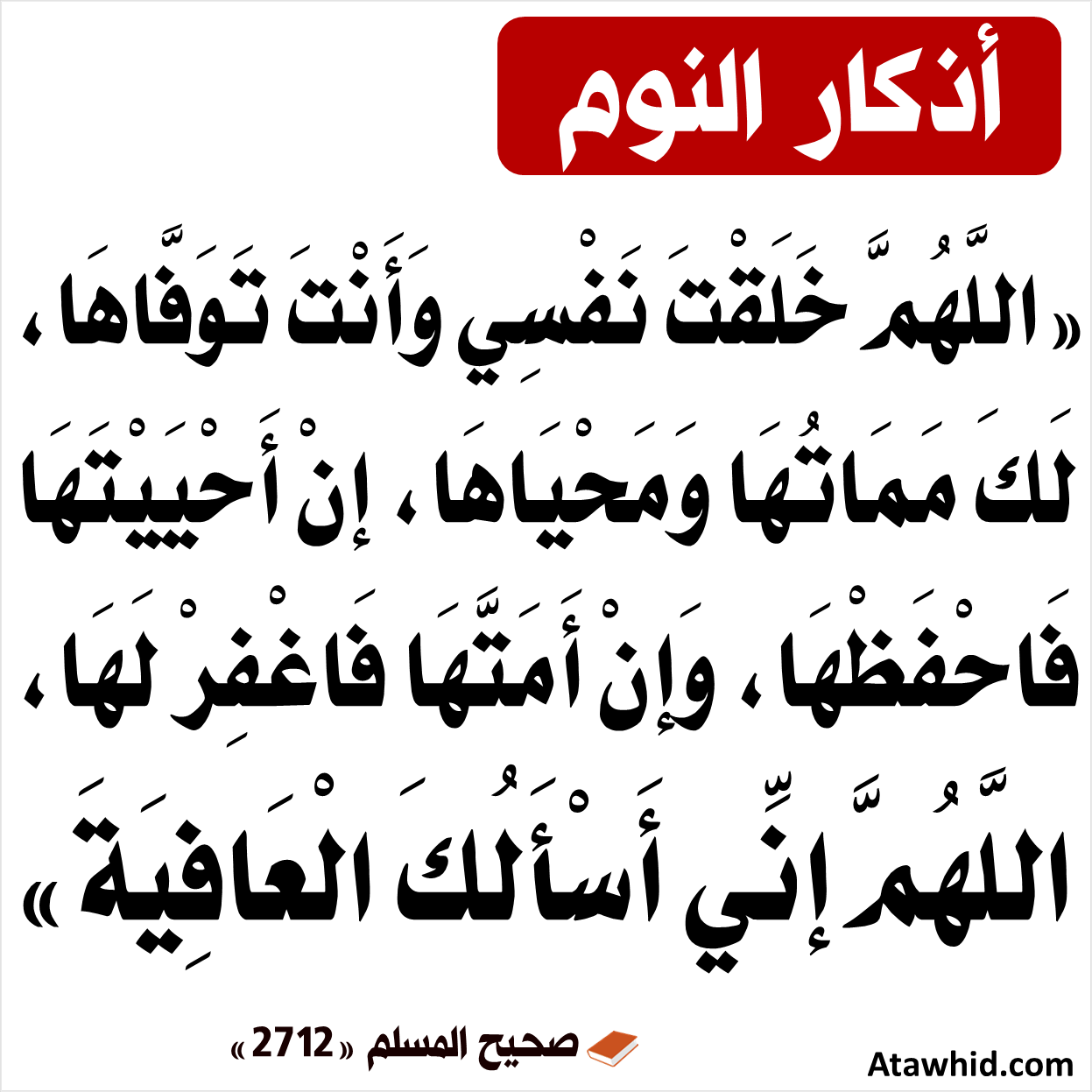
C) The saying: “0 Allah, verily You have created my soul and You shall take its life…” ‘Abdullah Ibn ‘Umar (R.A) once ordered a man to say the following words upon going to sleep: “0 Allah, verily You have created my soul and You shall take its life, to You belongs its life and death. If you should keep my soul alive, then protect it, and if You should take its life, then forgive it. 0 Allah, I ask You to grant me good health.” A man asked ‘Abdullah (R.A) “Did you hear this from ‘Umar (R.A) (‘Abdullah’s father)?” ‘Abdullah (R.A) said, “From one who is better than ‘Umar (R.A) – from the Messenger of Allah (Pbuh). [Muslim, 2712]
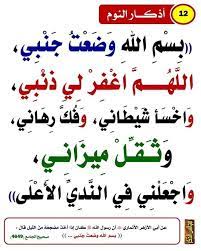
D) The saying: “In Your name, my Lord, I lie down and in Your name I rise…” Abu Hurairah related that the Messenger of Allah (Pbuh) said, “When one of you retires to his bed, then let him dust off his bed with the side of his lower garment, for indeed, he does not know what came on it after he left it [the last time]. Next, let him lie down on his right side, and then let him say, “In Your name, my Lord, I lie down and in Your name I rise, so if You should take my soul, then have mercy upon it, and if You should return my soul, then protect it in the manner You do so with Your righteous servants.” [Muslim, 2714]
E) The saying: “0 Allah, Lord of the seven heavens, the earth, and the exalted throne…” Abu Hurairah (R.A) said, “The Messenger of Allah (Pbuh) would command us to say [the following] upon retiring to our beds: “0 Allah, Lord of the seven heavens, the earth, and the exalted throne, our Lord and Lord of all things, Splitter of the seed and the date stone, Revealer of the Tawrah, the Injeel, and the Furqaan (One of the many names of the Qur’an; it means: The Criterion which distinguishes between truth and falsehood), I take refuge in You from the evil of every beast You shall seize by the forelock. 0 Allah, You are The First, so there is nothing before You, and You are The Last, so there is nothing after You. You are Ath-Thaahir (Indicates the greatness of His attributes and the insignificance of every single creation in respect to His greatness and Highness, for He is above all of His creation as regards His essence and attributes), so there is nothing above You and You are Al-Baatin (Indicates His awareness and knowledge of all secrets, of that which is in the hearts and the most intimate of things, just as it indicates His closeness and nearness to all in a manner which befits His majesty), so there is nothing closer than You. Settle our debt for us and spare us from poverty.” [Muslim, 2713]

F) The saying: “0 Allah, Creator of the heavens and the earth…” Abu Hurairah (R.A) reported that Abu Bala. As-Siddeeq (R.A) said, “0 Messenger of Allah, command me with words I should say in the morning and in the evening.” The Prophet (Pbuh) said, “Say: 0 Allah, Creator of the heavens and the earth, Knower of the seen and the unseen, Lord and Sovereign of all things, I bear witness that none has the right to be worshipped except You. I take refuge in You from the evil of my soul and from the evil and shirk (to associate partners with Allah in worship) of the devil.”
The Prophet (Pbuh) said, “Say them (these words) in the morning, in the evening, and when you retire to your bed.”[Abu Daawood, 5067]
G) The saying: “All praise is to Allah, Who has fed us and gave us drink, and Who is sufficient for us and has sheltered us…” Anas (R.A) related that upon retiring to his bed, the Messenger of Allah (Pbuh) would say: “All praise is to Allah, Who has fed us and gave us drink, and Who is sufficient for us and has sheltered us, for how many have none to suffice them or shelter them.” [Muslim, 2715]

H) To make At-Tasbeeh and At-Tahmeed 33 times each, and to make At-Takbeer 34 times ‘Alee (R.A) related that Faatimah (R.A) complained about her hand and [the sores] it received in working the hand mill. She went to the Prophet (Pbuh) in order to ask him to provide her with a servant, but since she didn’t find him at his home, she mentioned her situation and request to ‘Aaisha (R.A). When the Prophets returned home, ‘Aaisha (R.A) informed him about her meeting with Faatimah (R.A). ‘ Alee (R.A) later related, “He (the Prophet (Pbuh) then came to us, and by then we were lying down [to sleep]. I made a move to stand up, and he (Pbuh) said, ‘Remain where you are,’ after which he sat between us until I felt the coldness of his feet on my chest. He (Pbuh) then said, “Shall I not guide you to that which is better for you than a servant: When you both retire to your bed or lie down [to go to sleep], then Kabbiraa (i.e., say, ‘Allahuakbar,’ Allah is the Greatest) 33 times (in other narrations, he 0, said, ’34 times’), Sabbaihaa (i.e., say, ‘Subhaanallah,’ How perfect Allah is!) 33 times, and Ihmidaa (i.e., say, ‘Alhamdulillah,’ All praise is to Allah) 33 times. Doing this is better for you than [for you to have] a servant.”[Muslim, 2727]
I) The saying: “In Your name, 0 Allah, I lie down; 0 Allah, forgive me my sin…” Abu Zuhair Al-Anmaaree (R.A) related that, whenever the Messenger of Allah (Pbuh) would lie down on his bed at night, he would say, “In Your name, 0 Allah, I lie down; 0 Allah, forgive me my sin, drive away and humiliate my Shaitaan (devil), help free my soul from all rights that are upon me (by forgiving me for the deeds I did which did not please You), and make me join the gathering of the highest company of angels.”[Abu Daawood, 5054]
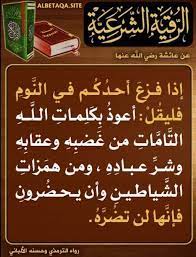
J) The saying: “I take refuge in the perfect words of Allah from His anger and punishment…” for a person who becomes frightened during his sleep. ‘Amr Ibn Shu’aib related from his father, who related from his father that the Messenger of Allah (Pbuh) would teach his Companions (R.A) words to say when they became frightened or terrified: “I take refuge in the perfect words of Allah from His anger and punishment, and from the evil of His servants, and from the madness and appearance of devils.”
Ahmad related the Hadeeth with this wording: “The Messenger of Allah (Pbuh) would teach us words to say when we [wake up from] sleep in a state of fear: ‘I take refuge in the perfect words of Allah…'” [Abu Daawood, 3893]
K) The saying: “0 Allah, I submit my soul unto You, and I entrust my affair unto You…” Al-Baraa Ibn ‘Aazib (R.A) related that the Prophet (Pbuh) said, “When you go to your bed, then perform the same ablution that you perform for prayer; then lie down on your right side; and then say: ‘0 Allah, I submit my soul unto You, and I entrust my affair unto You, and I totally rely on You, in hope and fear of You. Verily there is no refuge nor safe haven from You except with You. I believe in Your Book which You have revealed and in Your Prophet whom You have sent.’ If you die on that night, then you will be upon Al-Fitrah (Al-Haafiz Ibn Hajr said that Al-Fitrah here means ‘the Religion of Islam’). And make them the final [words] you speak…”[Muslim, 2710]
Related Issue: Shaddaad Ibn Aous (R.A) reported that the Prophet (Pbuh) said, “The Chief of Al-Istighfaar (Invocations with which one invokes Allah (Swt) to forgive him) is for you to say: ‘0 Allah, You are my Lord; none has the right to be worshipped but You. You created me, and I am Your slave. I am upon Your covenant and promise as much as I am able to be. I seek refuge with You from the evil of what I have done. I completely acknowledge to You Your favor upon me, and I completely acknowledge my sin, so forgive me, for verily, none forgives sins except You.’ Whoever says them (these words) during the day, believing with certainty in them (i.e., sincerely saying them, believing with certainty that what one is saying is true, etc.), and then dies on that day before the evening arrives, then he is from the people of Paradise. And whoever says them in the night, believing with certainty in them, and then dies before the morning, then he is from the people of Paradise.’ [Ahmad, 16666]
This invocation is from Allah’s countless favors upon His believing slaves: a small deed, which requires a small effort -yet immense rewards. Therefore, no Muslim should fail to say this supplication every day and night; and a Muslim must be sure to fulfill its condition, ‘believing in them,’ so that he may achieve Paradise, whose width is as vast as the heavens and the earth. 0 Allah, we ask you to make us from the dwellers of Paradise, those with whom You are pleased, those who You make pleased, Aameen.
7) Dreams: What One Should Say And Do Upon Seeing A Nightmare Or A Dream That Pleases Him (One That Has A Good Meaning)
There are two kinds of dreams: the good dream, which is from Allah (Swt) and the evil dream – one that contains evil meanings or one that is a nightmare – which is from Ash-Shaitaan (the Devil). Abu Qataadah reported that the Prophet (Pbuh) said, “The good dream is from Allah, and Al-Hulm (evil dream: one that is a nightmare or that contains evil meanings) is from Ash¬Shaitaan (the Devil). So if one of you sees an evil dream that he is afraid of, then let him spit to his left and take refuge with Allah from its evil, for then it will not harm him.” [Muslim, 2261]
Through another chain, Bukhaaree related the same Hadeeth with this wording: “So whoever sees something that he dislikes, then let him lightly spit to his left three times, and let him seek refuge [with Allah] from Ash-Shaitaan (the Devil).” Muslim related it thus: “The good dream is from Allah, and the evil dream is from the Shaitaan. So whoever sees a dream and dislikes something from it, then let him lightly spit to his left, and let him take refuge with Allah from the Shaitaan, and then it (the dream) will not harm him. And he should not inform anyone about it. But if he sees a good dream, then let him rejoice, and let him inform no one save those whom he loves.” Muslim also related the following from the Hadeeth of Jaabir (R.A): “Then let him spit to his left three times, and let him seek refuge with Allah from the Shaitaan three times. And let him turn away from the side he was upon (so if he was lying on his left side, he should turn around and lie down on his right side).” [Muslim, 2262] Muslim also related the following, which is from the Hadeeth of Abu Hurairah (R.A) “So if one of you sees what he dislikes, then let him stand and pray; and he should not inform any person about it.” [Muslim, 2263]
Through the various chains of the Hadeeth, there are a number of lessons one can learn:
1) A dream can be either good or evil, the former being from Allah (Swt) and the latter (which is called ‘ Hulm’) from Ash-Shaitaan.
2) A person who sees a good dream should rejoice and hope for good to befall him.
3) When one sees a good dream, he is receiving glad tidings from Allah (Swt) and he should inform no one about the dream except for those whom he loves.
4) When one sees a dream he dislikes, it is recommended for him to spit three times to his left and to seek refuge with Allah (Swt) from the accursed Shaitaan and from the evil of the dream. It is best to do that three times. Next, he should turn sides, and it is even better if, instead of continuing to sleep, he stands up and prays. If he takes all of these steps, or at least some of them – since certain narrations mention only some of them – the dream will not harm him. And finally, he must not inform anyone about what he saw.
8) It Is Disliked For One To Sleep On His Stomach
Tafkhah Al-Ghaffaaree (R.A) was from the people of As-Suffah, poor Companions (R.A) who stayed in the Masjid, eating and sleeping there. He said, “While I was sleeping in the Masjid at the end of the night, a person came to me. I was [at the time] sleeping on my stomach; the [one who came] then moved me with his foot and said, ‘Rise, for Allah hates this position of lying down.’ I then raised my head, and there was the Prophet standing over my head.”[At-Tirmidhee, 2768] Ibn Maajah related it with this wording: “What is the matter with you that you are sleeping like this? This is a kind of sleeping that Allah dislikes – or that Allah detests.” This Hadeeth clearly prohibits the act of sleeping face down, on one’s stomach; Allah (Swt) hates this position of lying down, or at the very least -according to the second narration – dislikes it; and we must avoid all that is disliked by Allah (Swt). As for why it is a disliked position of lying down, Abu Dharr (R.A) said in another narration, “The Prophet (Pbuh) passed by me while I was lying down on my stomach. He (Pbuh) then struck me with his foot and said, “0 Junaidab, this is nothing other than the lying-down position of the dwellers of the Hellfire.” [Ibn Maajah, 3724]
With this Hadeeth in mind, it becomes clear that the reason behind the Karahaa (i.e., the deed being ‘Makrooh,’ or disliked) is that one resembles the dwellers of the Hellfire when one lies down on his stomach.
9) It Is Disliked To Sleep On A Roof That Does Not Have A Fence Or Wall Or Anything Similar To Prevent One From Falling
‘Alee Ibn Shaibaan (R.A) related that the Prophet (Pbuh) said, “Whoever spends the night on the roof of a house that does not have a screen (in another narration, ‘that does not have rocks’; the meaning is the same: rocks, a screen, a wall, a fence, or anything that prevents a person from falling), then he is freed from safety (or from guarantee; i.e., he has no safety or guarantee, and he will have to face the consequences of his action).”
Ahmad related it thus: “Whoever spends the night on top of a wall (or fence) or on top of a house with nothing around it (i.e., around the roof) to prevent his leg [from falling], then he is freed from safety (or from guarantee; i.e., he has no safety or guarantee, and he will have to face the consequences of his action…” [Bukhaaree, 1192] Fadlullah Al-Jeelaanee said, “…A person must not be remiss in taking the commonsense, necessary steps to bring about that which is beneficial and to ward off that which is harmful, and the aforementioned Hadeeth proves this point. When one sleeps on a roof that has no barrier on its sides, he has not taken reasonable steps to ward off harm, for a person might turn over in his sleep (if he is sleeping near the edge) [and fall down] or he might stand up and walk while being drowsy or in a state of near-sleep, whereby he will continue to walk until he falls off; such a person should have taken the reasonable step of not sleeping on that roof. By sleeping there, he placed himself in danger.
In contrast to such a person is one who mentions Allah’s name, places his trust in Him, and takes commonsense steps to avoid harm. Either Allah (Swt) will protect him, reward him for any harm that befalls him by making that harm an expiation for his sins, or raise him in ranking. If one dies after having taken reasonable, commonsense steps to avoid harm and danger, then he dies a martyr – as is related about the person who falls [from a high altitude] or who drowns. But a person who is remiss in taking reasonable, commonsense steps to avoid harm is not in Allah’s Dhimmah (i.e., he does not have what is mentioned above for a person who takes those steps): if harm befalls him, he is not rewarded; if he dies, he is not a martyr; in fact, it is feared that he is considered as one who commits suicide. And Allah (Swt) knows best what is right.”
10) What One Should Say When He Wakes Up From Sleep
Upon waking up from sleep, one should recite a number of invocations as well as verses from the Qur’an, all of which are detailed in the Prophet’s Sunnah. Here, we will mention a few of them:
A) The saying, “None has the right to be worshipped except Allah, alone without associate, to Him belongs sovereignty and praise…” ‘Ubaadah Ibn As-Saamit reported that the Prophet (Pbuh) said, “Whoever wakes up from the night and then says, ‘None has the right to be worshipped except Allah, alone without associate, to Him belongs sovereignty and praise, and He is over all things wholly capable. How perfect Allah is, and all praise is for Allah, and none has the right to be worshipped except Allah, Allah is the greatest, and there is no power or might except with Allah,’ and then says, ‘0 Allah, forgive me,’ or supplicates – [then] he will be answered. And if he performs ablution and prays, his prayer will be accepted.” [Bukhaaree, 1154]
لاَ إِلَهَ إِلاَّ اللَّهُ وَحْدَهُ لاَ شَرِيكَ لَهُ، لَهُ الْمُلْكُ، وَلَهُ الْحَمْدُ، وَهُوَ عَلَى كُلِّ شَىْءٍ قَدِيرٌ. الْحَمْدُ لِلَّهِ، وَسُبْحَانَ اللَّهِ، وَلاَ إِلَهَ إِلاَّ اللَّهُ، وَاللَّهُ أَكْبَرُ، وَلاَ حَوْلَ وَلاَ قُوَّةَ إِلاَّ بِاللَّهِ. ثُمَّ قَالَ اللَّهُمَّ اغْفِرْ لِي
B) Reciting the last ten verses of “The Family Of Imran” Chapter. This practice is related by Ibn ‘Abbaas (R.A) who mentioned it while he was giving an account of a night he spent in the home of his aunt, Maymoonah (R.A) “…At midnight, or just before, or just after, the Messenger of Allah (Pbuh) woke up. He (Pbuh) sat down and wiped the sleep off his face with his hand. He (Pbuh) then recited the last ten verses from the ‘Family of Imran Chapter. Next, he stood near a hanging canteen, from which he made ablution, performing it well. He A then stood up and prayed…”[Muslim, 763]
C) The saying: “All praise is for Allah, Who gave us life after having taken it from us and unto Him is the resurrection.” Hudhaifah Ibn Al-Yamaan said, “When the Prophet (Pbuh) would retire to his bed, he (Pbuh) would say, “In Your name, 0 Allah, I live and die.’ And when he (Pbuh) would rise up, he would say, ‘All praise is to Allah, Who gave us life after having taken it from us and unto Him is the resurrection.” [Ahmad, 22760]
 Books of Muslims