On the authority of Abu Maalik al-Haarith ibn Aasim alAshari, may Allah be pleased with him, who said: The Messenger of Allah (peace be upon him) said, “Purification is half of the faith. The phrase al-hamdulillah (‘All praise be to Allah’) fills the scale. The phrases sub-haanallaah (‘High is Allah above every imperfection and need; He is pure and perfect’) and al-hamdulillah (‘All praise be to Allah’) together fill– or each fill– what is between the heavens and earth. Prayer is a light. Charity is a proof. Patience is a brightness. The Quran is either an argument for or against you. And everyone goes out in the morning and sells himself, either freeing or destroying himself.” (Recorded by Muslim.)
- “Purification is half of the faith.”
- “The phrase al-hamdulillah (‘All praise be to Allah’) fills the scale.”
- “The phrases subhaanallaah and al-hamdulillah together fill-or each fill-what is between the heavens and earth.”
- “Prayer is a light.”
- “Charity is a proof.”
- “Patience is a brightness.”
- “The Quran is either an argument for or against you.”
- “And everyone goes out in the morning and sells himself, either freeing or destroying himself.”
- Other Points Related to this Hadith
General Comments About This Hadith: This hadith touches upon some of the most important deeds. It refers to purity, remembrance of Allah, prayer, charity, patience, abiding by the Quran and the ultimate journey of mankind.
1. “Purification is half of the faith.”
There is a great deal of difference of opinion as to what the Prophet (peace be upon him) exactly meant by this statement. Below are some of the explanations that have been offered by the scholars:
(1) Its meaning is that the reward for purification is up to half of the reward for faith. In other words, the reward for cleanliness and purity is so great that it could reach to half the reward of faith. This points out the importance of purity and cleanliness in Islam. This interpretation is one of many mentioned by al-Nawawi. Most of the other commentators either did not mention it or did not accept it. Sultan, for example states, “This goes against the apparent meaning of the text and there is no evidence for it.” However, alSabbaagh favors this interpretation while al-Baitaar calls it acceptable.
(2) Faith wipes away all of the previous sins that were committed. Similarly, ablution wipes away the previous minor sins. But ablution is not sound without faith. Therefore, the effectiveness of ablution is dependent on faith in the same way that half of something is dependent on the other half. This interpretation also seems far-fetched according to Sultaan.
(3) The meaning of imaan or faith in this phrase is the prayer. For example, Allah says in the Quran “Allah would never allow your imaan to be lost” (al-Baqara 143). This is in reference to the prayers that were performed in the direction of Jerusalem before the command to face Makkah. The explanation of the word imaan in this verse is “prayers”. Since purification is a condition for the soundness of prayer, it is like it is half of the prayer. (In this case, the word shatr does not mean exactly half but it means one of two parts.) This is the opinion that alNawawi favors. Commenting on this interpretation, Sultaan wrote, This particularizes and restricts the meaning of “faith”. There is no strong evidence for this, especially since some of the Quranic commentators interpret “faith” in the above verse to mean constancy and steadfastness to the faith when the direction of the qibla was changed. But some scholars say that the stronger view is to interpret faith to mean prayer in that verse due to an authentic sunnah regarding that. So this is a possible interpretation.
(4) Another interpretation is that faith is made up of affirmation by the heart and outward submission in deeds. These are the two parts to faith. Purity, or tahaara, implies the prayer which is the greatest outward form of submission. That is why it has been referred to as half of faith.
(5) lbn Uthaimeen argues that faith is comprised of having some characteristics and being free of other characteristics. A person, for example, should be free of associating partners with Allah and sinful living. He argues that this is the purification that is referred to in this hadith. A Muslim purifies himself, thusly, from all physical or spiritual filth. This comprises one-half of faith, as stated by the Messenger of Allah (peace be upon him) in this hadith.
(6) Some interpret “purification” in this phrase to mean avoiding sins. This usage for “purification” may be noted in the Quran. For example, the people of Lot said about him and his family, “These are indeed people who want to be pure [from sins]” (al-Araaf 82). Faith is made up of two aspects: performing the proper deeds and remaining away from the improper deeds. “Purification” is the remaining away from the improper deeds. Therefore, it makes up half of faith as stated by the Prophet (peace be upon him). lbn Rajah mentions this interpretation and says that it would be plausible if it were not for the other narratives that state, “Ablution is half of faith,” and “Completing the ablution is half of the faith.” lbn Rajah points out another problem with this interpretation. He says that many deeds, like the prayer, are also acts of purification as they wipe away sins. Hence, they must be included under purification. But then purification could no longer be considered half of faith in the sense they described. Therefore, ibn Rajah rejects this interpretation.
(7) Ibn Rajah states that the correct view concerning the meaning of “purification” in this hadith is that it refers to the ritual purification by water as found, for example, in ablution. He says that this is the majority opinion and this is why Muslim, ibn Majah and others included this hadith in the chapters related to ablution. Furthermore, this is consistent with the other narrations that state, “Ablution (wudhu) is one-half of faith,” and “Completing the ablution is one-half of faith.”
2. “The phrase al-hamdulillah (‘All praise be to Allah’) fills the scale.”
Al-Haitami states that this reward comes to the person who states this expression while thinking about its meaning and submitting to its implications.’ Hence, a mere verbal statement without one’s heart or mind being involved is not what is requested from the individual. (This point is also true for the saying of subhaanallaah that shall be discussed below.) There is a difference of opinion concerning the meaning of “fills the scale”. Some state that this is a metaphorical statement: If al-hamdulillah had a physical mass to it, it would fill the scale. The second interpretation, which is much closer to the literal meaning, is that Allah will give deeds mass and form on the Day of Judgment. This can be proven through many hadith. This hadith is stating that the physical manifestation that Allah will give the statement alhamdulillah will be so great that it will fill the scale.
2.1 The Meaning and Importance of al-Hamdulillah
Al-Hamdulillah is a heartfelt expression of both praise and gratitude toward Allah. It truly comes about when a person realizes the numerous bounties Allah has bestowed upon him. This includes even the bounty of knowing Allah and recognizing that He should be thanked. It also comes about when one thinks about Allah and His attributes of perfection. In his commentary on the Quran, Maudoodi has explained the phrase al-hamdulillah, which forms part of the second verse of Surah al-Faatiha, in the following manner,
Whenever we praise someone, we do so for two reasons. First, because excellence calls for praise, irrespective of whether that excellence has any direct relevance to us or not. Second, we praise one whom we consider to be our benefactor; when this is the case our praise arises from a deep feeling of gratitude. God is worthy of praise on both counts. It is incumbent on us to praise Him not only in recognition of His infinite excellence but also because of our feeling of gratitude to Him, arising from our awareness of the blessings He has lavished upon us.
It is important to note that what is said here [meaning the phrase al hamdulillah] is not merely that praise be to God, but that all praise be to God alone. Wherever there be any beauty, any excellence, any perfection– in whatever thing or in whatever shape it may manifest itself- its ultimate source is none other than God Himself. No human beings, angels, demigods, heavenly bodies– in short, no created beings– are possessed of an innate excellence; where excellence exists, it is a gift from God. Thus, if there is anyone at all whom we ought to adore and worship, to whom we ought to feel indebted and grateful, toward whom we should remain humble and obedient, it is the creator of excellence, rather than its possessor.
Although commonly used interchangeably, there is a difference between al hamd (praise and gratitude), al-madh (praise) and al-shukr (thankfulness). A person can be praised (al-madh) for things that he does voluntarily as well as for things that are beyond his control. A person may be praised for his physical appearance, for example, which he has little control over, or for his spending in charity, which is a voluntary act on his part. In fact, madh is even done toward non-living things, such as praising the quality of a pearl. Al-hamd would only be used in the latter case of the person’s own voluntary act and not in the former case. Hence, in this sense, al-hamd is something more specific than al-madh. Furthermore, with respect to Allah, alhamd is much more befitting as He is being praised for His qualities that He has set for Himself.
On the other hand, al-hamd is more general than al-shukr. Al-shukr is only in response to something that has come from somebody else. For example, if a person does another person a favor, he would thank him for that favor. One would not give “thanks” to a person because of that person’s characteristics. If another person is generous, for example, one would not say, “I thank him because he has the characteristic of generosity,” although one would thank him for an act of generosity. However, al-hamd is expressed for both specific acts as well as the qualities of a person. Furthermore, al-hamd is used for an act done toward the person himself as well as acts done toward others. In other words, one does not give shukr for what Allah has bestowed upon others but one does express hamd in such a case.
Therefore, one states al-hamd (“praise and gratitude”) for Allah due to His acts that He has determined for Himself and are not forced upon Him, due to the bounties that He has bestowed upon a person, due to His perfect and sublime attributes and qualities, due to His being free from any imperfections and blemishes, and due to one’s need and reliance upon Him. According to ibn al-Qayyim, al-shukr is more general than al-hamd in the sense that shukr or thankfulness is exhibited by one’s heartfelt feelings, by the tongue in one’s statement of thanks and by one’s deeds in acting out one’s feelings of thankfulness. Al-hamd, however, is exhibited only by one’s heart and tongue. However, according to al-Raazi, hamd is also expressed by one’s actions. Allah knows best.
2.2 Belief in the Scale
In this hadith, the Prophet (peace be upon him) made reference to the Balance or Scale. The belief in the existence of the Balance forms part of the Muslim’s belief. Ibn Abu al-Izz has discussed the belief in the Balance in some detail. He wrote,
As for the Balance (al-Mizan), we believe in the Balance. Allah has referred to it in various verses of the Quran. For instance, “We shall set up scales (mawazin) of justice for the Day of Judgment, so that not a soul will be dealt with unjustly in the least. And if there be (no more than) the weight of a mustard seed, We will bring it (to account). And enough are We to take account” (al-Anbiyaa 47). And, “Then those whose balance (of good deeds) is heavy they will attain salvation, but those whose balance is light will be those who have lost their soul, in Hell will they abide” (al-Muminoon 1 02-1 03).
Al-Qurtubi has said that scholars think that when the reckoning will finish, deeds will be put in the Balance. Since weighing is meant for determining reward or punishment, it will take place after the reckoning. Reckoning shall be for determining works, and weighing shall be for determining the value of works so that the reward or penalty may be fixed. The word mawazin in verse 47 of surah al-Anbiyaa quoted above is plural, it means that there will be a number of balances there. It may also mean that there will be different kinds of balances for weighing different kinds of work. True knowledge, however, is with Allah.
There are many hadith on the subject that make it quite clear that the Balance will have two scales visible to the eyes. Imam Ahmad has recorded a hadith transmitted by Abu ‘Abd alRahman al-Hubuli from ‘Abdullah ibn ‘Amr that the Prophet (peace be on him) said, “Allah will pick out a person from my Ummah from all the creation, ask him to proceed forward, place before him ninety nine registers recording his deeds, each register as long as his eyes could see, and ask him, ‘Do you deny any item mentioned in these registers? Have my scribes wronged you in any way?’ He will say, ‘No, my Lord!’ Allah will then ask, ‘Have you any excuse to offer or any good deed to mention which is not here?’ He will say, ‘I have nothing to say, my Lord! ‘ Allah will say, ‘No, you have a good thing to mention. There will be no injustice to you this day. ‘ A card will then be produced which will have, ‘I witness that there is no god except Allah, and that Muhammad is his servant and messenger. ‘ It will be handed to him, but he will wonder and say, ‘What can this do in the presence of so many evil records?’ Allah will say, ‘ You will not be wronged. ‘ Then all the registers will be placed on one scale and that card will be placed on the other scale and it will outweigh them. Nothing can outweigh the name of Allah, the Merciful, the Compassionate.” This is recorded by al-Tirmidhi, Ibn Majah and lbn Abi al-Dunya from al-Layth. In al-Tirmidhi’s version the last words are, “Nothing can outweigh the name of Allah.”
Al-Bukhari has recorded a hadith from Abu Hurayrah in support of this hadith. The Prophet (peace be on him) said, “On the Day of Judgment, a very big and heavy man will be brought but in Allah’s sight his weight will be less than the wing of a mosquito. If you like you may recall the verse, ‘We shall not give them any weight on the Day of Judgment‘ (alKahf 105).” Imam Ahmad has recorded a hadith wherein it states that one day Ibn Masud was trying to pluck a small branch of an Arak tree in order to brush his teeth. His shanks, which were very thin, were exposed by the wind, and some people burst into laughter at them. The Messenger of Allah (peace be on him) asked, “Why are you laughing?” They said, “O Prophet of Allah, we are laughing at how thin lbn Masud’s shanks are.” He retorted, “By Allah, they will be heavier than Mount Uhud in the Balance.”(Ahmad, and al-Tabaraani).
Actions themselves will be weighed in the Balance. Muslim has recorded a hadith reported by Abu Malik al-Ashari that the Prophet (peace be on him) said, “Cleanliness is half of faith, and the words, al-hamdu Li-Allah (all praise is for Allah) will fill the Balance.” The last hadith in al-Bukhari’s Sahih is, “Two sentences are light on the tongue, but they are very dear to Allah and heavy on the scales: Subhan Allah wa bi hamd-ihi (glory to Allah and praise to Him) and Subhan Allah al Azim (Glory be to Allah, the Majestic).”
In view of these hadith, the objection of an obstinate denier, who says that actions are accidents not bodies and therefore they cannot be objects to be weighed, has no significance. Allah can change the accidents into bodies and put them on the scale, as was shown earlier. This is also suggested in a hadith which Imam Ahmad has recorded from Abu Hurayrah: The Prophet (peace be on him) said, “Death will be brought in the form of a ram covered with dust and placed between Paradise and Hell. A call will be given to the people of Paradise, who will raise their heads and look. A call will also be given to the people of hell, who will raise their heads and look. They will think that perhaps the time of relief has arrived. The ram will be killed and the announcement will be made, ‘Life is forever; there will be no more death. ” Al-Bukhari has also recorded this hadith with some difference in wording. All this proves that the deeds, doers and the records of deeds will all be weighed, and that the Balance will have two scales. Further details of how these things only Allah knows.
Our duty is to believe in what the Prophet (peace be on him) has said about the Unseen without adding or deducting anything. Woe to those who deny the setting of the balances on the Day of Judgment of which the Prophet has spoken. They fail to see the reason behind it and therefore deny it. They say that balances are required for weighing groceries. I am afraid that these people will be given no weight on the Day of Judgment. Balances will be set up in order to demonstrate Allah’s justice to all the people, although no one more readily accepts excuses than Allah. This is also the reason why He sends messengers to give good tidings and to issue warnings to the people. There may be other reasons, too, that we do not know. You may see the point if you reflect upon what transpired between the angels and Allah when He told them, “I shall create on the earth a vicegerent. They (the angels) said, ‘Will you place therein who will make mischief therein and shed blood, whilst we do celebrate Your prayers and glorify Your holy name?’ Allah said, ‘I know what you know not”‘ (2:30). At another place He has said: “Of knowledge it is only a little that is communicated to you” (al-Isra 85).
In the earlier discussion [in Abu al-Izz’s book] on the Fountain (al-Hawd), we have quoted al-Qurtubi saying that the Fountain will come before the Balance and the Balance will come before the Bridge. In the two Sahihs, it states, “When the Believers cross the Sirat they will be detained at an arched bridge ( qantarah) between Paradise and Hell. Every wrongdoer will pay for the wrong he has done. When they are purged of all ills and cleansed, they will be allowed into Paradise.”1 As alQurtubi has said, this qantarah will be the second bridge which the Believers will have to cross. However, no one will fall from this bridge. Allah knows best.
“The phrases subhaanallaah (‘High is Allah above every imperfection and need; He is pure and perfect’) and al-hamdulillah (‘All praise be to Allah’) together fill-or each fill-what is between the heavens and earth.”
3. “The phrases subhaanallaah and al-hamdulillah together fill-or each fill-what is between the heavens and earth.”
The narrator of the hadith could not recall if each of these statement fills what is between heaven and Earth or if the two of them together fill what is between heaven and Earth. In either case, it definitely points to the importance of these two phrases. Nowadays, people have some understanding of the great distance between earth and the lowest heaven. There are stars that are billions of miles away from the Earth. However, these two important phrases fill the space between the Earth and heaven.
3.1 The Meaning and Importance of Subhaanallaah
When one states the phrase subhaanallaah it means that he is denying that Allah could have any blemish, shortcoming, imperfection or defect whatsoever. He is complete and perfect and not in need of anything or anyone. This also denies that He could have or be in need of a spouse, son and so forth. Allah is free, for example, of any imperfection or blemish with respect to His names. Allah has said, “And to Allah belong the. most beautiful and excellent names” (al-Araaf 180). Allah is also free of any imperfection or blemish with respect to His attributes and qualities. This is the meaning or implication of the words al-mathal al- ‘ala in the following verse, “For those who disbelieve in the Hereafter there is an evil description. And for Allah is the highest and loftiest description (al-mathal al- ‘ala). And He is the ‘ All-Mighty, the All-Wise” (al-Nahl 60).
Allah’s acts are also free from any blemish or shortcoming. His creation, for example, is according to His wisdom and excellence. That which He has commanded and ordered is also free of any blemish or shortcoming. Allah has said, “Do they then seek the judgment of the Days of Ignorance? And who is better in judgment than Allah for a people who have firm faith” (al-Maaidah 50). The phrase subhaanallaah implies all of the above aspects. The Prophet (peace be upon him) described the merits and importance of this concept when he said,
“There are two statements that are light on the tongue but heavy in the scale and beloved to the Most Merciful [Allah]: Subhaanallaahi-l-Adheem (‘High is Allah above any imperfection or want, the Great, from every imperfection’) and Subhaanallaahi wa bihamdihi (‘Far above is Allah from every imperfection and I glorify His praises’).” (Recorded by al-Bukhari and Muslim.)
lbn Rajah astutely points out the difference between al-hamdulillah and subhaanallaah and why, in general, subhaanallaah is stated in conjunction with other statements, as in the hadith just mentioned. lbn Rajah stated,
[In another narration, it states,] “Subhaanallaah is half of the Scale while al hamdulillah fills it.” The reason for that is that al-hamdulillah confirms all praises for Allah. It makes reference to all of the Perfect Attributes and Majestic Qualities. However, subhaanallaah simply negates from Allah any shortcoming, blemish or deficiency. Confirmation is more important than negation. In fact, for this reason subhaanallaah is not stated by itself. It is joined with something that indicates confirmation of completeness and perfection. Sometimes it is accompanied with praises, as in, “Subhaanallaah and to Him is the Praise,” or “Subhaanallaah and al-Hamdulillah” [as in this hadith]. Sometimes it is accompanied with [one of Allah’s] names that indicate His greatness and grandeur, such as in the statement, “Subhaanallaah, [Allah] the Great (al-Adheem).” If this hadith of Abu Malik means that together subhaanallaah and Allahu Akbar1 fill what is between the heaven and earth, the matter is clear. If the meaning is that each of them fills what is between the heaven and earth, the scale is more spacious than what is between the heaven and earth. Therefore, what fills the Scale fills something more than what is between heaven and earth.
3.2 The Importance of Dhikr
This hadith demonstrates the importance and great reward for dhikr or remembrance of Allah. Ibn al-Qayyim calls dhikr the food for the hearts, the weapon by which one fights, the cure for the diseases and the connection between the servant and his Lord. The following hadith clearly indicates the superiority of dhikr. The Messenger of Allah (peace be upon him) said,
“Shall I inform you of the best of your deeds, the one that raises you most in rank, most purifying to your Lord, which is better for you than giving gold and silver and better for you than meeting your enemy and striking their necks and them striking your necks?” They said, “Certainly, [tell us].” He said, “It is the remembrance of Allah, the Exalted. “ In the Quran, Allah has ordered people to make dhikr (al-Ahzaab 413); prohibited its opposite, namely neglectfulness and forgetfulness (al-Hashr 19); tied success into constantly remembering Allah (al-Anfaal 45); praised the people of dhikr (al-Ahzaab 35); stated that the losers are those who turn away from dhikr to useless pursuits (al-Munaafiqoon 9); stated that He mentions those who mention Him (al-Baqara 1 52); mentioned that it is greater than everything (al-Ankaboot 45); and has stated that it must accompany every act, and that dhikr is like the “spirit” or soul of each act (Taha 14).
In his book on the benefits of dhikr, Wahbi has mentioned eighty-three different beneficial aspects to dhikr. Among the most important of them are the following:
Dhikr increases one’s love for Allah. Love for Allah is the spirit and heart of this religion, as ibn al-Qayyim mentioned. One’s happiness in this life and the Hereafter revolves around it. 1 The more one remembers Allah and thinks about His attributes as well as all of the blessings He has bestowed on mankind, the more one will love Allah.
Dhikr may also lead one to the exalted level of ihsaan, which was discussed under Hadith Number 2. Ihsaan is where one realizes that Allah is watching him at all times or where one feels he sees Allah in front of him. If a person is not thinking about Allah and remembering Allah, he will not attain this level. It can only be attained when a person is mindful of Allah and remembers Him. This is the essence of dhikr.
Al-Sabbaagh points out that if a person remembers Allah while performing an obligatory deed, he will make sure to perform it in the best way. If he remembers Allah when he is about to perform a sin, this remembrance may keep him from committing that sin. In this way, dhikr protects him from all evils. This is why al-Hasan al-Basri once said that there are two types of dhikr. One is where a person remembers Allah between himself and Allah and, therefore, it is known only to Allah. This is a great deed and will have a great reward. He says that the dhikr that is even better than that is the remembrance of Allah in the presence of what Allah has forbidden. This will keep the person away from the forbidden act and will protect him.
Therefore, every Muslim should try to increase his remembrance of Allah. No matter what deed he is about to do, he should always try to keep Allah in his mind. It is when he forgets about Allah that he will be apt to commit sins. Indeed, it is when he forgets Allah that his heart begins to die and he becomes like the dead, although he is physically living. The Prophet (peace be upon him) said,

4. “Prayer is a light.”
First it should be noted that there are three ways of understanding an expression of this nature in Arabic. The first way is to understand it as an embellished way of expressing the likeness between the two things. As in the translation here, “Prayer is a light,” while, in fact, prayer is not really a light but the likeness between them is so great that one can call it a light. The second understanding is that prayer is full of light. The third understanding is that prayer gives light. All of these are possible and all may be meant here by this expression.
The scholars have interpreted, “Prayer is a light,” in more than one fashion. Some scholars say that the meaning of “light” here is not a physical light but a spiritual light. In other words, prayer, in a sense, guides the person and keeps him along the Straight Path. Its effects are such that it keeps the person away from sins and evil deeds because it builds up one’s relation with Allah. In this way, it can be called a “guiding light”. This interpretation is supported by the Quranic verse, “Verily, the prayer prevents one from great sins and wicked deeds” (alAnkaboot 45).
A second interpretation is that light here is meant in a physical sense. On the Day of Resurrection, the prayers will be transformed into a true physical light for the one who performed them. Allah says in the Quran, “On the Day you shall see the believing men and the believing women: their light running forward before them and by their right hands” (al-Hadeed 12).
A third interpretation is that light, once again, means a physical light but in this life and not in the Hereafter. In other words, the faces or physical being of those who pray will have a presence of light about them. This is based on the Quranic verse, “Their mark [of faith] is on their faces from the traces of prostration (during their prayers)” (al-Fath 29).
The Prophet (peace be upon him) stated that the prayer is “light”. He did not confine it to any particular type of light but he left it general. Hence, it is possible that all three of the above meanings may have been meant by the Prophet (peace be upon him) in this statement. They are all plausible and acceptable. This hadith, therefore, is one portion of much evidence demonstrating the importance of the prayer. It will guide the person to and along the Straight Path. It will help him to know where that path is and will help him stay on it. In addition, it may be a light for him on the Day of Judgment that will guide him to the Path to Paradise. Indeed, it will be a light for him in this life also.
4.1 The Difference between Noor (Light), Burhaan (Rays) and Dhiyaa (Illumination)
In this hadith, the Prophet (peace be upon him) used a different word to describe prayer, charity and patience. There is, though, a close relationship between the three words used. They all are related to light or giving light. Light itself has a very important connotation in the Quran. It is closely related to the concepts of being guided, guidance and following guidance. The Prophet (peace be upon him) used the word (noor) for the prayer and (dhiyaa’) for patience.
Dhiyaa’ has a stronger implication than noor. Allah has used the word dhiyaa’ to describe the sun and noor to describe the moon in the following verse, “It is He who made the sun a splendor of brightness and the moon a light” (Yoonus 5). Noor itself is a light. A light guides and, in general, is not harmful or damaging in any way. Noor is light without any burning to it. On the other hand, dhiyaa’ is the thing itself that is shining and bright and giving off extreme heat. It is the thing that is the source of light and that can be harmful, for example, when touched.
Noor is therefore more befitting for prayer than dhiyaa’. Siddiqi wrote, “The light of the moon is very soothing and comfortable, so is the case with prayer. It provides great comfort to the soul by bringing it into the presence of the Merciful Lord. On the other hand, patience, which has been described as dhiyaa’, usually involves a great deal of effort and work. Hence, it involves some kind of “heat” or “burning” with it. It still guides the person and may lead to his rescue from his situation. But that guidance comes only with the price of effort and work. Hence, it has been described differently from the prayers, although both of them are a sure “light” or guidance.
For charity, the Messenger of Allah (peace be upon him) used the word (burhaan). Burhaan are the rays that are emitted by the sun. The rays point to the existence of the sun, the source of light. This is perhaps why the Prophet (peace be upon him) used that term for charity because, as shall be discussed below, charity points to the existence of one’s faith in a manner similar to how the rays point to the existence of the sun. It is not a guiding light in the sense of prayer and patience. But it is a light that points to the existence of something else.
5. “Charity is a proof.”
“Charity” or sadaqa is the giving of one’s wealth to others for the sake of Allah. It includes giving to the poor and needy as well as giving to build mosques and so forth. As was just noted, the Prophet (peace be upon him) described charity, sadaqa, as a burhaan. Burhaan, again, are the rays that are emitted by the sun. Part of their significance is that they clearly and unequivocally point to the existence of their source, the sun. That is why a “proof’ or “definitive argument” is called a burhaan. It unequivocally points to the truth of what it is being used to prove.
The Prophet (peace be upon him) has befittingly called charity a burhaan or demonstrative proof. This has been explained in more than one way. These explanations are not contradictory and they all could have been meant by the Prophet (peace be upon him) when he made this statement. One explanation is that the Prophet (peace be upon him) was alluding to the fact that sadaqa is a sign of one’s true belief. By its nature, wealth is
something beloved to a human being. Allah says in the Quran, “And you love wealth with much love” (al-Fajr 20). The only way a person would give up part of his wealth is if he believed in something and loved something greater than that wealth. Hence, his overcoming of his desires and his willingness to part with something so beloved to his soul is a sign that he has true belief and love for Allah. Therefore, his willingness to sacrifice his wealth is a proof of his faith.
Giving up part of one’s wealth for the sake of Allah is a much greater sign of one’s faith than mere lip service. Al-Qaari points out that, in general, hypocrites are not willing to give in charity (unless to be seen) for they are not willing to part with their wealth. Al-Sabbaagh further noted, The correct measure– in most cases– for the faith of a person is his offering, spending and sacrificing. .. This is because it is very simple for a human to display his satisfaction with sound ideas and thought and to claim that he is a believer in them. But the true proof for his claim of faith is his offering, spending and sacrificing in the path of his beliefs and for what his beliefs require of him.
A second explanation is that a person’s sadaqa will be a proof for him on the Day of Judgment when he is asked about his wealth and how he used it in this life. He will rush to his charity and seek refuge in it in the same way that one rushes to a proof for support and help. This is in relation to the hadith of the Prophet (peace be upon him), “A person’s foot will not move away on the Day of Resurrection until he is asked about his life and how he spent it, about his knowledge and how he acted upon it, about his wealth and how he earned and spent it, and about his body and how he used it.” At that moment when he is asked about how he spent his wealth, his sadaqa will appear as a demonstrative evidence for him that he had used it in the proper fashion.
5.1 The Importance of Sadaqa
This hadith is one of the many Quranic verses and hadith that demonstrate the importance of sadaqa. First, it is a proof of one’s faith. In the Quran, there are numerous verses that relate true faith and spending together. For example, Allah has said, “This is the Book, whereof there is no doubt, a guidance for those who fear Allah: those who believe in the Unseen, establish the prayers and spend out of that which We have provided them” (al-Baqara 2-3). Elsewhere Allah says, “The believers are only those who, when Allah is mentioned, feel a fear in their hearts, and when His verses are recited to them, they increase their faith; and they put their trust in their Lord (alone); who perform the prayers and spend out of that which We have provided them. It is they who are truly the believers. For them are grades of dignity with their Lord, and forgiveness and a generous provision” ( al-Anfaal 2-4).
Numerous hadith demonstrate the importance and virtuousness of spending in the way of Allah or sadaqa. The Prophet (peace be upon him) said, “If someone gives in charity the equivalent of a date from his lawful and good earnings–and Allah only accepts what is lawful and good- Allah will take it in His right hand and raise it for its giver, in the same way that one of you raises his small colt, until it becomes similar to a mountain [in size].” (Recorded by al-Bukhari.) This hadith demonstrates how pleased Allah is with a person’s sadaqa. It also demonstrates that the amount that is given does not have to be large. A person may not have much that he can give in charity. However, that does not matter. He should still be willing to give in charity for there will be a great reward for him, Allah willing. Indeed, the little that he is able to give in charity may be enough to protect him from the Hell-fire. The Prophet (peace be upon him) advised his Companions and all Muslims by saying,

In fact, depending upon a person’s situation and his desire to please Allah by giving charity, a small amount of charity may be rewarded in a greater fashion than a large amount of charity. The Prophet (peace be upon him) stated, “One dirham surpassed one hundred thousand [dirhams].” The people said, “O Messenger of Allah (peace be upon him), how is that?” He answered, “[This is the case of] one man had two dirhams and he took one of them and he gave it in charity and another man had a great deal of wealth and went to part of his wealth and gave away one hundred thousand [dirhams].” [Recorded by al-Nasaai, ibn Hibbaan and al-Haakim]
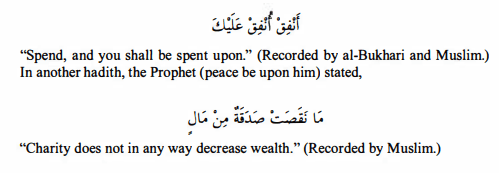
A very important point to realize is that when one spends for the sake of Allah, Allah will replace that money for the person. A person’s wealth will not be depleted by giving in charity. To believe in this fact and actually put it into practice requires true faith–and sadaqa is a proof of one’s faith, as stated above. Those who are weak in faith will only see their money leaving them and will not have the faith that Allah will somehow restore it to them. However, Allah says,
6. “Patience is a brightness.”
There are two interpretations as to the meaning of the word patience in this phrase. According to some, it is a reference to the fast; in other words, “Fasting is a brightness.” The word “fast” has been explicitly stated in one of the other narrations of this hadith. A second interpretation is to understand “patience” in its literal and general shareeah sense. This interpretation is the one that will be followed in the commentary here.
The Prophet (peace be upon him) described patience as a dhiyaa’. As described above, this implies that it is a type of light but it is not as soothing or easy on a person as noor. This is because patience is not always an easy thing for a person. By definition, it involves restraining oneself and controlling one’s actions. It can even be as if one is actually in a burning fire. Things around may be seemingly out of control. However, if he has patience, that will lead him or guide him out of his difficulties in the same way that dhiyaa’ or brightness gives light and guidance to a person.
Patience, therefore, is like a bright shining splendor that can aid a person through his most difficult hour. Indeed, it may be the only thing that gives him hope of there being light at the end of the tunnel. This light and guidance, of course, comes from Allah as He is the One who is with those who are patient and He is the One whose remembrance is in their heart bringing them comfort. As Allah says, “Have patience. Verily, Allah is with those who are patient” (al-Anfaal 46). Al-Nawawi stated that as long as the person has praiseworthy patience, he will have light and guidance that will keep him along the Straight Path.
This demonstrates the great importance of patience. During times of hardship, people easily stray from the Straight Path as they seek any solution to their problems, whether it is a permissible or forbidden solution. Similarly, during times of ease, when people have the wealth, time and ability to engage in forbidden acts, they need patience to keep them along the Straight Path. Hence, this light of patience at various levels is needed by everyone at practically all times.
Al-Sabbaagh points out one more important subtlety in calling patience a dhiyaa’. This, he says, implies that a small amount of patience can overcome a great deal of hardship and “dark times” in the same way that a small dhiyaa’ can overcome a great deal of darkness. Al-Haitami also mentions that, as was noted above, the Quran has called the sun dhiyaa’ and the moon noor. Noor, in this case, simply reflects the light of the source of light or dhiyaa’. In the same way, patience is called dhiyaa’ because it is the real source. As explained in Hadith Number 19, patience includes the patience that is required to fulfill the obligatory deeds as well as remain away from the forbidden. Hence, without patience, there is no prayer, ablution, fasting and so forth. Patience in this sense is, in fact, the source for all of the other “light” that comes from prayer and other deeds. Therefore, it is truly the dhiyaa’ or splendid and bright source of light. Allah has given patience precedence over prayers in the following verse, “Seek help in patience and prayer. And truly this is hard except upon the true believers who humble themselves [to Allah]” (al-Baqara 45).
Al-Haitami states that Allah has mentioned the most important aspect’fi rst (patience), followed by another important aspect (prayer). Al-Haitami also mentions the following verse, “And We made from among them [the Tribes of Israel], leaders giving guidance under Our command, when they were patient and believed with certainty in Our signs” (al-Sajdah 24). Al-Haitami notes that Allah states the cause as, “when they were patient,” and not, “when they prayed.’ Al-Qaari comments that patience is a dhiyaa’ for the person in the grave. In other words, if a person has patience, meaning he fulfills the obligatory and avoids the forbidden, Allah will reward him by giving him light in the darkness and compact space of his grave.
7. “The Quran is either an argument for or against you.”
In this hadith, the Prophet (peace be upon him) makes it clear that the Quran is either a proof for someone or a proof against him. There is no third, neutral party. One must be from one group or the other. This is similar to what Allah has said in the Quran, “And We send down of the Quran that which is a healing and a mercy to those who believe. And it increases the wrongdoers nothing but loss” (al-Israa 82). This verse shows the diametrically opposite results that come about through the Quran. If a person turns to it with belief and seeks its guidance, it is a healing and a mercy. However, if a person ignores the Quran and refuses to follow it, that does not harm the Quran in any way. Indeed, that only harms the person himself. The Quran will then come as a witness against that person and will lead him to the Hell-fire.
Commenting on this verse, Qatada stated that no one sits with the Quran except that it will either increase or decrease him. In other words, any time one listens to the Quran, it will either increase his faith and blessings or it will cause him greater harm due to his neglect of it. One of the early scholars stated that a person may be reading the Quran while the Quran is cursing him. For example, in the Quran, Allah curses the wrongdoers while the person himself is reading the Quran and not applying it. He is, therefore, one of the wrongdoers. He is reading his own curse and not even realizing it”
One of the early scholars stated that no one sits with the Quran and stands up from it while remaining the same as he was before. Either he profited from it or he lost due to it. And then the person recited the above verse. The Companion ibn Masood stated that if a person puts the Quran in front of him, as a guide, it will lead him to Paradise. If he puts it behind him, not using it as a guide, it will take him to the Hell-fire. On another occasion, he said, “The Quran will come on the Day of Resurrection. It will intercede for its companion and will be a guide to Paradise. Or it will come as a witness against him and drive him to the Hell-fire.”
Abu Musa al-Ashari, another Companion, stated, “This Quran will be a reward for you or it will be a burden upon you. Follow the Quran and do not have the Quran follow you up. For one who follows the Quran, he will descend with it into the gardens of Paradise. And for one who is followed up by the Quran, he will have it take him by the back of his neck and he will be thrown into the Hell-fire.”
7.1 The Quran is First and Foremost a Book of Guidance
In the opening verses of surah al-Baqarah, at the beginning of the Quran, it is explicitly mentioned that the Quran is guidance. This demonstrates the major goal of the Quran: to guide humanity to the Straight Path with all of its connotations. As Abdul Hameed Siddiqi wrote, This explains the main purpose of this Divine Book. This Book is primarily meant as a Book of right guidance for humanity. It is neither the Book explaining the fundamentals of physical sciences nor the laws of medical science, it is meant to guide people to the path of righteousness. This book is in fact a visible expression of a very favourable response from the Lord for the supplication made to Him in the concluding part of Sura al-Fatiha that Allah, in His infinite mercy, should direct the humanity on the right path.
Although this point should be quite obvious, it is something that is often forgotten. People have a tendency to turn to the Quran for reasons other than trying to receive the guidance of how to believe and live. People read it for the sake of barakah (blessings) or to cure illnesses. Some read it as some sort of intellectual journey, learning about the past, metaphysics or to get some temporary spiritual high. When this occurs, and the Quran is not looked upon first and foremost as a book of guidance, the true blessing and teaching of the Quran is lost, although people might still continue to read it.
It also should be noted that the guidance that it gives covers all realms of human life. In other words, it is not simply a guidance related to ritual matters. It guides man in its relation to his Lord, to other humans in society, and even to himself. The fundamental and guiding principles for social, political and financial life are all encompassed as part of its teachings and guidance. The most important guidance it contains is the guidance related to knowing one’s Lord and one’s relationship with his Lord. Allah has made all of these matters very clear in the Quran. If a person sincerely turns to the Quran and sincerely seeks this guidance from the Quran, this Quran will be a proof or witness for him on the Day of Judgment. However, if a person turns away from the Quran and does not bother to benefit from what the Quran has to offer him, then the Quran will be a proof against him on the Day of Judgment.
Allah’s revealing of the Quran is one of the greatest blessings that He has bestowed upon mankind. There is virtually no excuse for anyone’s not benefiting from the Quran. The meaning of the Quran is clear. Its message to all of mankind is clear. If a person does not turn to it, learn it and apply it, he will be misusing one of the greatest blessings from Allah. On the Day of Resurrection, he will have no argument on his behalf. Instead, it will be the Quran that will be a witness against him.
On the other hand, if a person turns to the Quran and benefits from this great blessing in a proper way, it will be a witness or proof for him on the Day of Judgment. He had followed the guidance that came from Allah and this was all that was required from him in this life. In the Hereafter, the Quran will be his guide to Paradise.
8. “And everyone goes out in the morning and sells himself, either freeing or destroying himself.”
This part of the hadith is stating an important aspect of reality. Every day a human is faced with a new situation. Every morning he gets up, he is going to do something. Every day he is either going to obey Allah or he is going to disobey Allah. In essence, every day he is going to be setting himself free from the Hell-fire or leading himself to the Hell-fire and his own destruction. Like the stance toward the Quran, there is no third option. Every day of a person’s life, he is either doing something that will set his soul free or he is doing something that will destroy himself. Even the person who sits and seemingly does absolutely nothing is, in reality, actually leading himself to some result. Allah says in the Quran,
“Certainly, your efforts and deeds are diverse (different in aims and purposes); as for him who gives and keeps his duty to Allah and fears Him, and believes in a reward [from Allah], We will make smooth for him the path of ease [goodness]. But he who is greedy and thinks himself self-sufficient, and belies the good reward, We will make smooth for him the path for evil” (al-Lail 4-10). The one who is successful is the one who sells himself to Allah or buys his freedom from Allah. Allah has said in the Quran, “Verily, Allah has purchased of the believers their lives and their wealth for [the price] that theirs will be Paradise. They fight in Allah’s cause, so they kill and are killed. It is a promise in truth which is binding on Him in the Torah and the Gospel and the Quran. And who is truer to his covenant than Allah? Then rejoice in the bargain which you have concluded. This is the supreme success” (al-Tauba 111 ).
They have given their lives and wealth in this world for the sake of Allah. Actually, their lives and wealth were given to them by Allah. But, in His mercy, Allah will “take them back” in exchange for Paradise. In another verse, Allah says, “And of mankind is he who would sell himself, seeking the pleasure of Allah. And Allah is full of kindness to [His] slaves” (al-Baqara 207). These are the people who “sell themselves” for the sake of Allah. However, the disbelievers sell themselves to Satan, to this world or to their desires. Such a trade can never bring about anything beneficial because, in reality, these trading partners have nothing to offer. All that they can offer are delusions and promises that end up to be punishment in the Hereafter. People sell themselves for money, power, lusts and so forth. Many times, they are willing to give up their dignity for these things. In reality, they are simply selling themselves in exchange for the Hell-fire. Their trade is an evil one indeed. This is why Allah describes some of the unbelievers in the following way, “And how bad indeed was that for which they sold their own souls, if they but knew” (al-Baqara 1 02).
Al-Qari explains this hadith by saying, “Everyone who abandons this world and gives preference to the Hereafter has purchased himself from his Lord for this world. Therefore, he sets himself free. Whoever abandons the Hereafter and gives preference to this world, then he is selling the Hereafter and is destroying himself.”
Ibn Uthaimin gives a comparison between the believer and unbeliever in the light of this passage. He states that a believer gets up in the early morning and the first thing he does is make ablution and purify himself. And, “Purification is half of the faith.” Then he goes and prays. Hence, he is beginning his morning with tauheed and belief in Allah. Indeed, as soon as he awakes, before he even gets to making ablution, he should recite certain words of dhikr. He is indeed setting himself free from the Hell-fire.
On the other hand, an unbeliever gets up in disobedience to Allah. He does not remember Allah and does not begin his day with specific worship of Allah. In fact, the food and drink he gets in the morning will be a source of punishment in the Hereafter. The clothing he wears will be a source of punishment for him in the Hereafter. This is because they are all bounties from Allah, yet he refused to give gratitude to Allah for those bounties. Hence, everyday he is selling his soul and leading himself to his own destruction. Finally, the word that the Prophet (peace be upon him) used word implies one who exchanges something for something else. In that case, it applies equally well to a seller or a buyer. This is a type of speech in Arabic where the Prophet (peace be upon him) could have meant both aspects: buying and selling. In other words, every morning the person goes out and either buys himself from Allah or he sells himself to Satan.
9. Other Points Related to this Hadith:
(1) This hadith demonstrates the great mercy and blessing of Allah. Allah has prescribed certain deeds that are very easy to perform. They do not require sacrifice of life or wealth; but their effects can be great on a person, while their reward in Allah’s sight is very great. These acts are the statements of dhikr: al-hamdulillah and subhaanallaah. When a person realizes how merciful Allah is in this regard, it should make him love Allah more and remember Him even more fervently.
(2) Al-Sindi states that no one will have the right attitude toward the Quran until he truly realizes who the Sender is and who it is sent to. The Sender is Allah, the Master of the Day of Judgment, the One in whose Hand is the Dominions of the Heavens and the Earth. It is sent to mankind–those who are lost without the guidance from their Lord and who are in need of their Lord’s help in every moment of their life. The Quran is the guidance that has come to them from their Lord. How can anyone ignore it and not apply it properly once he realizes exactly who it came from and what its purpose is? When a person realizes these aspects, he will turn to the Quran in the proper way and, in the Hereafter, the Quran will be a witness on his behalf.
(3) The believer is precious and worthy of great dignity. He knows that his soul is worth more than anything that this world has to offer. Hence, he will sell it only to the most qualified buyer and for the best price. He will only sell it to his Lord and only for his Lord’s pleasure. Anything else would be an insult to the dignity and honor that a believer should have, for he is one of Allah’s noble creatures.
Summary of the Hadith:
• “Purification is half of the faith.” This either means that purification, such as ablution, is so essential to the prayer that it becomes like half of the prayer, with the word “faith” meaning prayer here. Or it means that purifying oneself from associating partners with Allah or from committing sins fulfills half of the faith.
• The simple words, al-hamdulillah, when said with belief and adherence are very great in Allah’s sight. Indeed, these words fill the scale.
• The words, subhaanallaah and al-hamdulillah, together are also so great that they fill what is between the heavens and the earth.
• “Prayer is a light” means that the effect of prayer is like a light of guidance. Prayer keeps the person away from performing evil deeds. In addition, prayer will be transformed into a light for the person to guide him to Paradise on the Day of Judgment.
• “Charity is a proof.” Charity is a proof of one’s true belief in Allah. On the Day of Resurrection, when the slave is asked about his wealth and how he spent it, his charity will come as a clear proof that he used his wealth properly.
• Patience is a brightness that every individual needs. Indeed, this brightness is the source of light and guidance. It is this light that guides the person to performing the obligatory deeds, abstaining from evil deeds and behaving properly in the face of every situation he meets.
• The Quran will either be a proof for the individual or a proof against him. There is no third category. Either the person believes in and obeys the Quran or he does not. If he does, it will be a witness on his behalf. If he does not, it will be a witness against him.
• Every day, whether the individual realizes this or not, he is either taking
himself closer to his own rescue or to his own destruction. This is an
inescapable fact of life. He can either free himself by selling himself to
Allah or he can destroy himself by selling himself to Satan, his lusts or this
world.
 Books of Muslims