- The Circumstances Behind the Hadith circumstance
- General Comments On This Hadith general
- Tell me about Islam
- The Concept of Imaan
- Imaan, Islam and Ihsaan
- “It is to believe in Allah”
- “His angels”
- “His books”
- “His messengers”
- “The Last Day”
- “To Believe in the divine decree ( al-Qadar), [both] the good and the evil thereof.”
- Some Conclusions about the Islamic Beliefs.
- He said, “Tell me about al-Ihsaan (goodness).”
- 13.1 A General Conception of Ihsaan
- 13.2 He answered, “It is that you worship Allah as if you see Him. And even though you do not see Him, He sees you.”
- 13.3 This is Not in Reference to Rites of Worship Only
- 13.4 The Reward for al-Ihsaan and Its Relationship to This Hadith
- 13.5 The Hadith Does not Imply Seeing Allah in this World
- He said, “Tell me about [the time of] the Hour.” He answered, “The one being asked does not know more than the one asking.”
- He said, “Tell me about its signs” He answered
- “It was [the Angel] Gabriel who came to teach you your religion ( Deen).”
- Additional Points Related to This Hadith
- Summary of the Hadith
Hadith #2 : The Hadith of Angel Jibreel..
On the authority of Umar also who said: One day while we were sitting with the Messenger of Allah (peace be upon him), there came before us a man with extremely white clothing and extremely black hair. There were no signs of travel on him and none of us knew him. He [came and] sat next to the Prophet (peace be upon him). He supported his knees up against the knees of the Prophet (peace be upon him) and put his hands on his thighs.
He said, “0 Muhammad, tell me about Islam.” The Messenger of Allah (peace be upon him) said, “Islam is to testify that there is none worthy of worship except Allah and that Muhammad is the Messenger of Allah, to establish the prayers, to pay the zakat, to fast [the month ofl Ramadhaan, and to make the pilgrimage to the House if you have the means to do so.” He said, “You have spoken truthfully [or correctly].” We were amazed that he asks the question and then he says that he had spoken truthfully.
He said, “Tell me about Imaan (faith).” He [the Messenger of Allah (peace be upon him)] responded, “It is to believe in Allah, His angels, His books, His messengers, the Last Day and to believe in the divine decree, [both] the good and the evil thereof.” He said, “You have spoken truthfully.”
He said, “Tell me about al-Ihsaan (goodness).” He [the Prophet] answered, “It is that you worship Allah as if you see Him. And even though you do not see Him, [you know] He sees you.”
He said, “Tell me about [the time ofl the Hour.” He [the Prophet (peace be upon him)] answered, “The one being asked does not know more than the one asking.”
He said, “Tell me about its signs.”
He answered, “The slave-girl shall give birth to her master, and you will see the barefooted, scantily-clothed, destitute shepherds competing in constructing lofty buildings.”
Then he went away. I stayed for a long time. Then he [the Prophet (peace be upon him)] said, “0 Umar, do you know who the questioner was?” I said, “Allah and His Messenger know best.” He said, “It was [the Angel] Gabriel who came to teach you your religion.” Recorded by Muslim.
1. The Circumstances Behind the Hadith
In one of the narrations in Sahih Muslim, this hadith of Gabriel begins in the following manner: Abu Huraira narrated that the Messenger of Allah (peace be upon him) said, “Ask me [about matters related to the religion].” However, the people abstained from doing so because they were overawed out of profound respect for him. In the meanwhile a man came there and sat near his knees and said, “Messenger of Allah, what is Islam?” …
According to al-Ubayy, the reason the Prophet (peace be upon him) said, “Ask me,” is because they were asking many questions and the Prophet (peace be upon him) realized that some were asking obstinately. Therefore, he became angry and said, “Ask me, ask me, for, by Allah, you will not ask me about anything except that I shall tell you about it as long as I am standing in this place. After hearing and seeing this, the people became fearful and refrained from asking any questions. When the people refrained from asking questions, Allah sent the angel Gabriel to put these important questions to the Prophet (peace be upon him).
Al-Sanoosi adds that such questions do not go against the prohibition of asking questions. Actually, one must ask these types of questions because the answers to them are needed. Hence, this is an application of the Quranic verse, “So ask of those who know the Scripture, if you know not” (al-Nahl 43). In other words, there is a type of questioning that should be avoided and a type of questioning that is commanded. Questions of a useless nature or of a purely theoretical nature with no benefit to them are to be avoided. Questions for which answers are truly needed must be asked. Hence, Allah sent the angel Gabriel to the Prophet (peace be upon him) to ask him these questions and to demonstrate that important questions like these are to be asked of the people of knowledge.
2. General Comments On This Hadith
This is one of the most comprehensive hadith of the Prophet (peace be upon him). It touches upon almost every deed of Islam. Qaadhi Iyaadh has pointed out that this hadith covers or points to all of the aspects of inward and external acts of worship of Allah. It touches upon the deeds that are related to the external organs as well as that of the heart. Indeed, he stated, “[It covers the religion] to such an extent that all the religious sciences are found in it and branch out from it. “
This hadith is known as the hadith of Gabriel; it is also called Umm alSunnah (or “the foundation of the Sunnah”) in the same way that Soorah alFaatiha is called Umm al-Kitaab (or “the Foundation of the Book”). In the same way that Soorah al-Faatiha encompasses the meaning of the Quran as a whole, this hadith encompasses the meaning of the sunnah as a whole.
Some scholars point out the relationship between this hadith and the previous hadith, “Verily, all actions are but driven by intention.” The previous hadith has a position like the statement, “In the name of Allah, the Compassionate, the Merciful,” while this hadith has a position like Soorah alFaatiha. It is said that it is for this reason that scholars such as al-Baghawi began some of his works with the hadith about intention first and then this hadith in the same way that the Quran begins with the saying Bismillaah alRahmaan al-Raheem followed by Surah al-Faatiha. According to ibn Hajr, this incident took place close to the Prophet’s death. Some say that it was just before the Farewell Pilgrimage. Hence, it was as if the Prophet (peace be upon him), through the questioning of the angel Gabriel, was summarizing his mission and message. He summarized the essential concepts of imaan, islam and ihsaan. Then, at the end, he stated that the person was the Angel Gabriel who had come to teach them their religion.
Extremely white clothing and extremely black hair: In other narrations, it also states that his clothing was so clean that there were no traces of dirt upon them. Scholars understand from Gabriel’s appearance that it is recommended to have a good appearance and to be clean. This is especially true when one is going to the mosque and when one is attempting to attain knowledge. White clothing is a preferred clothing, especially for the people of knowledge. According to al-Haitami, Umar recommended it for the reciters of the Quran. Cleanliness is also an important characteristic of the true Muslim and, like all characteristics of true Muslims, must be even more-so emphasized for the scholars and the students of knowledge. They should set the examples for others.
There may be another aspect of note here. Islam places emphasis on both the outward and inward aspects of a human being. Neither aspect is neglected. One can understand from many texts that there is a strong relationship between the two. If one wants to attain knowledge, one must approach that knowledge in the proper manner by first having the correct intention and also by having the proper respect for the knowledge that he seeks to attain. Having proper respect for the knowledge includes being willing to sacrifice one’s time and wealth for it as well as outwardly showing respect for it by sitting and appearing in a proper manner while attaining knowledge or passing on knowledge.
There were no signs of travel on him and none of us knew him: He was not from the people of Madinah and yet there were no signs that he had come from travel. Hence, his appearance was something special and immediately attracted the people’s attention to him. Perhaps, Allah knows best, this was so the people would watch and listen to what he did very carefully. In this way, they would pay close attention to him, grasp his words and the Prophet’s response and then pass it on to others who came afterwards. Umar said that none of them knew the man. This was not simply conjecture on Umar’s part. In other narrations, it explicitly states that the people looked at each other and had no idea who this man was.
He [came and] sat next to the Prophet (peace be upon him). He supported his knees up against the knees of the Prophet (peace be upon him): This should be the attitude of those who are truly seeking knowledge. They should try to get close to the teacher so that they can understand and hear everything he says correctly. Unfortunately, one does not always find such an attitude among Muslims today. They have more of a desire to sit in a comfortable way, with their backs against a wall, for example, rather than getting close to the teacher so that they can absorb as much as possible.
And put his hands on his thighs: Al-Nawawi declares that the Angel Gabriel put his own hands on his own thighs. However, in the narrations from ibn Abbas and Abu Amr alAshari, it explicitly states that the Angel put his hands on the thighs of the Prophet (peace be upon him). This was also the conclusion of al-Baghawi, alTaimi and al-Teebi. Al-Turabashti also argues that this is the correct interpretation as this is the way a student should sit in front of his teacher. Perhaps it was done so he could best listen to the Prophet (peace be upon him) and absorb everything the Prophet (peace be upon him) had to say in response to the important questions he was about to pose. It shows that the questioner should be humble and polite in front of the one he is questioning.’ On the other hand, Ibn Hajr points out that, once again, this abrupt manner of coming all the way to the Prophet (peace be upon him) and putting his hands on the Prophet’s thighs may have been just another means by which he is showing himself to be a rough, ill-mannered bedouin Arab. Hence, it could have been simply another act to attract the people’s complete attention.
He said, “O Muhammad … “: Allah Says in Quran “Make not the calling of the Messenger among you as your calling of each other” (al-Noor 63). In this hadith, the Angel addressed the Prophet (peace be upon him) by saying, “O Muhammad.” This has caused some concern. Such a way of addressing the Prophet (peace be upon him) is not considered proper and is censored in the above verse of the Quran. How is it that the angel addressed him in that manner?
- Three answers have been given to this question:
- The prohibition of such address applies to humans only and not to the angels;
- This event occurred before the prohibition of such address (although this explanation seems unlikely since the event took place so late in the Prophet’s life); and
- This was done to further the appearance that he was a bedouin Arab.
3. Tell me about Islam:
In this narration of the hadith, the Angel first asks about Islam. In other narrations, he first asks about Imaan. There are some who argue that asking about Imaan should be first as that is more consistent with the Quranic presentation of such topics. Note the following verse in which the topics of faith are stated first and then the outward practices are described,
“It is not righteousness that you turn your faces towards the East or West [in prayer]. But righteousness is [the quality of] the one who believes in Allah, the Last Day, the Angels, the Book and the Prophets. [Who] gives his wealth, in spite oflove for it, to the kinsfolk, to the orphans, and to the poor who beg, and to the wayfarer and to those who ask, and to set slaves free. [And who] offers prayer perfectly and gives the Zakat. And who fulfill their covenant when they make it, and who are patient in extreme poverty and ailment and at the time of fighting. Such are the people of the truth and they are the pious” (al-Baqara 177). A similar approach is taken in the beginning verses of Surah al-Anfaal. Allah knows best.
In his reply, the Prophet (peace be upon him) did not give the linguistic meaning of the word Islam, in the same way that he did not give the linguistic meaning of the word Imaan when asked about that. Perhaps, the concepts were something very clear and the Prophet (peace be upon him) realized that the person was asking about what makes up Islam and Imaan and not the definition of those two terms.
The Messenger of Allah (peace be upon him) said, ‘Islam is to … pilgrimage to the House if you have the means to do so: A discussion of the meaning of the five pillars of Islam and related aspects shall be delayed until the discussion of the following hadith which is entirely concerning these five pillars. However, it is important at this time to briefly define the word “Islam” since this term shall be used often while discussing the concept of Imaan.
Lexically speaking, the word islam implies submission. In its particular sense related to the religion of Islam, Nomani wrote, Literally, Islam denotes self-surrender or to give oneself up to someone and accept his overlordship in the fullest sense of the term. The religion sent down by God and brought into the world by His Apostles has been called Islam for the simple reason that, in it, the bondsman yields completely to the power and control of the Lord and makes the rendering of whole hearted obedience to Him the cardinal principle of his life. This is the sum and substance of the Islamic creed …
He said, ‘You have spoken truthfully [or correctly].’ We were amazed that he asks the question and then he says that he had spoken truthfully: The behavior of the angel was something very strange for the people. First, he had asked the Prophet (peace be upon him) some questions. In general, when a person asks a question, it implies that he does not know the answer. Therefore, it is strange that he should comment that the answer was correct. Second, more importantly, this was information that was known only from the Prophet’s teachings. This man who had come to ask the questions was not known to any of the people and, so, he was not known to have been someone who learned from the Prophet (peace be upon him). This made it all the more surprising that he had the boldness to state that the Prophet’s replies were correct.
4. The Concept of Imaan
He said, ‘Tell me about Imaan (faith): In this narration, after asking about Islam, the Angel asked the Prophet (peace be upon him) about Imaan or faith. Once again, the Prophet (peace be upon him) understood that he was not asking about the nature of faith but he was, instead, asking about what is to be believed in. However, before discussing the aspects that the Prophet (peace be upon him) mentioned, it is important that one have the correct understanding of the concept of Imaan derived from the Quran and sunnah. Therefore, the following pages will be a discussion of the concept of faith.
What is Imaan (faith)? Who is a believer? What is disbelief? Who is a disbeliever? These questions appeared very early in the history of Islam. Unfortunately, they also led to differences of opinion as well as division among the Muslims. In the first century of Islam, the Khawaarij had developed their own theory of faith and began to call many of the Muslims of that time disbelievers. In response to them came groups such as the Murj ia, Jahamiyah and others whose definitions of Islam embraced everyone regardless of their deeds. Another group, the Mutazila, developed their own theory which was termed the “position between the two positions”.
Through all of this, though, by the grace of Allah, the position of the Quran and sunnah on these questions was clear and propagated by the true followers of Islam.
ibn Taimiya wrote, One must understand that if any term is found in the Quran or hadith, and its explanation is known and its purport made clear by the Prophet (peace be upon him), there is then no need to use as evidence the statements of the linguists or others .. If anyone wants to explain such terms in any way other than how the Prophet (peace be upon him) explained that term, such an explanation will not be accepted … The terms Imaan, Islam, nifaaq (hypocrisy) and kujr are more important than all of those terms [just mentioned]. The Prophet (peace be upon him) explained the meanings of those terms in such a way that it is not necessary to look for their linguistic origins or how they were used by the [pre-Islamic] Arabs and so forth. Therefore, it is a must that, while trying to determine the meanings of such terms, one refers to how Allah and His Messenger explained those terms. Their explanation is clear and sufficient..
4.1 The Definition of Imaan According to the Quran and Sunnah
The view of the ahl al-Sunnah wa al-Jamaah: According to this view, the locus of imaan is the heart, tongue and physical actions.
Imaan increases and decreases. Deeds form a part of imaan. Some such deeds are essential, others are required and yet others are recommended. This does not preclude the possibility that true believers commit sins. Such sins, even major sins if they are less than kufr and shirk, do not take the person out of the fold of Islam. In the Hereafter, the sinner may be punished in the Hell-fire or be forgiven by Allah. However, all people who have even the slightest amount of imaan in their hearts will eventually be rescued from Hell and entered into Paradise. This is the belief that was passed on from the Prophet (peace be upon him) to his Companions and their followers. It is the only view that takes into consideration of the different relevant pieces of evidence from the Quran and sunnah.
lbn Abu al-Izz wrote, [The Prophet (peace be upon him)] has made it absolutely clear that a person is definitely not a mu’min (a believer) if it is claimed that he believes in the Prophet (peace be on him) but he does not profess it with his tongue, even though he can, nor does he offer salaat, nor fasts, nor loves Allah and His Prophet (peace be on him), nor fears Him. If, he also hates the Prophet (peace be on him) and fights against him [then he obviously cannot be called a believer].
He has also made it clear that our happiness and position in the hereafter depends upon our statement of the testimony of faith and our sincerely believing in Allah’s unity and acting accordingly.
- For instance, he said,
- “Imaan has more than seventy parts, the highest is the confession that there is no god except Allah, and the lowest is removing a harmful object from the road.”
- “Modesty is part of lmaan.”
- “The most perfect mu’min (believer) is the one who is best in character.”
- “Simplicity in dress is part of Imaan.
If Imaan has different parts and each part is called Imaan, it follows that Salat is Imaan, Zakat and hajj are Imaan, virtues such as modesty, trust, fear, and submission, even removing an obstacle from the way, are part of Imaan. Some of these parts are so basic, like the two Shahaadah, that if you lose them you lose Imaan completely; others are so marginal, such as removing an obstacle from the road, that if you lose them you do not lose Imaan. In between the two, we have numerous parts of varying importance, some next only to the Shahaadah, and others only a little more important than removing an obstacle from the way. As the parts of lmaan are Imaan, similarly the parts of kufr are kufr. To judge according to the rules revealed by Allah is part of Imaan, and to judge against them is kufr.
4.2 The Components of Imaan
As just noted, a thorough study of the Quran and sunnah shows that Imaan has certain components.
- Ibn al-Qayyim once wrote that Imaan is a compound of the following components:
- Having the knowledge of what the Prophet (peace be upon him) taught.
- Having complete and firm belief in what the Prophet (peace be upon him) brought.
- Verbally professing one’s belief in what he brought.
- Yielding or submitting to what he brought out of love and humility.
- Acting in accord with what the Prophet (peace be upon him) brought, both outwardly and inwardly, implementing it and calling to its path according to one’s ability.
These components were summed up by the earliest scholars in their statement, “Imaan is statement and action.” Statement here includes both statement of the heart (affirmation) and statement of the tongue (verbal profession). Action includes both the actions of the heart (willingness to submit, love and so forth) and actions of the body (such as prayer and so forth). For the sake of clarity, over time, these two components were broken down into the three following essential components of Imaan that have also been stated by many scholars: (1) Belief in the heart; (2) Profession by the tongue; (3) Performance of deeds by the physical parts of the body. Each one of these three components shall be discussed separately. The third component shall be dealt with in some detail in the next section entitled, “The Relationship Between Imaan and Deeds”.
4.2.1 Belief in the Heart.
The heart is the locus of Imaan or its foundation. Allah says in the Quran “O Messenger, let not those who hurry to fall into disbelief grieve you, those who say, ‘We believe,’ with their mouths but their hearts have no faith” (alMaaidah 41 ) . If what is present in the heart is not sound and proper, then nothing else will be sound and proper. The first component of Imaan being belief in the heart has two aspects. The first aspect is what the scholars call the “statement of the heart”. It is made up of recognition, knowledge and affirmation. For example, one recognizes that there is none worthy of worship except Allah, one has knowledge of that and one affirms that. Obviously, if one does not meet this necessary condition of faith, one cannot truthfully claim to have Imaan.
The second aspect is what the scholars call the “Actions of the heart”. This aspect is made up of commitment, voluntary submission and acceptance (al-iltizaam, al-inqiyaad and al-tasleem). There are also other necessary components in the heart. These include love for Allah, awe of Allah, trust in Allah, fear of Allah and hope in Allah. Al-Misri stated, “The Pious Fore fathers and leaders of the Muslims agreed that these follow the first essential aspect and are necessary consequences thereof. A person is not a believer unless he possesses both of them.” This is so because, as was already alluded to, simple affirmation of belief in Allah and His Messenger without the minimum requirements of love, awe and submission does not make one a believer. Actually, the first aspect should directly lead to the second aspectunless one’s heart is diseased and refuses to follow the truth.
This was pointed out by ibn Taimiya. He stated that if a heart has the knowledge and recognition of the truth then, if it is free from diseases such as envy, arrogance, following of doubts and misconceptions, following of desires and lusts, it will fill with love for the truth and will submit to the truth. This is because the hearts are endowed with a love for truth and seeking it. Therefore, there is nothing more beloved to a pure and sound heart than Allah , In reality, the first aspect of recognizing and admitting the existence or truth of Allah is something that readily comes about. It is, in fact, ingrained in the nature of man. It is the second aspect of this first component, the actions of the heart, that needs to be stressed and implied properly. In fact, in general, when Allah sent messengers to mankind, their main message and dispute with their people was not the recognition or acceptance of Allah’s existence but it was with respect to submitting to Allah and following His commands. The truth of the first proposition was clear and could not be denied. Allah has made it clear in many verses of the Quran that the main problem for disbelievers is not a recognition of the truth but a hatred for it. Allah has said,
“It is not you [O Muhammad] that they deny, but it is the signs of Allah that the wrongdoers deny” (al-Anaam 33). In another verse, Allah says, “Nay, he brought them the Truth but most of them are averse to the Truth” (alMuminoon 70).
It is this component of Imaan, “belief in the heart”, that is the most important. It is the foundation and driving force behind the other componentsof Imaan. When it comes to the components of faith, one is never excused from fulfilling this component while, under different circumstances, one may be excused for not fulfilling the other components. Hence, if a person really wants to be certain that he has true Imaan and he seeks to protect himself from losing that Imaan, he must concentrate on these components and follow the steps that will strengthen them in himself. The essential components are the recognizing of the truth, desiring the truth and having love for the truth in one’s heart. This is combined with hatred for falsehood and disbelief. Note what Allah stated while describing the true believers
“But Allah has endeared the faith to you and has beautified it in your hearts and has made disbelief, wickedness and disobedience hateful to you. These! They are the rightly guided ones” (al-Hujuraat 7).
It must once again be noted that the word tasdeeq (“affirmation, belief’) when used in the definition of faith does not simply refer to the abstract or theoretical concept of believing in something rationally. Instead, it means the belief in something that drives one to accept it, submit to it and implement it. This is what is meant by tasdeeq being the foundation or essential definition of faith.
4.2.2 Profession by the Tongue.
The second necessary component of Imaan is profession of one’s faith by the tongue. Al-Misri stated, “It is inconceivable that the belief in the heart is completely realized- both statement and deeds of the heart- without the faith being realized with the profession of the tongue. ” This profession of the tongue plays a two fold role. It is first a statement of a fact. One is testifying that he recognizes the truthfulness of that statement of faith. This would be analogous to a person giving testimony in a court of law. All he is really stating is that those are the facts that he believes to be true. Second, though, it is statement of commitment to that fact.
It is an admission by the person that he intends to adhere to the requirements and guidance of what he has testified to. In an important passage in Kitaab al-Imaan, ibn Taimiya has written,
The Arabs do not have any such thing in their language as affirmation or denial unless it be in meaning and wording or wording that points to meaning. One will not find in Arabic speech the statement, “Mr. X believed in Mr. Y,” or “denied him” if he knew only in his heart that so and so was true or false. [Such a statement would only be made if the person actually] spoke it. Whoever does not affirm his belief in someone else with his speech, if he has the ability to do so, is not called, according to the Arabs, a believer.
Therefore, the Pious Forefathers of this Nation, of the Companions and those who followed them in goodness, agree on this point. The one who believes in his heart but does not verbally state his belief is not treated in either this life or the Hereafter as a believer in any way. Allah has not declared such a person to be a believer in the Messenger simply because of the knowledge and belief in his heart. He is only considered a believer if he confirms it by his speech. Therefore, the outward speech is an essential aspect of the faith and, according to the early and later scholars, one will not be saved except with that speech. The Muslims have agreed that the one who does not make the profession of faith although he has the ability to do so is a disbeliever. He is a disbeliever both inwardly and outwardly according to the Pious Forefathers and Imams of this Nation.
However, the simple pronouncement of the words in and of themselves
is not what is sought. Obviously, the hypocrites did such and they were by no means true believers. The pronouncement of the words must be accompanied by a sincere attempt to implement the following aspects:
- The correct belief in the Lordship of Allah and its related aspects;
- The abandonment of and freedom from any kind of association of partners with Allah; and
- The following and implementation of the laws of Islam.
If this is not what the person means by his profession of faith, then such a profession will not avail the person whatsoever. Hence, before a person makes the testimony of faith, he must be taught and explained that this is what he is testifying to. The testimony does not have to be in the Arabic language or with specific terms but it must be very clear as to the exact meaning and purport of what the person is saying.
4.3 The Relationship Between Imaan and Deeds
The third component mentioned above as an essential component of Imaan is “performance of deeds by the body”. Deeds form a primary part of the concept of Imaan. The concept or word Imaan incorporates in its meaning the deeds that are to be performed in accordance with Imaan.
Some scholars get stuck on the linguistic meaning of Imaan as being tasdeeq (belief) and, therefore, they divorce actions from the essential aspects of Imaan. However, such a view is not the view of the early scholars of Islam. In Kitaab al-Umm, al-Shafi’ee wrote, “There was a consensus of the Companions and the Followers after them and those we have met that Imaan is statement, action and intention. None of them are sufficient in themselves without the others.” The Maliki jurist Ibn Abdul Barr also said,
The scholars of fiqh and hadith have agreed that lmaan is statement and action. And there is no action without intention. Faith, in their view, increases by acts of obedience [to Allah] and decreases by acts of disobedience. Every act of obedience is a part of faith in their view … As for the remaining jurists of personal reasoning (ahl al-ra’i) [other than Abu Hanifah] and the scholars of the reports from the Hijaz, Iraq, Greater Syria and Egypt, including Malik ibn Anas, al-Laith ibn Saad, Sufyaan al-Thauri, al-Auzaa’ee, al-Shafi’ee, Ahmad ibn Hanbal, Ishaaq ibn Rahawaih, Abu Ubaid al-Qaasim ibn Salaam, Dawood ibn Ali, al-Tabari and those who follow their path, they all say that Imaan is statement and action. [They say that it is] statement with the tongue, which is profession of the faith, belief in the heart and deeds of the body. All of that [must be] with purity towards Allah by a sincere intention. They also say that every act of obedience to Allah, whether obligatory or voluntary, is a part of Imaan.
Sahl ibn Abdullah al-Tustari, one of the early ascetics, was once asked, “What is Imaan?” and he answered, “[It is] statement, action, intention and [following the way of the] sunnah. This is because if Imaan is only a statement without action then it is disbelief. If it is statement and action without [proper] intention, it is hypocrisy. If it is statement, action and intention without [following the way of the] sunnah, it is heresy.” Similar statements have also been recorded from Ali ibn Abu Taalib, al-Hasan al-Basri, al-Auzaa’ee, Sufyaan al-Thauri and Saeed ibn Jubair.
The heart is the driving force behind all actions. Therefore, if the heart is filled with Imaan- with the love of Allah, fear of Allah, hope in Allah- it will drive the body to perform acts of obedience and keep away from forbidden, and even doubtful or questionable, acts. Hence, in reality, there is no such thing as true or strong Imaan being in the heart and that not being reflected in the deeds. Such is simply not possible. Ibn Taimiya’s view on this point is clearly expressed in his words,
It is inconceivable that there be a man who is a believer with confirmed belief in his heart that Allah has obligated him to pray, give zakat, fast and perform the pilgrimage and he lives his whole life without making one prostration to Allah or never fasting any month of Ramadhaan, never paying zakat for the sake of Allah and never making the pilgrimage to His house. This is impossible. This would only happen if the person has hypocrisy and opposition to Islam’ in his heart. It would not happen with a true faith. For this reason, Allah describes those who refused to prostrate as unbelievers ..
In the same discussion, ibn Taimiya makes another very important point: This imaan must be reflected in the ritual acts, such as the prayer and fasting, because Allah has made such acts obligatory. It is not sufficient that the person is honest in his speech, fulfills his trust and so forth. These are not sufficient as long as the person does not have the imaan that leads him to the ritual acts. Ibn Taimiya comes to this conclusion because even the polytheists, Jews and Christians believe in and perform those acts. Therefore, a person cannot be considered a believer in Allah and His Messenger if he is not performing any of the rites that were specifically made obligatory in the message of the Prophet Muhammad (peace be upon him).
The relation between true faith and acts may be one reason why Allah so often describes the believers by the acts they perform. If the true Imaan really exists in the heart, the corresponding good deeds must follow. It is simply inconceivable that the inner aspects are at a level of great faith and the external deeds do not demonstrate that Imaan whatsoever.
This is why a believer must always be a “submitter” or Muslim. The belief in his heart drives him to submit externally. On this point, al-Khattaabi wrote, A Muslim could be a mumin some of the time. He also may not be a mumin during some times. However, a mumin is a Muslim at all times. This is because the root of Islam is submission and enactment. The root of Imaan is belief and affirmation. A person could be outwardly submitting while he is not submitting internally. But he could not be believing on the inside while not submitting externally. Therefore, every mumin is a Muslim and not every Muslim is a mumin.
Similarly, ibn Taimiya wrote, If the belief is truly in the heart, the deeds will not delay in following it whatsoever. The complete recognition of Allah and proper love cannot be in the heart if it does not have an overriding effect on the outward deeds. For this reason, Allah has denied faith for those who do not fulfill its necessary consequences. The absence of the necessary consequences is a denial of the necessitating factor. For example, Allah says, “And had they believed in Allah and in the Prophet and in what has been revealed to him, never would they have taken them [the disbelievers] as patrons” (al-Maaidah 81). And, “You will not find any people who believe in Allah and the Last Day making friendship with those who oppose Allah and His Messenger” (al-Mujaadilah 22). The external and internal must go together. The external acts cannot be sound and upright unless the internal aspects are sound and upright. If the internal aspects are upright, then the external deeds must also be upright.
However, the question here is somewhat tricky. There is no question that deeds form part of Imaan in the sense that true Imaan leads to actions and there is a direct relationship between the dynamic growth or stagnation of Imaan and deeds. However, according to the Ahl al-Sunnah wa al-Jamaah, as can be clearly proven from the Quran and sunnah, a person does not leave the realm of Islam simply due to a sin that he commits. Therefore, what exactly is the relationship between these different components? Ibn Abu al-Izz has offered one answer to this perplexing question:
It has also been pointed that qawl (“statement”) is of two kinds: qawl of the heart which is faith (i’tiqaad), and qawl of the tongue which is uttering the testimony of Islam. Similarly ‘amal (action) is of two kinds: actions of the heart, which are intention and sincerity, and actions of the body. When all four of these disappear, Imaan disappears completely. When faith (tasdeeq) of the heart disappears, the other three do not avail the person; tasdeeq is the condition of their authenticity and significance. If there is tasdeeq in the heart but the others are no longer there, this is the case where the dispute arises [whether such a person is still a believer or not].
There is no doubt that the non-submission of the body implies lack of submission on the part of the heart. For if the heart submits, the body also surrenders and obeys; but if, on the other hand, the heart does not submit there will be no assent (tasdeeq) that would manifest in obedience. The Prophet (peace be on him) said, “There is a lump of flesh in the body. When it is sound, the whole body is sound; but when it goes wrong, the whole body goes wrong as a result. Lo! it is the heart.” This means that one whose heart is good, his body [and actions] shall definitely be good. The opposite is not true. However, the point is that when a part of Imaan is lost, the whole Imaan is lost only in the sense that it does not remain intact, but not in the sense that it disappears completely. It is only impaired [not completely gone]
Faith is like intelligence in that it differs from person to person. Although everyone has a core of intelligence which qualifies him as a rational being and distinguishes him from a lunatic, some people are definitely more intelligent than others. It is also obvious that the faith which produces actions of the heart and the body is more complete than the faith which does not produce them. Similarly, the knowledge upon which one acts is more complete than the knowledge upon which one does not act. That which cannot produce anything is plainly weaker than that which can produce something. The Prophet said, “One who is told about something is not equal to one who sees it.” When Moses was told that his people were worshipping a heifer he did not cast the stone tablets down.
He threw them only when he actually saw them worshipping the calf. The reason was not that he doubted the information Allah gave him. The reason was that the importance of a thing informed, no matter how reliable is the informer, is often not realized to the extent it is when it is seen. Ibrahim, peace and blessings of Allah be upon him, said, “My Lord! Show me how you give life to the dead? (Allah) said: Do you not believe? He said: Yea, but to satisfy my own heart” (al-Baqara 260).
In fact, faith in the faith formula (kalimah), “there is no god except Allah”, varies in its radiance from heart to heart. There are, in fact, innumerable degrees of faith’s radiance which are known only to Allah. In some hearts it is as bright as the sun, in others it is like stars, in some like a big lamp, in some like a glowing candle, and in some like a flickering light. That is why, on the Day of Judgment, the light of the believers will shine according to the strength of their faith in Allah’s unity, and the nobility of their practices. As the light of the kalimah increases, doubts and disbelief burn away till one reaches a stage where all uncertainties and vacillations are completely destroyed.
This is the stage of the true believer in tawheed where the heights of his faith are fully secured against the assault of all miscreants. He who knows this would know the meaning of the Prophet s words, “Allah has barred him from the Fire who says, ‘There is no god except Allah , and by it seeks no one’s pleasure but Allah’s,” or “No one will enter the Fire who says, ‘There is no god except Allah. “
There is no doubt that the one who has firm sincerity in his heart, that cannot be overridden by desires or doubts, will not commit sins. If one is not afflicted by desires and doubts, or one of them, one would not commit sins. However, at the time of committing a sin, his heart is occupied with the sin and it loses its sincerity and remembrance of a threatened punishment. Therefore, he sins.
4.4 Imaan Increases and Decreases
Although historically speaking there has been some dispute over this question, it is very clear from the Quran that a person’s Imaan increases and decreases. For example, Allah says,
“And when His verses are recited to them they [the verses] increase their faith” (Anfaal 2). “And Allah increases in guidance those who seek guidance (Maryam 76)
“We have set none but angels as guardians over the fire. We have fixed their number [at nineteen] only as a trial for the disbelievers and in order that the people who were given the book [before] would be certain [that this is the truth], and so that the believers may increase in faith” ( al-Mudaththir 31 ).
“It is He who sent down tranquillity into the hearts of the Believers, in order that faith be added to their faith” (al-Fath 4).
“Those to whom people said: ‘A great army is gathering against you, hence you should fear it, but such only increased their faith and they said: ‘For us Allah is sufficient’ ; He is Perfect in Disposing affairs” (ali-Imraan 173).
Commenting on these verses, ibn Abu al-Izz wrote, Obviously, one cannot say that the increase mentioned in the last verse and the other verses means increase in the objects of faith [or aspects that one must believe in]. Is there anything in the statement, “A great army is gathering against you,” which pertains to some additional aspect that one must believe in?
Did the tranquillity that Allah sent down in the hearts add to the objects of faith? Allah sent down to their hearts calmness upon their return from Hudaibiyah in order to increase their tranquillity and conviction. This is supported by the verses,
“They (the hypocrites) were that day nearer to not having faith than to faith” (ali-Imraan 167) and the verse, “Whenever there comes down a surah some of them say: ‘Which of you has had his faith increased by it? Yes, those who believe- their faith is increased and they do rejoice. But as for those in whose hearts is disease, it only adds wickedness to their wickedness, and they die while they are disbelievers” (al-Tauba 124-125).
There is no question that there are differences in the outward deeds of mankind. This is a reflection and an aspect of the increase and decrease in Imaan. One must not believe, though, that such is the only fluctuation of Imaan. Actually, all of the aspects of faith are exposed to this possibility, including- or especially- the deeds of the heart. Even the level of “belief’ in the heart or certainty can change in one person and certainly is different from one person to the next. Indeed, one’s love for Allah, fear of Allah, trust in Allah and other aspects of the heart are probably the most prone to change and fluctuation.
Perhaps every individual has experienced this fact described in the verses above. At times, a person is very aware of Allah and of his fear and love for Him. This strong feeling in the person’s heart brings tranquillity and warmth to the person and it also keeps him from committing sins. Not only that, it drives him to sacrifice and work harder for the sake of Allah. He becomes very anxious to get up late at night for prayer, for example, or give freely for the sake of Allah. However, at other times, perhaps when the affairs of this world are engulfing him, his remembrance and attachment to Allah is not that great. He does not feel that great feeling of Imaan in his heart. His behavior and actions are not of the same quality as they are at other times.
When he encounters this stage, when he thinks about getting up at night for prayer or giving charity for the sake of Allah, his soul becomes too tired or not willing to sacrifice. This is nothing but the fluctuations of Imaan in the person’s heart.
There may be times when a person is at a very high level of Imaan and remembrance of Allah. When he mixes with worldly events, his family and friends, he may not be at that same level. This type of occurrence even happened to Abu Bakr, who was known as al-Sideeq. A hadith in Sahih Muslim states that Abu Bakr asked Handhalah, another Companion, how he was doing. He answered that he was committing hypocrisy. He explained that by saying that when they are with the Prophet (peace be upon him) and reminded of Heaven and Hell, they are as if they are seeing Heaven and Hell. Then when they retreat to their families, they forget much of what they felt earlier. Abu Bakr stated that he also experienced the same. This is something natural.
The person should learn to appreciate those times when he was at his highest level of faith and seek to maintain them for as long as possible. Even the level of affirmation and knowledge in the heart varies from person to person and time to time in one person. Ibn Taimiya states that the affirmation in the heart of the person who simply knows the general aspects of the teaching of the Prophet Muhammad (peace be upon him) will not be the same as that of the person who knows the details of the Prophet’s life and teachings. Similarly, the one who knows more about Allah’s names and attributes, the life of the Hereafter and so forth will be at a different level of affirmation and knowledge than the one who is ignorant of such matters.
Ibn Taimiya also argues that the faith of a person who knows the proofs for his beliefs and recognizes the falsehood of other beliefs will be stronger and greater than the one who is unaware of these aspects. Ibn Taimiya concludes that there is nothing more variable in the heart of man than faith. He says that people should be able to recognize this fact when they consider one of the components of imaan, which is love. People recognize their own different levels of love. Love sometimes simply implies a desire to be with or close to one’s beloved. However, it can reach the level where one cannot live without being in the presence of one’s beloved. Similarly imaan, of which love for Allah is one component, can be extremely variable.
This question of imaan increasing or decreasing is not simply a theoretical question over which the scholars of the past differed. If a person feels that he has imaan and imaan is a fixed attribute, he will not strive for increasing his imaan and he will not fear or notice a decrease in his imaan. This approach in itself can be very dangerous to his imaan as the person may not recognize the signs that his imaan is decreasing. Imaan can decrease to the level that one is deserving of punishment. Indeed, it can decrease to a level that it actually leaves the person completely and he falls outside of the fold of Islam.
On the other end, as Wamaidh al-Umari noted, there is no limit to the greatness and completion Allah’s attributes. Therefore, no one can ever reach the limit beyond which there will be no further imaan for which he can yearn or work. Instead, one can always grow in one’s imaan as one learns more and more about Allah.
4.5 Complete Imaan and Lacking Imaan
Allah says in the Quran, “The bedouins say, ‘We believe.’ Say [to them], ‘You believe not but say, “We have submitted [in Islam],” for faith has not yet entered your hearts.’ But if you obey Allah and His Messenger, He will not decrease anything in reward for your deeds. Verily, Allah is Oft-Forgiving, Most Merciful” (al-Hujuraat 14). In this verse, Allah is distinguishing between Imaan and Islam.
However, it is clear that the bedouins were not hypocrites, void of any belief in their hearts whatsoever. If that were the case, the remainder of the verse would not make any sense because such people who are completely void of faith shall not be rewarded for their obedience to Allah and His Messenger. What is being described is a case where the true and complete Imaan is not yet present in their hearts. However, they are not outside of the fold of Islam although they are not deserving of being called true or complete believers. Al-Bukhari and Muslim both record the following hadith (this being Muslim’s wording):
Saad reported: The Messenger of Allah (peace be upon him) bestowed [some gifts] upon a group of people and I was sitting among them. The Messenger of Allah (peace be upon him) left out a person and did not give him anything. I thought that he was the best of the group. So I stood up before the Prophet (peace be upon him) and said, “O Messenger of Allah (peace be upon him), what about so and so. By Allah, I find him to be a believer.” The Messenger of Allah (peace be upon him) answered, “He may be [just] a Muslim.” I kept quiet for a short while but then I could not restrain myself and again said to the Messenger of Allah (peace be upon him), “O Messenger of Allah (peace be upon him), what about so and so? By Allah, I find him to be a believer.”
He said, “He may be [just] a Muslim.” I remained quiet for a while and then what I knew about that man made me speak again, “O Messenger of Allah (peace be upon him), what about so and so? By Allah, I find him to be a believer.”
The Messenger of Allah (peace be upon him) answered, “He may be [just] a Muslim. I often bestow something upon a person whereas someone else is dearer to me than he, because of the fear that he may fall headlong into the Fire.”
In this hadith one also finds the Messenger of Allah (peace be upon him) differentiating between a true or complete believer and a Muslim. What can be derived from the above is that for a person to be called an absolute, complete or true believer, he must fulfill the conditions and obligations of Imaan. If he is lacking in them, then he is not deserving of being called a believer. But he has not left the fold of Islam. Instead, he has moved from the lofty level of being called a “believer” to the level of being a “muslim”.
This is a very important point to understand as, when misunderstood, this point leads to a great deal of confusion. In fact, it leads to more than just confusion- it leads to Muslims calling other Muslims disbelievers. A disbeliever is one who completely leaves the fold of Islam. A Muslim is one who is in the fold of Islam by performing the outward deeds of Islam.
However, a Muslim may not perform all of the required aspects of faith, especially those deeds of the heart, to be called a believer in an absolute sense. A believer, in an absolute sense, on the other hand, is one who submits completely- that is, fulfills the requirements of Islam- but, in addition to that, fulfills all of the characteristics and requirements of a true believer. Hence, he is termed a believer. Therefore, every true believer must first be a true Muslim. However, not every Muslim is necessarily a true and complete believer in an absolute sense.
This point must be kept in mind when one reads hadith like the following: “None of you truly believes until he loves for his brother what he loves for himself.” (Recorded by al-Bukhari and Muslim.) In other words, no one is a true and complete believer- meeting all the requirements and necessary components of Imaan- until he loves for his brother what he loves for himself. This is one of the necessary components of being a true and complete believer.’ Another hadith states, “A fornicator while committing illegal sexual intercourse is not a [true] believer. A thief while committing theft is not a [true] believer. A drinker while drinking alcohol is not a [true] believer.” (Recorded by al-Bukhari and Muslim.) A similar hadith states,
“When a person commits illegal sexual intercourse, Imaan leaves him and remains above his head like an awning. When he discontinues this [illegal] behavior, Imaan comes back to him.” (Recorded by al-Tirmidhi) Ibn Taimiya was asked about the meaning of this hadith and whether it should be taken at face value. He wrote, During the time of the Messenger of Allah (peace be upon him), some people committed adultery, stole and drank alcohol. The Prophet (peace be upon him) did not declare them to be disbelievers nor did he cut off the relations between them and the Muslims. Instead, he flogged this one and cut the hand of the other. At the same time, he also sought forgiveness for them … Some say that such people’s Imaan is still complete without any shortcoming… That statement goes against the Quran, sunnah and consensus of the earlier scholars and those who followed them. .. The opinion of the Ahl al-Sunnah wa al Jamaah is that the term believer is not completely removed from them nor is it given to them unconditionally. We say [regarding a person who performs such deeds]: He is a believer who has a deficiency in his faith. Or, he is a believer with respect to his faith and a faasiq (evildoer) with respect to the great sin he performed. Or, one says that he is not a true believer or he does not fulfill his faith sincerely …
[Someone asked:] Did any Imam take this hadith at face value? This question is not clear. If one means by that statement that the apparent meaning of the hadith is that a fornicator is a disbeliever, then none of the Imams understood this hadith in that sense. However, that is not the apparent meaning of the hadith anyway. The Prophet’s words, “Imaan leaves him and is above his head like an awning,” indicates that Imaan did not depart from him completely. Certainly, an awning shades its companion and is directly connected to it. ..
The correct view is that the exact essence of tasdeeq (belief and assent) that distinguishes him from a disbeliever is not non-existent. However, if that level of tasdeeq had remained at its previous level, the person would believe and affirm that Allah has forbidden that great sin and has threatened a great punishment for it. [He also would know] that Allah sees the doer and witnesses him; also, Allah, in His Greatness, Esteem, Exaltedness and Pride despises that act. Therefore, when he commits that act, one of three aspects must be true:
- His belief is confused and muddled, thinking that the threat of punishment is not exactly as it states…
- He has become heedless or neglectful that the act is forbidden, of the greatness of his Lord and the harshness of His punishment.
- Or his desires have completely overtaken him and overpowered the effects of Imaan… [His Imaan] has become like the rational thought of a person who is sleeping or drunk. [That is, it has no influence over him whatsoever.] …
It is known that the Imaan that is the real Imaan no longer resides in him as it had resided. It is not apparent and residing in his heart… [His case is similar to the soul while one is asleep. In some aspects, the person is dead while sleeping (while with respect to other aspects he is still alive)
Similarly, the fornicator, thief and drinker have not lost the Imaan that can keep them from being forever in the Hell-fire. Therefore, intercession and forgiveness is still hoped for him. He still has the right to get married and inheritance [since he has not left the fold oflslam) … There is one more level that goes beyond “believer” and this is muhsin, the one characterized by ihsaan (excellence in his worship of Allah). Every muhsin must meet all of the conditions of a Muslim and a believer. Hence, every muhsin is a Muslim and a believer. However, not every believer is a muhsin. Being a muhsin is a stage higher than that of being either a mumin or a muslim.
These different levels of Imaan, Islam and Ihsaan bring up some very important questions. These questions are related to the fact that disbelievers will be in the Hell-fire forever while believers may either be punished first in Hell and then rescued from Hell and entered into Paradise or they may go directly to Paradise without first being punished in Hell. Therefore, it is logical to ask the following:
( 1) What is the minimum level or foundation of Imaan that will prevent
one from being among the disbelievers in the Hell-Fire forever?
(2) What is the level of Imaan that one must fulfill to be saved from
ever being punished in the Hell-fire?
(3) What is the level of Imaan that will raise one to the highest ranks in
Paradise? These questions shall be dealt with separately.
- (1) What is the minimum level of Imaan that will prevent one from being among the disbelievers in the Hell-Fire forever? The minimum which forms the basics or foundations of faith that is obligatory upon every Muslim at all times is where the person has met the minimum requirement of tasdeeq (belief, assent) and inqiyaad (submission, yielding). These are composed of:
- (a) Belief in everything that one knows to be from the Messenger of Allah(peace be upon him) as well as the readiness to believe in all new information that one receives from the Messenger of Allah (peace be upon him). That is, one accepts, admits and realizes the he must believe in everything that is authentically reported from the Messenger of Allah (peace be upon him). This includes everything that the person knows at the present moment as well as anything that the person may learn in the future.
- (b) Adherence to everything that one knows to be from the Messenger of Allah (peace be upon him) as well as the readiness to adhere to all new information that one receives from the Messenger of Allah (peace be upon him) that one previously did not know. What this means is that every Muslim have the willingness, desire and recognition that he is obligated to adhere to everything that he knows has come from the Prophet (peace be upon him) as well as have the willingness and desire to adhere to anything that he shall learn in the future. Although a Muslim may not actually adhere to everything of the Quran and sunnah, the essential aspect is that he believes and understands that it is obligatory upon him to adhere to everything found in the Quran and sunnah.
This is the absolute minimum that is required of a person. This touches upon a very important concept, especially for new converts to Islam. Belief in Islam is based on overwhelming proof and evidence for the authenticity of the Quran and the veracity of the Prophet (peace be upon him). Belief does not mean that each believer has established or verified every aspect of the Quran or sunnah. Indeed, there are many aspects that mankind may have no knowledge of. Similarly, there are many aspects that disbelievers may, in their ignorance, believe that the opposite is true, fairer or more beneficial.
The unquestionable truth of the Quran and the Prophet (peace be upon him) is sufficient for the person to realize that everything that comes from them is true. This is the correct Imaan that every new Muslim must understand. Hence, whenever he now reads something in the Quran or authentic hadith that he previously did not know, he is willing to accept it and apply it because he knows full well the truthfulness of the Quran and the Prophet (peace be upon him).
This is what ibn Taimiya refers to as al-Imaan al-Mujmal or the general and unspecified faith. If someone only fulfills these minimum requirements, he is not deserving of the honorable title of “believer” or “true believer”. However, if he fulfills these two aspects- and does not contradict them or negate them by any belief, statement or action- then he will have saved himself from kufr (disbelief) and from being in the Hell-fire forever. In
other words, by simply fulfilling these conditions, he remains within the fold of Islam and that is the key to being rescued from the Hell-fire.
This minimum level can be thought of as the level of Islam, as Allah has referred to in reference to the bedouins. Although there is some submission and acceptance of the Quran and sunnah, the people of this level lack the characteristics of true believers whose faith is strong in their hearts. Therefore, they will be lacking with respect to deeds like jihad and sacrificing for the sake of Allah. Furthermore, they might be quite lax with respect to performing major sins and acts of that nature. They have not reached the level where Allah and His Messenger are more beloved to them than anything else. They do not love for their brother Muslim what they love for themselves. They do not fear Allah alone and they do not put their trust only in Allah. All of these are obligatory aspects of being a true believer. However, at the same time, these people are not hypocrites and they may not even be evildoers. They are not deserving of the honorific title of “believers,” but they are, instead, “muslims” (people of some faith who are submitting to Allah).
lbn Taimiya writes about those who convert to Islam or those who were born in Muslim families but who have not taken the time to thoroughly learn about Islam. These people, he says, obey Allah and His Messenger concerning the basics of Islam. Hence, they are within the fold of Islam. However, real faith takes time to enter into their hearts. It comes gradually, as the person’s knowledge, understanding and certainty increases. ‘ This was probably the case with the bedouins described above in the verse from Surah al-Hujuraat. Allah has stated their case in a very beautiful manner that indicates that true Imaan will come to them but at the time of the revelation of those verses, it simply was not there.
This is an important point. It should make the person realize, especially the new convert, that there are greater levels of Imaan waiting for him if he sincerely turns to Allah and seeks His guidance. This true Imaan, Allah willing, will come about as the Muslim understands the Quran better, as he associates more with pious and knowledgeable people, and as he obeys Allah more and as he implements the sunnah more in his life. Allah willing, his Imaan will continue to grow until he becomes a true and complete believer that Allah praises throughout the Quran. He then will taste the sweetness of Imaan. On the other hand, if he is content with little faith and little submission to Allah, he may block off all the means to increase his Imaan and come closer to Allah.
Hence, one should not be satisfied with being at the level of only “Islam”. This level implies that one is not doing a great deal to please Allah. He is not working for Allah’s love, mercy and forgiveness. Indeed, it may mean that he is exposing himself to Allah’s displeasure and punishment in the Hereafter. One second of Allah’s punishment in the Hell-fire will be much greater than any sort of punishment that anyone could possibly receive in this world, although humans complain a lot about their suffering in this world. On the Day of Judgment, everyone will quickly realize that Allah’s pleasure will mean more to him than everything that this world contains.
(2) What is the level of Imaan that one must fulfill to be saved from ever being punished in the Hell-fire? If a person goes beyond the minimum requirements of faith and fulfills all of the necessary as well as obligatory (minimum) aspects of the faith, then he has moved from the lower levels of Imaan to a higher level. This is the level in which he fulfills all of the obligatory aspects of Imaan. This is where he fulfills the description of the true believers as given in the Quran and sunnah. If a person fulfills the obligations upon him with respect to faith and submission to Allah and avoids the forbidden acts, then he will never enter the Hell-fire; he deserves to be called a believer in an absolute sense. He is the one who fulfills the description of the true believers as found in the Quran. For example, he is the one who embodies the following characteristics:
“The [true] believers are only those who, when Allah is mentioned, feel a fear in their hearts and when His verses are recited to them, they increase their faith. And they put their trust in their Lord. Those who establish the prayer and spend out of what We have provided them” (al-Anfaal 2-3). In the following verses, Allah says about the people who have those characteristics:
“Certainly, it is they are who are the true believers. For them are grades of
dignity with their Lord, and Forgiveness and a generous provision” (al Anfaal 4).
(3) What is the level of lmaan that will raise one to the highest ranks in Paradise? These are the people of complete Imaan. They not only possess the necessary as well as the obligatory components of Imaan, but they go on beyond that. They perform much more than the essential or required deeds. They also perform voluntary or supererogatory deeds. They perform them as a result of their greater extreme Imaan- in other words, their greater love of, fear of and hope in Allah. They, therefore, excel in their worship of Allah.
lbn Taimiya stated, “The People of the Sunnah and Hadith state that all good deeds, obligatory as well as recommended, are part and parcel of lmaan. That is, they form part of the Imaan that is completed by performing the beloved recommended deeds, even though they are not from the obligatory aspects of lmaan. They differentiate between Imaan and the Imaan that is complete through recommended aspects … The word ‘complete’ [or ‘perfected’] may mean complete in the sense that the obligatory parts are fulfilled or complete in the sense that the extra or recommended parts are fulfilled.” The Prophet (peace be upon him) stated,
“lmaan is composed of seventy some-odd- or sixty some-odd- branches. The greatest aspect is the statement, ‘There is none worthy of worship except Allah,’ and the lowest aspect is removing something harmful from the road. And modesty is a branch of faith.” Obviously, the one who is driven by his faith to remove something harmful from the road for the sake of Allah has gone beyond the minimum or obligatory aspects of faith. Because of his faith in Allah, he will stop and remove something harmful from the road. The only thing driving him to do that is his Imaan.
In sum, ibn Taimiya argues that Imaan is composed of:
(1) Essentials or foundation without which Imaan is missing in totality: If one fails to fulfill any one of these, he is outside of the fold of Islam and will remain in the Hell-fire forever.
(2) Obligatory aspects: If one fails to fulfill any one of them, he may be deserving of punishment in the Hereafter. However, the person who fails only in these aspects will not be in the Hell-fire forever. Instead, he will be rescued by the mercy of Allah and entered into Paradise. If one performs all of these obligatory aspects, one will be entered, by the grace and mercy of Allah, directly into Paradise without first suffering any punishment for what was lacking in his Imaan.
(3) Recommended or beloved acts: These are the acts that will distinguish the People of Paradise from one another. These are the acts that will determine the various degrees of reward and positions of Paradise that are described in the Quran and hadith. lbn Taimiya then quoted the following verse of the Quran as referring to these three categories of “Muslims-believers-those who excel”:
“Then We gave the Book for inheritance to such of Our slaves whom We chose [the followers of Muhammad]. Then of them are some who wrong themselves, and of them are some who follow a middle course, and of them are some who are, by Allah’s leave, foremost in good deeds. That [inheritance of the Quran]- that is indeed a great Grace” (Faatir 32).
Entering Paradise is Tied to Being a Believer Ibn Taimiya also points out that the promise of Paradise is always tied to being a believer or having faith. There are no verses, for example, that promise Paradise for the “Muslims”. There are only promises given to the believers unconditionally or those who have faith and perform good deeds. For example, Allah has said,
“Allah has promised to the believers, men and women, gardens through which rivers flow to dwell therein forever, and beautiful mansions in Gardens of Paradise. But the greatest bliss is the Good Pleasure of Allah. That is the supreme success” (al-Tauba 72). An example of the second type includes, “And give glad tidings to those who believe and do good deeds that for them will be Gardens through which rivers flow … ” (al-Baqara 25).
After the Battle of Khaibar, the Companions of the Messenger of Allah
(peace be upon him) were commenting about some of the valiant Muslims who had died fighting. They said, “So and so is a martyr, so and so is a martyr.” They came to one person and said that he was a martyr and the Prophet (peace be upon him) told them, “Certainly not, for I have seen him in the Hell-fire due to a cloak or garment that he had misappropriated from the booty.” Then the Messenger of Allah (peace be upon him) said to Umar ibn al-Khattaab,
“O ibn al-Khattaab, go and announce among the people that no one enters Paradise except the believers.” (Recorded by Muslim.)
For every person, it is only when he has been purified of wrongs and he then fulfills the requirements of imaan that he will be entered into Paradise. Al-Umari wrote, The important point here is this: When the effects and traces of evildoing are removed by repentance or erased by good deeds or hardships or by being entered into the Hell-fire– and we seek refuge in Allah from that- and nothing is left with the Muslim except what he has of imaan, and true imaan cannot be denied of him, then he will enter Paradise as a believer, even if his imaan is less than the imaan of others.
5. Imaan, Islam and Ihsaan
Some people are very much confused by the use of the words Imaan and Islam. Are Imaan and Islam actually synonymous, implying one and the same thing? Does one actually imply the other or not? If the answer is yes, how is it that Imaan is often differentiated from Islam, as in the case of the hadith of Gabriel. The solution to this question is quite simple and boils down to the following points:
(1) If Imaan is mentioned by itself, not in conjunction with Islam, then the reference to Imaan includes all of the outward acts of submission that are considered exclusively part of Islam. That is, if the word Imaan is used by itself, its meaning encompasses or also indicates the acts of lslam.
(2) If the word Imaan is used in conjunction with Islam, then, Imaan is only a reference to the acts and beliefs of the heart and not the outward acts that form the definition of lslam.
(3) Similarly, if Islam is mentioned by itself, not in conjunction with Imaan, then it also includes Imaan as part of its meaning; that is, for example, a “Muslim” is one who has at least the minimum requirements of Imaan.
(4) If lslam is used in conjunction with Imaan, then Islam is a reference to the outward acts of submission to Allah while Imaan is in reference to the acts of the heart and the beliefs of the person.
(5) Similarly, the word Ihsaan encompasses both Islam and Imaan when it is used alone. However, when used in conjunction with Islam and Imaan, as in this hadith of Gabriel, it has a special and distinct meaning from both Islam and Imaan. Ibn Abu al-Izz has a very lengthy and detailed discussion proving the above points. Here is a greatly abridged translation of what he wrote:
It has been said that ‘amal (action) has been often mentioned in conjunction with Imaan- this implies that action is not included in the connotation of Imaan. The first thing that should be noted in this connection is that Imaan is mentioned [in the texts] in two ways. Sometimes it is mentioned alone,
and neither any particular act nor islam is mentioned along with it; and sometimes it is mentioned in association with a religious act or islam. In the first case, Imaan necessarily includes action. For instance, “Believers are those who, when Allah is mentioned, feel a tremor in the heart” (al-Anfaal 2), or
“Only those are believers who have believed in Allah and His Messenger, and have never since doubted” (al-Hujuraat 15), “They only are true believers who believe in Allah and His Messenger” (al-Noor 62) …
In the second case where any righteous action is associated with Imaan, the implication is that Imaan is different from action even though their predicate is one. However, the difference is of varying degrees …
It has been recorded in the Sahih that the Prophet (peace be on him) said to the delegation from the ‘Abd al-Qays tribe visiting him, “I enjoin upon you to believe in none other than Allah. Do you know what does faith in Allah mean? It is to testify that there is no god besides Allah, the one and the only God, without a partner. It is to establish salaat, pay zakat and hand over (to us) a fifth of the booty.” Obviously the Prophet (peace be on him) did not mean by that that these acts could be called Imaan in Allah without having faith in the heart. On several occasions he emphasized the necessity of faith in the heart. It is, therefore, certain that Imaan is these acts along with faith in the heart. What greater proof than the hadith of the Prophet (peace be on him) can there be to show that actions are included as part of faith? He defined Imaan in terms of actions and did not mention conviction (tasdeeq) of the heart, that is because it is well known that actions have no value if rejection is in the heart …
To conclude: When Islam and Imaan are mentioned together [in the same sentence] it is different from the case when one is mentioned without the other. Islam is to Imaan like the two testimonies- witnessing to Muhammad’s Prophecy in relation to witnessing to Allah’s unity- are to each other. In essence these two testimonies are two different things although the idea and the effects of the one are associated with the idea and the effects of the other, as if they were one thing. The same is the case with islam and Imaan. No one can have Imaan without islam, nor is/am without Imaan. One has to have islam to some extent in order to prove his Imaan, just as one has to have Imaan in order to authenticate one ‘s islam.
An Example: Belief in the Unseen: Before moving on to discuss what a Muslim is supposed to believe, an important conclusion from the above discussion must be explicitly stated: True and complete Imaan requires the person to act in accordance with what he has Imaan in. For example, the true Imaan in al-ghaib (the unseen) means that the person believes truly in his heart in the unseen and that this belief in his heart has some affect on his life and his actions. Belief, therefore, is not simply a theoretical or intellectual aspect in the heart that does not affect the person– although historically some have argued that such is correct linguistically speaking. For example, someone may believe that smoking is harmful and wrong by accepting the facts showing smoking to be harmful as true but he continues to smoke and he does not let what he recognizes to be true guide his actions. In other words, he does not submit to the truth he sees nor does he implement what it implies. Hence, his recognition of the facts is not the same thing as “belief’ or imaan. Imaan necessitates that one has the willingness to submit to or enact what one recognizes to be true.
In the case of Imaan, if that Imaan is strong and healthy at that moment, then it will put the feeling of hatred in the person’s heart for that act that he believes to be wrong or harmful. It will keep the person from wanting to commit that harmful act. It will, therefore, rule his life and it will guide him to what he should do. If it is weak and can be overcome by other forces in the heart, it may not have that effect.
Therefore, true belief or imaan in al-ghaib means that one acts in accordance with that belief. When, for example, he says that he believes in the angels, it means that he knows that the angels are present and that they are actually recording his deeds. This should affect him in that he will not perform those deeds that he does not want those angels to see and record.
6. “It is to believe in Allah”
Belief in Allah is the cornerstone of Islamic faith. All of the other Islamic beliefs revolve around belief in Allah. It is a must that a Muslim’s beliefs about Allah be correct. If a person’s beliefs about Allah are not correct, then his whole faith may be ruined. For this reason Muslim scholars delineated and explained the correct beliefs concerning Allah in some detail. The importance of the correct belief in Allah, termed tauheed, was demonstrated by ibn Abu al-Izz al-Hanafi. He stated that, “Most of the Quran, rather all of it, refers to tauheed.” He concluded this by showing that all of the Quran, in essence:
(1) Discusses Allah’s names, attributes and actions, and this is part of tauheed in knowledge and affirmation.
(2) Calls people to Allah’s worship alone, without ascribing any partners to Him and leaving everything that is worshipped other than Him, and this is tauheed of intention and action.
(3) Commands, forbids and requires obedience to Him, and this is all part of the rights or implications of tauheed and its completion.
(4) States how Allah honors those who believe in tauheed and how He treats them in this world and what He honors them with in the Hereafter; all of this is the reward for tauheed.
(5) Discusses those who have associated partners with Allah and whom He has punished in this life or would punish in the next, this is the just reward of those who abandon tauheed.
Ibn Abu al-Izz concludes,
Thus the entire Quran is about tauheed, its consequences and the reward for it. [It also discusses the negation and opposite of tauheed or] shirk, those who commit it and the punishment they will suffer for it. [The opening verses of the first chapter of the Quran], “Praise be to Allah, the Lord of the Worlds” is tauheed; “the Most-Compassionate, the Most-Merciful” is tauheed; “Master of the Day of Judgment” is tauheed; “You only do we worship and in You only do we seek help” is tauheed; “Guide us to the Straight Path” is tauheed as it is a request to be guided to the path of the people of tauheed, those whom Allah has blessed, “Not those who have earned the wrath of Allah nor those who have gone astray” or, in other words, those who have forsaken tauheed.
The term tauheed, meaning “making something one,” or “asserting oneness”, is not a term from the Quran or sunnah. However, it became the main term used to cover the aspects of belief in Allah, dating back to the time of ibn Abbas. In order to clarify matters, the scholars divided the discussion of tauheed into different branches, each branch covering or explaining one aspect of the complete and correct belief in Allah. There is nothing sacred about these divisions or their terminology, although they have been accepted and passed on by scholars for centuries. However, what is of critical importance is the concept or belief that is being explained. Many of the deviant sects used the term tauheed or different types of tauheed but what they meant by it was not what is clear from the Quran and sunnah. Therefore, the most important point is that the understanding of the concept or the belief itself be correct according to the Quran and sunnah.
6.1 The Division of Tauheed Into Three Categories
A popular way of discussing tauheed is to divide it into three distinct categories. These three categories are tauheed al-ruboobiyah, tauheed aluloohiyah and tauheed al-asmaa wa al-sifaat. For quick reference, is a graphical representation of this way of viewing or considering tauheed. Each of these three essential components of tauheed shall be discussed
separately.

(1) Tauheed al-Ruboobiyah:
In essence, this is belief in the uniqueness of Allah with respect to His actions. This is the belief in the Oneness of Allah with respect to His Lordship. He alone is the Lord (al-Rabb).
He is One without Partner in His Dominion and His Actions. He is the Only Creator and true Owner of the creation. He is also the only One who nourishes, maintains and Sustains this creation. All creation has been created by Him and Him alone.
According to ibn Uthaimin, all of mankind except the most arrogant and haughty accepts and recognizes this aspect of tauheed, namely, that there is no Lord and Creator but the One Lord and Creator. This is so because this belief is ingrained in the nature of mankind. Mankind recognizes and realizes that this creation must have had a Creator. Mankind also realizes that this Creator must only be One. It is clear from numerous verses of the Quran that even the polytheistic Arabs knew and recognized that the true and only Creator was above and beyond the idols that they used to worship. For example, Allah says in the Quran,
“Say, ‘Whose is the earth and whosoever is therein, if you know?’ They will say, ‘It is Allah’s.’ Say, ‘Will you not then remember.’ Say, ‘Who is [the] Lord of the seven heavens, and [the] Lord of the Great Throne?’ They will say, ‘Allah. ‘ Say, ‘Will you not then fear Allah.’ Say, ‘In whose hand is the
sovereignty of everything? And He protects [all], while against whom there is no protector.’ They will say, ‘ [All that belongs to] Allah.’ Say, ‘How then you are deceived and turn away from the Truth?”‘ (al-Muminoon 84-89).
However, this belief concerning Allah also necessitates or implies the following aspects: Everything that occurs in this creation is by the Decree, Permission and Will of Allah. Sustenance and provisions are from Allah and Allah alone. Life and death are in the Hand of Allah alone. All blessings come from Allah. Guidance and misguidance are by the Will and Permission of Allah. Legislation or prescribing a way of life is the right of Allah alone. Allah alone has knowledge of the unseen. No one has any rights over Allah unless Allah Himself has laid down such upon Himself.
(2) Tauheed al-Uloohiyah:
This is the oneness of Allah with respect to Him being the only one who is an ilaah (God, object of adoration and worship). This is the actualization of tauheed as found in the actions of the humans or servants of Allah. This is the meaning of the testimony of faith, “There is none worthy of worship except Allah.” This is the reason for which the messengers were sent and the books were revealed. This is the “trial” or test that mankind is facing in this world. Allah has said,
“I have not created jinn and mankind except that they should worship and serve Me” (al-Dhaariyaat 56). Allah also says “And your Lord has decreed that you worship none but Him” (al-Israa 23).
This branch of tauheed is the real goal or essence of the teachings of all of the messengers and prophets. The first type of tauheed, tauheed alruboobiyah, is necessary and essential. In reality, there has been very little dispute or controversy over that first type of tauheed. Many people would accept the basic concept that the Lord and Creator is One Lord and Creator only. However, this belief must lead to this second form of tauheed wherein one directs all of his acts of worship towards Allah and Allah alone. This is why so many Messengers are quoted in the Quran as telling their people
“O my people, worship Allah as you have no other God besides Him” (al-Araaf 59, 65, 83, 85; Hood 50, 61, 84; al-Muminoon 23 and 32).
Many authors have given definitions for this type of tauheed. Al-Qaisi, for example, defined it in the following manner, This is the knowledge, belief and recognition that Allah has the position of God over all of His creation. This category of tauheed- which is called tauheed al-uloohiyah or tauheed al ‘ibaada- requires that one single out Allah alone for all acts of worship. It is the singling out of Allah and the specifying of Him as the object of all acts of worship, external and internal, statements and actions. It is the denial of the worship of anything other than Allah, whatever that other thing or being might be. It is the negation of any partner with Allah in any form whatsoever and refusal to turn any act of worship to anyone other than Him. The concept of worship which must be devoted solely to Allah covers everything that is beloved and pleasing to Allah, whether it be acts or statements, both inward or outward, including purity of intention, love, fear, hope, awe, turning to [Him alone], putting one’s trust [only in Allah], seeking aid and assistance, seeking a means of approach …
He goes on to mention many acts of worship, including the obvious ones, such as prayer, prostration, fasting, animal sacrifice, pilgrimage and so forth. All of these must be done solely for the sake of Allah. They must also be done in the manner that is prescribed by Allah and that is pleasing to Him. To perform any of these acts for anyone other than Allah negates and destroys one’s fulfillment and implementation of tauheed.
This aspect of tauheed comprises both the actions of the heart as well as the deeds of the physical body. There are two aspects in particular that must be combined in the worship of Allah. Al-Saadi stated, The spirit and actuality of worship is by the realization of love and submission to Allah. Complete love and full submission to Allah is the reality of worship. If the act of worship is missing both or one of those components, it is not truly an act of worship. For the reality of worship is found in submission and yielding to Allah. And that will only occur if there is complete and full love [for Allah] which dominates all other expressions of love.
This feeling of gratitude is so important that a nonbeliever is called kafir which means, “one who denies a truth” and also “one who is ungrateful”. One can understand why this is so when one reads in the Quran that the main motive for denying the existence of God is that of unjustified pride. Such a proud person feels that it does not become him to be created or
governed by a being whom he must thus acknowledge to be greater than himself and to whom he must be grateful. “Those who dispute concerning the signs of God without any authority come to them, in their hearts is only pride that they shall never attain” ( Ghafir 56).
With the feeling of gratitude goes that of love: “There are some people who take to themselves [for worship] others apart from God loving them as they should love God; But those who believe love God more ardently than they love anything else” (al-Baqara 165).
A believer loves and is grateful to God for His bounties, but being aware of the fact that his good deeds, whether mental or physical, are far from being commensurate with Divine favors, he is always anxious lest because of his sins God should withhold from him some of these favors or punish him in the Hereafter. He therefore fears Him, surrenders himself to Him, and serves Him with great humility.
There is thus no real worship unless the heart is filled with the feeling of love and glorification for Allah. Along with this flows the other necessity components of having hope in Allah and fear of Allah in the heart. Fear of Allah comes about when one truly glorifies and exalts Allah. Hope in Allah flows from a complete and true love of Allah. All of these components must be present and in a proper balance. If they are not present at all or if they are not properly balanced, one’s worship becomes distorted and incorrect. Allah says about some of His true and pious servants,
“Verily, they used to hasten to do good deeds. They used to call upon Us with
hope and fear. They also would humble themselves before us” (al-Anbiyaa 90). In reference to the pious and devoted servants Jesus, Uzair and the angels, Allah has said:
“They hope for His mercy and fear His torment” (al-Israa 57). This category of tauheed is the key to a “real life”, a life that is sound and proper. Ibn Taimiya wrote, You must know that a human’ s need for Allah- that he worship Him and not associate any partner with Him- is a need concerning which there is no comparison that one can make an analogy to. In some matters, it resembles the need of the body for food and drink. However, there are many differences between the two.
If someone worships anything other than Allah- even if he loves it and attains some love in this world and some form of pleasure from that- [that false worship] will destroy the person in a way greater than the harmful displeasure that comes to a person who ate poison …
You must know that if anyone loves something other than for the sake of Allah, then that beloved thing will definitely be a cause of harm and punishment. .. If somebody loves something other than for the sake of Allah, that thing will harm him whether it is with him or he is without it. ..
In order for any deed to be accepted by Allah, it must be done in accordance with this aspect of tauheed. In other words, if a person is fulfilling and understanding this form of tauheed properly, this, by necessity, implies that he is accepting and applying the other forms of tauheed. Therefore, his deeds may then be accepted by Allah. Allah says,
“So whoever hopes for the meeting with his Lord, let him work righteousness and not associate anyone [with Allah] in the worship of his Lord” (al-Kahf 110). One of the acts that must be done solely towards Allah is prayer or supplication. The Prophet (peace be upon him) has said,
“Supplication is the [essence of] worship.” When a person prays or supplicates to another, he is showing his trust and reliance in that other. He is demonstrating his need for the one he is praying to. He is demonstrating his trust in that person or being’s ability to know, understand and fulfill his need. This kind of feeling in the heart that is reflected in supplication must be directed towards Allah only. That is why the Prophet (peace be upon him) called supplication the essence of worship. Hence, anyone who prays or supplicates to anyone other than Allah is associating partners with Allah or, in other words, committing shirk. This is the antithesis of Imaan and tauheed.
This type of tauheed is actually a necessary consequence or result of the correct belief in tauheed al-ruboobiyah. If one realizes that there is no rabb (Lord) except Allah, then one will realize that none is worthy or deserving of worship except Allah. If none other than Allah is worthy of worship, then why would anyone worship somebody or something other than Allah? On this aspect of tauheed, ibn Abu al-Izz al-Hanafi wrote,
The Quran abounds with statements and parables concerning this type of tawhid. It first affirms the tawhid al-ruboobiyah, that there is no Creator other than Allah. This conviction necessitates that no one should be worshipped except Allah. It takes the first proposition [that Allah is lord] as evidence for the second proposition [that Allah is the only one worthy of worship]. The Arabs believed in the first proposition and disputed the second. Allah then made it clear to them: Since you know that there is no Creator except Allah, and that He is the One who can give a person what benefits him or keep away from him what harms him, and He has no partner in those acts, then how can you worship others besides Him and associate partners with Him in His Godhead? For example,
Allah says in the Quran, “Say: Praise be to Allah and peace on His servants whom He has chosen [for His message]. Who is better: God or the false gods they associate with Him? Or who has created the heavens and the earth, and who sends you down rain from the sky with which He brings forth beautiful gardens? It is not in your power to cause the growth of the trees in them. Can there be another god besides Allah? Yet they are a people who assign equals [to Him]” (al-Naml 59-60).
At the end of other similar verses, Allah states, “Can there be another god besides Allah?” (al-Anbiyaa 61, 63 and 64). This is a question with a clearly implied negative answer. They accepted the notion that no one but Allah does such things. Allah used that as a proof against them. It does not mean to ask if there is another god besides Allah, as some have claimed. Such a meaning is inconsistent with the context of the verses and the fact that the
people actually used to take other gods alongside Allah. As Allah says, “Can you possibly bear witness that besides Allah there is another god? Say: I witness it not” (al-Anaam 19).
And they used to say [about the Prophet], “Does he make all the gods one? That it is truly a strange thing” (Saad 5). But they would never say that there was another god [with Allah] that would “make the earth a fixed abode, place rivers in its fold, and place firm hills therein” (al-Nahl 61). They accepted the fact that only Allah did all of those things. Therefore Allah
says, “O people, adore your Guardian-Lord who created you and those who went before you that you may learn to be righteous” (al-Baqara 21) and “Say: Think, if Allah took away your hearing and your sight and sealed up your hearts, who, a god other than Allah, could restore them to you” (al-Anaam 46). And there are other similar verses.
(3) Tauheed al-Asmaa wa al-Sifaat:
The third aspect of tauheed, in this way of viewing tauheed, is recognizing and affirming the Oneness of Allah with respect to His names and attributes. One must affirm that these attributes are perfect and complete in Allah alone. These attributes are unique to Allah. No one else can attain any of these attributes. Throughout the history of Islam, this is another aspect of tauheed concerning which many sects deviated. Shuaib al-Amaoot describes the different views that developed in the following passage,
There is no doubt that the topic of Allah’s attributes must be considered as one of the greatest and most important topics of the foundations of faith. The views of the Islamicists have differed on this issue. Some of them followed the approach of complete denial of the attributes. Others accepted Allah’s names in general but denied the attributes. Some of them accepted both the names and attributes but, at the same time, rejected or gave interpretations for some of them, turning away from their apparent meanings [of the texts found in the Quran and sunnah].
Some of them took the approach that it is obligatory to believe in all of the names and attributes that are mentioned in the Book of Allah and the authentic sunnah. They took them and passed them on according to their plain,apparent meaning. They deny any understanding of their modality (kaifiyah) and deny any kind of similarity [of those attributes to any other than Allah]. The people of this last opinion are those who are called the salaf [pious predecessors] and ah! al-sunnah.
The correct belief concerning this topic that has been passed on from the time of the Prophet (peace be upon him) and his Companions was aptly summarized by al-Saadi when he wrote,
As for belief in Allah, it includes: belief in whatever attributes Allah has described Himself with in His book and whatever attributes His Messenger (peace be upon him) has attributed to Him. [The belief in those attributes are] without any distortion or negation, and without stating how or what manner the attributes are. In fact, the belief is that there is nothing similar to Allah and, at the same time, He is the All-Hearing, the AllSeeing. Therefore, what He has attributed to Himself is not denied nor are such descriptions distorted from their proper meanings. In addition, the names of Allah are neither denied, nor is their manner described, nor are they depicted in a way that makes His attributes similar to the attributes of any of His creation. This is because there is no one and nothing similar or comparable to Him. He has no associate or partner. One cannot make an analogy between Him and His creation, glorified and most High be He.
With respect to belief in what Allah has been attributed with of attributes and names, there must be a combination of affirmation and negation. The ahl al-Sunnah wa al-Jamaah do not allow any straying from what the Messengers preached, as that is the Straight Path. Included in this very important principle are all the statements from the Quran and the Sunnah detailing Allah’s names, attributes, actions and what should be negated of Him. Included among this is the belief in Allah’s settling Himself over the Throne , His descending to the lowest heaven, the believers seeing Him in the Hereafter- as the confirmed, continuous reports have stated. Also included under this principle is that Allah is close and responds to the supplications. What is mentioned in the Quran and sunnah concerning His closeness and “being with” the believers does not contradict what is stated concerning His transcendence and His being above the Creation. For, Glory be to Him, there is nothing at all similar to Him with respect to any of His characteristics.
In one verse, Allah has pointed out that both nothing is similar to Him whatsoever and, at the same time, He has attributes, such as hearing and seeing. Allah has stated,
“There is nothing similar to Him and He is the All-Hearing, the All-Seeing” (al-Shoora 11). Hence, there is a complete denial of anthropomorphism while affirming Allah’s attributes of hearing and seeing. This aspect of tauheed is very important and should not be underestimated. Muhammad Qutb highlighted the importance of understanding this branch of tauheed when he wrote, You will not be able to fulfill the true form of worship and
servitude nor attain the proper direction [in your worship] if you do not know the one who you are worshipping and directing your worship toward-that is, if you do not know the attributes that He has. [You will not be able to fulfill the true worship] until your worship is based on recognition and knowledge. And Allah has described Himself in His noble book with attributes that He wants us to know and attribute Him with [so that our worship of Him can be proper and as complete as we can make it].
Ahmad Salaam points out that the people before the coming of the Prophet (peace be upon him) accepted the idea of Allah alone being the only Creator of the Universe. However, they associated partners with Allah in different forms of worship. Therefore, Islam came to purify this concept of Allah being the Lord or Rabb and gave it its proper understanding. By doing
so, then they would worship Allah alone properly. But the way to achieve that, or the beginning point, is to have the knowledge and correct understanding of Allah’s names and attributes.
If one has knowledge of and a correct understanding of Allah’s names and attributes, then one would never turn to anyone else or direct any form of worship to anyone other than Allah. Hence, a correct and detailed understanding of Allah’s names and attributes is truly the foundation for the correct fulfillment of the other types of tauheed. He further states that tauheed al-ruboobiyah is like a tree. Its root, then, is tauheed alasmaa wa al-sifaat. In other words, tauheed al-ruboobiyah stands on a foundation, which is tauheed al-asmaa wa al-sifaat. If that root or foundation is not found, the tree itself may be diseased and weak.
However, given that parable, the real fruit of tauheed al-asma wa alsifaat, once again, is tauheed al-uloohiyah. The more that one knows about Allah and His attributes, the more one will love Allah, fear Allah and have hope in Allah. Definitely, the more one knows about Allah, the more one will love Allah and desire to please Allah and have Allah pleased with him. Hence, the correct understanding of the names and attributes of Allah is very important and very beneficial. Those people who stray on this issue have harmed themselves greatly and lost a great fortune.
6.2 The Division of Tauheed Into Two Categories
The division of tauheed into three categories is a very common presentation of the concept of tauheed. Another important presentation of it is to divide it into two categories. It is important to note at the outset that the twoways are simply two presentations of exactly the same concepts and ideas. In essence, there is no difference between them. However, one approach may be easier for some to understand and grasp than the other- and the correct understanding is the goal of both presentations.
A second way to view tauheed is to divide it into two categories. These two categories may, in essence, be referred to as “tauheed in theory” and “tauheed in practice”. One’s beliefs about Allah must be correct. That is, at the theoretical or rational level, one must know what to believe about Allah. These aspects are clearly presented and explained in the Quran and sunnah. However, tauheed is not simply a theoretical matter, a matter of “dry” belief or academic discussion. It is something that is supposed to be put into practice in the life of a Muslim. Hence, tauheed goes beyond the simple matter of, “What do I believe about Allah,’‘ to the question, “What are the ramifications that this belief must have on my life and actions?” This is the other essential half of tauheed: how one relates to Allah and implements that belief in Allah.
Ibn Abu al-Izz mentioned this conceptualization of tauheed when he stated,
The tauheed which the prophets preached and the heavenly books taught are of two kinds:
- Tauheed in knowledge and recognition and
- Tauheed in will and intention.
The first is to affirm that God is unique in His essence, attributes, name and acts; that there is nothing like Him in any respect; and that He is as He has said about Himself or as His Prophet (peace be on him) has said about Him. The Quran has expounded this type of tawhid in the clearest fashion, as may be found in the beginning of surah al-Hadid (chapter 57), Taha (chapter 20), end of al-Hashr (chapter 59), beginning of Alif Lam Mim Tanzeel (chapter 32), beginning of ali ‘Imran (chapter 3), all of al-Ikhlaas (chapter 1 12) and so on.
The second type of tauheed, tauheed in actions and intention, is described in al-Kafirun (chapter 1 09), in the verse, “Say: 0 People of the Book, let us agree to a statement that is fair and just between you and us .. . ” (3 :64), in the first and last parts of Tanzi[ al-Kitab (chapter 39), in the beginning, middle and end of Yunus (chapter 1 0), in the beginning and ending of al Araaf (chapter 7) and the whole of al-Anaam (chapter 6)
Figure 2.3 is a graphical representation of this conceptualization of tauheed. The two basic or general categories are quite basic and simple to understand. To understand them fully, they have been divided into separate subsections. In this way of discussing tauheed, specific emphasis is given to some issues that are grouped together under the three categories of tauheed mentioned earlier.
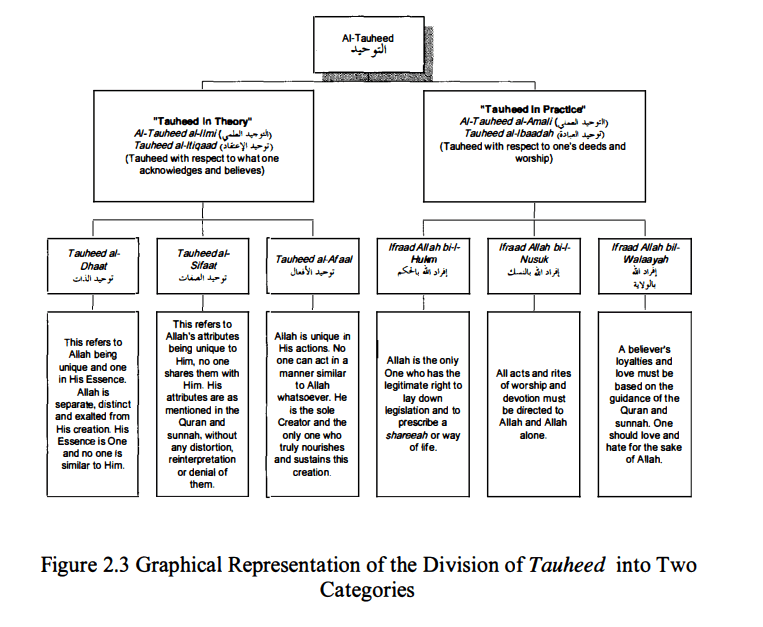
(1) “Tauheed in Theory”: This category of tauheed is actually known by many names, including al-tauheed al- ‘ilmi al-khabari al- ‘itiqaadi (tauheed with respect to what one knows and believes to be true), tauheed al- ‘itiqaad (tauheed with respect to what one believes) and tauheed al-marafah wa alithbaat (tauheed with respect to what one recognizes and affirms of Allah). This category of tauheed can also be divided into three subcategories:
- tauheed al-dhaat (the Oneness of Allah with respect to His being and essence, that He is separate and distinct from His creation);
- tauheed al-sifaat (the Oneness of Allah with respect to His attributes, which are unique unto Him alone);
- tauheed al-afaal (the Oneness of Allah with respect to His actions, being the sole Creator of the Universe and the One who nourishes it). These are shown and defined in Figure 2.2. In essence, the topics covered under this branch of tauheed are the same as those discussed under tauheed al-ruboobiyah and tauheed al-asma wa al-sifaat.
(2) “Tauheed in Practice”: This branch of tauheed is also known by other names, including tauheed al-talab wa al-qasd (tauheed with respect to one’s goal and purpose; that is, one’s goal and purpose is to worship Allah alone), tauheed al- ‘ibaadah (tauheed with respect to one’s ibaadah or acts of worship; that is, one worships Allah and Allah alone) and al-tauheed al- ‘ amali (tauheed with respect to one’s deeds; that is, one only performs the deeds that are pleasing and acceptable to Allah). This branch of tauheed is often divided into three subcategories. Each of these subcategories form an essential and necessary aspect of implementing tauheed in one’s life. These three can be characterized in the following statements:
- making Allah the only object of one’spritual acts of worship;
- submitting oneself only to the commands and revelation coming from Allah; and
- submitting one’s loyalties and love to the commands and guidance of the revelation of Allah.
6.3 An Incorrect Conceptualization of Tauheed
The term tauheed is used quite often by many sects in Islam. Everyone claims to have tauheed. The only true tauheed is that which was taught by the Prophet Muhammad (peace be upon him) to his Companions and which came down from them. In later years, philosophers and scholastic theologians developed their own concepts of tauheed which shared some aspects with the true tauheed but also strayed from it in many aspects.
Similarly, the Sufis developed their own concept and levels of tauheed. In reality, in many cases, what they claim to be tauheed is nothing but shirk (associating partners with Allah) and kufr (disbelief). Hence it is important to be aware of some of their misconceptions that they spread among Muslims.
Concerning their views of tauheed, ibn Abu al-Izz wrote, Now that it is established that al-tawhid al-uloohiyah is what the prophets preached and what the heavenly books taught, as has been pointed out, then one should not listen to the statement of those who divide tawhid into [the following] three types: This first type of tawhid, they say, is the tawhid of the commoners. The second type is the tawhid of the elect which, they say, is the tawhid that is realized in mystical experience. The third is the tawhid of the elect of the elect (khaasat alkhaasah ). This tawhid, they believe, is affirmed by the Eternal Being Himself.
No one should heed these statements for the people who were most perfect in tawhid are the prophets (peace be on them all) … No tawhid can be more complete than the tawhid which the messengers stated, preached and struggled for. That is why Allah commanded His Prophet (peace be on him) to follow in their footsteps. After describing Abraham’s argument with his people in support of tawhid and his denunciation of shirk, and after mentioning other prophets among his descendants, Allah says, “Those were the ones who received Allah’s guidance; follow then their way” (al-Anaam 90). No one can be more complete in tawhid than those whom the Prophet (peace be upon him) was told to follow …
The millah (way, religion) of Abraham is tawhid. The religion of Muhammad is every statement, action, and belief that He brought from Allah. The ‘statement of sincerity’ is the testimony that there is no god but Allah. The fitrah of Islam is the natural disposition man has been given to love and worship only Allah without ascribing any partner to Him and
submitting to Him with complete servitude, humility and reverence.
This is the tawhid of the most elite or dear from among the chosen ones of Allah. Whoever turns away from it is the fool of all fools. Allah has Himself said, “Who turns away from the faith of Abraham but such as debase their souls with folly? Him We chose and rendered pure in this world, and he will be in the Hereafter in the ranks of the righteous. Behold! His Lord said to him, ‘Submit to me,’ [and] he said, ‘I submit to the Lord and Cherisher of the Universe”‘ (al-Baqara 130-131 ).
The second and third types of tawhid, which have been called the tawhid of the elect and of the elect of the elect, culminate in the passing away of the self which most Sufis strive for. It is a dangerous alley which leads to [the false concept of] union (ittihad).
Here is the Book of Allah, the hadith of the Prophet (peace be on him), the traditions of the best people of all ages after the age of the Prophet and the works of the leading scholars. Is there any mention of Iana (Self) in any of them? Has anyone of them talked about these stages of tawhid? In fact, this concept developed later when some people became excessive with respect to some parts of the religion, just as the Khawaarij did earlier in Islam or the Christians did in their religion. Allah has condemned all excess in religion and has strictly prohibited them. Allah states, “O People of the Book! Commit not excesses in your religion; nor say aught of Allah except the truth” (al-Nisa 171). And also, “Say: 0 People of the Book! Exceed not in your religion the bounds (of what is proper), trespassing beyond truth, nor follow the vain desires of people who went wrong in times gone by, who mislead many and strayed themselves from the even way” (al-Maaidah 77).
A very important point that ibn Abu al-Izz makes in that passage is that the Messenger of Allah (peace be upon him) was the most knowledgeable of Allah. The best worshipper of Allah was the Prophet Muhammad (peace be upon him). The best way to submit and serve Allah is the way of the Prophet Muhammad (peace be upon him). The best and correct beliefs about Allah are those of the Prophet Muhammad (peace be upon him). If Muslims would truly reflect on this point and apply it properly, then all the innovations that have developed since the Prophet’s time could be removed.
7. “His Angels”
The second article of faith mentioned by the Prophet (peace be upon him) in the narration of Umar was belief in the angels. Angels are a type of creation of Allah that is, in general, unseen by man. They have been created from light but they do have forms and bodies. They are servants of Allah and have no aspect of divinity to them whatsoever. They submit to His command completely and never stray from fulfilling His orders. Qutb notes that the angels are at all times involved with what is true and correct. They never stray from what is correct even for one second, as humans and jinn do.
Salaam points out that if a person does not believe in angels, he then cannot believe in the coming of revelation to the Prophet Muhammad (peace be upon him). This is because it was an angel, Gabriel, that brought the Quran to the Prophet Muhammad (peace be upon him). Therefore, belief in the Quran cannot be confirmed unless one believes in the angels, as a class, and the Angel Gabriel, in particular, who brought that revelation to the Prophet (peace be upon him)
According to ibn Uthaimeen, proper belief in the angels comprises four matters:
- First, one must believe in their existence.
- Second, one must believe in them in general but also one must believe in their names that have been explicitly stated in either the Quran or authentic sunnah. For example, one of the angels is named Jibreel (Gabriel). He was the angel who brought the revelation to the Prophet (peace be upon him).
- Third, one must believe in their attributes as stated in the Quran or sunnah. For example, it is stated in a hadith that the Prophet (peace be upon him) saw the Angel Gabriel covering the horizon and he had six hundred wings. This shows that this species of creation is a truly great and marvelous creation of Allah. It is also demonstrated, such as in this hadith currently being discussed, that an angel can appear in different forms, such as in the form of a human. This also demonstrates Allah’s great power and ability to do whatever He wills.
- Fourth, one must believe in the actions that they perform as mentioned in the Quran or authentic hadith. It is stated in the Quran that they worship Allah and glorify Him. It is also indicated that specific angels have been given specific responsibilities. Jibreel is in charge of the “life of the heart” which is a reference to the revelation that has come from Allah. Israafeel is responsible for blowing the trumpet that will resurrect the bodies on the Day of Judgment. Hence, he is related to the reviving of life on the Day of Resurrection. Mikaaeel is responsible for the rain and vegetation. These are the “sources” of life on earth. lbn Uthaimin points out that it is perhaps the relationship between these three angels and their “life-giving” responsibilities that led the Prophet (peace be upon him) to open his late-night prayers with the following supplication, “O Allah, Lord of Jibreel, Mikaaeel and lsraafeel, the Originator of the Heavens and the Earth, the One who Knows the Unseen and Witnessed, You judge between Your slaves in that wherein they differ, guide me to the truth in the matters concerning which they have differed, by Your Leave. You guide whom You will to the Straight Path.”
A fifth matter that one must fulfill in his belief in the angels is to have a strong love for them due to their obedience and worship of Allah. Furthermore, they declare the Oneness of Allah and fulfill His commands. They also have strong love and loyalty for the true believers in Allah. They pray to Allah on behalf of the believers and ask Allah to forgive them. They support them in both this life and the Hereafter.
An important aspect related to belief in the angels is that everyone must believe that he has with him at all times two angels that are recording his deeds. The following verses are in reference to those angels:
“[Remember] that the two receivers [recording angels] receive [him], one sitting on the right and one on the left. Not a word does he utter, but there is a watcher by him ready [to record it]” (Qaaf 17-18).
7.1 Some of The Beneficial Results of Proper Belief in the Angels
( 1) One has knowledge of or recognizes the greatness of Allah and His Power when he ponders over the greatness of the angels. This marvelous creation is an indication of the greatness and knowledge of their Creator. Therefore, their creator is deserving of complete and sincere praise. Thus, Allah, in referring to how He made this creation, has said,
“All the praises and thanks be to Allah, the (only) Originator of the heavens and the earth, Who made the angels messengers with wings– two or three or four [sets of wings]. He increases in the creation what He wills. Verily, Allah is able to do all things” (Faatir 1).
Qutb states that if one looks at the visible things of this creation, one will be amazed and will see signs pointing to the greatness and wonderfulness of Allah. However, if one realizes that beyond what one can see, there are even great creations that are beyond the view of humans, this should increase one’s imaan and servitude to Allah. These creatures are beyond the imagination of humans. Therefore, the greatness of Allah’s creation does not end with what humans can see but it is much greater and much more wonderful than that.
(2) One should be thankful to Allah for His extreme care and concern for humans. He has created these creatures to support the believers, protect them, record their deeds and other aspects which are beneficial to the believers.
(3) One should be thankful to Allah that He has obliged different creatures to worship Him in that matter that they are capable of performing. The angels worship and glorify Allah at all times of day and night. But Allah did not require humans to be in that same state of constant and great worship. However, some creatures are able to do that and if Allah had willed, He could have required humans to perform acts of worship in a manner similar to that of angels. By His mercy and wisdom, though, Allah did not require that from humans.
(4) Recognizing the great worship of Allah that angels are involved in should make humans yearn to even more devout in their worship of Allah, to get closer to Allah and become beloved to Allah like His noble angels.
( 5) When performing a sin while all alone and not harming the rights of any other human, a person may think that Allah is all-forgiving and merciful and he will then hope that Allah will forgive him for that sin. However, he must remember that it is not only Allah who is seeing what he is doing. The angels are also there recording his deeds and the angels are also harmed by his sin. Therefore, although he has not harmed any other human, he has harmed one of Allah’s dear and noble creatures. When he considers this fact, this should be a deterrent keeping him from sinning even when all alone.
8. “His books”
Belief in Allah’s books is the third article of faith mentioned in this hadith. It refers to the revelations that Allah sent down to His messengers as a mercy and a guidance to lead mankind to success in this life and happiness in the Hereafter. In particular, the Quran is the final revelation. It is the uncreated speech of Allah. lbn Uthaimeen points out that the belief in Allah’s books comprises four aspects:
First, one must believe that those books were truly revealed fromAllah.
Second, one must specifically believe in the books mentioned in theQuran and sunnah. They are the Quran revealed to the Prophet Muhammad (peace be upon him), the Taurah revealed to the Prophet Moses (peace be upon him), the Injeel revealed to the Prophet Jesus (peace be upon him) and the Zahoor revealed to the Prophet David (peace be upon him). There is also reference in the Quran to the “pages” of Abraham and Moses. The books that the Jews and Christians possess today, which they call the Torah, Gospel and Psalms, may contain some of those original revelations but there is no question that they have been distorted. Hence, to believe in the Torah of Moses, for example, does not mean that a Muslim believes in the first five books of the Old Testament. The two are different books although the latter may possess some of what was in the original Taurah.
Third, one must also believe in everything that Allah has revealed, whether it be in the Quran or in the previous books. That is, for example, if the Quran states something, then the Muslim must believe in it. He has no choice in this matter. If he rejects any statement in it, he has negated his beliefs in the Books of Allah. Allah says,
“Then do you believe in a part of the Scripture and you reject the rest? Then what is the recompense of those who do so among you, except disgrace in the life of this world. And on the Day of Resurrection they shall be consigned to the most grievous torment. And Allah is not unaware of what you do” (alBaqara 85).
Fourth, one must act in accord with the non-abrogated revelation, which is the Quran. One must be pleased with it and submit to it completely. This is so even if the person does not completely grasp the wisdom behind the command or statement.
All of the previous revelations of Allah have been abrogated by the final revelation, the Quran. There is no need for any Muslim to turn to the remnants of any of the earlier scriptures. Everything that he needs for his guidance is contained in the Quran and what it points to, such as the sunnah of the Prophet Muhammad (peace be upon him). Allah has stated in the Quran,
“And to you We have revealed the Scripture in truth, confirming whatever Scripture that came before it, and a watcher and judge over it. So judge among them according to what Allah has revealed” (al-Maaidah 48). Commenting on this verse, ibn Uthaimeen says, “It is a ruler over the previous scriptures. Hence, it is not allowed to act in accord with any ruling of the rulings from the previous scriptures unless it is verified and accepted by the Quran.”
It is one of the greatest blessings of Allah that He sent revelations for mankind. These revelations guide man to the purpose for which he was created. This is one of the many aspects of this creation that helps a human being see and recognize the truth. Commenting on this point, Idris wrote, God created men so that they may serve Him. His being a servant of God constitutes the essence of man.
Man cannot therefore attain to his true humanity and acquire peace of mind unless he realizes this aim for which he was created. But how can he do this? God, being merciful and just, has helped him in many ways. He granted him … an originally good nature that is inclined to know and serve its true Lord. He granted him a mind that possesses a moral sense and the ability to reason. He made the whole universe a natural book full of signs that lead a thinking person to God. But to make things more specific and to give him more detailed knowledge of his Lord, and to show him in a more detailed manner how to serve Him, God has been sending down verbal messages through His prophets chosen from among men, ever since the creation of man. Hence, the description of these messages in the Quran as guidance, light, signs, reminders, etc
In fact, not only did He send revelations for mankind but He also sent specific and different revelations according to the needs and circumstances of different people over time. This is another expression of Allah’s great mercy for mankind. This process continued until the Quran was revealed, containing all the guidance that mankind needs from the time of the Prophet Muhammad (peace be upon him) until the Day of Judgment. Since it is meant to be a guidance for all times until the Day of Resurrection, as opposed to the earlier scriptures, Allah has protected the Quran from any tampering, mistakes or distortions. Allah has said,
“Verily, it is We who have sent down the Reminder [the Quran] and surely We will guard it [from corruption]” (al-Hijr 9).
8.1 The Previous Scriptures
As noted above, the scriptures that were revealed prior to the Prophet Muhammad (peace be upon him) are not the same as what the people today possess and call the Torah, Gospel and so forth. The Quran makes it clear that the earlier peoples distorted their books in three different manners:
- They distorted the meaning or interpretation of it while leaving the wording the same;
- They distorted and changed the wording of the text; and
- They distorted the message by concealing what Allah had revealed to them.
Allah says about the previous peoples, “(And remember) when Allah took a covenant from those who were given the Scripture (Jews and Christians) to make it known and clear to mankind, and not to hide it, but they threw it away behind their backs and purchased with it some miserable gain. And indeed, worst is that which they bought” (ali-Imraan 1 87).
One of the most important aspects that the Jews and Christians tried to conceal were the clear signs in their books of the coming of the Prophet Muhammad (peace be upon him). Allah refers to this blatant cover up of the
truth in the verse,
“Those to whom We gave the Scripture (Jews and Christians) recognize him (Muhammad) as they recognize their own sons. But, verily, a party of them conceal the truth while they know it” (2: 146).
Concerning distorting the meaning or wording of their scriptures, Allah says in the Quran about the Christians,
“And verily, among them is a party who distort the Book with their tongues, so that you may think it is from the Book but it is not from the Book, and they says, ‘This is from Allah,’ but it is not from Allah. And they state a lie against Allah while they know it” (ali-Imraan 78).
Allah has also said about the Jews,
“So because of their [the Tribes of lsrael] breach of their covenant, We cursed them and made their hearts grow hard. They change the words from their [right] places and have abandoned a good part of the message that was sent to them. And you will not cease to discover deceit in them, except a few of them” (al-Maaidah 13)
9. “His messengers”
The next article of faith mentioned by the Prophet (peace be upon him) is belief in the messengers of Allah.2 A messenger is any human who was chosen by Allah to receive revelation from Him and who was commanded to pass that revelation on. A person cannot by himself, through spiritual exercises, incantations or whatever, reach the level of being a messenger or prophet. It is Allah alone who chooses His messengers and He knows best whom to choose. Allah says,
“Allah chooses messengers from angels and from men. Verily, Allah is allhearer, all-seer” (al-Hajj 75). Allah also says, “Allah knows best with whom to place His message” (al-Anaam 124).
The first of the messengers was Noah (Nooh ). 1 Every people were sent messengers and these messengers came with the same fundamental teaching: “And verily, We have sent among every nation a Messenger proclaiming, ‘Worship Allah [alone] and avoid all false deities”‘ (al-Nahl 36). The final messenger and prophet is the Prophet Muhammad (peace be upon him). Allah has said,
“Muhammad is not the father of any man among you, but he is the Messenger and the Seal of the Prophets” (al-Ahzaab 40).
It is important to note that all of these messengers and prophets were simply human beings. They did not have any divine status or attribute of any kind. They had no knowledge of the unseen except for that which Allah revealed to them. Their loftiest attribute is that of being a servant of Allah. Such is Allah’s description of them in the Quran. Indeed, with respect to the Prophet Muhammad (peace be upon him), in reference to three of the greatest events in his life, Allah refers to him as His servant.
Correct belief in the messengers comprises four aspects:
First, one must believe that the message of all of them is the truth from Allah. If a person today denies any single one of them who is confirmed in the Quran or authentic hadith, then he is in fact denying all of them. Allah says about the people of Noah,
“The people of Noah belied the messengers” (al-Shuaraa 105). However, Noah was the first messenger. This implies that, in essence, if a person denies one messenger, he is in fact denying all of them since their message is essentially one and consistent. Therefore, the so-called followers of Jesus who refuse to follow the Prophet Muhammad (peace be upon him) are actually denying their belief in Jesus as even in their own gospels there are plenty of signs that another messenger would come, but they do not wish to recognize these signs. Allah has referred to such aspects in the following verses, “Those [Jews and Christians] to whom We gave the Scripture recognize him as they recognize their sons. But, verily, a party of them conceal the truth while they know it” (al-Baqara 146)
“Those who follow the Messenger, the prophet who can neither read or write, whom they find written in the Torah and the Gospel. .. ” (al-Araaf 1 57). Hence, the Prophet (peace be upon him) said,
“By the One in whose Hand is the soul of Muhammad, there will be no Jew or Christian of this nation who hears of me1 and then dies without believing in that with which I have been sent except that he will be one of the inhabitants of the Hell-fire.” (Recorded by Muslim.) This is one of the aspects that distinguishes Muslims from the earlier peoples. Muslims believe in all of the prophets. However, the others refused some- whether it be the Jews rejecting Jesus (peace be upon him) or the Jews and Christians rejecting the Prophet Muhammad (peace be upon him) although, in reality, they had no grounds whatsoever to refuse the later prophet. Each messenger came with clear signs and evidence. Their rejection by the people could only be based on arrogance, ignorance or hostility to the truth.
Second, one must believe in all of the Messengers mentioned by name in the Quran or sunnah. As for those not mentioned, one must believe in them at a general levet, knowing that Allah has sent many messengers although not all of them are mentioned by name in the Quran or hadith. Allah has stated in the Quran, “And indeed We have sent messengers before you. Of them, some We have related to you their story and some We have not related to you their story” ( Ghaafir 78).
Third, one must believe in everything that they stated. They communicated their messages from Allah completely and properly. They exerted themselves to propagate Allah’s message. They strove for the sake of Allah in the most complete manner. They were most knowledgeable of Allah and the best worshippers and servants of Allah. The messengers “have been protected from attributing to Allah something of their own invention, judging according to their own desires, falling into major sins, and adding to or diminishing from the religion. “
Fourth, one must submit to, accept and act in accord with the law of the messenger who has been sent for his guidance. Allah says in the Quran, “We sent no messenger but to be obeyed by Allah’s leave” (al-Nisaa 64). With respect to the Prophet Muhammad (peace be upon him), Allah says in the verse after the verse quoted above “But no, by your Lord, they can have no faith until they make you judge in all disputes between them, and find in themselves no resistance against your decisions, and accept them with full submission” (4:65).
The believer should realize that the sending of messengers for the benefit and guidance of mankind is a great blessing from Allah. The knowledge that they conveyed is knowledge that is beyond the grasp of the human intellect by itself since it deals with matters of the unseen. Any cursory study of history would demonstrate that mankind is not able to find the absolute and complete truth with respect to God and the worship of Him except through a reliable source that has the necessary knowledge from the proper source, and that is the messenger receiving his knowledge from Allah alone.
Indeed, mankind is in more need of their guidance than they are in need of food and drink. If they are void of food and drink for any period of time, they will die, implying loss of this life. But if they are refusing Allah’s guidance through the messengers, they will lose the everlasting bounties of the Hereafter. Unfortunately for humans, in every era and in every generation, many of them think that they possess a great mind and intellect, therefore, they are not in need of any other human to guide them- even if that human were a messenger of Allah. They think they can find their own way. This arrogance and attributing to their intellects what is well beyond its reach will lead to their final destruction– unless they repent, accept the messengers, believe in what they brought and follow their guidance.
10. “The Last Day”
“The Last Day” is called such because there will be no new day after it, as the people of Paradise shall be in their abode as will the people of Hell. Among its other names are “The Day of Resurrection,” “The Reality,” “The Event,” “The Day of Judgment,” and “The Overwhelming.” This is the greatest day that mankind shall pass through. Indeed, it will be the gravest and most fearful day. A person’s new life will be decided on that day. It will mark a new beginning for each and every soul. This new step may lead to eternal bliss or eternal damnation.
Belief in the Last Day implies belief in everything that the Quran or the Prophet (peace be upon him) has stated about the events of that Day and thereafter. There are some general aspects (resurrection, judgment and reward, Paradise and Hell) that every Muslim should be aware of and believe in with certainty. There are also more detailed aspects that the Quran or the Messenger of Allah (peace be upon him) mentioned. The more one has knowledge of that Day and its surrounding events, the greater the effect this belief will have on him. Hence, it is highly recommended for each individual Muslim to learn about the events that occur prior to and on the Day of Resurrection.
As recorded in Sahih Muslim, before the Day of Judgment and the destruction of this earth, Allah will send a wind softer than silk, coming from Yemen, that will take the souls of every individual who has even the slightest amount of faith in his heart. Therefore, the events of the end of the earth will only be lived through by the worst of people, those with no faith whatsoever. One of the first events to occur is the sun rising from the West. At that time, all those people will declare their faith but it will be of no avail to them. Then the Hom shall be blown and all on this earth shall die. Allah says,
“And the trumpet will be blown, and all who are in the heavens and all who are on the earth will swoon away, except him whom Allah wills” (al-Zumar 68). This earth and heaven shall then be destroyed. After a period of forty- it is not known whether it is forty hours, days or years- a second Hom will be blown and the people will be resurrected:
“And the Trumpet will be blown [the second blowing] and, behold, from the graves they will come out quickly to their Lord. They will say, ‘Woe to us! Who has raised us up from our place of sleep?’ [It will be said to them,] ‘This is what the Most Beneficent [Allah] has promised, and the Messengers spoke the truth”‘ (Ya-Seen 5 1-52). According to ibn Uthaimeen, belief in the last day encompasses three aspects. First is belief in the Resurrection: after the Second Blowing of the Hom, the people will be resurrected in front of Allah. They shall be naked, barefoot and uncircumcised. Allah says,
“As We began the first creation, We shall repeat it. [It is] a promise binding on Us. Truly, We shall do it” (al-Anbiyaa 104).
The resurrection is going to be in the same body that the person had in this worldly life. Ibn Uthaimeen has pointed out the wisdom and importance of this: “If it were a new creation, it would mean that the body that performed the sins in this world would be safe from any punishment. To come with a new body and have that body punished goes against what is just. Hence, the texts and rational argument indicate that the [person] resurrected is not a new [creation] but a return [of the old creation].” He also points out that Allah has the ability to recreate the bodies even after they have disintegrated. Humans may not be able to understand how exactly that is possible- like so many other aspects that humans cannot fathom- but Allah has stated it and a believer knows full well that it is true and well within Allah’s ability to do so.
The second aspect is belief in the accounting or reckoning of the deeds and the reward/punishment for those deeds. This aspect is mentioned and stressed in numerous places in the Quran. Here are a couple of examples:
“Verily, to Us will be their return. Then, verily, upon Us will be their reckoning” (al-Ghaashiyah 25-26).
“And We shall set up balances of justice on the Day of Resurrection, then none will be dealt with unjustly in anything. And if there be the weight of a mustard seed, We will bring it. And sufficient are We as those who reckon” (al-Anbiyaa 47). Allah has made it clear that all deeds will be weighed on the Day of Judgment. Allah says,
“And the weighing on that Day will be the true weighing. So as for those whose scale [of good deeds] will be heavy, they will be the successful. And as for those whose scale will be light, those are they who will lose their own selves because they denied and rejected Our Signs” (al-Araaf 8-9).
Once again, some people might ask, “Actions are like what the philosophers call accidents, without weight or mass, how can they be weighed?” The answer is that Allah has the ability to weigh them. No human has any conception of the Scales themselves that will be used on that day, not to speak of the weights of particular deeds. Allah will weigh them and He is
just. Each deed will weigh exactly what it is truly worth according to Allah’s
scale.
One should always recall that the reward Allah gives to His servants is an act of His mercy as He rewards them more than what their deeds entail. However, Allah’s punishment is out of His justice and He does not punish anyone more than what he deserves. The third essential aspect of belief in the Last Day is belief in Heaven and Hell. Heaven is the eternal abode or reward for the believers. Hell is the eternal abode of punishment for the disbelievers. The stronger opinion is that they both are in existence at this present time and they both shall exist forever.
They are not simply states of mind as some non-Muslims and a few heretical Muslims believe. Allah and His Messenger made mention of them and have described them clearly and in unequivocal terms. There is absolutely no room for any Muslim to deny their existence or their descriptions. About Heaven, for example, Allah has said,
“Verily, those who believe and do righteous deeds, they are the best of creatures. Their reward with their Lord is gardens of eternity, underneath which rivers flow, they will abide therein forever. Allah being well-pleased with them and they with Him. That is for him who fears his Lord” (al Bayyinah 7-8)
“No person knows what joy is kept hidden for him as a reward for what they used to do” (al-Sajdah 17). Concerning Hell, for example, Allah has said,
“Verily, We have prepared for the wrongdoers a Fire whose walls will be surrounding them. And if they ask for relief, they will be granted water like boiling oil that will scald their faces. Terrible the drink and evil a resting place” (al-Kahf 29).
“Verily, Allah has cursed the disbelievers and has prepared for them a flaming Fire. They will abide therein forever and they will find neither a protector or a helper. On the Day when their faces would be turned and rolled in all sides of the Fire, they will say, ‘Oh, would that we had obeyed Allah and obeyed the Messenger”‘ (al-Ahzaab 64-66).
10.1 Aspects of the Grave
lbn Taimiya points out that belief in the Last Day also includes belief in everything that shall occur to a person after his death and before the Day of Resurrection. This includes the trial in the grave and the pleasure or punishment in the grave. The trial in the grave is mentioned in an authentic hadith recorded by al-Tirmidhi. It states that two angels, al-Munkar and al-Nakeer, come to the person and ask him: What did you use to say about this man [meaning the Prophet (peace be upon him)]? Other narrations mention two angels coming and asking three questions:
- Who is your Lord?
- What is your religion?
- Who is your prophet?
The punishment and reward in the grave are what is referred to in the following two verses of the Quran. The first is a description of the blessings coming through the angels before the believers enter Paradise. The second is in reference to the punishment wrongdoers receive before the day of Judgment:
“Verily, those who say our Lord is Allah and then they stand straight [along the straight path], on them the angels will descend [at the time of their death, saying,] ‘Fear you not, nor grieve! But receive the glad tidings of the Paradise which you have been promised”‘ (41: 30)
“If you could but see when the wrongdoers are in the agonies of death, while the angels are stretching forth their hands [saying], ‘Deliver your souls. This day you shall be recompensed with the torment of degradation because of what you used to utter against Allah that was not the truth. And you used to arrogantly reject His signs with disrespect”‘ (al-Anaam 93).
Many people ask the following question about the punishment in the grave: Is the punishment in the grave a punishment that afflicts the soul only or does it also afflict the body, which over time decomposes? Ibn Uthaimeen has answered this question by saying,
The punishment in the grave is first and foremost upon the soul and, perhaps, it also reaches the body. However, it being foremost upon the soul does not mean that the body does not get any of it. In fact, it must receive some of that punishment or pleasure, even if it is not direct. Know that the punishment or pleasure in the grave is the opposite of the punishment or pleasure in this world. The punishment or pleasure in this world is [first and foremost] upon the body and it then affects the soul. In the period between death and the Day of Judgment, the pleasure or punishment is upon the soul and it also has an affect upon the body.
Ibn Uthaimin also addresses the following question: How can one say that the grave squeezes the body of a disbeliever, to the point that his ribs are crushed, while if the grave is uncovered one will find no change in the coffin or the person? Ibn Uthaimin responded by saying,
First and foremost, the punishment of the grave is upon the soul. It is not something physically experienced by the body. If it were something physically experienced and witnessed upon the body, it would not be one of the matters of faith in the Unseen. And there would be no benefit to such belief. However, it is from the matters of the Unseen that is related to the soul. A person may see in a dream, while he is sleeping in his bed, that he is standing, going, coming, beating someone or being beaten. He might even see, while he is sleeping in his bed, that he traveled to perform Umra, circumambulated the Kaaba and went between the two hillocks of Safa and Marwa, shaved or trimmed his hair and then returned to his homeland. All the while, his body is in his bed and does not change at all. Therefore, the affairs of the soul are different from that of the body.
There are additional detailed aspects related to the Hereafter that a believer should learn about and believe in. Due to space limitations, they cannot be discussed in detail here.
- These matters include:
- The Fount or Cistern of the Messenger of Allah (pbuh)
- The different intercessions
- The distribution of the books of deeds;
- Passing over the siraat (bridge) over Hell; and
- The entrance into Paradise and Hell with all of its related aspects
10.2 Importance of Proper Belief in the Last Day
The belief in and knowledge of the great events of the Last Day and the Hereafter should have some very profound effects on the individual- if he takes the time to remember and seriously think about that Day.
First, it should make the believer rush to perform good deeds, knowing the reward that may be in store for them. The bounties of Paradise are greater than what any eye has seen or even what any mind could imagine. First and foremost, this great reward includes the pleasure of Allah and the opportunity to see Him in the Hereafter. If a person could possibly be conscious of this aspect at every moment of his life, he would be anxiously seeking and searching for any good deed he could perform.
Second, the threat of punishment should sway the person from committing any sin, no matter how “light”. No sin performed in this world could be worth the punishment it could bring about in the Hereafter. Furthermore, by committing sins, the person may also be earning the displeasure of Allah, his Lord, Creator and Beloved.
Third, according to ibn Uthaimin, the reckoning and justice of the Day of Judgment should bring comfort and solace to the heart of the believer. It is normal for humans to have a hatred for injustice. In this world, it appears to occur often. Those who cheat and who are unethical many times get ahead in this world without ever suffering for what they have done. However, that is only because, on a grand scale, this world is not the final place for judgment, reward and punishment. They will not escape the evil that they are doing. The good deeds of a person will also not be in vain, as they sometimes seem to be in this world. The time will come for all those matters to be settled and to be settled in a just manner. And that time is the Day of Judgment.
Fourth, without the guidance of Allah and the proper belief in Allah, the result could be complete despair and no purpose to living. If there is no purpose to living, then there is no purpose for being moral, for doing what is right or for any type of work. In fact, this is the conclusion that Jean-Paul Sartre came to. He is considered by many to be a leading thinker of this century and yet he concluded that all of this creation has no purpose and it is all in vain and there is no wisdom or meaning to the existence of man. Allah’ ss response to this unfortunate way of thinking that some humans come to is: “We have not created the heaven and earth in vain. That is the presumption of those who disbelieve. So woe to the disbelievers from the Fire” (Saad 27).
11. “To Believe in the divine decree ( al-Qadar), [both] the good and the evil thereof.”
11.1 The Restatement of “to believe in”
The first aspect that one may note is that the Messenger of Allah (peace be upon him) repeated the word, “to believe in,” before mentioning divine destiny (al-Qadar). The Messenger of Allah (peace be upon him) did not repeat this word before any of the other articles of faith. Obviously, there must have been some reason for this. The scholars have discussed and differed concerning the reasoning behind this.
One view, expressed by al-Qaari, is that there is some “verbal distance” between the beginning of the sentence and the last article of faith. Hence, the word was repeated to state that al-Qadar is also something that must be believed in. In this author’s view, this argument does not sound very convincing.
Al-Ubayy states that it has been mentioned that the reason behind the repeating of the word, “to believe in,” is that the Messenger of Allah (peace be upon him) knew that the people would later differ about al-Qadar. Indeed, the concept of al-Qadar is one that has led to a great deal of division and difference of opinion in the history of Islam. Some groups openly denied its existence completely. Hence, the Messenger of Allah (peace be upon him) emphasized that it is an essential part of imaan to believe in al-Qadar.
A third view is given by al-Mudaabaghi. He states that the governing word, “to believe in,” has been repeated due to the importance of the matter of al-Qadar. Its importance is not in the manner just described in the second view, but because it is something concerning which only those who are truly knowledgeable of the religion of Allah realize. They alone understand its importance and the fact that one must believe in it. This is different from the other articles of faith that are, in general, known and recognized by all Muslims.
11.2 Belief in al-Qadar
The next and final article of faith mentioned by the Prophet (peace be upon him) is belief in “divine decree” or al-Qadar. Idris discusses the meaning of this word and states, The original meaning of the word Qadar is specified measure or amount, whether of quantities or qualities. It has many other usages which branch out from this core. Thus yuqad-dir means, among other things, to measure or decide the quantity, quality, position, etc., of something before you actually make it. And it is this latter sense which interests us here.
It is obligatory upon every Muslim to believe in the concept of Qadar or Divine Decree. In fact, this hadith of Jibreel was passed on by Abdullah ibn Umar when some people came to him telling him that there had appeared a people who were rejecting Qadar. The beginning of the narration in Sahih Muslim is as follows:
It is narrated on the authority of Y ahya ibn Y amur that the first man who discussed Qadar in Basra was Ma’bad al-Juhani. [Yahya] along with Humaid ibn Abdul Rahman al-Himyari set out for pilgrimage or Umrah and said, “If it should so happen that we come into contact with anyone of the Companions of the Messenger of Allah (peace be upon him), we shall ask him about what is being talked about concerning Qadar.”
Unexpectedly, we came across ‘Abdullah ibn ‘Umar ibn alKhattab while he was entering the mosque. I and my friend surrounded him. One of us was on his right side and the other stood on his left. I expected that my friend would authorize me to speak [for both of us]. Therefore, I said, “O Abu Abdul Rahman [Abdullah ibn Umar], there have appeared some persons in our land who recite the Quran and pursue knowledge.” Then, after explaining their affairs, I said, “They claim that there is no such thing as Divine Decree and all events are new [to everyone, including Allah].” [Abdullah ibn Umar] then said, “When you happen to meet such persons, tell them that I have nothing to do with them and they have nothing to do with me. And, verily, they are in no way responsible for my belief.” Abdullah ibn Umar then swore by Allah and said, “If any of them [who does not believe in Divine Decree] had with him gold equal to the bulk of the Mountain of Uhud and then he should spend it [in the way of Allah], Allah would not accept that from him unless he affirms his faith in Divine Decree.”1 He then said, “My father Umar ibn al-Khattaab told me … ” [He then went on to narrate the hadith of Jibreel.]
If one does not believe in these four aspects, he does not have the correct or proper belief in Allah.
The first level is belief in Allah’s knowledge of everything, both of universals and particulars, before its existence. This is related to both, what is sometimes referred to as, the actions of Allah, such as producing rain, giving life and so forth, as well as the actions of human beings. Allah has foreknowledge of all of the deeds of the creation according to His ever-existing knowledge that He is described as having eternally. This includes His knowledge of all their affairs with respect to obedience, disobedience, sustenance and life-spans. This aspect can be concluded from many Quranic verses, including:
“And with Him are the keys of the Unseen. None knows them but He. And He knows whatever there is on the earth and in the sea; not a leaf falls, but he knows it. There is not a grain in the darkness of the earth nor anything fresh or dry, but is written in a Clear Record” (al-Anaam 59).
The second level of belief in Qadar is belief in Allah’s recording of all
things before He created the heavens and the earth. Hence, Allah not only knew
and knows what will happen, but Allah has also recorded this information in the Preserved Table (al-wuh al-Mahfoodh). Such an act is not difficult for Allah whatsoever. Allah says,
“Don’t you know that Allah knows all that is in heaven and on earth? Verily, it is all in the Book. Verily, that is easy for Allah” (al-Hajj 70). Allah also says,
“No calamity occurs on the earth or among yourselves but it is inscribed in the Book [of Decrees] before We bring it into existence. Verily, that is easy for Allah” (al-Hadeed 22). Furthermore, the Prophet (peace be upon him) said,
“Allah recorded the measures of the creation fifty thousand years before He created the heavens and the earth.” He also said, “And His Throne was over the water.” (Recorded by Muslim.)
Ibn al-Qayyim points out that there are actually four different types of “pre-recording” or “pre-determination” of future events.’ These four are the following:
- (a) The pre-existent measure by the knowledge of Allah that is recorded in the Preserved Tablet;
- (b) Allah’s decree concerning the life of an individual while he is still a fetus in the womb of his mother. This includes the person’s sustenance, life span, deeds and whether he will be successful or miserable.
- ( c) A yearly determination that occurs on La,ilat al-Qadr which measures what will occur during the year.
- (d) A daily pre-measuring for everything that occurs. According to ibn al-Qayyim and others, based on some reports recorded by al-Tabaraani and others, this is what the following verse is in reference to, “Every day He has a matter to bring forth” (al-Rahmaan 29). Allah knows best.
The third level is to believe in Allah’s decreeing of everything that is in existence, and if He does not will something, it can never come into existence. Once again, this also refers to all things. It refers to Allah’s actions of giving life, sustenance and so forth; and it also includes all of the acts performed by human beings. Nothing can be done unless Allah decrees it and allows it to occur. A person may intend or try, for example, to shoot and kill another person but such can only occur if Allah decrees it. The person may take all the necessary steps but if Allah does not will it to occur, it will not occur. In the case just mentioned, Allah may will the gun to jam or the shooter’s hand to flinch and miss his target and so forth.
This aspect of Qadar may also be concluded from numerous pieces of evidence. For example, Allah says, “If Allah had willed, succeeding generations would not have fought against each other, after clear verses of Allah had come to them. But they differed, some of them believing and others disbelieving. If Allah had willed, they would not have fought against one another, but Allah does what He likes” (alBaqara 253). Allah also says,
“Verily, this [Quran] is no less than a reminder to whomsoever among you who wills to walk straight. And you will not will such unless [it be] that Allah wills, the Lord of the Worlds” (al-Takweer 27-29).
lbn Uthaimeen also offers a rational argument for this aspect of belief in Qadar. He says that it must be accepted that Allah is the Owner, Master and Controller of this creation. Hence, it cannot be the case, as long as everything is under His Control and part of His Dominion, that something occurs in His Dominion that He does not want to happen. Therefore, everything that occurs in His creation is by His Will. Nothing could ever occur unless He willed it. Otherwise, His control and mastery over His dominion would be deficient and lacking, as things would be occurring in His dominion that either He did not will to occur or they occurred without His knowledge. These hypotheses are unacceptable.
The fourth level of belief in Qadar is the belief in Allah’s creating of everything, bringing of everything into existence and making everything be. This aspect is also demonstrated by numerous verses in the Quran, including: “Blessed be He who sent down the Criterion to His slave [Muhammad] that he may be one who warns the Worlds. He to whom belongs the dominion of the heavens and the earth, and who has begotten no offspring and for whom there is no partner in the dominion. He has created everything, and has measured it exactly according to its due measurements” (al-Furqaan 1-2).
Also, “Allah has created everything” (al-Zumar 62). Another verse states, “Verily, We created all things with Divine Pre-ordainment” (al-Qamar 49). Allah also says, “And Allah has created you and what you make” (al-Saaffaat 96). lbn Uthaimin has explained this point by saying,
Everything is a creation of Allah. Even the deeds of mankind are creations of Allah. Although they are by [man’s] free choice and will, they are creations of Allah. This is because every act of a human is the result of two aspects: a definitive will [to do the act] and the complete ability [to do the act]. For example, suppose that in front of you is a stone weighing twenty pounds. I say to you, “Lift this stone,” and you say, “I don’t want to lift it.” In this case, your lack of will has prevented you from lifting the stone. If I said a second time to you, “Lift that stone,” and you said, “Yes, I will listen and do what you have said.” In this case, if you wanted to lift it but you were not capable of lifting it, you would not have lifted it because you did not have the capability to do so. If I said to you a third time, “Lift that stone,” and you complied and lifted it above your head, that was because you had the ability and the will to do it.
All of our deeds that we perform are, therefore, the result of a definitive will and complete ability. The one who created that ability and will is Allah. If Allah had made you paralyzed, you would not have the ability. If you turned your attention to some other deed, you would not have done it.
Therefore, we say: All of the actions of humans are created by Allah. This is because they are the result of definitive will and complete ability. The one who created that will and ability is Allah. The way in which Allah is the creator of that will and capability is that the will and ability are two characteristics of the one who wants something and the one who has ability but the one who created that person with that ability was Allah. The One who created the person who has specific characteristics is also the one who created those characteristics. This makes the matter clear and shows that the actions of human beings are the creation of Allah,
Actually, there are a number of questions and misconceptions that have arisen surrounding the concept of Qadar. Due to space limitations, they cannot be dealt with in detail here. However, in a not-too-lengthy passage, Jaafar Sheikh Idris has adequately dealt with a number of such issues. He wrote,
God decided to create man as a free agent, but He knows (and how can He not know?) before creating every man how he is going to use his free will; what, for example, his reaction would be when a Prophet clarifies God’s message to him … “But if we are free to use our will,” a Qadari might say, “we may use it in ways that contradict God’s will, and in that case we would not be right in claiming that everything is willed or decreed by God.” The Quran answers this question by reminding us that it was God who willed that we shall be willful, and it is He who allows us to use our will. [He then quotes surah al-Insaan 29-30, also quoted above.]
“If so,” says a Qadari, “He could have prevented us from doing evil.” Yes, indeed he could, “Had God willed, He would have brought them all together to the guidance; if thy Lord had willed whoever is in the earth would have believed, all of them, all together” [Yunus, X:99]. .. But He had willed that men shall be free especially in regard to matters of belief and disbelief. “Say: ‘The truth is from your Lord; so let whosoever will believe, and let whosoever will disbelieve” [al-Kahf, 18:29]. ..
“If our actions are willed by God,” someone might say, “then they are in fact His actions.” This objection is based on a confusion. God wills what we will in the sense of granting us the will to choose and enabling us to execute that will, i.e., He creates all that makes it possible for us to do it. He does not will it in the sense of doing it, otherwise it would be quite in order to say, when we drink or eat or sleep for instance, that God performed these actions. God creates them, He does not do or perform them. Another objection, based on another confusion, is that if God allows us to do evil, then He approves of it and likes it. But to will something in the sense of allowing a person to do it is one thing; and to approve of his action and commend it is quite another.
11.3 “[both] the good and the evil thereof’
After mentioning, “the good and evil thereof,” other narrations mention, “the sweet and the sour thereof’. Al-Mudaabaghi states that the good is obedience to Allah while the evil is disobedience. The sweet is what is beloved to the soul, such as rain, health and so forth. The sour is what is displeasing to the soul, such as illness and disease. Ibn al-Qayyim points out that what is meant by “evil” is with respect to the human beings and not with respect to Allah. The “evil” is the result of the human’s act of ignorance, wrong, oppression and sin. However, it was allowed and brought into being by Allah. But no evil is to be attributed to Allah because, with respect to Allah, the act is good and full of wisdom, as it must be a result of Allah’s knowledge and wisdom. Any act of that nature must, in its essence, be good and cannot be pure evil. This is supported by the Prophet’s hadith,
“Evil is not to be attributed to You.” (Recorded by Muslim.) That is because every act that occurs is the result of some wisdom and goodness and can never be pure evil. The individual himself may think it otherwise, but in reality there is wisdom and good in everything that occurs in Allah’s creation. Ibn Uthaimeen gives an example illustrating this point. Allah says in the Quran,
“Evil has appeared on land and sea because of what the hands of men have earned, that Allah may make them taste a part of that which they have done, in order that they may return [by repenting]” (al-Room 41). In this verse, Allah states the evil (jasaad) that has appeared, the cause for it and its result. The evil (jasaad) and the cause of it are both evil (sharr). However, the goal of it is good: that Allah may make them taste a part of that which they have done, in order that they may return [by repenting]. Hence, there is a wisdom and a goal behind that fasaad. This goal and wisdom makes the entire action something good and not a pure evil. Pure evil, on the other hand, would be one in which there was no benefit or positive result related to it. Allah’s wisdom and knowledge preclude the existence of acts of that nature.
11.4 The Fruits of Proper Belief in al-Qadar
(1) When a person realizes that all things are under the control and decree of Allah, he is freeing his belief from any form of shirk or associating partners with Allah in His Lordship. There is truly only One Creator and Master of this creation. Nothing occurs except by His will and permission. When this is firmly in the heart of the person, he then also realizes that there is none worthy of praying to, seeking assistance from, relying upon, and so forth, except that one Lord. Hence, he directs all of his acts of worship toward that One who has decreed and determined all matters. Thus, both tauheed alruboobiyah and tauheed al-uloohiyah are correctly and completely fulfilled with the proper belief in al-Qadar.
(2) A person will put one’s reliance upon Allah. A person should
follow the outward “causes and effects” that one sees in this world. However, he must realize that those “causes and effects” will not bring about any ends unless Allah so wills them to do so. Hence, a believer never puts his complete trust and reliance upon his own actions or the worldly aspects that he might have some control over. Instead, he follows whatever causes he may know of which lead to a desired end and then he puts his trust in Allah to bring about that desired end.
(3) Ibn Uthaimeen argues that with proper belief in al-Qadar, one does not become arrogant and boastful. If he achieves any goal that he desired, he knows that such goal only came about because Allah, in His mercy, had decreed it for him. If Allah had so wished, He could have put many obstacles in his way and prevented him from reaching his goal. Therefore, instead of becoming full of himself and arrogant upon reaching his goal, the person who truly believes in al-Qadar becomes very thankful to Allah for bringing about that blessing.
( 4) The proper belief in al-Qadar brings about tranquillity and peace of mind. The person realizes that everything that occurs is according to Allah’ Divine Decree. Furthermore, there is a wisdom behind everything Allah does. Hence, if the person loses a beloved or something of this world, he does not go insane, despair or give up hope. Instead, he realizes that such was the will of Allah that he must accept. He must also realize that such has occurred for a purpose. It did not occur haphazardly or accidentally, without any reason behind it. Allah has said,
“No calamity befalls on the earth or in yourselves but it is inscribed in the
Book [of Decrees] before We bring it into existence. Verily, that is easy for
Allah. In order that you may not be sad over matters that you fail to achieve, nor rejoice because of that which has been given to you. And Allah likes not prideful boasters” (al-Hadeed 22-23)
( 5) Belief in al-Qadar gives a person strength and courage. He knows that Allah has recorded his life and his sustenance for him. Such comes only from Allah and is already decreed. Hence, he need not fear struggling and
fighting for the sake of Allah as the time of his death is already recorded. He need not fear anyone when it comes to his sustenance and provision as such come only from Allah and have been already recorded for him. No human can cut off his sustenance and livelihood if Allah has decreed that he shall continue to receive provisions and sustenance from some source.
( 6) When a person does not believe that there is a wise being controlling this universe and that everything just happens by chance, then there is no real need to work and strive for any goal. This striving does not really increase the chance of achieving one’s goal, if everything is truly by chance or the merciless, impersonal works of nature. However, when one realizes that everything happens according to Allah’s decree and wisdom and that Allah has designed natural and moral laws for this creation, he knows that ifhe abides by what Allah has guided him to, Allah will help him and he will be able to achieve his goals by the help and will of Allah.
12. Some Conclusions about the Islamic Beliefs.
Before moving on to the next topic mentioned in this hadith of Jibreel, some important conclusions should be stated about these beliefs. ‘
First, they are the beliefs that are pleasing to Allah and they are part of the blessings that Allah has bestowed upon the believers. Allah has stated, describing this deen that the Angel Jibreel came to teach the Muslims in this hadith,
“This day I have perfected your religion for you, completed My favor upon you and have chosen for you Islam as a religion” (al-Maaidah 3). No other creed or way of life can make such a claim because every other ideology has either been completely invented by man (such as existentialism) or have been distorted from the pure teachings originally revealed by God (such as Judaism and Christianity). The only ideology that can realistically, logically and historically make a claim for itself that it is truly pleasing to God is the ideology or creed of Islam.
Second, it is the foundation of the correct worship of Allah. Therefore, it is the foundation for the proper way of life in this world, such that a person lives his life according to the purpose for which he was created. Allah says, “I created not jinn and mankind except for them to worship Me alone” (alDhaariyaat 56).
Third, this belief, when it is understood in its complete and proper sense, encompasses all of the person. There is no moment of his life except that he is guided and inspired by these articles of faith that he adheres to. In this way, every aspect of his life becomes a virtual application and enactment of these articles of faith. He begins to fulfill what the Prophet Muhammad (peace be upon him) was ordered in the Quran to say and fulfill, “Say: My prayers, my rites of sacrifice, my life and my death are for Allah, the Lord of the Worlds” (al-Anaam 162).
Fourth, since this belief and resulting way of life is the only one that comes from the Creator of mankind and the One who knows the inner secrets of mankind, it is the only one that can put one’s life in a true equilibrium and balance, without any extremes of any sort. It is the only ideology that can strike the proper balance between the material world and the spiritual world. It also strikes the proper balance between aspects of the experienced world as well as the unseen. It strikes a balance, for example, between following the outward causes of this worldly life and belief in qadar. It also strikes a balance between all of the different aspects of life as a whole, social, political, economic and so forth. Therefore, it is the only ideology that can truly bring peace and solace to the heart.
13. He said, “Tell me about al-Ihsaan (goodness).”
The Implication of ” al’ in al-Ihsaan: The “al’ in al-ihsaan implies that the matter referred to is something known and recognized by the speakers: the known ihsaan. Ihsaan and its linguistic relatives are mentioned in a number of places in the Quran. For example, Allah says, “On those who believe and do righteous good deeds, there is no sin for what they ate [in the past], if they fear Allah and believe and do righteous deeds, and again fear Allah and believe, and once again fear Allah and did good deeds with ihsaan (perfection). And Allah loves the good-doers (muhsineen)” (alMaaidah 93).
The al might imply that it is that concept that is being referred to. The Angel Jibreel asked about it so that the people would understand how great and important a concept it is. On the other hand, others state that it is not referring to that known concept but it is referring to ikhlaas (purity of action). However, the first interpretation is more apparent. It implies that there are three levels in Islam: the level of lslaam, the level of Imaan and the level of Ihsaan, as was alluded to in the discussion on the concept of Imaan.
13.1 A General Conception of Ihsaan
The lexical meaning of ihsaan implies doing well, doing goodness, behaving with others in a goodly manner. It is the opposite of causing harm to someone else. In such a case, the form of the word will be followed with a preposition. However, the word also implies perfecting something or doing something in the best way. This is, perhaps, closer to what is meant by the word ihsaan in this particular hadith. However, the two concepts are not inseparable. A person will behave towards others in the best way possible if he is truly doing that to please Allah. Hence, he excels both in his relation towards Allah- or rites of worship– as well as in his relationship to Allah’s creatures, due to his knowledge that Allah is watching him.
Therefore, ihsaan is a very comprehensive term. It includes all types of acts of goodness to others. Its meaning is that a person spreads good instead of harm to others. He uses his wealth, knowledge, position and body to do good to others. He gives part of his wealth in zakat and charity, and that is ihsaan. He spreads his knowledge and never misses an opportunity to guide others, and that is ihsaan with respect to his knowledge. He uses his rightful position and influence to help those that are deserving and in need of help. That is also ihsaan. He helps his brother get into his car or to carry something and that is an example of ihsaan with respect to his body.
In this hadith of Jibreel, the Messenger of Allah (peace be upon him) did not give a dictionary-type definition of ihsaan. Instead, he explained the main motivating factor behind ihsaan or goodness and excellence. This is the fact that Allah is watching one’s actions. If the heart is aware of that fact, the person will hope to please his Lord and fear displeasing Him. This will bring about purity in his heart. When such ikhlaas or purity is present in the heart, he will do what he can for Allah’s sake. This also means that he will try to do everything in the best possible way. He will be concerned about the quality of his deeds and not simply their quantity or outward execution.
13.2 He answered, “It is that you worship Allah as if you see Him. And even though you do not see Him, He sees you.”
Perhaps the first matter that needs to be discussed is whether these two sentences embody one concept or two distinct concepts. Scholars have interpreted this hadith in both ways.
The View that Two Concepts are Being Conveyed: Ibn Rajab, ibn Hajr and others are of the view that this hadith describes two different levels of awareness at which a believer may be. One of the positions is loftier than the other. If a person cannot achieve the loftier position, he should at least seek the less loftier position. It is as if the Messenger of Allah (peace be upon him) said, “Worship Allah3 as if you are seeing him. But if you cannot achieve that level, worship Him knowing that He sees you.”
The believers and muhsineen differ quite a bit in the levels that they reach, depending on their levels of imaan and ihsaan. The loftier position is known as al-mushaahadah (“personal witnessing”). This is not the real seeing of Allah but a very strong feeling in the heart. This is where the realization of Allah’s presence, by His knowledge and mercy, is so great that the person practically witnesses Allah in front of him. The person’s thought and mind become completely attuned to the act of worship he is performing. This is the implication of the first sentence, “It is that you worship Allah as if you see Him.” There is no question that if one could see Allah, this would have a profound effect on his worship and obedience of Allah. This can be seen in the following hadith:
“Allah has some angels who look for those who celebrate the Praises of Allah on the roads and paths. And when they find some people celebrating the Praises of Allah, they call each other, saying, ‘Come to the object of your pursuit.’ The angels then encircle them with their wings up to the sky of the world. Then their Lord asks them, although He is most knowledgeable of them, ‘What do My slaves do?’ The angels reply, ‘They say, subhaanallaah, allaahu akbar and al-hamdulillaah.’ Allah then says, ‘Did they see Me?’ The angels reply, ‘No, by Allah, they didn’t see You. ‘ Allah says, ‘How would it have been if they saw Me?’ The angels reply, ‘If they saw You, they would worship You more devoutly, and celebrate Your Glory more deeply, and more often declare Your freedom from any resemblance to anything .. . ‘” [Recorded by al-Bukhari. See Khan, vol. 8, pp. 278-279]
The effect of the feeling of the seeing of Allah on the person is that he will perform every act of obedience in the best way possible. He practically sees Allah in front of him so he knows full well- beyond a mere theoretical belief- that Allah is observing everything that he is doing. He will be extremely shy and embarrassed to do anything in a less than perfect or
excellent manner. He will also be filled with the fear, awe and admiration of Allah. He will make every effort to please Allah who he “sees” in front of him. He will exert himself to perform his act of worship in the best way possible, without any deficiency.
So the person who reaches the higher level of ihsaan has reached a level wherein his heart practically witnesses his Lord, wherein he becomes full of pleasure when being alone with his Lord and when he remembers Allah, speaks to Allah and beseeches Him. These acts become the most beautiful and enjoyable acts in his eyes. The Prophet (peace be upon him) himself was undoubtedly at this level of worship of Allah. He one time said,
“The sweetness of my eye has been made the prayer.”
If a person is not able to reach that level or if it is difficult for him, then he moves to the lower level where he worships Allah realizing full well that Allah is watching him and knows both what goes on externally and inside of the person’s heart and soul. This level has been termed al-muraaqabah (“the level of one who is being observed and watched”). This level of ihsaan is still quite important and beneficial. The person knows that Allah is seeing him and observing every action that he performs. This can drive a Muslim to perfect and excel in his acts of worship. Hence, this level also leads to ihsaan or excellence in worship.
But this feeling cannot be considered as strong as in the first case of almushaahadah. The feeling of being watched may not always be that strong in a person’s heart. Even though he may theoretically know that he is being watched, he may still be lax at times. He does not experience the same feelings of awe and humility than the feeling of he who is practically seeing Allah in front of him.
Thus, the presence of either level of ihsaan makes the person worship Allah in an excellent manner- which is what ihsaan would imply linguistically. Those who reach the level of ihsaan are far ahead of those Muslims who may know and believe- but unfortunately only at a theoretical or academic level- that Allah knows and witnesses all things. All Muslims must know and believe this. But as long as that knowledge has no real effect on their worship of Allah, they are not deserving of the title of Muhsin, or a person who has the quality of ihsaan. Yes, they legally fulfill their obligations of worship. But those acts are lacking in spirit and quality and, therefore, they do not rise to the level of ihsaan and excellent worship of Allah.
lbn Uthaimin notes other aspects that differentiate between these two levels of ihsaan. According to him, al-ihsaan with respect to the worship of Allah is where the person worships Allah as if he sees Him, as is stated in this hadith. This type of worship is the worship of craving, yearning and delight. This makes the person, on his very own, very keen on performing the acts of worship. This is because he sincerely loves that act and he will seek that act of worship because he loves it so much. He will anxiously desire to get closer to Allah and will tum to Him as ifhe is seeing Allah. The lower level of al-ihsaan is one of fleeing and fear. If one does not worship Allah as if he is seeing him, he must at least realize that Allah is seeing him. That is, he is being watched.
His deeds are being accounted for. Hence, the person should fear the Watcher’s punishment and displeasure. This level or drive behind worship is considered lower than the first. However, all worship is actually built upon these two aspects: extreme love and extreme submission. When love is present, the person seeks the object. When submission is present, there is fear and flight. Ibn Uthaimin does not make this point, but it must be noted that those of the lower level of ihsaan also have this feeling. They do not see Allah yet, at the same time, they know that Allah is seeing them. Hence, they combine both of these aspects of love and submission and that is one of the reasons why their worship of Allah is so excellent.
If this understanding of the hadith is accepted, then, as was mentioned by al-Qastilaani, al-Ubayy and al-Shanqeeti, there are three levels for the Muslim with respect to ihsaan. The lowest level is where the Muslim fulfills all of the minimum requirements of an act. Hence, he has performed the act and has fulfilled that legal requirement. This person must theoretically recognize that Allah has witnessed his act. However, that knowledge may not have much or any real affect on his act of worship. The highest level is where one is at a position where he practically sees Allah in front of him. This was the state of the Messenger of Allah (peace be upon him).
The middle level is the one who has not reached the level of feeling that he sees Allah but he has reached the level that he very much feels that Allah is observing and watching every act he performs. Hence, he also excels in his acts beyond those of the first level mentioned above, but not to the level of the loftiest position. Al-Ubayy then states, “All three of these positions are ihsaan. However, the ihsaan that is a condition for the soundness of an act of worship is the first level. The ihsaan of the last two levels are characteristic of the more devout, special people. Many are not capable of reaching those levels.
The View that Only One Concept is Being Conveyed: An alternative view of this hadith is given by al-Nawawi, al-Sindi and Uthmani. According to this view, the two sentences are just conveying one concept. In other words, it was as if the Prophet (peace be upon him) had said, “Although you do not actually see Allah, you should still excel in your worship because He is seeing you.” Ibn Rajah points out that it is as if the second statement is a causal statement for the first. Uthmani has presented the logic behind the reasoning of this view, The first sentence [that you worship Allah as if you see Him] deals with the real objective, but there was a possibility of a doubt arising, which he [the Prophet (peace be upon him)] has answered in the second sentence [that Allah sees you although you cannot see him].
This can be understood by an analogy. Suppose, there are some people present before a king in his palace. Now, how far these will observe the requisite respect and dignity of the court is known to everyone. There are two things here. The one is that the king is looking at them and also that they see the king. What is the reason behind this perfect observance of respect and obedience? Which reason has motivated their attitude of subservience? Is it the seeing of the king or their seeing the king? By a little deliberation, it will be clear that it is the king’s seeing them (which really matters). For instance, if there is a blind man amongst them who cannot see the king, would his observance of respect and subservience for the king be in any case less than that of the others?’
This argument has some merit to it. However, it seems that the interpretation given by ibn Hajr and others is to be preferred. The analogy or question that Uthmani presented may not be quite complete. In the first case of al-mushaahadah, the person both feels that Allah is watching him and that he can also see Allah in front of him. Hence, there is a stronger and clearer motivating factor. When a person is being watched but does not feel the presence of the one watching him, he may become forgetful or neglectful of the fact that he is being watched. Allah knows best.
13.3 This is Not in Reference to Rites of Worship Only
Nomani has made a very important point with respect to this portion of this hadith. He wrote, Often it is maintained about this part of the above Tradition that it applies exclusively to Namaz (Prayer). It is said that only Namaz is required to be offered with full humility and devotion. But the words of the Tradition do not justify it. It speaks of T’ abud which denotes absolute worship and obeisance. Thus, there is no justification for limiting the Prophet’s observation to Namaz.
Moreover, in another version of this Tradition the word Takhshi has been used in the place of T’abud, which, when translated into English reads: “lhsaan means that you fear God as if you saw Him.” Yet another version has it that “Ihsaan means that you perform every act for the sake of God and in such a way that you were seeing Him.” Both of these accounts make it clear that Ihsaan is not related only to Namaz but it covers the entire range of living and doing and its pith and substance is that every act of worship and obeisance should be performed and all the Divine commands carried out and the prospect of Final Reckoning dreaded as if the Lord was present before us and watching every act and movement of ours.
13.4 The Reward for al-Ihsaan and Its Relationship to This Hadith
The hadith makes it clear that the one who has ihsaan either worships Allah as if he is seeing Him or, at the very least, he is fully conscious of the fact that Allah is seeing him. The muhsin will receive a special reward for this attitude of worship. Allah has stated in the Quran, “For those who have done good is the best and even more” (Yoonus 26).
In Sahih Muslim, it is stated that the Prophet (peace be upon him) explained the meaning of “even more” as the bounty of seeing Allah in the Hereafter. Hence, the one who worships Allah as if he is seeing Him or who knows that Allah is seeing him while he is worshipping will be rewarded by the great reward of seeing Allah in the Hereafter. This is the opposite of the recompense of the disbelievers in the Hereafter:
“Nay, surely, they (evil-doers) will be veiled from seeing their Lord that Day” (al-Mutaffifeen 1 5). These people refused to submit to Allah. Instead of worshipping Allah as if they see Him, they behaved as if Allah had no idea of what they were doing. Hence, their recompense is that they will be veiled from seeing Allah in the Hereafter in the same way that they have kept themselves from worshipping Him in this life.
13.5 The Hadith Does not Imply Seeing Allah in this World
Both ibn Rajah and ibn Hajr are adamant that this hadith does not imply the possibility of seeing Allah while one is alive in this world. They say that this is how some unfortunate Sufis have incorrectly interpreted this hadith Ibn Hajr demonstrates that these people are both ignorant of the Arabic language as well as the other narrations of this hadith.
Ibn Rajah also discusses the “seeing” of Allah with one’s heart while one is alive in this world. He stated, As for whoever claims that the hearts can reach a level in this life where they can physically see Allah in the same way they will see them by their sights in the Hereafter- as some of the Sufis claim- [it should be known] that this is a false claim. That special level is a level that some of the Companions, such as Abu Dharr, ibn Abbas and others, including one narration from Aisha, stated occurred for the Prophet (peace be upon him) [only] twice …
He states that such was something special for the Prophet (peace be upon him) that distinguished him from others. However, the Sufis claim that some of them reach that level often or are always in such a state. Hence, they consider their “saints” to be superior to the prophets. Ibn Rajah then stated, “Branching off from this belief are many of their aspects of misguidance and ignorance. And Allah guides whomsoever He wills to the Straight Path.
14. He said, “Tell me about [the time of] the Hour.” He answered, “The one being asked does not know more than the one asking.”
“Tell me about [the time of] the Hour.”: In the narration from Ammaara ibn al-Qa’qa’a, the question is explicitly stated as, “When is the Hour?” It is to that question that the Messenger of Allah’s (peace be upon him) response is directed. Furthermore, in the narration of Abu Farwa, it is also mentioned that the Messenger of Allah (peace be upon him) lowered his head and did not respond. The Angel repeated the question three times and the Messenger of Allah (peace be upon him) then raised his head and responded.
“The one being asked does not know more than the one asking.”: This response is not meant to imply that the two of them were equal in some knowledge concerning the occurrence of that Day. Instead, it was meant to say that this knowledge is something that Allah has kept to Himself and has not conveyed to anyone. In fact, in the narration in Sahih al-Bukhari, the
Prophet (peace be upon him) mentioned that there were five aspects that are known only to Allah. And then the Prophet (peace be upon him) recited the verse, “Verily, Allah, with Him (alone), is the knowledge of the Hour. He [alone] sends down the rain, and knows that which is in the wombs. No person knows what he will earn tomorrow, and no person knows in what land he will die. Verily, Allah is All-Knower, All-Aware” (Luqmaan 34)
One should note how the Messenger of Allah (peace be upon him) responded to the question. At that time, as shall be discussed below, the Messenger of Allah (peace be upon him) was not aware that the questioner was the Angel Gabriel. However, his response was in a general form and its meaning is: “No one being questioned about this matter will have any more knowledge concerning it than any one who may ask such a question.” That is, no one of mankind will ever have knowledge of when the Day of Resurrection will occur. Hence, anyone who claims to have such exact knowledge is either a blatant liar or a deluded fool.
According to al-Qurtubi, the purpose of this question was to put an end to any further asking of when the Day will occur. Many people- as can be seen by reference to it in the Quran and hadith, such as surah al-Naaziaat 42- 44 and al-Araaf 187- would ask the Messenger of Allah (peace be upon him) about when the Day would occur. Due to the nature of the Prophet’s response in this question and the later statement that the questioner was the Angel Gabriel, it became understood that such knowledge would never become available to mankind. The noblest of the human beings and the noblest of the angels have no knowledge whatsoever of when that Day shall occur. Hence, there is no need to ever ask this question again.
Therefore, one can also see that the purpose of this question was different from the purpose of the previous questions. The previous questions were posed in order to extract beneficial knowledge while this question was posed to bring an end to the asking of this particular question.
Why is it that the knowledge of the Hour has not been given to mankind? Allah knows best, but there may be two important aspects related to this fact. First, for the individual, the more important matter is not the occurrence of the Hour but the occurrence of his own individual Hour. That is, the more important issue is for the person to realize that he is going to face death. When his death occurs, this is his “Hour,” as his deeds will have come to an end and after that there will be only reckoning. This important aspect was alluded to by the Prophet (peace be upon him) when he once asked by a bedouin about the time of the Hour and he pointed to the youngest boy among them and said,
“If this [boy] should live, he will not become old and decrepit until your Hour has already been established for you.” (Recorded by al-Bukhari and Muslim.) Again, the time of the Hour is not what is important. The second important aspect is how one spends one’s life in preparation for the final Hour. On another occasion, a bedouin asked the Prophet (peace be upon him) when the Hour would come and his response was,
“Woe to you! What have you prepared for it?” (Recorded by al-Bukhari and Muslim.) Hence, the individual is required to prepare for the Hour by faith and good deeds. He has no obligation with respect to when and how it will occur.
15. He said, “Tell me about its signs” He answered …
15.1 The Importance of the Signs of the Hour
No one can know when the Day of Judgment will occur. However, Allah has mercifully taught His messengers some of the signs that alert one to the fact that the Hour is approaching. These signs play a very important role, especially for those who live at a time distant from the Prophet (peace be upon him) and who did not experience first hand his teaching and example. These
signs reinforce one’s belief in the Prophet (peace be upon him). More importantly, these signs, if one takes the time to reflect upon them, are a reminder of the Day of Judgment. They should revive the heart of the person and make him recall what he is doing on this earth and to where all this is heading.
There is a very direct and clear relationship between the signs of the Hour and ihsaan. When one witnesses these signs around him, they should be clear reminders of Allah and one’s future meeting with Allah. They should be a reminder that Allah has foreknowledge of everything that is occurring in this world- this is how He could convey those signs to His messenger. Therefore, Allah also has knowledge of everything the person is doing. Allah is watching and aware of every act of His creatures. At the very least, this consciousness, which comes about through witnessing the Signs of the Hour, should make the person worship and fear Allah knowing full well that He is seeing him. This is that level of ihsaan known as al-muraaqabah, which was explained earlier.
The signs of the Hour can be divided into two types. First are those that occur as part of the changes in everyday life. The second are the extraordinary or supernatural events that will occur just before the actual Hour. In his reply, the Messenger of Allah (peace be upon him) only mentioned some signs of the former category. Perhaps, Allah knows best, this is because these are the signs that have much more of an effect on one’s ihsaan in everyday worship, although the recognition of these signs are sometimes more difficult or subtle.
15.2 Why it is Called “the Hour”
The “Hour”1 refers to the Last Day or the Day of Judgment. There are a number of explanations for why it is called the Hour. Some say it is called the “Hour” because, although it will last for a very long time, it will be established suddenly, to the point that a person who is holding some food in his hand will not be able to taste it. For example, Allah says in the Quran,
“Do they then await [anything] other than the Hour-that it should come upon them suddenly? But some of its portents have already come” (Muhammad 18). Hence, it is referring to the first event or beginning of the Hour that will come all of a sudden. It could also be referred to as the “Hour” because that is with respect to the “timing” of Allah. Allah says,
“The angels and the Rooh (Gabriel) ascend to Him in a Day the measure whereof is fifty thousand years” (al-Maarij 4). Hence, it is a very long event but as part of that day, it is like but one hour. Finally, some say it is called an “Hour” in the way of a good omenhoping that it will pass easily and quickly- in the same way that, in Arabic, an important matter is referred to as the successful matter.
15.3 “The slave-girl shall give birth to her master.”
The scholars have differed concerning the interpretation of this sign of the Hour. Indeed, it is difficult to explain many of the signs of the Hour that the Messenger of Allah (peace be upon him) stated. In some cases, perhaps only those who actually live through the events being described will have a complete and correct understanding of what the Messenger of Allah (peace be upon him) was actually alluding to. For example, it may be only in modern times that one truly witnesses and understands what the Prophet (peace be upon him) meant by women who are dressed but naked. Before modern times, the scholars could only hypothesize as to exactly what that was referring to.
Ibn al-Tin says that there are seven explanations for this sign mentioned by the Prophet (peace be upon him). Ibn Hajr says that in reality these seven opinions boil down to four separate and distinct opinions. These four are:
(1) Al-Khattaabi mentions that its meaning is that Islam will spread, dominate the lands of the disbelievers and take their inhabitants as slaves. Then a man will have a child through his slave-girl and that child shall be like her master because she is the daughter of her master. Al-Nawawi states that this is the opinion of the majority of the scholars. However, this interpretation is somewhat problematic. Ibn Hajr points out that such a thing existed during the time of the Prophet (peace be upon him) and the early years of Islam. The implication of the speech is that such an event will occur close to the Day of Judgment and will be a sign of its coming. Others give a slightly different interpretation by saying that a woman will give birth to a child and then that child will end up being the king of the land. Hence, the woman will fall under his general citizenry and he will be her master. Some even say that the king will later buy his own mother who was a slave, either out of ignorance or knowingly, and then use her as a servant. Hence, the mother has given birth to her own master.
(2) A second interpretation is that the slave-girls who have given birth to the owner’s children will be sold by the owners. There will be so much selling of such women that the woman’s own son will later buy her and not realize that it is his mother. Hence, the one she gave birth to will become her master. According to some scholars, if a slave-girl gives birth to a child, she cannot then be sold and she becomes free on her master’s death. Hence, this sign of the Hour reflects either ignorance of the laws of Islam or disdain for the laws of Islam in the later years. However, some scholars say that such sales are permissible so that is neither a sign of ignorance or disdain. Finally, to reconcile the two views, some say that the woman are sold while they are still pregnant and this is absolutely forbidden according to the consensus of the scholars.
(3) A third interpretation is that a woman gives birth to a child. However, that child was not the result of a completely legal act of intercourse, such as the child being the result of fornication or an improper marriage. Then the mother is sold in a proper and correct manner and she continues to be sold until, finally, her own child buys her.
(4) The fourth interpretation is that the children will disobey their mothers. The child will end up treating his own mother like a slave owner treats a slave girl, showing disdain, perhaps beating her and, in general, treating her simply like a servant. In this case, “her master” is either figurative or in the sense of the one who brings up the other. This is the view that ibn Hajr prefers. He states that it is the most general. Furthermore, it is parallel to the next sign that the Prophet (peace be upon him) stated. That is, it is further evidence that the society has changed so much that things are, in essence, upside down. This is a sign of the coming of the Hour as things are no longer in the way that they should be.
15.4 “And you will see the barefooted, scantily-clothed, destitute shepherds competing in constructing lofty buildings.”
The point of this sign is, as al-Qurtubi mentioned, that, once again, the affairs will be turned upside down. The bedouins will be in charge, taking over by force and having the wealth in their hands. Their only concern after that will be competition and boasting in constructing tall buildings. Al-Qurtubi, who died in 671 A.H., said, “We have witnessed that during this time.” In general, it means that those not qualified to be in charge and to have the wealth in their hands will be running the affairs and will be in control of the wealth. They will not know the proper way to deal with their wealth or how to run the affairs. Hence, they will waste their money in extravagance and frivolous pursuits. Other hadith of the Prophet (peace be upon him) give the same impression of what will occur before the Hour. The Prophet (peace be upon him) said,
“The Hour will not be established until the happiest of all people with this world is Luka’ ibn Luka’.” The name Luka’ ibn Luka’ means “the most ignorant, stupid fool, the son of the most ignorant stupid fool.” Another hadith states,
“If the ‘trust’ is lost, then expect the Hour.” He was asked, “How will it be lost?” He answered, “When the affairs are in the hands of those who are not qualified for it, then expect the Hour.” (Recorded by al-Bukhari.) Note that the word is usually translated as “naked”. However, alQaari points out that it also applies to the person who has left a part of his body that should be covered uncovered. This is the most likely meaning here and, hence, the translation “scantily-clothed” has been used. Allah knows best.
15.5 Summary of the Two Signs Mentioned in the Hadith
Both of the signs indicate that the state of affairs will not be proper. In the first sign, those that are deserving of authority, respect and good treatment- mothers- will be treated with disdain and without their due respect. In the second sign, those that are not deserving of wealth and authority or who do not know how to handle it will receive wealth and authority. One can only imagine what society as a whole must be like when such occurs. Ibn Rajab wrote,
The points that are mentioned in these signs of the Hour in this hadith go back to the fact that matters are not in the hands of qualified people, as the Prophet (peace be upon him) mentioned in [another hadith quoted above] … If the barefoot, scantily-clothed shepherds- and they are the people of ignorance and crudeness- are the leaders of the people and the owners of the resources and wealth, to the point that they compete in constructing buildings, then the entire structure of the religion and worldly affairs will be ruined and in disarray.
If the leader of the people is someone who used to be poor and destitute, and he is the ruler over the people, regardless if that is a general rule or a specific rule only in some matters, then it is hardly conceivable that such a person will give the people their rights. Indeed, instead, he will hide from them what wealth he possesses. One of the early scholars stated, “For you to stretch your hand to the mouth of a sea monster and he bites on to it is better than for you to stretch your hand to the hand of a rich person who used to be poor.” If in addition to being ignorant, he is also coarse and harsh, then religion will also be ruined. This is because it is of no importance to him to rectify the religion of the people nor to teach them their religion. His only concern is to gather and store wealth. He will not be
concerned with how the people’s religion has become ruined or what poor soul has lost his life out of need ….
If the kings and rulers of the people are of that nature, then all of the other affairs will also be turned upside down. The liar will be believed in and the truthful one will not. The deceitful one will be trusted and the trustworthy one will be deceived. The ignorant one will speak while the scholar will remain silent. Alternatively, there will not be any scholars at all. It is authentically reported that the Prophet (peace be upon him) said, “One of the signs of the Hour is that knowledge will be removed and ignorance will be dominant.” [Recorded by alBukhari.]
He also stated, “Knowledge shall be taken away by the taking away of the scholars, until no scholar is left. The people will take ignorant persons as their leaders. They shall ask them and they will reply without knowledge. They are misguided and they misguide others.” [Recorded by al-Bukhari and Muslim.] Al-Sha’bi said, “The Hour will not be established until knowledge becomes ignorance and ignorance becomes knowledge.” This is all part of the turning upside down of the realities at the end of Time and the affairs being the opposite of what they should be.
Perhaps American society is very much approaching the first sign. Nowadays, children seem to have more rights than their parents. If a parent even somewhat mildly disciplines his or her child, he or she may be arrested and the children taken away. On the other hand, young teens may even beat up their parents, and hardly get more than a slap on the wrist from the authorities.
Perhaps one of the greatest signs of this turning upside down of the ways things should be is the place of the Muslims vis-a-vis the disbelievers today. Although Muslims should be witnesses against mankind, leading mankind and demonstrating the truth of Islam, today that is definitely not the case. Indeed, the case is almost completely the opposite. Muslims are under the control and influence of the disbelievers. This is definitely a case of the affairs being in the wrong hands and may be considered a sign that the Hour is approaching.
Al-Qaari also points out that the first sign, concerning the slave girl giving birth to her master, implies the presence of a great deal of injustice, evil and ignorance. These aspects even reach the higher classes of society, as they are the ones most likely to have slaves and so forth. The second sign implies extreme love for this world and a neglect of what this world leads to in the Hereafter. The desire for this world is also exhibited among the lowest classes who can barely clothe themselves.
16. “It was [the Angel] Gabriel who came to teach you your religion ( Deen).”
Commenting on these words, Ibn Uthaimin stated, [He came to teach the religion] although it was the Prophet (peace be upon him), in reality, who was teaching the religion. However, the Prophet (peace be upon him) called Gabriel the teacher. This is because he was the one who asked and the teaching was due to him. One can conclude from this that the one who is the cause of something is similar to the one who does the direct act. When it comes to capital offenses, the jurists have derived the legal principle: The cause of the act is similar to the one who directly performs the act.
For that reason, the Prophet (peace be upon him) called Gabriel a teacher because he was the cause of the teaching of the religion by the Prophet (peace be upon him), through the responses to his questions. Second, if a person asks a question to which he knows the answer and he only asks so that the people would know the answer to that question, he has become a teacher.
The Angel Gabriel came to teach the Prophet (peace be upon him) and his Companions the deen. This deen or way of life is actually the religion of Allah. Therefore, for one’s deen to be correct, it must be built upon what Allah has revealed, through revelation, by sending the Angel or from the words of His messenger (peace be upon him). If any Muslim wants to know his deen he must turn to these sources and he must not tum to other non-Islamic sources to get guidance and understanding of the religion.
Allah says in the Quran “Follow what has been revealed to you from your Lord. There is none worthy of worship but Him. And tum away from the polytheists” (al-Anaam 1 06). If one is supposed to tum away from them and have nothing to do with them, also one would not go to them for guidance and inspiration. The disbelievers in general, those who turn away from what Allah has revealed, only have some small knowledge of the apparent aspects of this world but they actually have no knowledge of the reality of life and man’s purpose here. Hence, they can offer no real guidance to anyone. Allah says,
“Therefore stay away [O Muhammad] from him who turns away from Our Reminder [this Quran] and desires nothing but the life of this world. That is what they could reach of knowledge. Verily, your Lord is He who knows best who goes astray from His path, and He knows best him who receives guidance” (al-Najm 29-30).
16.1 The Religion (Deen)
The Prophet (peace be upon him) described what the Angel taught as being the Deen or religion. In Arabic, deen is a word that means any creed that is followed, any way of life that is implemented openly and inwardly or any ideology that one follows. 1 Its root implies to submit to something and accept it as the authority or rule. So the deen of any person is, in reality, that way of life or ideology to which he submits and by which he lives his life in toto. For the Muslim, his deen must be the deen of Islam. Therefore, the deen or religion of Islam must cover and dominate all of the aspects of one’s life.
Deen, when looked at more closely in the light of this hadith, comprises the states of Islam, Imaan and Ihsaan. For a person to try to complete his religion, he must try to complete all three aspects. Nomani summarizes this point, In fact, three things make the sum-total of Faith. Firstly [sic], the bondsman surrenders himself wholly to God and casts his life into the mold of submission to Him. This is what Islam actually is and its tenets and practices are the signs and symbols of this fundamental reality.
Secondly, the major transcendental truths the Apostles of God have revealed and called on mankind to believe in are accepted as true. This is Imaan. Thirdly, should God, in His Infinite Mercy, make it possible for one to complete the stages of Islam and Imaan, the third and ultimate stage is that the consciousness of God … became so strong that allegiance was rendered to Him and His commands were carried out as if He was present before our own eyes in all His Glory and Splendour, and watching all our deeds and actions closely. This state of feeling is called Ihsaan.
17. Additional Points Related to This Hadith
- In some of the narrations of this hadith, it is stated that since the Prophet (peace be upon him) would sit among his Companions like any one of them, it was difficult for strangers to come and recognize the Prophet (peace be upon him). Hence, the Companions sought permission to erect a special elevated place for the Prophet (peace be upon him) to sit and teach from. Al-Qurtubi concludes from this that it is recommended for the teacher or scholar to sit in a reserved elevated place for the purpose of being recognized and for teaching, if needed
- In some narrations of the hadith, it is stated that the Angel Jibreel sat in the same manner that one sits in the ritual prayer. According to some commentators, this points out the importance of posture or of the sitting position while gaining knowledge. One should sit in such a way that he will be attentive and will fully grasp the teacher’s words.
- Al-Nawawi also concludes from this hadith that if a person or scholar is asked a question and he does not know the response to that question, he must show that he does not know the answer. This is what the Messenger of Allah (peace be upon him) did in response to the angel’s question about the occurrence of the Last Day. This will not lessen the person’s status in any way. It will be a sign of his piety and fear of Allah, the Exalted. Indeed, many of the early scholars had a reputation for saying, “I don’t know,” when asked questions whose responses they did not know. Imam Malik was once asked forty questions and to thirty-two of them, he replied, “I do not know.” Unfortunately, many people do not wish to “demonstrate” their ignorance and attempt to answer questions even when they truly do not know the answers to them. Such a path is very dangerous as the person’s ignorant reply may be taken and followed by others.
- This hadith demonstrates that questions and answers are a good way of conveying knowledge. Indeed, asking good questions in itself is a good way of producing knowledge. Gabriel simply asked questions but the Prophet (peace be upon him) described him as the one who was teaching. An expression in Arabic states, “Asking good questions is half of knowledge.”‘ Sultaan says further that the teacher or caller to Islam must use every means to make the subject appealing and interesting to the listener.
- It is important to note, as al-Nawawi has done, that simply because the Messenger of Allah (peace be upon him) mentioned something as a sign of the Hour, this does not necessarily mean that such an act is forbidden, blameworthy or permissible. For example, a hadith states that there will be a time when one man will have to look after fifty women. This is obviously not forbidden. Hence, by themselves, no fiqh conclusion can be made from a specific sign of the Hour. Allah knows best
18. Summary of the Hadith
- The pillars or foundation upon which Islam, the submission to Allah, rests are five: the declaration of the testimony of faith, the establishment of the prayers, the paying of Zakat, the fasting of Ramadhaan and the pilgrimage.
- The articles of faith in which all Muslims must believe are six: belief in Allah, the angels, the messengers, the books, the Day of Resurrection and Divine Decree
- As for ihsaan, Al-Nawawi’s following statement provides an excellent summary of the Messenger of Allah’s (peace be upon him) answer to the meaning of ihsaan: “This is one of the comprehensive expressions that the Messenger of Allah (peace be upon him) was given. This is because if anyone of us could stand in worship while he is seeing Allah, then he would not leave anything that would be in his ability of submission, humility, fear, beautiful features, and combine them all both outwardly and inwardly. One would take care to complete the act in the best possible way …. Hence, the purpose of these words is to encourage purity in worship and recognition by the person that his Lord is watching him, so that he will be as complete as possible when it comes to submission, humility and fear.”
- The religion or deen is comprised of the three different levels of islaam, imaan and ihsaan. The one who continues only at the level of Islam until he dies will be saved from being forever in the Hell-fire, although he may enter it due to his sins. On the other end, the one who continues in ihsaan until he dies will go directly to Paradise and will have the pleasure of seeing Allah in the Hereafter
- The knowledge of when the Hour will be established is known only to Allah. The noblest of mankind and the noblest of the angels demonstrated that they have no knowledge of when it will occur. Some Shiites and Sufis make outlandish claims that their Imams and saints have knowledge of the Unseen- some even say that the saints look at the Preserved Tablet. In fact, some even claim that their Imams or saints have all the knowledge, just like Allah. These beliefs go against the Quran and sunnah and if a person insists on them even after being shown their falsehood, the insistence on this belief takes him out of the fold oflslam.
- Allah has blessed mankind with the knowledge of some of the signs of the Hour. These signs that occur around the person should act as reminders of the coming Hour and Judgment. This should also remind him that Allah! sees and knows all things, including what the person himself is doing at any moment
 Books of Muslims