This is the Book by Salman al-Oadah “ln the Company of God Closeness to Allah through the Beauty of His Names and Attributes”
- Introduction
- Focusing on Allah’s Love
- Knowing Allah
- Allah’s Beautiful Names
- Allah’s Greatest Name
- The Name “Allah”
- 1. The Beneficent, the Merciful – (al-Rahman, al-Rahim)
- 2. The King – (al-Malik)
- 3. The Holy One – (al-Quddus)
- 4. The Source of Peace – (al-Salam)
- 5. The Giver of Security – (al-Mu’min)
- 6. The Guardian – (al-Muhaymin)
- 7. The Mighty – (al- ‘Aziz)
- 8. The Compeller – (al-Jabbar)
- 9. The Great, the Supreme – (al-Kabir, al-Mutakabbir)
- 10. The Creator- (al-Khaliq)
- 11. The Maker, the Fashioner – (al-Bari’, al-Musawwir)
- 12. The Forgiving – (al-Ghafur, al-Ghaffar, al-Ghafir)
- 13. The Subduer – (al-Qahir, al-Qahhar)
- 14. The Bestower – (al-Wahhab)
- 15. The Provider – (al-Razzaq)
- 16. The Opener of the Way- (al-Fattah)
- 17. The All-Knowing – (al- ‘Alim)
- 18. The Withholder, the Giver of Abundance – (al-Qabid, al-Basit)
- 19. The All-Hearing- (al-Sami’)
- 20. The All-Seeing – (al-Basir)
- 21. The Most Kind, the Aware of Subtleties – (al-Latif)
- 22. The All-Aware – (al-Khabir)
- 23. The Forbearing – (al-Halim)
- 24. The Magnificent – (al- ‘Azim)
- 25. The Grateful- (al-Shakir, al-Shakiir)
- 26. The Most High- (al- ‘Ali, al-A’la, al-Muta’ali)
- 27. The Protector – (al-Hafiz, al-Hafiz)
- 28. The Giver of Sustenance – (al-Muqeet)
- 29. The Reckoner, the Sufficer – (al-Haseeb)
- 30. The Beautiful – (al-Jamil)
- 31. The Generous, the Most Generous – (al-Karim, al-Akram)
- 32. The Ever-Watchful- (al-Raqeeb)
- 33. The Near One – (al-Qareeb)
- 34. The Answerer of Prayers – (al-Mujeeb)
- 35. The All-Embracing- (al-Wasi’)
- 36. The Wise, the Judge – (al-Hakim, al-Hakim)
- 37. The Loving- (al-Wadud)
- 38. The Glorious – (al-Majid)
- 39. The Witness – (al-Shahld)
- 40. The Evident – (al-Mubin)
- 41. The Truth – (al-Haqq)
- 42. The Disposer of Affairs – (al-Wakil)
- 43. The Bringer into Existence – (al-Fatir)
- 44. The Strong, the Unyielding in Strength – (al-Qawi, al-Matin)
- 45. The Patron – (al-Wali, al-Mawla)
- 46. The Praiseworthy- (al-Hamid)
- 47. The Living – (al-Hayy)
- 48. The Sustainer, the Self-Sustaining – (al-Qayyum)
- 49. The One – (al-Ahad, al-Wahid)
- 50. The Self-Subsisting – (al-Samad)
- 51. The All-Powerful, the Able – (al-Qadir, al-Qadir)
- 52. The Expediter and Deferrer – (al-Muqaddim and al-Mu’akhkhir)
- 53. The First and the Last – (al-Awwal and al-Akhir)
- 54. The Manifest and the Hidden – (al-Zahir and al-Batin)
- 55. The Benevolent – (al-Barr)
- 56. The Accepter of Repentance – (al-Tawwab)
- 57. The Lord – (al-Rabb)
- 58. The Pardoner – (al- ‘Afuw)
- 59. The Compassionate – (al-Ra’uf)
- 60. The Lord of Bounty and Honor – (Dhu al-Jalal wa al-Ikram)
- 61. The Self-Sufficient – (al-Ghani)
- 62. The Light – (al-Nur)
- 63. The Indivisible – (al-Witr)
- 64. The Guide – (al-Hadi)
- 65. The Originator – (al-Badr)
- 66. The Inheritor – (al-Warith)
- 67. The Good – (al-Tayyib)
- 68. The Exalter of Status – (Rafi’ al-Darajat)
- 69. The Benefactor – (al-Mannan)
- 70. The Helper- (al-Nasir, al-Nasir)
- 71. The Possessor of Munificence- (Dhu al-Tul)
- 72. The One Whose Help is Sought – (al-Musta ‘an)
- 73. The All-Encompassing- (al-Muhit)
- 74. The God- (al-Ilah)
- 75. The Magnanimous – (al-Jawad)
- 76. The Possessor of Modesty- (al-Hayiyy)
- 77. The Possessor of Grace – (Dhu al-Fadl)
- 78. The Lord of the Ways of Ascent – (Dhu al-Ma ‘arij)
- 79. The Gentle – (al-Rafiq)
- 80. The Giver of Good – (al-Muhsin)
- 81. The Most Glorified – (al-Subbuh)
- 82. The Coverer [of People’s Faults] – (al-Sittir)
- 83. The Noble One – (al-Sayyid)
- 84. The Healer – (al-Shafi)
- 85. The Most Gracious – (al-Hafi)
- Conclusion
Introduction
It grieves me to see how people these days, especially among the younger generation, are almost wholly preoccupied with negativity: through baseless arguments, gossip, and useless talk. They are constantly wasting their time and energy on fruitless distractions that squander their potential, foster enmity, and make them unmindful of Allah’s remembrance. These habits are like an addiction. They are hard to shake off, and they are as effective as any intoxicant in making people speak and act contrary to good sense.
I believe that the greatest way to repel such tendencies is to focus on Allah. This is not only a cure for negative thoughts and bigoted notions, but it provides relief for all the negativities, problems and worries of life. The remembrance of Allah calms and fortifies the soul. It cultivates fortitude and perseverance, moderates impatience, and repels depression despair.
Remembering Allah is also very easy. It is accessible to everyone. There are no prerequisites to fulfill or procedures to follow. There are no permissions to be sought. The doors to Allah’s remembrance are open at all times, whether we have recently been engaged in worship or have recently committed a sin. We have the opportunity to remember Allah upon waking, whenever something good happens, when misfortune strikes, when we make a mistake, and whenever else we are given cause to be reminded of our Lord.
It has been my experience that remembering Allah is the first step in treating all maladies, both physical and spiritual. It is a prescription for every person afflicted with bodily illness or spiritual doubt. It is equally suitable for the young and old, rich and poor, the powerful and the weak, since everyone is equally dependent on Allah.
On the strength of this conviction, I began a regular television broadcast entitled “Being with Allah” which aired on Qatar National Television, al-Majd Channel, and other regional networks. The programs were also made available as a series of audio cassettes. In preparing these programs, I relied upon whatever relevant information, stories and poetic verses I could recall from memory.
Later on, I felt the need to return to this material and look at it more thoroughly, recasting it and supplementing it with material that had earlier escaped my attention and with the benefits gleaned from further reading and research. The present book is the result of this effort, and it is a mere trickle from the vast ocean that represents the topic of Allah’s names. Since then, I have gone over the present work a dozen times to improve it, adding something here, changing or removing something there, drawing material and ideas from a number of research works and university studies, hoping to make the book as comprehensive and useful as possible.
Throughout this effort, I have been supported and assisted by my colleague and friend, Dr. Abdulwahhab Nasir al-Turayri. He has followed the work keenly, making valuable suggestions and corrections wherever needed. May Allah bless him for his efforts, as well as all the people whose names go unmentioned who have contributed to the book for Allah’s sake.
Focusing on Allah’s Love
Anyone who takes time to consider the names of Allah will come to a surprising realization: not a single one of His names focuses on His’s punishment, anger or wrath. Instead, we find names that express His mercy, love, and kindness, others that communicate His knowledge and wisdom, those that speak about His greatness and majesty, as well as those that speak about His creative powers and providence.
We find names like: the Beneficent, the Merciful, the Forgiving, the Source of Peace, the Bestower, the Provider, the Most Kind, and the Loving. There are no names like: “the Punisher”, “the Avenger”, or “the Wrathful”. The Qur’an speaks about Allah being “severe in punishment”, but this is actually a description of Allah’s punishment and not of Allah Himself. It is Allah’s punishment that is severe. A number of scholars have pointed out this distinction, among them Ibn Taymiyah who writes:
None of Allah’s names denote anything terrible or bad. The consequences of Allah’s actions, however, can at times be described as bad. For instance, Allah says: “Announce, (0 Muhammad) to My slaves that verily I am the Forgiving, the Merciful, and that My punishment is a painful one.” [Surah al-Hijr. 49-50] and: “Indeed Your Lord is swift in punishing, and indeed He is Most-Forgiving, Merciful.” [Surah al-A ‘raf. 167] and: “Know that Allah is severe in punishing and (know as well) that Allah is Most-Forgiving, Merciful.” [Surah al-Maidah: 98]
Ibn al-Qayyim observes: Blessings and salvation are attained through Allah’s mercy, forgiveness, benevolence, and generosity. Therefore, we find these meanings attributed to Allah. As for Allah’s punishment and its consequences, these are among Allah’s creations, and as such, Allah is not called “the Punisher” or “the Wrathful”. This is an important difference. The former set of meanings is attributed to Allah directly while the latter are only used to describe His actions. This distinction can even be found in a single passage of the Qur’an, for instance: “Announce, (0 Muhammad) to My slaves that verily I am the Forgiving, the Merciful, and that My punishment is a painful one.” [Surah al-Hijr. 49-50]
Dr. Umar al-Ashqar writes: “Names are not ascribed to Allah from the derivative attributes of His actions, such as His being severe or swift in punishing, or swift in reckoning … ” These phrases are always descriptive of certain circumstances and we never see them directly attributed to Allah as names. Moreover, such descriptions only apply to the specific contexts in which they appear. Therefore, Allah is not described as being eternally in a state of anger or wrath, or of eternally dispensing punishment. By contrast, the meanings that Allah’s names convey are eternally and constantly applicable to Him.
Prophet Muhammad (peace be upon him) once said, while beseeching Allah in prayer: “Evil is never applicable to You.” [Sahih Muslim (771)] This means that Allah is perfectly and completely good in His essence, names, and attributes. He is praiseworthy in every way. His actions are full of wisdom and justice and they are always for the best. His names are all depictions of beauty.
Evil exists in the world that Allah created, since Allah’s wisdom dictated that He create a world containing both good and evil. It is in this way that evil can be understood to exist as a consequence of Allah’s actions as Creator, and Allah alone knows why the presence of evil in the world is for the best. It is something that goes beyond our limited human understanding.
When we regard all of Allah’s names together, we see a clear pattern. All of His names refer to benevolence, generosity, mercy, kindness, clemency, and forgiveness. This tells us something very important. It shows us that love is the foremost quality that we should focus on in our relationship with Allah. It is the quality that brings us nearest to Him, and it should govern how we conduct with ourselves others in the world.
Our love for Allah should transcend the fear we have of Him as well as the hopes we pin on His favor. This does not mean that we should fail to pin our hopes on Allah, nor that we should be devoid of feelings of awe or fear of Him, since Allah describes some of His righteous servants as follows: “They would vie with one other in good deeds, and they cried unto Us in longing and fear, and they were submissive unto Us.” [Surah al-Anbia’: 90]
He also says: “Call upon your Lord humbly and in secret. Lo! He loves not those who are aggressors. Do no mischief on the Earth after it hath been set in order, but call on Him with fear and longing (in your hearts): for Allah’s mercy is always near to those who do good.” [Surah al-A ‘rqf. 55-56]
However, the fact that Allah’s names praise Him for His mercy, clemency and kindness, means that these are the qualities that we should remind people of when we call them to Allah, and these are the qualities we should strive to cultivate in ourselves and our children.
When we affirm that the love of Allah is foremost, we must not be hesitant in doing so, fearing that our categorical commitment to Allah’s love means we should no longer fear Him or pin our hopes of salvation upon Him. All of these feelings are aspects of our relationship with Allah. They complement and reinforce one another. Once we understand this, we will find ourselves open to more goodness than ever before. Our deeds will be better for it, and we must know that Allah’s mercy far surpasses the merit of our best deeds. So we beseech Allah for His mercy and support, and ask Him never to leave us to our own efforts.
Knowing Allah
A believer should be with Allah under all circumstances – in weakness and strength, poverty and prosperity, happiness and sorrow, in the flower of youth and old age, in outward expression, and in the deepest recesses of the soul.
It is a positive thing to speak about the great people of history the reformers, leaders, scholars, and cultural icons. Far better than that is to speak about the Prophets and Messengers, at the forefront of whom is Muhammad (peace be upon him). Better and greater still is to speak of the majesty of our Lord and of His most noble names and attributes. We need to remain mindful of Allah at all times, as our Prophet advised us: “Be mindful of Allah in prosperity, and He will remember you in difficulty.” [Sunan al-Tirmidhi (2516)
We remain mindful of Allah by mentioning and contemplating on his beautiful names and sublime attributes. This God-consciousness provides solace in times of sorrow, reassurance in times of fear, strength in times of weakness, and sufficiency in times of want. Allah is the source of honor and strength that never wavers and that knows no limit.
All people, no matter how powerful, wealthy, or famous they might be, sooner or later feel the need to turn to Allah. However, many only do so when their backs are to the wall and they have nowhere else to turn. When misfortune strikes, when the pain becomes too much to bear, or when faced with the imminent prospect of death, only then do they cry out: “O Allah!”
Even those who at some time in their lives deny that Allah exists – and this goes equally for those advocates of atheism who spend most of their lives touring and lecturing people to convince them that there is no God – as soon as they are faced with a major life crisis they realize how powerless they are and, willfully or instinctively, cry out: “O Allah!”
This is true for none other than Pharaoh, the man who boasted “I am your Lord on high”, and: “I know of no other god but myself” He was forced at the end of his life to declare his faith in Allah. When the sea was falling upon him and his death by drowning was imminent, he cried: “I believe that there is no god but the God of the Children of Israel.” At that final moment, Pharaoh believed in Allah. He called out to his Lord and beseeched Him. But it was too late.
Allah said: “What! Now! When hitherto you had rebelled and been of the spoilers? But We will this day deliver forth your body so that you may be a sign to those after you, and most surely the majority of the people are heedless to Our communications.” [Surah Yunus-. 91-92]
This is the lot of those who are arrogant and shun their Lord, thinking Him to be of little consequence, because they are beguiled by the charms of their worldly lives: by the prospects of wealth, power and beauty they that see before them. They might ultimately turn to their Lord, only when it is too late to avail them. This is at the time of death – the time when a person moves from the realm of free will to the realm of Divine Decree, from the world where knowledge of Allah’s promise requires faith in the unseen to the world where the articles of faith come into plain sight. This is the time when faith is of no benefit for someone who had not believed beforehand.
“But their faith could not avail them after they saw Our doom. This is Allah’s law which has ever taken course for His servants. And then the disbelievers are ruined.” [Surah Ghijir. 85]
We should think about the fate of all those dictators and tyrants whose names have gone down in history: the likes of Genghis Khan, Hulagu, Hitler, and Stalin, despoilers of the world who never gave a single thought of their duty to Allah.
For believers, then, why should they not turn readily and willingly to Allah and not wait until the pain of their circumstances forces their hearts? What does it cost us? Drawing close to Allah does not keep us away from any of life’s wholesome pleasures. It does not take away from our provisions. Instead, it blesses our provisions and makes them more bountiful. God-consciousness safeguards us from the quagmire of vice where so many people waste away their lives and earn nothing of account for their worldly lives or their souls.
The best and brightest times in a person’s life are those times spent in closest communion with the Lord – not only when we speak about Allah, give thanks to Him, or busy ourselves in His worship, but also in our everyday lives when we remain conscious ·of our obedience to Him or help our fellow human beings and serve the common good.
Indeed Allah has made all of this easy for us: “And He has made of service unto you all that is in the heavens and on Earth; it is all from Him. Most surely there are signs in this for those who reflect. ” [Surah al-jdthfyah: 13]
Our Lord is close to us. Every heartbeat, every fleeting thought, every movement of our bodies, each moment of every day and every night is in the Lord’s hands. Not an atom’s weight of our concerns escapes Him. Allah said to Moses: “I am with you, I hear and I see.” [Surah TaHa: 46]
We would consider it a shame to forget a dear friend whom we love and long to meet again. We would feel it a shame to forget someone who has been kind and stood by us through our difficulties and sorrows and gave us the support we needed when we were too weak to cope on our own. Allah is greater than all of that. He is closer to you than your jugular vein. It is unfitting for someone who believes in Allah to forget Him for even a moment.
We should endeavor to make ourselves more aware of Allah and become better acquainted with His noble names and attributes. We should also increase our awareness of how those attributes relate to our lives. Everything in our life experience as human beings – everything in our surroundings from inanimate objects to living things to the stars in the heavens – are manifestations of Allah’s greatness and His infinite capability. In this way, all of creation participates in a grand celebration of Allah’s praises. The heavens and Earth, the stars and the firmaments, the flora and fauna: everything glorifies Allah and testifies to the divinity and lordship which are His alone.
“The seven heavens and the Earth and all they contain glorify Him, and there is not a thing but extols His glory; but you do not understand how they glorify Him.” [Surah al-Isrd’: 44]
Let us join in this celebration by remembering Allah, praising Him, and proclaiming His glory. Allah possesses the most sublime names and attributes, all of whichimplicationshave for the religious and everyday aspects of a believer’s life. This is why knowledge of Allah’s names and attributes is the greatest and purest of all forms of knowledge.
We encounter, on a daily basis, stories of various kinds, from news reports to novels to epic adventures. Some of us even center our lives on our favorite programs, following them day after day. Most of these stories are imaginary and serve no purpose other than to provide fleeting entertainment. Nevertheless, our fixation on them is undeniable, because we crave the variety of experience they provide.
So how is it when we focus our awareness on Allah and His greatness which we cannot describe in words, which transcends human cognition, and which not even our imaginations can begin to grasp?
As believers in Allah, we can appropriate something of that magnificence, just enough to illuminate the way ahead. This is the faith in our hearts that dispels the surrounding darkness. In our troubled times – rife with injustice, tragedy, and seemingly insurmountable obstacles – Muslims and non-Muslims alike are faced with more insecurity and uncertainty than ever before. We really need to have Allah in our lives, and to be in touch with His names and attributes. We must turn to Him with love and awe, and purify our hearts with God-consciousness and a commitment to draw nearer to Him.
Allah’s Beautiful Names
Prophet Muhammad (peace be upon him) said: “Allah has ninety-nine names, one hundred less one; whoever comprehends them all will enter Paradise.” [Sahih al-Bukhari (2737) and Sahih Muslim (2677)]
In some narrations of this hadith, these names are enumerated as follows: “He is Allah besides whom there is no God: the Beneficent, the Merciful, the Sovereign, the Holy … ” until ninety-nine names are listed.
This additional text is found in Sunan al-Tirmidhi and Sunan Ibn Mqjah with different chains of transmission. However, scholars of hadith are agreed that this addition is not from the words of Prophet Muhammad (peace be upon him).
Some observations about this hadith:
1. Allah has many names. He says in the Qur’an: “Say: If the ocean were ink (wherewith to write out) the words of my Lord, the ocean would be used up before the words of my Lord would be exhausted, even if we added another ocean like it to help us.” [Surah al-Kahf 109]
Allah also says: “And if all the trees in the earth were pens, and the sea, with seven more seas to help it, (were ink), the words of Allah could not be exhausted. Lo! Allah is Mighty, Wise.” [Surah Luqmdn: 27]
The various modes of Allah’s praise – all the numerous aspects of His glory, perfection, greatness, might, and power – are beyond human comprehension. Our minds can never conceive a limit to His nature. Therefore, we should not understand this hadith to be limiting Allah’s names to ninety-nine.
Indeed, it is authentically related from Ibn Masud that the Prophet (peace be upon him) said, while supplicating his Lord: “I beseech You by every name You have, by which You have named Yourself, or have revealed in Your Book, or taught any of Your creatures, or preserved in the knowledge of the unseen that is with You … ” [Musnad Ahmad (3712, 4318), Sahih Ibn Hibban (972) and Mustadrak al-Hakim (1/507)]
Also, in a hadith describing the Prophet’s intercession on the Day of Judgment, the Prophet (peace be upon him) foretells that he will prostrate beneath the Throne, and then Allah will reveal to him words of praise that had never before been taught to anyone. [Sahih al-Bukhari (7 410) and Sahih Muslim (193)]
Our Lord has names that He has attributed to Himself. Some of these he has revealed in His Books, like those that are mentioned in the Qur’an. Up to eighty-one names for Allah have been identified in the Qur’an. has revealed some of His names to a select few of His creatures, like the prophets and angels.
There are, however, names the knowledge of which Allah has withheld for Himself, names He has taught to no one. This is because Allah cannot be fathomed by His creatures. There are an infinite number of glorious meanings which we as His creatures simply cannot comprehend. His truth is absolute, and His majesty is boundless. His beauty, power, and perfection are without limit. As a consequence, only He can comprehend all of the meanings and names that apply to Him.
As for the ninety-nine names mentioned in the hadith, these are merely a fraction of His names which have a special significance attached to them. Among what is special about them is that “whoever comprehends them all will enter Paradise.”
2. Allah’s names are known to us only by way of the revealed texts. We cannot make up names for Allah. People may certainly extol the praise and glory of their Lord in various ways. There is tremendous creative scope for doing so, as we can see in the writings of scholars, literary masters, and poets. Indeed, sometimes even those who are illiterate, or uneducated, or new believers come up with the most exquisite and eloquent ways to praise and glorify their Lord, inspired as they are by their deep heartfelt love. This is perfectly alright, since it is part of what it means to communicate about Allah, whose deeds are most worthy of being proclaimed.
It is a different matter when we are talking about Allah’s names. It is impermissible for us to turn what we say about Allah into new names for Him – which we then use to address Him and invoke Him in our prayers. We can only attribute to Him the names that He has revealed to us in the scriptures.
This applies even to meanings about Allah that we can deduce from the Qur’an. For example, the Qur’an informs us that Allah speaks and that He declares things. However, it does not give Him names like: “The Speaker” and “The Declarer”.
The names we have for Allah are limited to what the Qur’an and Sunnah explicitly state as names, like: “The Creator, The Former, The Fashioner, The King, The Holy, The Peace, The Mighty, The Wise, The Sublime, The Great… ” I recall reading in Sheikh Hasan al-Banna’s Islamic Creed that he rejected the idea of naming Allah: “The Engineer of the Universe”. It is good that he criticized this tendency.
3. There are two names which are exclusively for Allah. No one else may be called by these names under any circumstances. They are the name “Allah” itself and the name “al-Rahman” (the Beneficent).
Allah says: “Say: Call upon Allah or call upon the Beneficent, by whatever name you call upon Him, (it is well): for to Him belong the Most Beautiful Names.” [Surah al-Isra’: 110]
This is why no created being has ever been called by these two names except that Allah has brought that person to disgrace. One of these people was Musaylimah, the false prophet who called himself “al-Rahman.” Allah brought death to him, ignominy, and disgrace to his memory. His followers used to call him “Rahman of the Yamamah region”, Allah punished him with the evil reputation that he acquired during his lifetime and that persists with him throughout history.
The rest of the words which are mentioned as names for Allah might be used to describe others as well, in one way or another; for instance: “Seeing” and “Hearing”. Allah says: “Indeed we created the human being from a mixed drop of fluid to test him, so we have made him hearing, seeing.” [Surah al-Insdn: 2]
The same can be said for gentle, merciful, lofty, great, well-acquainted, and the other words which are used as names for Allah. However, there is a great difference in the connotation of these words when used to describe Allah and others – the difference between the Creator and His creation. The reality and attributes of the human being are in conformity with the nature of a created being. Therefore, when a person is described as possessing the gifts of “hearing” or “seeing”, a modality of hearing or sight is intended, constrained by all the limitations of the human senses. There are limits to perception that human beings will never be able to transcend.
By contrast, the attributes of our Lord have a totality, a limitless perfection that our minds cannot even begin to fathom. Our inability to attain a true realization of these attributes is in itself a form of realization for us.
It is possible for a created being to be described with the same word that is used as one of Allah’s names, but there is an immense gulf when it comes to the reality of what the word describes when it is used for Allah and when it is used for a created being.
4. Some of Allah’s names can be mentioned on their own, like al- ‘Aziz (the Mighty), al-Hamid (the Praiseworthy), al-Hakim (the Wise), al-Rahim (the Merciful), al-Halim (the Forbearing), al-Khabir (the Well-Acquainted), and al-Basir (the Seeing).
We can call upon Allah by these names and refer to Him by these names. A few of Allah’s names are paired. Each of these names is always found with a complementary name that goes with it. These names should only be mentioned along with their corresponding complements. They include the name al-Darr (the Bringer of Harm). It should only be mentioned together along its corresponding complement as follows: al-Nafi’ wal-Darr (the Bringer of Benefit and Harm). Another example is al-Qabid (the one Who Withholds Sustenance). It should only be mentioned together along with its corresponding complement as follows: al-Qabid wal-Basit (the One Who Withholds and Enlarges Sustenance).
If we describe Allah as being “the Bringer of Harm” or “the One Who Withholds” in isolation from their corresponding complementary names, we would be implying a meaning that is false and inaccurate, one that contradicts with His greatness, magnanimity, and perfection. Therefore, names like these are not to be mentioned in isolation. They belong with their complements and should only be mentioned along with them.
5. The meaning of “comprehend” in the statement “Allah has ninety-nine names, one hundred less one; whoever comprehends them all will enter Paradise” encompasses a number of concepts:
First, it conveys the meaning of simply knowing these names and committing them to memory. A number of scholars have made efforts to deduce these names from the Qur’an and authentic Sunnah and to enumerate them. These scholars including al-Zajjaj, Ibn Mandah, Ibn Hazm, al-Ghazali, al-QurtubI, and among contemporary scholars al- ‘Uthaymin and ‘Umar al-Ashqar.
Knowing these names is undoubtedly part of what it means to “comprehend” them. It is certainly a virtue for a Muslim to know these names, invoke them, and call upon Allah with them. It is a good idea, therefore, for a Muslim to write these names down somewhere conspicuous for easy reference to serve as a reminder and facilitate memorization.
Secondly, part of “comprehending” Allah’s names is to have knowledge of their meanings. These names are not mere symbols or abstract signifiers of Allah. Neither are they obscure and difficult to comprehend. They are clear Arabic words which are intended to be readily understood. Therefore, it is essential for a Muslim to at least read a short book that explains the meanings of Allah’s names.
When we invoke Allah by His names, the different words we utter should have meaning for us. We should not simply be uttering by rote a string of syllables that we do not understand. Understanding Allah’s names is in itself a great blessing which elevates our hearts, minds, and spirits.
Thirdly, we should invoke Allah by these names when we beseech Him in supplication. Allah says: “Allah’s are the most beautiful names, so call on him by them; and leave the company of those who use His names in profanity.” [Surah al-A ‘raf.180]
I once saw a man get angry with a merchant. He turned to face the direction of prayer, raised his hands to the sky, and recited all of Allah’s names in a single breath. I was amazed at how well he had memorized this noble list of names. I was equally amazed at his ignorance and mean-spirited conduct that caused him to mention these names in such an unseemly manner. How could he rush to angrily invoke those names at the first instance of disagreement with someone else? He did not even have time to determine which of them was truly in the wrong.
When we beseech Allah by His names, we should do so with dignity, composure, and understanding. There are two ways we can call upon Allah. The first is to beseech him with our petitions and entreat him with the concerns we have about our worldly lives and our hopes for the Hereafter.
The second way we call upon Allah is through our acts of devotion. We do so by invoking His names in our remembrance, by meditating upon the meanings and significance of those names, by praising and glorifying Him through devotion in our prayers, our remembrances, and our God-consciousness.
Ibn al-Qayyim observes: “Allah is Knowing and He loves those who have knowledge. He is Beautiful and He loves beauty. He is Merciful, and He loves those who show mercy. He is Kind and He loves those who show kindness to others.” We must take something of Allah’s light to ourselves by learning His beautiful names and what they mean, and then developing ourselves and our temperaments accordingly. Then we have will truly comprehended His names. I recall reading, in a book by al-GhazzI entitled A Good Reminder, a hadith which reads: “Inculcate Allah’s good manners in your character.”
This hadith is not authentic, as explained by al-Albani in al-Silsilah al-Da ‘ifah (2822). However, as a statement, its meaning is a good one. It is as Ibn al-Qayyim explains, that Allah is Oft-Pardoning and He loves to pardon. Therefore, He rewards and blesses those of us who pardon their fellow human beings. He is Generous and loves for us to be generous as well. He is the Concealer of Faults, and He loves it for us to conceal the faults of those who might have wronged us. He is Merciful, and He shows His mercy especially to those of us who are merciful to others.
One way we call upon Allah’s names in our devotions is by reading the Qur’an. This is because the Qur’an is full of the mention of His names. We also do so when we call up their meanings in our minds so that they become a constant part of our lives. In this way, we become more fully reliant upon Allah, more penitent, more mindful of our conduct, and stronger in faith. These are all ways in which we bring Allah’s names to realization in our lives.
Fourthly, we should call the meanings of Allah’s names to mind. The worst thing we can be afflicted with in life is heedlessness of Allah by becoming totally immersed in our material concerns. The best medicine for our hearts is to remain aware of Allah’s greatness. We should strive to bring ourselves to ever higher levels of awareness and faith, until we attain the level the Prophet describes as: “to worship Allah as though you see him.”
Allah’s Greatest Name
Allah has described Himself to us with names all of which are beautiful, and attributes all of which are sublime. So, would it be right to describe any one of Allah’s names as being His “greatest name”? And if there is such a name, do we know it? Do the sacred texts define it for us? And does the name possess any particular distinction that sets it apart from Allah’s other names?
Some scholars of Islam have maintained that there is no name that we can describe as being Allah’s “greatest name”. This opinion has been expressed by such distinguished scholars as al-Tabari, Ibn Hibban, and al-Baqillani They dismiss the idea of a “greatest” name, since all of Allah’s names and attributes are expressions of absolute perfection and therefore none of them can be described as being better than any other.
Nevertheless, the majority of scholars affirm that one of Allah’s names can be described as being His greatest name, due to the numerous statements that have been related from the Prophet (peace be upon him) in this regard.
Buraydah b. al-Husayb relates that the Prophet (peace be upon him) heard a man beseeching his Lord in the following words: “O Allah! I beseech You by affirming that You are Allah, there is no god besides You, the One, the Self-Subsisting, who begets not and is not begotten, and who no one else resembles in any way.”
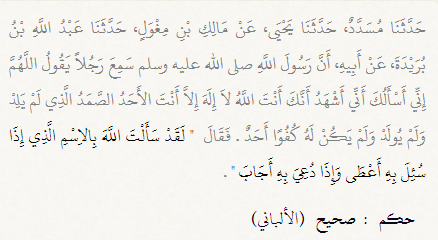
After the Prophet (peace be upon him) heard this, he said: “I swear by Him in whose hand is my soul, this man has beseeched Allah with His greatest name, which if anyone supplicates with it, that supplication will be accepted, and if anyone asks by it, it will be granted.”
This hadith is related in Musnad Ahmad (21873), Sunan ai-Tirmidhi (3475), Sunan Abi Ddwud (1493), Sunan Ibn Mdjah (3857), Sahib Ibn Hibbdn (892) and Mustadrak al-Hakim (1/504), among other works, with a good chain of transmission.
This hadith is not only evidence for there being a greatest name, but also for its being one of the following: either Allah, or the One (al-Ahad), or the Self-Subsisting (al-Samad). There is another hadith related by Anas that a man offered the following supplication: “O Allah! I beseech You by affirming that Yours is the praise, there is no god besides You, the Bestower, Originator of the Heavens and the Earth, the Lord of Bounty and Honor, the Living, the Self-Subsisting.”

To this, the Prophet said: “I swear by Him in whose hand is my soul, this man has beseeched Allah with His greatest name, which if anyone supplicates with it, that supplication will be accepted, and if anyone asks by it, it will be granted.”
This hadith is related in Musnad Ahmad (12150, 13081), Sunan al-Tirmidhi (3544), Sunan Abi Ddwiid (1495), Sunan al-Nasd’i (1300), Sunan Ibn Mqjah (3858), Sahih Ibn Hibbdn (893) and Mustadrak al-Hakim (1/503-504). However, the previous hadith has the stronger chain of transmission. There are also other hadith that refer to Allah having a greatest name.
The question remains as to which is the greatest name. Is it one particular name? Is it the name Allah itself? This is the view of a number of scholars, since all the other names are referred back to it. He is Allah the Creator, Allah the Sustainer, Allah the Giver of Life, Allah the All-Knowing, Allah the All-Hearing, Allah the All-Seeing, and so forth. It is also the name which, in itself, expresses the meaning of divinity. Or is it the Living (al-Hayy) or the Self-Subsisting (al-Qayyiim) as other scholars have opined?
What appears to be the soundest view to me is to beseech Allah with the phrases expressed in both hadith together – notwithstanding the fact that the first of these two hadith is the strongest in its chain of transmission. This means that we would say: “the One, the Self-Subsisting, who begets not and is not begotten, and who no one else resembles in any way” as well as: “the Bestower, Originator of the Heavens and the Earth, the Lord of Bounty and Honor, the Living, the Self-Subsisting.” In this way, we are certain to have encompassed all the possibilities mentioned in the two haclith.
Some scholars have expressed the view that Allah’s greatest name can actually be any of Allah’s names, as long as the supplicant who beseeches Allah with it does so with a heart fully intent upon Allah to the exclusion of any other thought. This view has been attributed to Ja ‘far al-Sadiq, al-Junayd, and others. However, though it is certainly true that our supplications are to more worthy be accepted when our hearts are fully attentive, it is unclear how this could be the definition of the “greatest name” of Allah.
It is significant that Allah’s greatest name has not been explicitly identified to us. It is just like Allah keeping from us the knowledge of exactly which night in Ramadan is Laylah al-Qadr (the Night of Decree). This night is affirmed for us, but the specific day on which it falls is not clear. As a consequence, people are encouraged to expend an extra effort in their worship to make sure they benefit from that night. People, in fact, outdo one another in seeking out the special night. Some increase their portion of worship throughout the month of Ramadan. Some strive on each of the last ten night of the month, or the odd nights from among those ten. Others single out one night – like the twenty-seventh – and expend extra efforts in their worship on that night hoping for it to be the special one.
Another example of this kind is the hour on Friday when supplications are accepted. And the same can be said for Allah’s greatest name. We can reasonably conclude that there is a name of Allah – this “greatest name” – which has certain special distinctions. Among these distinctions are that whoever beseeches Allah with the name will have that prayer answered and whoever asks Allah with that name will have the petition granted. This name is to be found in the following statement: “O Allah, I beseech You by affirming that You are Allah, there is no god besides You, the One, the Self-Subsisting, who begets not and is not begotten, and who no one else resembles in any way, the Bestower, the Originator of the Heavens and the Earth, the Lord of Bounty and Honor, the Living, the Self-Subsisting.”
If we beseech Allah with this comprehensive supplication which brings together what is mentioned in the texts, we will have thereby beseeched Him with His greatest name. This is especially true if we do so with a sincere heart devoted to our Lord. I have seen many women and men who, when hardship and distress have befallen them – whether in their personal lives, their communities or their countries – have found peace, succor and communion with their Lord through invoking His greatest name, though they acknowledge that Allah alone knows exactly which of His names that is.
This probably does not apply to those who invoke Allah’s greatest name with a distracted heart, and Allah knows best. Someone might utter Allah’s greatest name without any presence of mind. Such a supplicant cannot be assured of being entitled to the promise of an accepted supplication, when that supplication does not come from the heart.
Allah says: “Now, if they embark on a boat, they call on Allah, making their devotion sincerely (and exclusively) to Him; but when He has delivered them safely to (dry) land, behold, they give a share (of their worship to others)!” [Surah al- ‘Ankabut. 65]
This verse speaks about people who were polytheist. Nevertheless, when they were tossed helplessly in a storm at sea and turned to Allah alone in supplication with true humility, Allah answered their prayers and saved them. When we turn to our Lord, we must do so with our hearts as well as with our words and deeds. We must do so in a state of true humility and feel how much we truly need Allah.
The Name “Allah”
“Allah” is the name that the Qur’an and Sunnah most frequently mention when referring to the Lord of the Worlds, the Creator of the Heavens and the Earth. Many scholars assert that it is the greatest of all His names. “Allah” is the name most often used by Muslims to refer to God, regardless of their native languages.
“Allah” is a special word. It indicates the only being in existence who truly possesses the qualities of divinity and lordship. This name belongs to Him alone. No one else shares it. It can never be used as a name for anyone else. No one else can claim it for himself.
“Allah” is the proper name of the only one who is worthy of worship, the one whom all creation praises and glorifies. Everything on land or sea – indeed everything in the seven heavens and the seven earths – glorifies Him. The day and night praise Him.
Allah says: “The seven heavens and the Earth, and all beings therein, extol His glory: there is not a thing but celebrates His praise; but you do not understand how they praise Him! Verily He is Oft-Forbearing, Most Forgiving! ” [Surah al-Isrd: 44]
“Allah” is comprised of letters and sounds that are easy for everyone to pronounce. They are an “l” an “h” and the vowel sound “aa”. A baby would have no problem with these sounds, regardless of what his native language might be. Even a person suffering from impaired speech could manage to say it.
This wonderful name belongs to God, as do all of His other lofty names and attributes. But what, specifically, does the name “Allah” mean? Allah is the one and only Lord, whom the hearts and souls reverence and long for. All creation depends on Him at every moment. He is the Creator, the Sustainer upon which everything and everyone depends.
All creatures, without exception, sense that Allah is the one who provides for them and their needs, and He is the one from whom all blessings emanate. They all have a sense of His greatness, generosity, and beneficence. This is why it suits the human heart to glorify Him and proclaim His greatness.
Among the meanings of “Allah” is: The God who is reverenced and longed for by the hearts. Allah says: “O you who believe! Whoever from among you turns back from his religion, then Allah will bring a people whom He loves as they love Him.” [Surah al-Md’idah: 54] Allah loves His worshippers who love and obey Him; who adhere to His commandments and His Law. They love Him.
The Prophet (peace be upon him) taught us that the love of Allah is the highest level of faith a believer can attain. He said: “”If anyone possesses three qualities, he will experience the sweetness of faith: The first is that Allah and His Messenger are dearer to him than anything else. The second is to love another person only for Allah’s sake. The third is to hate falling into unbelief as much as one would hate being thrown into the fire.” [Sahih al-Bukhari (16) and Sahih Muslim (43)]
We see that the Prophet made the sweetness of faith depend upon three things, all of which relate to love: to love Allah, to love for His sake, and finally to hate unbelief which is none other than the rejection of Allah and His blessings.
Love is an emotion. It is something that must be genuinely experienced by the heart. A believer loves the Lord and desires that the Lord returns this love. The one whom Allah loves has no reason to fear, and the world will be an abode of contentment and virtue. Death and what comes after it will be better by far. When Allah loves a believer, He raises that person’s status in Paradise and brings that person near to Him.
Another meaning of the name “Allah” is “the one who is of the utmost greatness in His names and attributes, and in His grandeur”. Our minds cannot grasp the extent of Allah’s greatness, nor can our imaginations. Therefore, our minds attest to our inability to contain the essence and nature of Allah within the limits of human reason.
Allah is the First who was never preceded by nonexistence. He is the Last who will never come to an end. He is the Manifest, and nothing is above Him. He is the Hidden, and nothing is below Him. There are aspects to His limitless majesty and perfection that we cannot even begin to conceive of. At the same time, our minds can apprehend something of His grandeur, because Allah has blessed us with that gift. We can, therefore, draw near to Him and worship Him as best we can. Allah is the name of the one true God, the one whom the believers worship with full sincerity and devotion, giving their hearts and their worship to no other.
Allah tells us: “Say: Truly, my worship, my sacrifice, my living and my dying are for Allah, Lord of the Worlds. He has no partner. This I am commanded, and I am first of those who surrender (unto Him).” [Surah al-An’dnr. 162-163]
The statement by which a person enters into Islam is “There is no God but Allah.” By making this declaration, we profess Allah’s lordship over all creation as well as His exclusive right to be worshipped. We then turn all of our strengths – those of the mind, the heart, and the body – to glorifying and praising Him.
Our bodies, and the atoms that make them up, already glorify their Creator, whether we acknowledge it or not. However, we are given the choice when it comes to our minds, our hearts, and our deeds. We can willingly turn to Allah and embrace the message He sent to us with His messenger, or we can remain heedless.
We as human beings are blessed with a natural inclination to recognize our Creator and worship Him. We instinctively feel the need to do so. Therefore, when we worship our Lord, we are in harmony with our own nature and with the rest of creation.
As for someone who worships something other than the Creator, that person is taken by the tides of worldly existence and his soul is torn by it. In ancient times, polytheism was generally expressed through the worship of stones and trees. The hearts and passions of the people would turn to these inert substances with their problems and hopes. This can still be seen openly today in some remote places. Indeed, it is amazing to find an educated person, a professor of microbiology or astronomy, or someone of great intellectual probity in other aspects of life, bowing his or her head to some stone statue of human manufacture, where written at its base we read: “made in 1910”!
This is just one extreme expression of devotion that people can be subject to if they neglect the worship of Allah. There are many other ways people can succumb to the world if their hearts are not devoted to the Creator. Some people fall victim to their personal desires. Some are beguiled by self-love. Some give themselves over to material wealth and become slaves to the almighty dollar. Some devote everything to their occupations or the pursuit of social status. Others revere those who wield political power.
There are many forms of devotion by which people lose themselves and stray from the guidance of Allah. All of these lead to anxiety, stress, and dissatisfaction with life. Allah says: “Allah puts forth a parable: a man belonging to many partners at variance with each other, and another man belonging entirely to one master: are those two equal in comparison? Praise be to Allah! But most of them have no knowledge.” [Surah al-Zumar. 29]
Today, we even find something called “Satan worship”, with adherents primarily in Europe, America, and other western countries. They have their own symbols, rites and rituals to unite them, and they build their religious beliefs and practices upon selfishness and carnal desire to the exclusion of everything else. These ideas have even penetrated into the Muslim world, capturing the imaginations of some adolescents who get together and toy with satanic rites and symbols. Allah tells us: “Did I not enjoin on you, 0 you Children of Adam, that you should not worship Satan; for he is to you an avowed enemy? And that you should worship Me? That is the right path.” [Surah YdSzn: 60-61]
1. The Beneficent, the Merciful
(al-Rahman, al-Rahim)

Allah is referred to as “the Beneficent” fifty-seven times in the Qur’an. We read, for instance: “And your God is One God; there is no god save Him, the Beneficent, the Merciful.” [Surah al-Baqarah: 163] And: “The Beneficent is established on the Throne.” [Surah TaHa: 5]
As for “The Merciful”, the Qur’an refers to Allah by this name 114 times. For instance: “For Allah is to all people Compassionate, Most Merciful.” [Surah al-Baqarah: 143]
And: “Whoever repents after his wrongdoing and makes amends, then surely Allah will relent towards him; surely Allah is Forgiving, Merciful.” [Surah al-Md’idah: 39]
The attribute of mercy – which both of these names are derived from – is one of our Lord’s greatest attributes. A believer meets a fellow believer with the greeting: “May peace be upon you and the mercy of Allah.” We say: “Praise be to Allah who has prescribed mercy upon Himself’ and: “Praise be to Allah whose mercy takes precedence over His wrath” and: “Praise be to Allah whose mercy encompasses all things.”
Allah is described as having the attribute of “mercy” in the Qur’an over 160 times. I have given some thought to how Allah’s mercy appears in the chapter of the Qur’an entitled Mary. It opens with the verse: “(This is) a recital of the mercy of your Lord to His servant Zechariah.” [Surah Maryam: 2]
Here we have mention of Allah’s mercy to one of his most honored devotees, Zechariah, who beseeched his Lord to bless him with a child in his old age. This shows us how close Allah’s mercy is to those who worship and beseech Him with sincere devotion and humility.
In the middle of the same chapter, we find an account of Abraham’s story. At one point, Abraham says to his father: “O my father! Do not serve Satan. Surely Satan is disobedient to the Beneficent.” [Surah Maryam: 44)
Abraham’s words show us the extreme ignorance that it takes to flagrantly deny Allah and disobey Him. Allah, the Beneficent and Merciful, truly deserves our obedience. We should thank Him, not deny His favor. We should cherish Him in our thoughts and never forget Him. We should respond to His goodness and His favor with our gratitude and devotion.
Abraham then says: “O my father! I fear lest a punishment overtakes you from the Beneficent, so that you become a comrade of Satan.” [Surah Maryam: 45] Here Abraham warns against the punishment that awaits those who disobey Allah and who spurn His guidance and His way. By referring to it as being “a punishment from the Beneficent”, Abraham is emphasizing how base and offensive it is to reject faith in Allah, so much so that in their rejection and unbelief they become deserving of Allah’s punishment in spite of His infinite mercy.
This chapter of the Qur’an comes to its conclusion with the verse: “Indeed, those who believe and do good deeds, the Beneficent will bestow love upon them.” [Surah Maryam: 96] This verse relates to us a meaning of great significance. Allah blesses those who believe and do good deeds with the gift of love. He loves them and they love Him. He then spreads their love throughout the Earth, so they feel love for each other. In this regard, the Prophet (peace be upon him) said:
If Allah loves someone, He summons Gabriel and says: “I love that person.” Then Gabriel also loves that person and calls out to the heavens: “Indeed Allah loves this person.” Then the denizens of Heaven also love that person. Thereafter it is manifested as acceptance on the Earth. [Sahih’ al-Bukhari (3209) and Sahih Muslim (2637)] These are some of the significant meanings that should enrich a Muslim’s faith and practice from contemplating on Allah’s mercy. “My mercy encompasses all things; so I will ordain it for those who guard (against evil).”
2. The King (al-Malik)

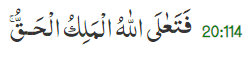
Allah is referred to as “King” five times in the Qur’an, including: “He is Allah, besides Whom there is no god; the King … ” [Surah al-Hashr. 23]
“So exalted be Allah, the True King!” [Surah TaHa: 114]
” … the King of humanity, the God of humanity.” [Surah al-Nds: 2-3]
“Lo! The righteous will dwell among gardens and rivers, in the seat of honor with a Mighty King.” [Surah alQamar. 54-55]
In Arabic, the word for “owner” (malik) is closely related to the word “king” (malik), the only difference being that “owner” is pronounced with an added stress on the letter a. Allah is referred to by this related name “Owner” in other verses, including:
“Owner of Judgment Day.” [Surah al-Fdtihah: 4]
(Indeed, in some modes of reciting the Qur’an, the word is pronounced with an unstressed a so the verse reads: “King of Judgment Day.”)
We also have: “Say: O Allah! Owner of Sovereignty!” [Surah Ai ‘Imrdn: 26]
Allah is “the Owner of Sovereignty”. Indeed, he is the King of Kings, since the lives and destinies of all earthly kings are in His hands. It is as Allah says: “Blessed is He for whom sovereignty is in His hand.” [Surah al-Mulk: 1] And thus He is the “True King” who has “sovereignty of the heavens and the Earth”.
Allah’s sovereignty is absolute. It has no limit. “Human beings can be described as possessing “sovereignty”, but theirs is transient and it is limited in scope. We say that someone is king of a particular country. We likewise say that someone is the owner of a field or a vehicle. These types of sovereignty and ownership are limited in their timeframe – the duration of a person’s lifetime at most, often less – as well as in the extent of what is being possessed or being ruled.
All over the world, we can see artifacts and monuments left behind by past civilizations: mighty castles, great estates, the ruins of Egypt, Greece and Rome. They attest to those who once possessed great power but then passed on intoannalsthe of history. They held sway for a period of time over a part of the globe. Then Allah decreed that their rule would come to an end. Thus it becomes clear to us that true sovereignty belongs to Allah alone, whereas human sovereignty is fleeting and capricious, restricted and incomplete.
Ahmad Zaky has written a series of moving articles entitled Civilizations which Have Come and Gone. How true this title is. Tell me: Who has ever possessed the entire world? People talk about prominent figures like Pharaoh, Nimrod, and Alexander the Great, but none of them were able to take possession of the whole world, or bring all of humanity under their sway. All who rule do so over a limited domain for a limited time. Allah has made it the norm throughout the ages that nations, kings, and powers contended with one another. He says: “And if not Allah did not check one set of people by means of another, the Earth would indeed be full of mischief: But Allah is full of bounty to all the worlds.” [Surah al-Baqarah: 251] No human being has ever possessed the whole of the Earth or has been able to govern all of its affairs. Consider, then, how small a part the Earth is of Allah’s vast universe.
Allah, indeed, is the True King in every way. He gives to His servants when they beseech Him, and Prophet Muhammad (peace be upon him) informs us that in Paradise, Allah will bestow “what no eye has yet seen, no ear ever heard, and no mind ever imagined.” [Sahih al-Bukhari (3244) and Sahih Muslim (2824)]
Moreover, Allah says: “And no soul knows what delights of the eye have been kept hidden in store from them as a reward for what they used to do.” [Surah al-Sqjdah: 17]
The people with the least reward in Paradise will abide for eternity in palatial splendor, dwelling in beauty and delight beyond all imagination. The lowliest denizen of Paradise will have what is equal to all the world and ten times more.” [Sahih’ al-Bukhari (7437) and Sahih’ Muslim (182, 187)]
The Prophet (peace be upon him) said: “The inhabitants of Paradise look up at inhabitants of the levels above them the way they would look upon a twinkling planet moving from East to West across the sky. This is the disparity between them.” When the people heard this, they asked: “Messenger of Allah, are those higher levels the levels of the Prophets, not to be attained by anyone else?”
He replied: “Indeed not. I swear by Him in whose hand is my soul, they are just people who believed in Allah and believed the Messengers.” [Sahih’ al-Bukhari (3256) and Sahih Muslim (2831)]
These are but a few of Allah’s bounties that He will bestow upon some of His worshipers. How much more glorious must Firdaws be, for it is the highest domain of Paradise, directly below the Throne of the Beneficent.
Allah gives and bestows without measure, and the bounty He gives to His servants does not decrease what He possesses in the least. The Prophet (peace be upon him) relates to us that Allah says:
- My servants! If the first of you and the last of you, human of you and jinn of you, were as the most God-fearing heart of any single man among you, this would not increase My dominion in the least.
- My servants! If the first of you and the last of you, human of you and jinn of you, were as the most sinful heart of any single man among you, this would not decrease My dominion in the least.
- My servants! If the first of you and the last of you, human of you and jinn of you, were to stand as one and ask of Me and I were to give each person what he asked for, it would not diminish what I have, any more than the ocean would be diminished if a needle were dipped into it. [Sahih’ Muslim (2577)]
Also, Allah tells us in the Qur’an: “Say: 0 Allah! Owner of Sovereignty! You give sovereignty unto whom You will, and You snatch sovereignty from whom You will. You exalt whom You will, and You abase whom You will. In Your hand is the good. Lo! You are able to do all things. You cause the night to pass into the day, and You cause the day to pass into the night. And You bring forth the living from the dead, and You bring forth the dead from the living. And You give sustenance to whom You choose, without measure.” [Surah AI ‘Imran: 26-27]
Consider the choice of word “snatch” here. This is because when a human being possesses something of value, he or she is very reluctant to part with it. It is not parted with easily.
We as human beings may comb the Earth for our sustenance. We might work to our utmost strength, producing, stretching our creativity and intellectual abilities to the limit. Nevertheless, we will forever be the subjects of our Lord, mere possessions of the one who created us. We should know that this servitude to our Creator is the greatest station of liberty there is, for the servant of Allah acts from free conviction and free desire.
Our belief that Allah is King benefits us. It increases our desire to turn to Allah and seek from His bounty. We increase our supplications to the one whom we know is the true Owner of all things. This belief also frees us from the thrall of what we see other people possessing. We do not debase ourselves before those people or compromise our human dignity in hopes of their favor. Instead, we apply our God-given talents to aspire to be the best we can be, placing our reliance and trust in Allah alone.
3. The Holy One (al-Quddus)


“All that is in the heavens and all that is in the earth glorifies Allah, the King, the Holy One, the Mighty, the Wise.” [Surah al- Jumu’ah: 1]
“He is Allah, besides Whom there is no god; the King, the Holy One … ” [Surah al-Hashr. 23]
Prophet Muhammad (peace be upon him) used to say while bowing and prostrating in prayer: “Most Glorified, Most Holy, Lord of the angels and the Spirit.” [Sahih Muslim (487)]
The Prophet (peace be upon him) used to glorify Allah in a number of ways. When he concluded his Witr prayer, he would repeat three times: “Glory be to the King, the Holy One,” raising his voice the third time he said it. [Sunan Abi Dawud (1430) and Sunan al-Nasa’i(1699, 1732)]
The Meaning of “Holy”:
The Holy One is among Allah’s beautiful names. The Arabic word quddus is derived from a linguistic root which conveys the meaning of “purity”. In the context of being one of Allah’s names, it conveys the meaning of being free from all imperfections, of being transcendent above deficiency, dependency, or any other meaning that does not suit His divine perfection. Among such unsuitable meanings are the notions that Allah could have a child, a companion, or a partner kind of any.
Some meanings are imperfections if considered in the context of divinity, though they would be considered part of what it means for a human being to be complete. Take the concept of “sleep” for instance. This is a characteristic of created beings, and for them it is an aspect of their wholeness and health. Imagine the state of a person suffering from insomnia. Such a person will seek medical treatment to be cured of that illness. At the same time, sleep would be a deficiency if attributed to Allah, for Allah does not need to sleep.
Another meaning of “the Holy One” is that Allah is characterized by attributes of perfection, for indeed Allah’s attributes do not resemble those of created beings in any way. Allah is the one whom we glorify. When we say: “Glory be to Allah”, we are asserting Allah’s transcendence above every deficiency and dependency while affirming for Him every attribute of perfection and beauty.
Another meaning of “the Holy One” is that Allah is the possessor of blessings and munificence. It may be from this connotation that the word conveys the meaning of “that which is sanctified and blessed”.
Allah talks about the Holy Land: “O my people! Go into the holy land which Allah has ordained for you.” [Surah al-Ma’idah: 21] Here He means the land which is blessed because He has bestowed His blessings upon that land and its vicinity. For He says: “Glory be to (Allah) Who took His servant for a journey by night from the Sacred Mosque to the Farthest Mosque, whose precincts We did bless.” [Surah al-Isra’: 1]
Allah is the possessor of all blessings: “Blessed is He for whom sovereignty is in His hand.” [Surah al-Mulk: 1] and “Blessed is He who revealed the Criterion unto His servant” [Surah al-Furqan: 1]
All blessings emanate from Him and all blessedness returns to Him. He blesses the good deeds of His worshippers and the time that they spend performing those deeds. He bestows blessings as He pleases. No constraints can be placed upon His blessings, by which we mean all that is good.
Blessings can manifest themselves in many ways. We are blessed in our sustenance when Allah makes a meager portion yield great benefit. Allah blesses us in our lifespans by making it easy for us to perform righteous deeds and achieve great things we might never have thought we would be able to accomplish. He blesses us in our wealth by making a little bit of wealth grow and bear fruits that are spent to achieve many good things.
By contrast, Allah can strip someone of blessings, so that in spite of possessing ample wealth, a long life and many opportunities, that person sees no benefit. When Allah blesses a person’s wealth, work, knowledge, or lifespan, it will be more fruitful and it will yield forth greater and more blessed results.
Another meaning of “the Holy One” is that Allah is sanctified in the hearts and minds of His creatures, including human beings and angels. Indeed, Allah extols His own sanctity and transcendence in numerous places in the Qur’an.
4. The Source of Peace (al-Salam)


Al-Salam (Peace) is one of Allah’s names. Allah says: “He is Allah, besides whom there is no God, the King, the Holy One, the Source of Peace, the Giver of Security … ” [Surah al-Hashr. 23]
Allah is the bringer of peace who spreads peace throughout creation. Since life was first created, it has been predominated by long stretches of calm, security, tranquility, and contentment. Allah is Peace and from Him emanates all peace. It is as the Prophet (peace be upon him) said: “O Allah! You are Peace and from You is peace. Blessed be You, O Lord of Bounty and Honor.” [Sahih Muslim (591)]
It is astonishing that some people who invoke Allah by this noble name live their lives in a state of hostility with the world. Their lives are full of discontent. They are strife-ridden within themselves, in their outward behavior, in their thinking, and with their families. How can such people find peace with their Lord?
Al-Salam as “Soundness”:
The name al-Salam also connotes “soundness”, the idea of being free from blemish. It conveys that meaning that Allah is free from every shortcoming and deficiency, like fatigue, sleep, sickness, or death. Allah’s existence is one of absolute perfection. He says: “Allah, there is no God but He, the Living and Self-Sustaining. Neither slumber nor sleep overtakes him.” [Surah al-Baqarah: 255]
Allah is free from anything that would contradict with his absolute self-sufficiency. Nothing can fatigue Him or elude Him. Nothing is beyond his reach.
The People of the Scripture attribute such a deficiency to Him when they claim that He rested on the seventh day, after creating the heavens and the Earth. This is why Allah says: “Indeed We created the heavens and Earth and everything between them in six days, and We were not touched by any fatigue.” [Surah Qaf. 38] If Allah wills anything to happen, He just says “Be!” – and it is. [Surah YaSin: 28]
This same connotation of the name al-Salam applies to Allah’s knowledge. Allah is free from ignorance, doubt, and indecision. Nothing is hidden from Him. His knowledge is not acquired through learning. It is absolute, complete, and entirely accurate, comprehending everything in the past, present, and future without exception.
“Do you not see that Allah knows all that is in the heavens and on Earth? There is not a secret consultation between three, but He makes the fourth among them, – nor between five but He makes the sixth,- nor between fewer nor more, but He is with them, wheresoever they be.” [al-Mujadilah: 7]
“It is the same (to Him) whether any of you conceals his speech or declares it openly; whether he lurks by night or walks forth freely by day.” [Surah al-Ra’d: 10] Likewise, His speech is free from all falsehood and injustice. Allah says: “Perfected is the Word of your Lord in truth and justice.” [Surah al-An’aam: 115]
His pronouncements are true and His decree is just. His Law and every expression of His will are perfect. Allah’s Law is full of wisdom and knowledge, as is the Qur’an which He revealed to His Prophet (peace be upon him). The Qur’an is rich in meaning, multilayered, guiding humanity in every way to what assures their welfare in this world and the next. It is unfortunate that so many people who read the Qur’an are content to neglect this richness and blindly follow traditional assumptions and rote knowledge. They have become incapable of creative thinking and renewal, and as a consequence wallow in the backwardness, ignorance, and cultural decline that we witness today.
Allah is free from having any contender, rival, or partner in His dominion. He alone holds sovereignty over creation, both in this world and the next. His decree and His command are free from tyranny or injustice. The Prophet (peace be upon him) relates to us that Allah says: “O my servants! I have forbidden Myself to act unjustly and have made it forbidden for you among yourselves, so do not oppress one another.” [Sahih Muslim (2577)]
From the perfection of Allah’s justice, He forbids Himself to ever act unjustly and prohibits us to oppress one another. He says: “And your Lord is not in the least unjust to His servants.” [Surah Fussilat. 46]
Allah commands us to cultivate the quality of justice within ourselves and never act unjustly towards other people. By acting justly, we are engaged in an act of devotion to our Lord, since Allah is not only just, but He loves justice and those who act justly. In the same way, He is All-Knowing and loves knowledge and those who possess knowledge. He is beautiful. He loves beauty and those who cultivate beauty within themselves. He is generous, and He loves generosity and charitable people. These are all among the attributes of our Lord.
This connotation of soundness – freedom from blemish – extends to His actions: to what He gives and to what He withholds. When Allah keeps something from us, it is not out of stinginess or scarcity. Glory be to Allah above that! It is from His infinite wisdom that He withholds certain things from his servants. Some people are better off wealthy while others are better off poor. “Allah enlarges the livelihood of whom He will, and straitens (it for whom He will); and they rejoice in the life of the world, whereas the life of the world is but brief comfort as compared with the Hereafter.” [Surah al-Ra ‘d:26] Likewise, some people benefit more by being healthy while others benefit more from experiencing illness. Allah knows what each of us needs and what is ultimately in our best interests.
All of Allah’s attributes share in this perfection, this freedom from deficiency. Allah’s attributes do not resemble those of created things. He is incomparable. It is from Allah’s wisdom that we, as created beings, are subject to the limitations and shortcomings inherent to our nature and that we suffer the tribulations of living in the world. Allah on the other hand is al-Salam, the one who is free from all shortcomings.
Allah’s name al-Salam is truly great in its meaning in that it articulates the perfection that all of Allah’s names possess. Each and every one of Allah’s attributes is free from shortcomings. When we greet each other with peace by saying: “Assalamu ‘alaykum”, we are invoking this name of Allah, and in doing so, we are communicating this connotation of Allah’s perfection as well as the idea of peace.
And indeed Allah has made “peace” the salutation of the believers: “Their salutation on the Day they meet Him will be ‘Peace!'” [Surah al-Ahzab: 44] He has commanded us to use this salutation: “So when you enter houses, greet yourselves with a salutation from Allah.” [Surah al-Nur. 61] Therefore, a believer invokes peace upon himself and upon others with this salutation.
Allah is the Bestower of Peace:
Indeed, Allah greets his creatures in this world with the salutation of peace. “Peace be upon Noah in all the worlds.” [Surah al-Saffath. 79] “Peace be upon Abraham.” [Surah al-Saffath. 109] “Peace be upon Moses and Aaron.” [Surah al-Saffath. 120] “Peace be upon Elias.” [Surah al-Saffath. 130] “Peace be upon the Messengers.” [Surah al-Saffath. 181] “Say: Praise be to Allah, and peace be upon the servants He has chosen.” [Surah al-Saffath: 59] “Peace be upon those who follow guidance.” [Surah TaHa: 47]
Allah’s salutation upon His servants is His decree that they will be safeguarded in this world and the next. Though they are subject to the trials and tribulations that others experience in the world, Allah bestows upon their hearts contentment and certainty of faith which transforms their difficulties into a boon and a rewarding experience. Their hearts are contented. They are at peace with whatever Allah decrees for them.
The eminent Companion Sa ‘d b. AbI Waqqas was blessed in that his prayers were always answered. When he became blind, people would ask him: “Why don’t you beseech Allah to restore your sight?” He would reply: “By Allah! My being content with Allah’s degree is dearer to me than what else I desire.” Allah! You are Peace and from You is peace. Blessed be You, O Lord of Bounty and Honor.
5. The Giver of Security (al-Mu’min)

We find this name of Allah in the verse: “Allah says: “He is Allah, besides whom there is no God, the King, the Holy One, the Source of Peace, Giverthe of Security… ” [Surah al-Hashr. 23] This name has various shades of meaning.
The Fulfiller of Promises:
One of the meanings of this name is: “the True One who always fulfills His promise.” “Indeed, Allah never breaks His promise.” [Surah Al ‘Imrdn: 9]
Allah provides His servants with their sustenance and wellbeing in this world. He forgives them of their sins, and in the Hereafter, He rewards them for their good deeds.
He is also the one who fulfills the good expectations that His servants have of Him. He does not disappoint them. The Prophet (peace be upon him) relates that Allah says: “I am as my servant thinks of Me. So think of Me as you will.” [Sahih al-Bukhari (7405) and Sahih Muslim (2675)]
Allah guarantees His servants they that will face no injustice or wrong in the Hereafter. Allah says: “On this Day, every soul shall be rewarded for what it has earned; no injustice (shall be done) this Day. Surely Allah is quick in reckoning.” [Surah Ghafir. 17]
“Then, on that Day,· no soul will be wronged in the least, and you shall be repaid naught but the merit of your past deeds.” [Surah YaSin: 54]
In the Sunnah, we read the story of the man who said: “My Lord! Will You grant me protection from injustice?” He replied: “But of course.”
The man said: “I permit nothing for myself except a witness from myself.”
He said: “Suffice yourself as a witness upon you today, and the noble recording angels as witnesses.” [Sahih Muslim (2969)]
Allah protects those who are oppressed from their oppressors. He also grants the oppressors timer to undo their wrongs, (Sahih al-Bukhari (4686)
Allah grants security to the oppressed. He protects them, supports them, and gives them sanctuary. Allah says: “Say: In whose hand is the dominion over all things – who gives protection, while against Him there is no protection – if you have knowledge?” [Surah al-Mu ‘minzn: 88]
The Giver of Security:
Another meaning of the name al-Mu’min is “the one who bestows security upon His servants.” Allah says: “(He it is) who provides them with food against hunger, and with security against fear” [Surah Qurqysh: 4]
Allah bestows the blessing of security upon His servants in so many ways. He promises the believers who fear Him that He will exchange their fear for security: “He will change (their state), after fear, to one of security and peace.” [Surah al-Nur. 55]
Allah will do the same for the believers in the Hereafter. He will placate their fears with His bountiful rewards and with His mercy. They will enjoy Paradise with their hearts at peace. Allah says about them: “They will say: Lo! Of old, among our people, we were ever fearful; but Allah has bestowed favor on us, and has delivered us from the punishment of the scorching wind … ” [Surah al-Tur. 26-27]
He also says about the denizens of Paradise: “Enter the Garden; you shall have no fear, nor shall you grieve.” [Surah al A’raaf. 49]
Allah assures us that the denizens of Paradise will experience nothing of fear or grief. They will abide forever in a state of love and good expectations. This is an indication of their worth and their lofty status.
Likewise, Allah describes Mecca as the “Land of Security” due to the special religious observances that are prescribed for it on account of the reverence that is owed to it. The game animals found in its precincts are not to be hunted. Its plants are not to be picked.
Lost valuables which are found there are not to be picked up, except for the sake of the person who is looking for them. In this way, security is extended to every human being, bird, and beast.
The Giver of Faith:
Another meaning of al-Mu’min is “the giver of faith”. Allah sends to us His Messengers and reveals to them His Books. He establishes for us the proof that His Messengers are genuine in what they relate from Him. He teaches us, through them, about His noble names and His attributes of perfection.
6. The Guardian (al-Muhaymin)

We find this name of Allah in the verse: “Allah says: “He is Allah, besides whom there is no God, the King, the Holy One, Peace, the Giver of Security, the Guardian … ” [Surah al-Hashr. 23]
The word muhaymin appears as a description of the Qur’an. Allah describes the Qur’an as “confirming the scripture that came before it and a guardian (muhaymin) over it.” [Surah al-Md’idah: 48]
Ibn ‘Abbas said: “The Qur’an is a guardian over every scripture that came before it.” It is also said that the the Qur’an encompasses the meaning of what is contained in the previous scriptures.
The Watcher, the Protector:
Allah is the Guardian over His creation, watchful of everything that takes place therein. He says: “And you are not engaged in any affair, nor do you recite concerning it any portion of the Quran, nor do you do any work but We are witnesses over you when you enter into it.” [Surah Yunus-. 61]
Therefore, one connotation of the name al-Muhaymin is that Allah watches over His creatures and is their protector. Another meaning of al-Muahymin is “the one who is responsible for the care of something, the one who has charge over it”.
Allah is above His servants. He is aware of all of their actions, and He has power over all things. He is clement, not hastening on His decree, but at the same time he has full mastery over his creatures. He encompasses them and everything in creation. Everyone and everything is dependent upon Him, while He effortlessly takes care of all affairs. “There is nothing like unto Him, and He is the Seeing, the Hearing.” [Surah al-Shuara. 11] Nothing escapes His power and His decision.
The Giver of Just Recompense:
Another meaning of the name al-Muhaymin is “the one who does not give the obedient servants less than their full reward, nor punishes the sinners with greater than they deserve.” He punishes the sinful only to the extent of their transgressions. He is never unjust to any soul. Rather, He bestows rewards far beyond what we deserve, and pardons most of our sins.
7. The Mighty (al- ‘Aziz)


The name al- ‘Aziz appears seventy-two times in the Qur’an, usually in conjunction with other names of Allah. For example: “the Mighty, the Wise” [Surah al-Baqarah: 129], “the Mighty, the All-Knowing” [Surah al-An’am: 96], “the Mighty, the Lord of Retribution” [Surah Al ‘Imran: 96], “the Mighty, the Forgiving” [Surah Fatir. 28], “the Mighty, the Oft-Forgiving” [Surah Sad: 66], and: “the Mighty, the Praiseworthy” [Surah Ibrahim: 1]
The same pattern of linking the name al- ‘Aziz with other names can be found in numerous hadith. Allah is the possessor of strength who faces no incapacity. Nothing can overpower Him or harm Him. The Prophet (peace be upon him) relates that Allah says: “None of you has the power to bring me any harm or benefit.” [Sahih Muslim (2577)]
The name al- ‘Aziz (the Mighty) is most often coupled with the name al-Hakim (the Wize). This tells us that Allah’s might is not like the might of mortal rulers who abuse their power, misallocate the resources they control, and oppress those who are subject to them.
We also find the name al- ‘Aziz linked with al-Rahim (the Merciful), which teaches us that in spite of the fact that Allah has such power over us, He withholds His wrath, grants us respite so we can make amends, and does not hasten to punish. The name al- ‘Aziz often comes lined with al- ‘Alim (the All-Knowing) to convey the idea of the precision and detail in His works and His proficiency.
It also comes linked with the name al-Hamid (the Praiseworthy), conveying to us that Allah is worthy of praise in the laws He prescribes for us and the matters He ordains for us. Allah’s might transcends and surpasses all might and power. None can aspire to it. Allah says: “All might belongs to Allah.” [Surah Yunus-. 65]
Rather, Allah bestows on created beings whatever power they possess. He gives might in this world to whomever he pleases. “They say: ‘If we return to the city, the mighty will surely drive out the weaker therefrom.’ Nay, to Allah belongs all might, and to His Messenger and to the believers.” [Surah al-Munafiqin: 8]
Whoever aspires to be mighty – whether it be through wealth, lineage, prestige, health, worldly success, or through the attainment of the Hereafter – they should seek it from the true Possessor of Might, the invincible one who is the source of strength and support for all who rely on Him. Whoever seeks out Allah to be their refuge and appeals to Him to fulfill their needs and give them strength, they will find Him to be the Mighty one who grants their requests, safeguard their dignity, and preserve their status. There is no indignity in begging from Allah, whereas begging from others is a shameful act, whether the beggar receives anything or not.
Whoever takes Allah as their source of strength will enjoy strength and might for themselves, though their bodies may be weak, their connections without influence, and their possessions few.
The best way to attain might that is free from all ignominy is to be humble and forgiving to other people, willing to pardon their abuse and their infringements upon your rights. Abu Hurayrah relates that Allah’s Messenger (peace be upon him) said: “Giving in charity never reduced a person’s wealth. Allah makes mighty those who pardon others. Allah raises in status those who show humility.
Finally, by being attentive to the Qur’an by reading it, understanding it, pondering its message, and living according to its dictates, a person can aspire to might and honor. Indeed, the Qur’an is described as al- ‘Aziz:

“Indeed, it is a mighty Book.” [Surah Fussilat. 41]
8. The Compeller (al-Jabbar)

We find this name of Allah in the verse: “Allah says: “He is Allah, besides whom there is no God, the King, the Holy One, Peace, the Giver of Security, the Guardian, the Compeller.” [Surah al-Hashr. 23]
The name also appears quite frequently in the Prophet’s Sunnah. When the name al-Jabbar describes Allah, it is an attribute of praise and glory. By contrast, when the word is used to describe human beings, it is to rebuke and censure them for their pride and self-aggrandizement. For instance: “They said: ‘O Moses! In this land are a domineering people.”‘ [Surah al-Md’idah: 22]
Jesus is quoted in the Qur’an as saying: “(He) has made me kind to my mother, not overbearing or unblessed.” [Surah Maryam: 32]
Allah also says: “Those who dispute about Allah’s revelations without any authority that He has given them; their conduct is hated by Allah and by those who believe. Thus does Allah set a seal over every proud, haughty heart.” [Surah Ghafir. 35]
One of the meanings conveyed by the name al-Jabbar is that Allah’s compels His creatures through His very act of creating them in the manner that He wills them to be. They are compelled to accept the forms, shapes, and essential characteristics that constitute their natural makeup. Likewise, their involuntary actions – like the beating of the heart, the circulation of blood, the firing of nerve cells, and the mysterious workings of the brain – are all compelled by Allah’s power in ways that we can understand and ways that we are not even aware of. There are so many aspects of our lives – like falling asleep, waking up, being alert or absentminded – which are not entirely up to our own decisions. Muhammad b. Ka ‘b observed: “The reason He is called the Compeller is because He compels creation to be as He wishes.”
Another connotation of al-Jabbar is “the one who resets or restores something to its full state”. The root word from which this name is derived can mean “to compel”, but is also used to describe the act of setting a broken bone as well as the act of setting things right in general.
Allah puts our lives in order for us. He provides us with our means of livelihood, relieves our want, and hides our mistakes. He shows mercy for the weak. He compensates the hardships we suffer in life with rewards and blessings from Himself. He consoles our hearts so we can be at peace and more accepting of what befalls us in life.
Likewise, those who worship Allah with piety, devotion, submission, and awe find that Allah sets their hearts right with certainty of faith, humility, and sublime meaning. Prophet Muhammad (peace be upon him) used to beseech Allah between the prostrations of his prayer with the words: “My Lord! Forgive me, have mercy on me, set me right, guide me and provide for me.” [Sunan Abi Ddwiid (850), Sunan al-Tirmidhi (284), and Sunan Ibn Majah (898)]
The name al-Jabbar also connotes that Allah is the Subduer, and all of creation submits to His might, glory, and authority. It conveys the meaning that he is sublime and transcendent above all things. It is an expression of His omnipotent and irresistible power.
Once when Prophet Muhammad (peace be upon him) offered the night prayer, he opened it with the following takbir. “Allah is the Greatest, the Possessor of omnipotent and irresistible power, owner of all dominion, and of all grandeur and might.” [Sunan al-Nasa’i (1069)]
The Prophet (peace be upon him) also used to say while bowing and prostrating in prayer: “Glory be to the Possessor of omnipotent and irresistible power, ownerand of all dominion, of all grandeur and might.” [Sunan Abi Ddwud (873) and Sunan al-Nasa’i (1049)]
In these supplications, the Prophet refers to Allah’s grandeur. Llke the name al-Jabbar, this word is a term of praise only when it is used to refer to Allah. When it is used in the context of created beings, it always comes in thecontext of blame and censure.
This is because it connotes arrogance, being overbearing to others, and forgetting one’s true place. This is why we find in the Qur’an that Moses (peace be upon him) sought refuge with Allah from people who, as a consequence of their arrogance, deny Allah’s reckoning: “Moses said: I seek refuge with Him who is my Lord and your Lord from every arrogant person who denies the day of reckoning.” [Surah Ghafir 27]
We have already seen this condemnation of arrogance in the verse: “Thus does Allah set a seal over every proud, haughty heart.” [Surah Ghafir 35]
Also, Prophet Muhammad (peace be upon him) said: “Heaven and Hell had an argument. The hellfire said: ‘I have been adorned with the prideful and the imperious.”‘ [Sahih’ al-Bukhari (4850) and Sahih Muslim (2846)]
Allah’s creatures need to be humble before their Lord, worshipping Him in submission to His glory. They must proclaim His divinity and willingly obey His commands. This is the secret of faith, true happiness, and salvation. It is the hallmark of God-given success.
9. The Great, the Supreme (al-Kabir, al-Mutakabbir)

We find the name al-Mutakabbir (the Supreme) in the verse: “Allah says: “He is Allah, besides whom there is no God, the King, the Holy One, Peace, the Giver of Security, the Guardian, the Compeller, the Supreme.” [Surah al-Hashr. 23]
We read the following account in the Sunnah of one of Prophet Muhammad’s sermons: The Prophet, while standing at the pulpit, recited the verse: “No just estimate have they made of Allah, such as is due to Him. The whole Earth shall be in His grip on the Day of Resurrection and the heavens rolled up in His right hand. Glory be to Him, and may He be exalted above what they associate with Him.” [Surah al-Zumar. 67]
The he said: “Allah glorifies Himself, saying: ‘I am the Compeller. I am the Supreme. I am the King. I am the Most High.”‘
Allah’s Messenger (peace be upon him) then kept repeating this until the pulpit started to shudder with it. We thought that the pulpit was going to split apart. [Sunan al-Nasa’i al-Kubrd (7696) and Sahih Ibn Hibbdn (7327)]
The name al-Kabir (the Great) appears six times in the Qur’an. For instance, we find: “The Most High, the Great.” [Surah al-Hajj: 62] and: “Indeed Allah is Most High, Great.” [Surah al-Nisa: 34]
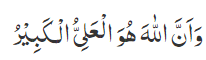
Allah’s greatness encompassed all things. He is great in His essence, His attributes, His names, and His actions. This is why a Muslim proclaims in prayer Allahu Akbari – Allah is the Greatest. Once a desert dweller came to Prophet Muhammad (peace be upon him) and said: “Teach me something that I can recite.”
The Prophet instructed him to say: “There is no God besides Allah alone, without partner. Allah is truly the Greatest and most bountiful is His praise.” [Sahih Muslim (2696)] Allah is the possessor of greatness and grandeur: “His is all grandeur in the heavens and on Earth.” [Surah al-Jathiyah: 37]
Allah is Supreme; transcendent above every limitation and deficiency that is inherent in created beings. He is exalted in glory, the one to whom every overbearing tyrant on Earth must ultimately bow.
Allah alone possesses such greatness. His is the glory. Any created being who presumes to aspire to it is arrogant and blameworthy. Prophet Muhammad (peace be upon him) tells us that Allah says: “Grandeur is my cloak and greatness is my robe. Whoever seeks to rival me in either I shall consign to the Fire.” [Sahih Muslim (2620)]
Allah teaches His devotees to be humble and prohibits them from domineering, tyrannical and aggressive behavior. Allah alone has the divine right to rule over His creation. His alone is all grandeur and greatness. He alone possesses omnipotent and irresistible power. Humanity’s place is one of humble submission. The greatest strength that human beings can attain is to place their reliance in Allah and seek His support. The highest level of greatness they can attain is to show humility to their Lord and defer to His honor.
The transgression people perpetrate against their fellow human beings, the powerful coercing and preying on the weak, occurs at the hands of tyrants whose hearts are bereft of faith. Likewise, those who are downtrodden on Earth, when they lose faith in Allah, willingly submit to the oppression and injustices of their overlords.
The artifacts left behind by the civilizations of the Pharaohs, Caesars, and others like them attest to this fact. This is why Moses (peace be upon him) said: “I seek refuge with Him who is my Lord and your Lord from every arrogant person who denies the day of reckoning.” [Surah Ghafir. 27]
We should consider Prophet Muhammad’s words: “No one shall enter Paradise whose heart contains an atom’s weight of arrogance.” This is a forcefully clear call to be humble and to show respect to others, though they may possess less knowledge, wealth, fame, or prestige. Humility is the opposite of arrogance. Prophet Muhammad was quite willing to roll up his sleeves, put on his boots, and engage in manual work. He did his own chores carried his own provisions. He treated everyone with respect. This is a lesson for in humility all those who profess to follow his example.
10. The Creator ( al-Khaliq)


Allah is the Creator. He is al-Khaliq, al-Khallaq, and he is Ahsan al-Khaliqin – “the best of Creators”. The name al-Khiliq appears in the Qur’an eleven times. For instance: “Allah is the Creator of all things.” [Surah al-Zumar. 62]
Allah also says: “He is Allah the Creator, the Maker, the Fashioner; His are the most excellent names; whatever is in the heavens and the earth declares His glory; and He is the Mighty, the Wise.” [Surah al-Hashr. 24]
The Qur’an refers to Allah as “the best of creators” in two places. The first is: “Then We made the seed a clot, then We made the clot a lump of flesh, then We made (in) the lump of flesh bones, then We clothed the bones with flesh, then We caused it to grow into another creation, so blessed be Allah, the best of the creators.” [Surah al-Mu’minun: 14]
The second place is where Elias exclaims to his people: “What! Do you call upon Ba’al and forsake the best of the creators – Allah, your Lord and Lord of your forefathers?”[Surah saffath. 125-126]
The more emphatic term al-Khallaq appears twice in the Qur’an: “Surely your Lord is the Creator of All Things, the All- Knowing.” [Surah al-Hijr. 86] and: “Is not He Who created the heavens and the Earth able to create the like of them? Yea! And He is the Creator of All Things, the All-Knowing.” [Surah YaSin: 81]
Everything in the universe is Allah’s creation, and it attests by its very existence to its Creator, its Lord and Sustainer. Everything we see around us is proof of Allah’s existence. Allah says: “This is the creation of Allah. Now show me that which those (you worship) beside Him have created. Nay, but the wrong-doers are in manifest error!” [Surah Luqman: 11]
Allah also says: “Say (O Muhammad): Have you considered what you call upon besides Allah? Show me what they have created of the Earth, or have they a share in the heavens? Bring me a book before this or traces of knowledge, if you are truthful.” [Surah al- Ahqaf. 4]
People ask if it is permissible in Arabic to use the word khaliq for human beings when speaking about a human being creating something. If we consider Allah’s statement “blessed be Allah, the best of the creators”, it indicates to us that when the word comes with the meaning of creating from nothingness, the idea of bringing something into existence from non-existence, then it applies to Allah alone. As for created beings, it is possible to refer to them as “creators” using the Arabic word khaliq when we mean by it working on something, crafting it, giving it shape, or some other meaning that is suitable for human beings to ascribe to themselves.
In fact, the Qur’an uses the word in reference to people when it says: “You only worship idols besides Allah and you create a lie.” [Surah al- Ankabtit. 17] This shows that the Arabic word khaliq can be used with reference to human invention and creativity.
Things to Consider:
1. At the time of conception, between five and six hundred million sperm cells pass through the vaginal tract, each of them capable of fertilizing the egg and becoming a human being. But Allah in His wisdom selects one from all of those millions to fertilize the egg, and this one will develop into the fully-formed human being Allah chooses to create, a being that by Allah’s grace possesses the capacity to reason and to dispose of its affairs.
This is how we were all created, so we should feel humility in recognition of the greatness and grandeur of our Lord. We should remember our humble beginnings so we can appreciate the vast difference between that little drop of mixed fluid from which we were conceived and the fully formed human beings we are today. This should compel us to glorify Allah, remain aware of Him at all times, and thank Him.
2. There are over one hundred trillion cells in the human body. Inside each of these cells are organelles, systems, complex processes, and vast stores of information. Each and every detail of the cell glorifies its Lord while carrying out its role in the cell in an exemplary manner.
The nucleus of each cell contains roughly 31 billion nucleotides the four molecular “letters” on the DNA molecule that spell out the genetic traits of the living organism and regulate its functioning. It is this information that an organism inherits from its father and mother.
These vast numbers of molecular “letters” which make up our DNA are duplicated in every one of the hundred trillion cells of our bodies. Each one of these letters attests to the greatness of the one who created them.
3. When we look up at the night sky, we stare off into the vastness of space and the billions of galaxies that are over our heads. Each galaxy is in turn a conglomeration of billions of stars, and these stars are all at various stages in their life-cycles. Some are in the process of being formed. Some are young, some are mature, while others are in the throes of death. Each of these stars glorifies Allah in space which is so immense that it boggles the mind. Allah alone knows the full extent of the universe. If we imagine a spaceship capable of travelling at the speed of light, 186 thousand miles per second, it would take thousands of years for that spaceship to cross a single galaxy, let alone what is beyond it.
Allah says: “But nay! I swear by all that you see, and by all that you do not see.” [Surah al-Hdqqah: 38-39] Allah also says: “Nay, I swear by the places of the stars, and verily that is a tremendous oath, if you but knew.” [Surah al-Waqi’ah: 75-7 6]
People sometimes fancy themselves as being all-important, looking disdainfully from side to side, holding their noses high in the air. But if they would only regard these great and awe-inspiring creations around them, it would give them a sense of humility and they would become humble before their Lord.
A given galaxy might contain from 100 million to a billion stars, and every day scientists are discovering something new about outer space. The means of observation presently available to science are still quite limited. We, as created beings, should see the greatness of Allah in His creation and view ourselves with humility.
The natural world is an open book that extols the praises of Allah. “The seven heavens and the Earth and all that is therein praise Him, and there is not a thing but hymns His praise; but you do not understand their praise.” [Surah al-Isra’: 44]
Allah also says: “Do you not see that all things that are in the heavens and on Earth bow down in worship to Allah – the Sun, the the Moon, stars; the hills, the trees, the animals, and a great number of human beings? But a great number are (also) such as are fit for punishment. And those whom Allah shall disgrace none can raise to honor, for Allah carries out all that He wills.” [Surah al-Hqjj: 18]
All the beauty and splendor of the universe that we can see is but a small glimpse of the Creator’s ingenuity. When a believer reflects on Allah’s creation, it reveals something of the greatness of Allah and His immense wisdom. It brings peace to the believing heart and fortifies a believer’s faith.
Allah says: “Behold! In the creation of the heavens and the Earth, and the alternation of night and day are indeed Signs for people of understanding – those who remember Allah standing and sitting and lying on their sides and reflect on the creation of the heavens and the Earth, saying: Our Lord! You have not created this in vain! Glory be to You. Save us then from the chastisement of the fire:” [Surah Al ‘Imrdn: 190-191]
11. The Maker, the Fashioner (al-Bari’, al-Musawwir)


Allah says: “He is Allah the Creator, the Maker, the Fashioner; His are the most excellent names; whatever is in the heavens and the earth declares His glory; and He is the Mighty, the Wise.” [Surah al-Hashr. 24]
Al-Khaliq (the Creator), al-Bari’ (the Maker), al-Musawwir (the Fashioner) are three of Allah’s name that are mentioned together in this verse. When these three names are mentioned together, each of them conveys a specific meaning. Here, the attribute of creation refers specifically to Allah’s determination of what He creates, so it comes first. The name al-Bari’ (the maker) refers to the creative act of bringing about what Allah wills to create. Finally the name al-Musawwir (the Fashioner) refers to giving each created thing its particular form. So Allah decrees what He creates, brings it into existence, and specifies its particular, unique form.
Allah originates the form of each created thing according to His wisdom, knowledge, and mercy. He gives each thing the form it has without need of a pre-existing model. Allah says: “Indeed, We have created the human being upon the best of forms.” [Surah al-Tin: 4]
Allah also says: “He it is who shapes you in the wombs as He pleases. There is no god but He, the Mighty, the Wise.” [Surah Al ‘Imran: 6] and: “We created you then fashioned you.” [Surah al- A ‘raf. 11]
These three actions – creation, making, and fashioning – manifest themselves in created things sequentially, the last of which is the fashioning of the form, which gradually comes to completion. We can see this in the growth of a plant from a seed and in the growth of an animal from an embryo.
Creation is the most evident proof of Allah’s greatness and divinity. That He confers life, motion and awareness to inert matter is a sign of His lordship and power. These are among the miracles that no one can deny without exhibiting the crassest obstinacy.
12. The Forgiving ( al-Ghafur, al-Ghaffar, al-Ghafir)


These three names refer to Allah’s forgiveness. The name al-Ghafir means the Forgiver, while the names al-Ghafoorr and al-Ghaffar are more emphatic, indicating that Allah is most forgiving, oft-forgiving.
Taken together, these three names occur in the Qur’an ninety-eight times. Allah says: “Announce, (0 Muhammad) to My slaves that verily I am the Forgiving, the Merciful.” [Surah al-Hijr. 49]
“I am Forgiving to those who repent and believe and do good, and afterward follow right guidance.” [Surah TaHa: 82]
In one instance, the Qur’an refers to Allah as being “the best of those who forgive” when relating where Moses offers the following supplication:

“You are our Protector: so forgive us and give us Your mercy; for you are the best of those who forgive.” [Surah al- A ‘raf. 155]
Allah mentions the claim of the Christians who say: “Indeed Allah is one of three.” In the very next verse, Allah says: “Will they not turn to Allah and ask His forgiveness? For Allah is Forgiving, Merciful.” [Surah al-Md’idah: 74]
Allah speaks about those who persecuted the believers of the past, saying: “Surely (as for) those who persecute believing men and women, then do not repent, they shall have the chastisement of Hell, and they shall have the chastisement of burning.” [Surah al-Buruj 10]
As for those who turn to Allah in sincere repentance, Allah will turn to them in forgiveness. Allah calls all the polytheists, sinners, and transgressors to seek His forgiveness and declares to them that the doors to His mercy are wide open: “”O My servants who have transgressed against their souls! Do not despair of Allah’s mercy, for Allah forgives all sins. He is Forgiving, Most Merciful.” [Surah al-Zumar. 53]
This verse affirms for us that Allah forgives all sins, without exception. Allah is willing to forgive even polytheism and unbelief, as long as the perpetrator renounces such falsehoods and sincerely repents.
Allah forgives whom He pleases. Allah makes it clear that His forgiveness is determined by his will. “Allah does not forgive that partners be associated with Him, but He forgives other than that for whomever he pleases.” [Surah al-Nisd’: 48]
This is with respect to those who believe in Allah and adhere to His guidance. If they perpetrate a sin or transgression, whether great or small, Allah has decreed that He can forgive that sin if He pleases or punish its perpetrator as He pleases.
It is affirmed in the Sunnah that Allah calls forth during the last third of the night, saying: “Is there anyone beseeching me, so I can give? Are any seeking my forgiveness, so I can forgive them? Are there any penitent people for me to pardon? Is anyone calling to me so I can answer?” [Sahih al-Bukhari (1145) and Sahih Muslim (758)]
This is an example of Allah’s generosity and boundless favor. Prophet Muhammad (peace be upon him) relates that Allah says: “O child of Adam! However much you beseech Me and place your hopes in Me, I will forgive you without any reservation. 0 child of Adam! If you have sins piling up to the clouds and then ask My forgiveness, I will forgive you without any reservation. O child of Adam! If you come to me with enough mistakes to fill the Earth, and meet Me without associating anything as a partner with Me, I will come to you with enough forgiveness to fill the Earth.” [Sahih Muslim (2687)]
Allah refers to Himself as the Oft-Forgiving because He created us knowing that our natures would make us prone to sin, and that we would seek His forgiveness and He would forgive us.
This is why the Prophet (peace be upon him) said: “I swear by Him in whose hand is my soul, if you did not sin, Allah would take you away and replace you with a people who would sin and then seek Allah’s forgiveness so He could forgive them.” [Sahih Muslim (2687)]
Allah has angels who “never disobey Allah in what He commands them and carry out whatever they are told to do.” [Surah al-Tahrim: 6] They glorify Allah without fail. Some are standing in prayer, some are bowing, and some are in prostration saying: “Glory be to the possessor of the dominion and its possessions! Glory be to the possessor of might and irresistible power. Glory be to the Living One who never dies!”
The Prophet (peace be upon him) said: “I see and hear what you do not. The heavens heaved, and they have a right to do so, since there is not a place the width of a handspan that is not occupied by an angel prostrating his forehead to Allah.” [Sunan al-Tirmidhi (2312) and Sunan Ibn MaJah (4190)]
In spite of all this, Allah in His wisdom wanted to create beings besides the angels, human beings who would need to be guided to the correct path and who were capable of going astray. Allah says: “Lo! We have shown him the way, whether he be grateful or disbelieving.” [Surah al-Insan: 3]
This is the nature upon which Allah created the human being. It is unavoidable that people will err. Therefore Allah has permitted us to ask His forgiveness. Indeed, He exhorts us to do so, and He promises us His forgiveness. We should make it a habit to seek Allah’s forgiveness as often as we can. Constancy in beseeching forgiveness is a cure for the ailments of the heart as well as a means of having our sins erased.
The Noblest Supplication for Seeking Forgiveness:
Prophet Muhammad (peace be upon him) taught his Companions the best supplication for beseeching Allah’s forgiveness. He taught them to say every morning and the evening:
اللَّهُمَّ أَنْتَ رَبِّي، لاَ إِلَهَ إِلاَّ أَنْتَ، خَلَقْتَنِي وَأَنَا عَبْدُكَ، وَأَنَا عَلَى عَهْدِكَ وَوَعْدِكَ مَا اسْتَطَعْتُ، أَعُوذُ بِكَ مِنْ شَرِّ مَا صَنَعْتُ، أَبُوءُ لَكَ بِنِعْمَتِكَ عَلَىَّ وَأَبُوءُ لَكَ بِذَنْبِي، فَاغْفِرْ لِي، فَإِنَّهُ لاَ يَغْفِرُ الذُّنُوبَ إِلاَّ أَنْتَ
“O Allah! You are my Lord. There is no God besides You. You created me, and I am your servant, and I honor Your covenant and Your promise as much as I can. I seek refuge with You from the evil that I do. I come to You by Your grace, and I come to You with my sins. So forgive me, for no one forgives sins but You.” [Sahih al-Bukhari (6306)]
This is the supplication of a believer. It is a supplication of someone who admits to stumbling into error and says: “I honor Your covenant and Your promise as much as I can” and who appeals to the Lord with the words: “I seek refuge with You from the evil that I do. I come to You by Your grace, and I come to You with my sins.”
When we offer this supplication, we profess that our sins are all the more wrong in light of Allah’s blessings and grace that He showers upon us, but alas we have sinned and appeal to Allah in His infinite grace to forgive us. This supplication is rich in meaning. There are so many ways in which it remedies the ills of the hearts of those who utter it.
Consider the words: “You created me, and I am your servant, and I honor Your covenant and Your promise as much as I can.” How honestly can we say these words? Even more, by uttering these words, we are reaffirming that our commitment to fulfill our covenant with our Lord to the best of our abilities. It is also a reminder to us of the covenant that we have with our Creator, which is mentioned in the following verse of the Qur’an:
“And when your Lord brought forth from the children of Adam, from their backs, their descendants, and made them bear witness against their own souls: Am I not your Lord? They said: ‘Yes! We bear witness.’ Lest you should say on the day of resurrection: ‘Surely we were heedless of this.'” [Surah al-A’ref. 172]
We should appeal to Allah with this supplication for forgiveness whenever we commit a sin. We should also offer it every morning and evening, for if we do so, it will bring us a greater assurance that Allah in His grace will forgive us of our mistakes and transgressions. It will also ensure that we cultivate our hearts to be penitent.
How much Allah is willing to forgive us can be seen in the following hadith related in Sahih al-Bukhari and Sahih Muslim Someone committed a sin and then said: “O Allah! Forgive me my sin.” Allah said: “My servant committed a sin, but knew that he has a Lord who forgives sins and punishes sins.” Then he committed the sin again and said: “My Lord! Forgive me my sin.” Allah said: “My servant committed a sin, but knew that he has a Lord who forgives sins and punishes sins.” Then he committed the sin again and said: “My Lord! Forgive me my sin.” Allah said: “My servant committed a sin, but knew that he has a Lord who forgives sins and punishes sins. Do as you will, for I have forgiven you.” [Sahih al-Bukhari (7507) and Sahih Muslim (2758)]
We understand from this hadith that when Allah forgives a sin, it is forgiven. If the person commits the same sin again, Allah will not revoke His forgiveness for the previous time the sin was committed, but will only hold the sinner to account for the present occurrence. Forgiveness is something Allah gives, and He does not revoke what He gives. Once a sin is wiped from our records, it is wiped away for good.
Someone asked me about the hadith: “Committing a sin after repenting of it is worse than committing it seventy times before repenting.” I told him that this hadith is unauthentic. It is not established with a sound chain of transmission back to the Prophet (peace be upon him). Moreover, the Qur’an and authentic Sunnah are quite clear that no matter how often a person commits a sin and repents, Allah will accept that person’s repentance. Whenever someone beseeches Allah’s forgiveness in earnest, Allah will forgive that person’s sins without reservation.
I believe that one of the best ways to win people’s hearts to righteousness is the path of repentance: asking Allah’s forgiveness, making atonement, and compensating for sins by performing good deeds for the benefit of other people. When calling people to return to Islam, it is wise to emphasize Allah’s forgiveness. No one should ever despair, even those who have returned to the same sin and repented for it a hundred times. Instead, they should repent and never weary of seeking forgiveness. Satan would inspire us to despair and give up on forgiveness. We should be even more resolute in asking Allah to forgive us, praying to Him with humility.
Even someone who fails to repent for a particular sin, if that person is someone who is constant in seeking Allah’s forgiveness, is sincere in doing so knowing that Allah is forgiving and merciful, and hopes that Allah will show clemency, then that person has a good chance of being forgiven of the sin he or she forgets to repent for. Allah is most generous. He is the greatest one to ask and the best one to pin our hopes on. Allah says: “Surely, good deeds wipe away evil deeds.” [Surah Hud: 114]
Prophet Muhammad (peace be upon him) has informed us of various kinds of good deeds that can atone for our sins. For instance, Abu Hurayrah relates that the Prophet (peace be upon him) said: A prostitute was forgiven when she passed by a dog near a well. It was panting and dying of thirst. She removed her shoe and tied it to her scarf. Then she drew out some water for it from the well. Allah forgave her for that. [Sahih al-Bukhari-(3321) and Sahih Muslim (2245)]
Abu Hurayrah also relates: The Prophet said: “Once a man was walking and he was extremely thirsty. He descended into a well and drank from it. When he came out, he saw a dog panting and eating mud to relieve its thirst. The man thought to himself: This creature has reached the same state that I was in. So he went down the well again, filled his shoe with water, and gave the dog water to drink. Allah was grateful to him and forgave him.” The people asked: “O Messenger of Allah! Do we receive rewards on account of beasts?” He replied: “There is a reward for being charitable to anything with a living heart.” [Sahih al-Bukhdn- (2363) and Sahih Muslim (2244)]
How much more can we expect the reward to be for helping our fellow human beings! Allah is most gracious and He never lets any of our good deeds come to naught. For this reason, being kind, generous, and magnanimous to others is one of the best ways to seek Allah’s forgiveness.
Indeed, Allah says: “And let not those of you who possess wealth and abundance swear against giving to the near of kin and the poor and those who have had to emigrate for Allah’s sake. They should forgive and forbear. Do you not love that Allah should forgive you? And Allah is Forgiving, Merciful.” [Surah al-Nur. 22]
If we want Allah to forgive us, we should be forgiving of others and willing to overlook their wrongs. This is part of what it means to be good to others. Allah describes his believing servants as “those who restrain their anger and are pardoning towards people.” He then says: “Indeed, Allah loves those who do good.” [Surah Al ‘Imran: 134]
Righteous deeds of all kinds bring us closer to Allah. We should show kindness to all creatures as well as to human beings, whether this kindness comes in the form of our personal behavior, our sharing of our wealth, giving assistance with our abilities and our influence, or praying to Allah on their behalf. We need to especially consider the homeless, the widows and orphans, and the poor.
The Prophet (peace be upon us) said: There was a merchant who used to extend credit to people. If he found one of his customers to be in straightened means, he would say to his assistants: “Forgive them their debt, perhaps Allah will forgive us.” Allah did forgive him. [Sahih al-Bukhari (2078) and Sahih Muslim (1562)]
Pardon, tolerance, and magnanimity should exemplify the way we treat one another. We should be willing to overlook. We should not always demand everything that is due to us. This is how we need to be with everyone we have dealings with. It is the way things should be between the husband and wife, between parents and children, between teachers and students, and between governors and the governed.
Tolerance and magnanimity stabilize interpersonal relationships and bolster the esteem and human worth that people have for one another. By Allah’s grace, these qualities make our dealings more successful, and certainly make our dealings more pleasing to Allah.
Prophet Muhammad (peace be upon him) said: “Once a man was walking down a road when he came upon a branch of thorns in the middle of the way. He moved it to one side and cleared the path, so Allah was grateful to him and forgave him.” [Sahih al-Bukhari (654) and Sahih Muslim (1914)]
Instead of placing obstacles in other people’s paths, why do we not rather make it our business to remove those obstacles and make it easier for them to find happiness in life? We should make this part of our life’s mission.
A young lady once contacted me and complained about all the difficulties and tribulations she was facing in her life. I suggested to her that she should focus on helping others, like her parents, siblings, and elders. A year later, she called me up again to tell me how happy she was, and how much Allah has provided for her and blessed her with opportunities. I said to her: “If people could only hear what you are saying, especially those who are coping with difficulties and sorrows in their lives. They could know firsthand a way out of their problems that is so easy to implement but so few ever think to try.”
The Prophet (peace be upon him) said: On the Day of Resurrection, a man from among my followers will be called forth from the assembly of all humanity. Ninety-nine scrolls, each stretching as far as the eye can see, will be rolled out before him. Then Allah will say to him: “Do you deny any of this?”
He will say: “No, my Lord.” Allah will ask: “Have my recording angels shown you any injustice?”
Then Allah will say: “Have you any excuse? Do you have any good deed to your credit?”
The man will just stand there in despair and say: “No, I have nothing.”
Allah will say: “Quite the contrary. You have good deeds with Us, and there will be no injustice shown to you today.”
A single card will be brought out for him to see wherein it will be written: “I bear witness that there is no god but Allah and that Muhammad is Allah’s servant and messenger.”
The man will say: “What is this card compared to all of these records of my bad deeds?”
Allah will say: “You will not be shown any injustice.” Then the card will be placed on one pan of the balance and the scrolls on the other, and the card will weigh the balance down. [Sunan al-Tirmidhi (2639), Sunan Ibn Mqjah (4300) and Sahih Ibn Hibban (225)]
Though some scholars of hadith have raised questions about the authenticity of this narration’s chain of transmission from the Prophet, the principleis it conveys sound: that belief in Allah which is free from all idolatry and polytheism is the greatest and mightiest of all acts of obedience. There can be no doubta that person who holds genuine monotheistic faith in Allah possesses something of great value. Beyond that are the person’s sins, which Allah will decide about as He pleases. Allah will either punish the person for those sins then admit that person into Paradise, or He will forgive the sins and admit the person into Paradise directly.
Allah may forgive us our sins in many ways. He may do so on account of our good deeds, or our repentance, or our sincere regret, or on account of the suffering we experienced in life. The Prophet (peace be upon him) said: “No misfortune or disease befalls a Muslim, no worry or grief or harm or distress – not even the prick of a thorn – but Allah will forgive some of his sins on account of it.” [Sahih al-Bukhari (5641, 5642) and Sahih Muslim (2573)]
13. The Subduer (al-Qahir, al-Qahhar)


Allah’s name al-Qahir is mentioned in the following two verse of the Qur’an: “And He is the One who Subdues, above His servants, and He is the Wise, the All-Aware.” [Surah al-An’am: 18]
“He is the One who Subdues, above His servants, and He sets guardians over you. At length, when death approaches one of you, Our angels take his soul, and they never fail in their duty.” [Surah al-An’am: 61]
Everything in creation is directly subjected to Allah’s power and will. Likewise, Allah sends His angels to carry out His will over creation. Allah’s absolute sovereignty over creation is clearly evident in the world, in how Allah maintains and governs all of its affairs. It will be even more evident in the Hereafter. This is why we see the more emphatic form of the name – al-Qahhar – being employed in the following verse: “The Day whereon they will (all) come forth not a single thing concerning them is hidden from Allah. Whose is the dominion this day? It is Allah’s, the One, the Subduer (of all)!” [Surah Ghafir. 16]
This verse is one of six places in the Qur’an where the emphatic form of the name – al-Qahhar – appears. In this verse, the question is asked – rhetorically – “Whose is the dominion this day?” In the Hereafter, there will be no question in anyone’s mind that everything and everyone in existence is subject to Allah’ dominion. The very existence of creation and all it contains depends on Allah, the Lord and Creator of all things.
Human Free Will:
It is true that everything in existence is subject to Allah’s will and power. However, this is no excuse for human beings to evade responsibility for their own decisions. No one can argue that it was their fate to sin. We know instinctively that we make our own decisions. We choose to do some things and refrain from doing others. We know this from our firsthand experience. We carry out intentional actions. We intend, for instance, to travel or stay at home, to eat or to sleep. When we carry out intentional actions, we recognize that we are doing so of our own free will.
It is on the basis of our intentions that Allah judges us. We are not judged for the involuntary actions of our bodies, nor for what we are coerced into doing. Allah says: “Whoever disbelieves in Allah after having believed – save one who is coerced (to make an utterance of unbelief) but whose heart is still fully resolved upon faith – but whoever finds ease in unbelief on them is Allah’s wrath, and they will have an awful punishment.” [Surah al-Nahl: 106]
Whoever is forced into doing something to the point of having no choice but to comply, then that person is legally exempt for that action in this world and sinless for it in the Hereafter. We are taken to account only for what we do of our own free choice.
Many people put forth questions about free will and predestination with the sole aim of justifying their sinful tendencies. Whenever someone admonishes them for their sins, they say: “What I did was fated for me. It was Allah’s will. I had no choice.”
When we consider what the Qur’an says about our actions, we see a clear connection between human free will and the idea of Allah permitting us to carry out actions by our own choice. We are told in the Qur’an that no one could believe or disbelieve except with Allah’s permission. If Allah had willed to subdue our wills, He could have compelled us to do one thing or another. Instead, He has permitted us to make our own choices and formulate our own intentions. This means we cannot avoid taking responsibility for the decisions we make.
Allah, in His wisdom, has given us an indisputable proof of our free will. This proof is our own unavoidable recognition that we make our own decisions. We can tell the difference between the involuntary movements of our body, like our heartbeats, and the free choices that we make. This means that people who wantonly go about sinning – exercising their free choice all the way – cannot then turn around and say that Allah compelled them to sin. Still, Allah is the Subduer, and He subdues the tyrants and arrogant despoilers of the world. Those who oppress and wrong others ultimately meet an ignoble doom. Their strength and their tyranny must come to an end, even if only in death, which ultimately strikes down everyone, and which can cut down the haughtiest of tyrants at the height of their worldly power.
The Subduer of False Arguments: One connotation of Allah’s name al-Qahhar is that He subdues the arguments of those who deny Him. He does so by placing in creation many irrefutable proofs and signs that attest to His existence and lordship and to the fact that He alone deserves to be worshipped. We see these clear and undeniable signs in the universe around us and within our very selves. Moreover, we have been given instinctive knowledge of our Lord and a natural belief in His existence. The evidence in creation that proclaims Allah’s existence can be witnessed by the scientist who studies the universe in depth with state-of-the-art instrumentation as well as by the simplest farmhand who looks at how a seed sprouts and grows in the soil, and by the coarse Bedouin who witnesses the rains and sees the desert bloom. With signs like these, Allah subdues the doubts people have and inspires their hearts to faith.
The Hereafter: Another connotation of Allah’s name al-Qahhar is that His creatures will be wholly subject to His will on the Day of Resurrection. They will have no choice in their being brought forth and gathered together for the final judgment. They will have no refuge place to flee to on that Day.
Allah says: “On the day when the Earth will be changed to another Earth, and the heavens (also will be changed) and they will come forth unto Allah, the One, the Subduer.” lSurah Ibrahim: 48]
There will be no disputations on that Day. Allah subdued the people’s doubts and arguments in the worldly life with His clear signs, and in the Hereafter he subdues them with his judgment while they wait and look on.
Believers are aware that they will be held to account for their deeds on the Day of Judgment. They have hope in Allah and His reward on that Day. They look forward to Allah’s promise. This helps them to refrain from sinful and unjust acts and to check their false desires, even when the prospect of appropriating unlawful wealth or indulging a sinful pleasure is close at hand. They are fortified in their resolve to do right by the hopes they have in the Hereafter.
14: The Bestower (al-Wahhab)


We find this name of Allah in the following verses of the Qur’an: “Our Lord Cause not our hearts to stray after You have guided us, and bestow upon us mercy from Your presence. Truly, You are the Bestower.” [SurahAl ‘Imran: 8]
“Or do they have the treasures of the mercy of your Lord, the Mighty, the Bestower?” [Surah Sad: 9]
“(Solomon) said: My Lordl Forgive me and bestow on me a kingdom such as shall not belong to anyone after me. Lo! You are the Bestower.” [Surah Sad: 35]
Our lives are a continuous succession of Allah’s gifts. Many people, due to their outlook on life or their circumstances, fail to see that they are receiving Allah’s bounty. Allah has made it clear that we will never be able to count all of His blessings upon us, since they are innumerable.
He says: “And if you would count Allah’s favors, you will not be able to number them; most surely Allah is Forgiving, Merciful.” [Surah al-Nahf. 18] and: “If you were to count Allah’s favors, you would not be able to number them; most surely humanity is very unjust, very ungrateful.” [Surah Tbrahim: 34]
Consider the human body. There are one hundred trillion cells in the human body. But this does not mean that there are one hundred trillion blessings in the human body, since Allah’s blessings manifest themselves within each one of those cells in innumerable ways. Moreover, each cell is exposed to an incalculable number of potential threats, from viruses to cancer to a variety of malfunctions, and Allah through His mercy protects the cells from all of these. Therefore, we can never begin to enumerate the blessings that Allah, at every moment, bestows upon us within our bodies.
Even if we entertain the idea that the blessings Allah bestows upon any one of us is some finite number, that number would not take into account all of the misfortunes that Allah withholds from us, though He tries some of His servants with those misfortunes. Then there are all the blessings Allah has bestowed upon our predecessors, our contemporaries, and our descendants and on the incalculable aspects of creation upon which our lives depend.
Close Look at Surah AdDuha:
We should consider a short chapter of the Qur’an, al-Duhd, or “The Morning Hours”, wherein Allah speaks directly to Prophet Muhammad (peace be upon him) and enumerates some of the blessings that He has bestowed upon him. The chapter opens with:
“I swear by the morning hours, and by the Night when it is still; your Lord has not forsaken you, nor is He displeased. And surely what comes after is better for you than that which has gone before. And surely your Lord will give you that which will make you well pleased.” [Surah al-Duha. 1-5]
In these opening verses of Surah al-Duhd, Allah responds to the claims that were being made by the unbelievers and the Prophet’s enemies that Allah was displeased with him and had forsaken him. Rather, Allah assures him that He has already given him so much, in this world and the next, and further assures him that what is soon forthcoming is better than what has past.
Allah had indeed given so much to the Prophet (peace be upon him). He gave him the Qur’an which contains His words and guidance for humanity. He gave him followers who were steadfast and righteous, and the Prophet would continue to have followers in every generation to come. Allah gave him a community of believers which would endure until the end of time. Allah fortified him with the noblest character. As Allah says elsewhere in the Qur’an: “And indeed you possess an exalted standard of character.” [Surah al-Qalam: 4]
Indeed, Allah had given him the highest honor by making him the greatest of all prophets and the final prophet to humanity. He would carry the highest honor in the Hereafter and be the first to enter Paradise. He has the status in both this world and the next that no one else in creation could ever aspire to. In spite of all this, Allah still addresses Prophet Muhammad as His “servant”. For instance, Allah says: “Blessed is He who revealed the Criterion to His servant.” [Surah al-Furqan: 1] and “Glorified be He who carried His servant by night from the Sacred Mosque to the Farthest Mosque whose precincts We have blessed.” [Surah al-Isrd’: 1]
Allah continues addressing Prophet Muhammad (peace be upon him) in Surah al-Duhd with the following words: “Did He not find you an orphan and give you shelter? And find you wandering and gave you guidance? And find you destitute and made you to be free from want?” [Surah al-Duha: 6-8]
Prophet Muhammad (peace be upon him) was an orphan. His father died before he was born and his mother died when he was a small child. Yet Allah made sure he was always cared for. Allah nurtured and protected him until he became the man he was. Moreover, Allah protected him from all the deviance and immorality that was rife in pre-Islamic Arabian society.
Likewise, Allah blessed Prophet Muhammad (peace be upon him) with guidance. Prophet Muhammad did not know anything about the scriptures before Allah revealed the Qur’an to him. Allah guided him and taught him, though he lived in an environment steeped in misguidance, ignorance, and blindness. Those who followed him became the noblest nation on Earth and the leaders of history and civilization.
When we consider Prophet Muhammad’s attitude towards wealth, we find that he lived very simply. At the time of his death, he had no money and his shield was being held in mortgage by a Jewish man. The Prophet (peace be upon him) even said: “We (prophets) leave no estate. Whatever we leave behind is charity.” [Sahih al-Bukhari (3093) and Sahih Muslim (1759)]
‘Umar came into the Prophet’s house and entered his private room, and what he saw made him weep. He found nothing but the simplest bedding on the floor, a few untanned animal skins, and a few handfuls of dried barley. There was nothing of the comforts that the people of his day were accustomed to. In spite of this, we can see that Allah says: “And (did He not) find you destitute and made you to be free from want?”
In fact, the whole world had been opened up to the Prophet (peace be upon him), all of its luxuries and comforts were at his disposal. Indeed, had he beseeched his Lord to give him a mountain of gold, Allah would have granted it. However, he was content with being a servant and Messenger.
Considerable wealth passed through his hands. He received camels, livestock, gold, and silver. Whatever came to him, he gave it away, dividing it among the people. ‘Uqbah gives us the following account:
I offered the afternoon prayer in congregation behind the Prophet (peace be upon him) in Madinah. When he finished praying, he stood up and hurried to his chambers, crossing through the ranks of people in his haste. The people were surprised by how hurried he was, and he noticed their surprise upon reentering the mosque, so he said: “I remembered we had some gold at home, and I disliked that it would remain too long in my keeping, so I went to order that it be given out.” [Sahih al-Bukhari(851)]
Prophet Muhammad (peace be upon him) never coveted possessions or kept any worldly things for himself. He loved to spend for the sake of Allah whatever wealth came to him. He used to say: “If I possessed gold piled to the height of Mount Uhud, I would not be want to have three coins from that pile remain in my possession without spending them in charity.” [Sahih al-Bukhari (1408) and Sahih Muslim (992)]
In the final verses of Surah al-Duha, Allah reminds Prophet Muhammad (peace be upon him) of the duties that these blessings demand: “Therefore, do not treat the orphan with harshness, nor drive away the one who asks, but proclaim the favor of your Lord.” [Surah al-Duha: 9-11]
Allah reminds him that as he was once an orphan, he should treat the orphans with love and kindness. Just like Allah sheltered and nurtured him in his youth, he should shelter and care for the orphan children of his day. Allah also reminds him never to shun or turn away the weak and the poor who approach him with their needs, and never to behave towards them in a prideful manner. If there is something to give them, then it should be given. If not, then at least show them kindness and goodwill.
The instruction not to “drive away the one who asks” also applies to those who are asking for religious guidance. When someone asks for clarification regarding something about Allah’s religion, it is wrong to become angry or impatient, but rather it is a duty to teach that person, just like Allah taught the Prophet (peace be upon him).
Finally, Allah commands His Prophet to proclaim the great honor and blessing bestowed upon him. This is not a command to be boastful, since these blessings are from Allah and not from himself. It is rather a declaration of the Lord’s grace and generosity, since no one has any claim on Allah.
Giving Thanks:
Allah has given all of us so much. Whenever we eat or drink, we should praise and thank Allah for providing it to us. We should thank Allah for every good thing in our lives and every manifestation of Allah’s grace that we notice. We owe our very existence to His generosity and grace.
Allah reminds us: “And whatever good thing you enjoy, it is from Allah. Then, when misfortune reaches you, you cry out to Him for help.” [Surah al-Nahl: 53]
We should look at ourselves and the way we behave towards Allah’s blessings. Do we use them in obedience to His commands? Do we realize that Allah has a right over us in everything that He gives us? If we are blessed with wealth, the poor have a right in it. If we are blessed with health and strength, the weak and the infirm have a right in it. If we are blessed with knowledge, then those who are in want of knowledge have a right in it. For every ability that we are blessed with, those who are unable have some right in it.
We must praise Allah for empowering us to do that which others are incapable of doing. Part of the thanks we owe Allah is to give something of whatever we are blessed with to those who cannot do for themselves. We should remember that every blessing we enjoy will inevitably come to an end. Either we will lose the blessing some day in our lives or we will depart this life and leave that blessing behind.
Another part of our gratitude to Allah is to serve Him with what He gives us and to use what we have in ways that are lawful and pleasing to Him. We should not be like Pharaoh. Some wise people advised him: “Do not exult. Surely Allah does not love the exultant.” [Surah alQasas-. 76]
Pharaoh replied: “I have been given this only on account of the knowledge I have.” So Allah tells us: “Did he not know that Allah had destroyed of the generations before him those who were mightier in strength than he and greater in assemblage? And the guilty need not be asked about their sins.” [Surah alQasas-. 78]
We often do not notice a blessing that we have until we lose that blessing or are threatened with its loss. We take our limbs for granted as long as we have them. We take our faculties, abilities, and talents for granted in the same way. These are but some of the blessings that exist in our own bodies. How many blessings surround us, in our families, our friends, our work, the status we enjoy, the connections we have.
Even the world on which we live is a blessing. It contains everything needed for life to thrive. How many other worlds do we see and are still discovering in the heavens, some approximating our Earth in size, some smaller, some many times larger, but we find them to be sterile, hostile, unaccommodating worlds. Praise be to Allah, who possesses all things and who gives without measure.
15. The Provider (al-Razzaq)


Allah says: “Lo! Allah! He is the Provider, the Possessor of Unyielding Strength.” [Surah al-Dhariyat. 58]
Allah is referred to as “the Best of Providers” in five places in the Qur’an. For example: “The recompense of your Lord is best, and He is the Best of Providers.” [Surah al-Mu’minun: 72]
Though people provide for one another, Allah is the Provider of them all. This is because He is the creator of all sustenance and of all people and of the various means by which sustenance reaches them. Allah provides two kinds of sustenance to His creatures:
1. General sustenance: This is the sustenance Allah providesfor everyone, whether they are righteous or wicked and whether they believe in Him or not. Allah says: “There is not a beast on Earth but its sustenance depends on Allah.” [Surah Hud: 6]
How many living creatures are there on Earth, not just on land, but also in the ocean depths? How many more must there be spread throughout the universe? Allah provides for them all, arranging for the means of their sustenance in ways we can apprehend and ways we cannot even imagine.
Abraham (peace be upon him) beseeched Allah with the following words: “My Lord, make it a secure town and provide its people with fruits, such of them as believe in Allah and the Last Day.” Allah replied: “And whoever disbelieves, I will grant him enjoyment for a short while, then I will drive him to the chastisement of the Fire; and it is an evil destination.” [Surah al-Baqarah: 126]
When Abraham appealed to his Lord to provide for the believing inhabitants of Mecca, Allah replied that His worldly sustenance He provides for all people. We find this idea reinforced by another verse of the Qur’an: “Is someone to whom We have made a goodly promise, and who is going to attain it comparable to someone to whom We have given the good things of this life, but who, on the Day of Judgment will be brought to task?” [Surah a!Qasa.r. 61]
2. Special sustenance: This Allah provides to His choicest servants. It is the providence of faith. The one who received it is to be inclined to the worship of one’s Lord, to know Him,to and obey Him, and to thereby attain His pleasure. Allah has placed in the hearts of the believers the faith, contentment, and spiritual awareness that is but a prelude for the reward they will receive in the Hereafter. This spiritual sustenance is also what Allah revealed to humanity in the Qur’an and by way of His Messengers.
The Sources and Means of Our Sustenance:
All sustenance is provided by Allah alone. Allah says: “O humankind! Remember Allah’s grace towards you! Is there any creator besides Allah who provides for you from the heavens and the Earth? There is no God save Him. How then are you turned away?” [Surah Fdtir. 3] Allah also tells us: “Say: ‘Who gives you sustenance from the heavens and the Earth?’ Say: ‘It is Allah.'” [Surah Saba’: 24]
The various causes and means that we observe in the world around us for acquiring our sustenance, they are all from Allah. It is Allah who imbues them with value and benefit. He is the one who provides food with the taste and nutrition it has, He is the one who invests goods with their useful qualities. He makes the worldly means of sustenance effective and easily attainable. As for our human efforts, Allah has made our strivings the vehicles by which He brings to us the sustenance He has ordained for us. We must therefore rely on Allah who created us and created the means that we employ to earn our livelihood. If Allah chooses to withhold His sustenance from us, then no one but Him has the power to provide for us.
Allah says: ”Who is it that will give you sustenance if He should withhold His sustenance? Nay, but they are set in pride and frowardness.” [Surah al-Mulk: 21] Prophet Muhammad (peace be upon him) used to beseech his Lord with the supplication: “O Allah! There is no one to prevent what You choose to give, and no one to give what You choose to withhold. And no one’s efforts will avail them against Your will.” [Sahih al-Bukhari (844, 633) and Sahih Muslim (477, 593)]
Our wealth and our worldly efforts do not bring us true benefit. Rather, it is our good deeds that benefit us. It is Allah who gives and who withholds and He manages all the world’s affairs, great and small. If Allah chooses to close a way for us, no one can open it. If he chooses to keep that way open for us, no one can place a hindrance in our path.
All the same, people should take practical steps to reach their goals. They should employ worldly means and work together with other people in productive ways. They should work hard and employ their minds to realize what they want to achieve. These worldly means are also part of what Allah provides for us. He puts them at our disposal and gives us the ability to benefit from them. What matters is that we do not put our faith in these worldly means, but place our trust in Allah. We should always make an effort to strengthen our relationship with Allah in everything that we do by remaining conscious of the fact that Allah is our true provider, and that He is the true possessor of all things. Indeed, even our hearts and our minds belong to Him.
Consider how Allah provides for the fetus in the womb by way of the umbilical cord. Likewise, he provides for the snake in its den, the bird in its nest, and the fish in the sea. Consider how He provides for the crocodile which brings down large animals with its powerful jaws, and then how He provides for the small bird which He enables to enter the crocodile’s mouth and pick food from between its teeth while the crocodile sits complacently. It is Allah who brings about this amazing relationship between the mighty crocodile and that fragile bird, and it is He who provides for the bird in this way.
There is a lesson in these things for all of us. Our provisions are ordained for us. No one can begrudge us what Allah has decreed for us. No amount of worry can bring us what is not meant for us. Everything comes from Allah. This is why the Prophet (peace be upon him) said: “Whoever is secure in his home, has his health and enough provisions for a day, it is as if he has everything in the world.” [Sunan al-Tirmidhi (2346) and Sunan Ibn Mqjah (4141 )]
A person who is free from worry, secure in home and health, takes greater pleasure in food and drink and life in general. The simple everyday enjoyments are savored, like time spent with one’s spouse or children and in partaking of even the simplest meals. The atmospherehappy that comes from being relaxed, feeling safe, and having one’s health makes one’s enjoyments all the greater.
By contrast, if someone possesses a variety of food and drink and wealth in abundance, but lives in a constant state of fear, anxiety, and stress, what that person possesses will be of little real value. The same can be said for a person who is stricken with a serious physical or mental illness.
It is a great blessing to have enough food, clothing, and shelter to satisfy one’s needs. There is nothing wrong with desiring more than that, as long as one seeks it by lawful means, since Allah apportions His bounty among His creatures as He pleases. Some people are better off being wealthy. If Allah gives them wealth, they spend a portion of it on the poor and needy. Moreover, they feel humble before Allah in recognition of what He has given them.
We should never forget that Allah provides us with our health, our minds, our food and drink, our children, our good appearances, our strength, our vitality in youth and our good sense. Many of us take these blessings for granted and fail to recognize them as Allah’s gifts. Only those whose hearts are alive with faith recognize the blessings in everyday things.
A man once approached a wise sage complaining of poverty. The sage asked him: “Would you sell me your eyesight for 100,000 gold coins?” The man said “No.” The sage continued: “Would you sell me your hearing for 100,000 gold coins?” The man again said “No.” The sage then asked the man about his hands, his feet, his sanity, and his other limbs. To each question the man replied that he would not sell. The sage then pointed out to the man that he had valued himself to the tune of a few million gold coins. He then said: “You have a great debt upon your shoulders. This great wealth you possess places demands on you. When are you going to show thanks? Instead, you complain that you want more. Your Lord is truly forgiving and generous.”
Prophet Muhammad (peace be upon him) said: “Allah is pleased with a servant who praises Him when he eats something and praises Him when he has something to drink.” [Sahih Muslim (2734)]
We show our thanks to Allah for all of His blessings when we praise Him. Is it a small thing to have your health and strength? Is it a small thing to live assured of enough food and drink, a home to live in, clothes to wear, and the means to get around?
“Glorified is He who has subdued these unto us, and we were not capable (of subduing them); and surely to our Lord we must return.” [Surah al-Zukhrnj 13-14]
The water we drink, the air we breathe, the ears we hear with, the eyes that allow us to see, the minds we reason with, the hearts by which we feel – these are all enjoyments that Allah provides for us, whether we realize it or not. We should make ourselves aware of this fact, thank Allah, and avoid ingratitude. When we show thanks for Allah’s blessings, they grow stronger in our lives. When we are ungrateful, those blessings abandon us. Allah tells us: ” … proclaim the favor of your Lord.” [Surah al-Duhd: 11]
One of the best things Allah can provide for us is a heart that is contented. We are also blessed immensely if we have stability in our lives, harmony in our homes, and peace in our hearts.
16: The Opener of the Way (al-Fattah)


Allah says: “Say: Our Lordus will gather together, then He will lay open His judgment between us in truth; and He is the Opener of all affairs, the All-Knowing.” [Surah Saba’: 26]
He also says: “Our Lord! Lay open Your true judgment between us and our people; as You are the best to lay open all affairs.” [Surah al-A ‘raf. 89]
These two verses establish that Allah is the Opener. He is the one who lays open all matters in truth and justice, and He does so in many ways.
The Opener of Hearts:
Allah is the one who opens up our hearts to faith and to His guidance. He makes the most stubborn and reluctant of hearts receptive to His message. We see this in history, especially in the stories of the Prophets. Tufayl b. ‘Amr al-DawsI used to place cotton in his ears to prevent him from hearing Prophet Muhammad’s words. Then he said to himself: “I am a well-grounded individual who can discern what is good from what is bad. By God! I will hear what he has to say. If it is right, I will accept it, and if not I will shun it.” The very first time he listened to the Prophet’s message, he believed in it and accepted it.
Then there was ‘Umar b. al-Khattab, a man of great strength and a severe manner. He used to abuse the believers in Mecca in the early days of Islam. Then he heard the Qur’An Allah opened up his heart to faith. He knocked on the door of al-Arqam b. Abi al-Arqam looking for Prophet Muhammad, intent upon following the truth that he now believed in. He openly declared his faith in front of all the people. From that day forth, he was unwavering in His belief, devout in prayer, and humble before his Lord.
This was how so many people came to Islam. ‘Ikrimah, the son of Abu Jahl fled from Prophet Muhammad (peace be upon him) when Mecca was taken peacefully. During his flight, Allah chose to make his journey a journey of faith. ‘Ikrimah returned to Mecca to a believer and became one of the pre-eminent members of the Muslim community, honored in history for his courage, his sacrifice, and ultimately his martyrdom.
We see the same pattern throughout history, and up to the present day. Those who are the most sinful or who show the most hostility towards Islam, after Allah opens up their hearts with the light of faith, become the strongest of believers. I have personally known a number of people who were rebellious, arrogant and disdainful about religion, who reformed themselves to the point where most of us could only hope to be more like them. Glory be to Allah who changes people’s hearts for the better.
The Remover of Hardships:
Allah relieves our sorrows. He shows us the way out of our difficulties and distresses. He removes our afflictions and covers us with His mercy. He opens up the gates of His bounty. This is why the Prophet (peace be upon him) taught us to say when we enter the mosque: “O Allah! Open to me the gates of Your mercy.” [Sahih Muslim (713)]
This supplication is most appropriate for entering the mosque. It reminds us that mosques are the places where we worship the one who can show us mercy, and we are there to bow and prostrate before Him in humility. It is Allah’s mercy that He does not prolong the times of sorrow and hardship in our lives.
Whenever the future looks bleak in the face of seemingly unending hardships, we should know that Allah will provide a way out for us. Relief may seem far off, but the night is at its darkest in the last hours before dawn. When we are stricken with sorrows, we must remember that Allah is “the Opener of all affairs, the All-Knowing”, and that He is “the best to lay open all affairs.” We should call out to Him by His name al-Fattiih, since a believer never despairs and never loses hope in Allah.
The Giver of Religious Knowledge:
Allah opens up for His devotees the gates of knowledge and wisdom. He blesses them with insight and religious understanding. This is why we see that scholars differ in their knowledge and proficiency. The Prophet (peace be upon him) informed us that Mu ‘adh b. Jabal will be brought forth on the Day of Resurrection the leading religious scholars and far ahead of them. [Musnad Ahmad (108)]
Allah opens up to us the path of knowledge. Take the Qur’an for example. Pause on each of its verses. Consider the various meanings, nuances, and aspects of rhetorical beauty each verse contains. Then turn to the books of commentary. You will find great differences between the scholars in the variety of insights they have, as well as in the meanings they are able to derive from the verses. This is Allah’s grace that He bestows on whom He pleases. Allah is the Opener of all affairs, the All-Knowing who opens up the treasures of knowledge and understanding to whom He chooses from among His devotees.
The Facilitator of Worldly Means:
Allah opens up for us the ways by which we set right our worldly affairs. The world is not made inaccessible to us. It is not a place of bewilderment. Allah encourages us to use our ingenuity and make discoveries about the world. He blesses us for doing so, and tells us in the Qur’an that He has subjected the world for our use: “And He has made of service unto you all that is in the heavens and on Earth; it is all from Him.” [Surah al-]ath!Jah: 13]
This is why the Prophet (peace be upon him) taught us to say when we leave the mosque: “O Allah! Forgive me my sins and open to me the gates of Your bounty.” [Sunan al-Tirmidhi(713) and Sunan Ibn Majah (771)]
This supplication is appropriate for departing from the mosque, since we are leaving the place of formal worship and returning to the market or our homes or our place of employment to seek Allah’s bounty. Allah says about the Friday prayers: “O you who believe! When the call is made for prayer on Friday, hasten to the remembrance of Allah and leave off trade; that is better for you, if you but knew.” [Surah al-]umu ‘ah: 9]
Then in the very next verse, He says: “But when the prayer is over, disperse in the land and seek of Allah’s bounty, and remember Allah often, that you may be successful.” [Surah al-Jumu’ah: 10]
Likewise, Allah says about the pilgrimage to Mecca: “There is no blame on you in seeking the bounty of your Lord, but when you hasten on from Arafat, remember Allah.” [Surah al-Baqarah: 198]
Allah makes clear to us in these verses the difference between seeking His mercy and seeking His bounty: In the context we are considering, Allah’s bounty refers to the good of this world, what we ask for when we leave from the mosque: “Open to me the gates of Your bounty.” This gives us a positive view of the world. Our worldly lives are not an obstacle for the next world, but rather the field wherein we sow the seeds for the harvest of Hereafter. People are not divided into those who seek after this world and those who aspire for the next. Instead, they are divided into those who pursue only the life of this world and those who pursue the good of both this world and the next – and therefore attain both.
Scientific Knowledge: Allah opens up for us the means to discover the laws of nature and how to harness that knowledge for our benefit. Our material advancement and scientific progress bear witness to this. Humanity has made startling advances that have overturned long-cherished assumptions about the natural world and changed our lives in fundamental ways. Humanity has ventured into space. Advancements in communications technologies have revolutionized the way we live. The genome has been mapped and the power of the sub-atomic world has been harnessed. Glory be to Allah who has taught humanity what they did not know before.
These scientific achievements are but a manifestation of what Allah has opened up for us. If humanity would only recognize the connection to their Lord in all of this, then scientific knowledge would be a true extension of the divine message that Allah sent to His Messengers. It would then most certainly serve human interests and never be a source of harm. What is the need for science to provide us with the means to make nuclear missiles and other dangerous weapons which can kill tens of thousands or more people at one time and cause harmful genetic mutations in the children of the survivors? What value are scientific discoveries when they are abused and applied in ways that are harmful to people or marginalize their humanity? Knowledge has a moral imperative as well.
The Opener of the Hearts of Nations:
Allah makes the nations and cities of the world open to His righteous servants. The Qur’an tells us that Moses (peace be upon him) said to his people: “Ask help from Allah and be patient; for surely the Earth is Allah’s to give as a heritage to whomever of His servants He pleases.” [Surah al-A ‘raf.128].
Allah addresses Prophet Muhammad (peace be upon him) in the Qur’an, saying: “And yet another (blessing) that you love: help from Allah and a victory near at hand; and give glad tidings to the believers.” [Surah al-Sqff. 13]
Allah has promised the believers that he will supportand them grant them success in the land, and Allah never breaks His promise. We find that, since Prophet Muhammad’s time, the message of Islam has spread east and west to the far corners of the Earth.
People enteredininto Islam droves so that Muslims now represent a considerable portion of humanity. Islam won the people’s hearts before it became established in the land. In this way the Berbers, Persians and other nationalities entered into Islam to make up the Muslim community whose hearts are united by Allah through faith.
Allah says: “And He has united their hearts. Had you spent all that is in the Earth, you could not have united their hearts, but Allah united them; surely He is Mighty, Wise.” [Surah al-Anfdl: 63]
The victory promised to Prophet Muhammad (peace be upon him) was neither a military victory nor an example of imperialistic expansion. It was rather the spread of justice, and the triumph of honor and liberty in a place where all they had known before was oppression and persecution. Allah opened up the hearts and minds of the people to Islam and established the values of humanity to an environment that had been debilitated by injustice.
This is implied by the meaning of Allah’s name al-Fattah. Allah says: “He it is who sent His Messenger with guidance and the religion of truth, that He might cause it to prevail over all religions.” [Surah al-Tawbah: 33] and: “Allah has promised to those of you whobelieve and do good that He will most certainly make them to inherit the Earth as He did for those before them, and that He will most certainly establish for them their religion which He has chosen for them. He will change (their state), after fear, to one of security and peace. They shall serve Me, not associating anything with Me.” [Surah al-Nur. 55]
Allah has fulfilled His promise to the Muslim community. Still, the believers hope that in the future Allah, with His grace, will open up the hearts of other nations of the Earth to Islam, and that He will bring forth those who will carry His message to the people and call them to it. There should never come a time to despair that Allah will open the way for other nations to accept Islam, for Allah is the best to lay open all affairs.
Perhaps the new developments in communications technology and the ease of human interaction today will help to spread the true message of Islam and genuine Islamic values. Muslims must use these resources to set a good example.
The Discloser of All Affairs in the Hereafter:
Allah will judge between all of His creatures in truth on the Day of Judgment. No matter how elusive the question of justice might have been on Earth, Allah will bring it to the surface in the Hereafter. Allah will open the way for the oppressed to finally find redress from their oppressors: “Our Lord! Lay open Your true judgment between us and our people; as You are the best to lay open all affairs.” [Surah al-A ‘raf. 89]
Allah! Open to your creatures the ways and means to success. Relieve them their sorrows and illuminate their path. Forgive them their sins and open to them the gates of your bounty and mercy, as You are the best to lay open all affairs.
17. The All-Knowing (al-‘Alim


Allah’s name al- ‘Alim (the All-Knowing) is an emphatic form of the word alim (knower). It appears 157 times in the Qur’an. For example: “Indeed You are the All-Knowing, the Wise.” [Surah al-Baqarah: 32] “And He is the All-Knowing, the All-Powerful.” [Surah Rum: 54] and “That is the determination of the Mighty, the All-Knowing.” [Surah al-An’am: 96]
The general form of the name, al- ‘Alim, appears thirteen times in the Qur’an with reference to Allah. For instance: “Knower of the unseen and the seen.” [Surah al-An’am: 73] and “Knower of the unseen, from whom not an atom’s weight is hidden.” [Surah Saba’: 3]
The name al- ‘Allam appears four times in the Qur’an. This is the most emphatic form of the word, emphasizing the perfection and totality of Allah’s knowledge. For instance: “Surely You have full knowledge of all that is unseen.” [Surah al-Ma’idah: 109]
Allah’s knowledge is complete and perfect. It comprehends the past, present and future and always corresponds to reality. Allah says: “Does He not know what He has created, and He is the Most Kind, the All-Aware.” [Surah al Mulk: 14]
Allah’s knowledge is neither acquired through learning nor preceded by ignorance. Allah’s knowledge compasses all things, as does His mercy and wisdom. Nothing in the heavens or on Earth escapes His notice. Allah says: “There falls not a leaf but He knows it, nor a grain in the darkness of the Earth, nor anything green nor withered but it is all in a clear book.” [Surah al-An ‘dm: 59]
Allah’s knowledge is not preceded by ignorance, nor is not followed by forgetfulness. As Moses (peace be upon him) told Pharaoh: “My Lord never errs, nor does He forget.” [Surah TaHa: 52]
Allah says: “And verily, We shall recount their whole story with knowledge, for We have never absent.” [Surah al-A ‘raf. 7] Allah knows the minutest of details of all things hidden and manifest. He knows every generality and every particular, from the most abstract of concepts to the most concrete object. He has recorded the properties of everything in a book that is with Him.
Indeed, Allah tells us: “What you (0 humanity) have been given of knowledge is but little.”[Surah al-Isra: 85] But He also teaches to offer Him the following prayer: “Say: My Lord! Increase me in knowledge” [Surah Taha: 114] And He assures us: “He has taught humanity what they did not know.” [Surah al- Alaq: 5]
When we recognize something of the vastness of Allah’s knowledge, it should inspire us to be humble. When we realize the completeness of Allah’s knowledge and that nothing escapes His notice, it should make us more cautious about our actions and inspire us to self-assessment. This is why it is said: The one who knows the most about Allah, fears Him the most.
Allah’s knowledge should also inspire within us love and admiration for Allah, since knowledge is a quality that we naturally admire. It should make us desire to learn, since Allah loves knowledge and those who possess it, as he hates ignorance and those who are willfully ignorant. We should be patient and persevere in the acquisition of knowledge and recognize that learning is a form of worship.
Religious knowledge is especially beloved, since it increases our knowledge of our Lord, which in turn draws us closer to Him. Religious knowledge also teaches us what Allah wants from us, so we can do what pleases Him, and also what He detests so we can shun what displeases Him.
Our acquiring knowledge of the world around us is also beloved to Allah. Such knowledge increases our appreciation of Allah’s creative power and His wisdom. It also helps us to derive benefit from the world. Allah says: “And He has made of service unto you all that is in the heavens and on Earth; it is all from Him. Most surely there are signs in this for those who reflect.” [Surah al- Jathiyah: 131)
So-called secular knowledge is not incompatible with religious knowledge. Religion did not come to obstruct people from engaging with the sciences. The very first verse of the Qur’an that was revealed proclaimed: “Read in the name of your Lord!” [Surah al Alaq: 1] Allah then continued on with the revelation to link our ability to acquire knowledge with His generosity. He says: “Read! And your Lord is Most Generous. He who taught by way of the pen. He has taught humanity what they did not know.” [Surah ai-‘Aiaq: 3-5]
It is from Allah’s generosity that He gave us the ability to think and to reason, and furthermore, that He gave us a natural hunger to learn. He encourages us to turn our attention to the study of the world around us, even to learn the secrets about our own biology and our nature: “He created the human being from a thing congealed.” [Surah al- ‘Alaq: 2] and: “And within your own selves, do you not turn your regard?” [Surah ad-Dhdriyadt. 21]
Equally, he turns our attention to the Earth we live upon and to distant realms of space: “Say: Turn your regard (to ask): What is in the heavens and on Earth?” [Surah Yunus-. 101]
Allah’s name al- ‘Alim instills within in our hearts the ability to accept what Allah has decreed for His creation. We know that what he does is by His knowledge and wisdom. Allah’s will and power are always in accordance with His knowledge and wisdom. They are always in harmony: “He is the All Knowing, the Wise” [Surah al-Tahrim: 2] “He is the All Knowing, the All-Powerful.” [Surah arRum: 45]
Everything takes place by His decree, and His decree accords with His wisdom: “No kind of calamity can occur except by the leave of Allah: and whoever believes in Allah, then Allah guides their hearts aright, for Allah knows all things.” [Surah al-Taghabun: 11]
When faced with hardship or sorrow, it reassures a believer to know that it is by Allah’s design, and it becomes easier for the believer to come to terms with it. and accept Our faith that Allah is All-Knowing brings us closer to our Lord and makes us feel more strongly that He is with us.
18. The Withholder, the Giver of Abundance (al-Qabid, al-Basit)


These two names – al-Qabid (the Withholder) and al-Basit (the Giver of Abundance) – are opposite in meaning. They come together as a complementary pair. For instance, during Prophet Muhammad’s lifetime, there was a period of severe inflation. The Companions asked him if he would consider imposing price controls. The Prophet (peace be upon him) replied: “Allah is the Creator. He is the One who Withholds and the Giver of Abundance. He is the Provider who gives things their value. I hope that when I meet Allah, no one will have a grievance against me that I did them an injustice in their lives or their property.” [Sunan Abi Dawud (3451), Sunan al-Tirmidhi (1314) and Sunan Ibn MaJah (2200)]
The acts of withholding and giving in abundance are mentioned together and separately with respect to Allah on a number of occasions. In the Qur’an, we read: “Who is it that will lend unto Allah a goodly loan, so that He may multiply it many times? It is Allah who withholds and who gives in abundance. Unto Him you will return.” [Surah al-Baqarah: 245]
The verse tells us that Allah withholds things from whomever He pleases and He gives in abundance what he deems to give to whomever He pleases, all in accordance with His wisdom.
Prophet Muhammad (peace be upon him) informs us that Allah grants forgiveness in abundance: “Allah extends His hand at night to give forgiveness to those who sinned during that day, and He extends His hand during the day to give forgiveness to those who sinned during the night.” [Sahih Muslim (2759)]
Allah will also hold back the Earth in His grasp on the Day of Judgment: “Allah will seize the Earth in His grasp on the Day of Resurrection and roll up the heavens in his right hand. Then he shall say: ‘I am the King. Where are the kings of the world?'” [Sahih al-Bukhari (7382) and Sahih Muslim (2787)]
Allah is the Giver of Abundance who extends His bounty widely among His creatures. He provides for them, enables them in many ways, and is generous towards them far in excess of their needs.
He is also the Withholder. He withholds the souls of the living at the time of death, which is a time appointed for all living things. At the same time, it is He who gives the soul to the body, thus enabling life.
Through the legislation of Zakah – the mandatory poor-rate – Allah withholds a portion of the wealth of the rich and enables the poor to share in its abundance. Indeed, it is Allah who gives abundantly to whom he pleases, thus making some of His servants rich, as it is He who withholds from some of His servants, so that they are poor and entitled to receive Zakah.
Prophet Muhammad (peace be upon him) summoned the Muslims to stand in ranks together to praise their Lord, and He beseeched Allah with these two qualities: “O Allah! All praise is Yours. 0 Allah! There is no one who can withhold what You choose to give, and no one to give what You choose to withhold.” [Sunan al-Nasd’i al-Kubrd (10445)]
19. The All-Hearing (al-Sami’)


Allah is referred to as “the All-Hearing” forty-five times in the Qur’an. For instance, Allah says:
“And remember Abraham and Ishmael raised the foundations of the House (With this prayer): ‘Our Lord! Accept this service from us: For You are the All-Hearing, the All-knowing’.” [Surah al-Baqarah: 127]
“Say (0 Muhammad): ‘If am astray, I only stray to the loss of my own soul: but if I receive guidance, it is because of what my Lord reveals to me. He is All-Hearing, Ever-Near’.” [Surah Saba’: 50]
“Allah has heard the plea of the woman who pleads with you (O Muhammad) concerning her husband and complains unto Allah. And Allah hears your discussions. Lo! Allah is All-Hearing, All-Seeing.” [Surah al-Mujaddilah: 1]
‘A’ishah says about this last verse: “Glory be to Allah whose hearing embraces all voices. The woman came to the Prophet (peace be upon him) with her plea. She had a grievance against her husband. I was in the corner of the house and did not hear what she said. Then Allah revealed: ‘Allah has heard the plea of the woman who pleads with you … “‘ [Sunan al-Nasa’i (3460) and Sunan Ibn Mqjah (188, 2063)]
Allah hears all sounds. He hears everything we say, no matter how privately we speak. Allah says: “It is the same to Him whether one of you conceals his speech or declares it openly; whether he lies hidden by night or walks forth freely by day.” [Surah al-Ra’d: 10]
Our most secretive speech is an open declaration before Allah. Indeed, he hears even our innermost thoughts. Everything is evident to Him, since He is its Creator and He is the one who enables and sustains all that unfolds.
The One Who Answers Prayers:
The idea that Allah hears every sound and every utterance is the most obvious connotation of His name “The All-Hearing”, but this noble name all also conveys the meaning that Allah hears and answers our prayers.
Allah answers the prayers of those who beseech Him humbly with firm faith and who perform righteous deeds. This is why Prophet Muhammad (peace be upon him) used to seek refuge with Allah from “a prayer that goes unheard”. The Prophet did not mean that he feared Allah would not hear the prayer itself, but rather that the Allah would leave the prayer unanswered.
It is the same when we say after bowing in prayer: “Allah hears the one who praises Him.” We mean that Allah answers those who praise Him and beseech Him in prayer. We have many opportunities in our formal prayer to beseech Allah. We can do so after the first takbir, and on some occasions before bowing, also while bowing, when we rise from bowing, during our prostrations, between the two prostrations, and at the very end of the prayer before we say our “salam”. These are seven places where we beseechwith Allah supplications during our formal prayers.
When we know that Allah hears every word we utter, it should make us fearful of uttering false or evil speech. This is why, on the Day of Judgment, will Allah say to some of the evildoers: “And you did not veil yourselves against (the possibility that) your own ears and eyes and skins would bear witness against you, but you thought Allah did not know much of what you did. And that was the (evil) thought you entertained about your Lord which has tumbled you down into perdition, so you have become among the lost.” [Surah Fussilat. 22-23]
Ibn Mas’ud informs us about the occasion on which this verse was revealed: Three men assembled in front of the Sacred House. Their hearts which were poor of understanding, but their stomachs were well-fattened. One of them said: “Do you think that Allah can hear what we say?”
Another replied: “He hears us if we speak aloud, but not when we speak secretively.”
The third countered: “If He could hear us when we speak aloud, He could also hear us if we speak softly.”
Then Allah revealed the verse: “And you did not veil yourselves against (the possibility that) your own ears and eyes and skins would bear witness against you … ” [Sahih al-Bukhari (4817) and Sahih Muslim (2775)]
20. The All-Seeing (al-Basir)


Allah is referred to as “the All-Hearing” forty-two times in the Qur’an. For instance, Allah says: “For those who keep from evil are Gardens with their Lord, beneath which rivers flow wherein they will abide, and pure companions, and contentment from Allah. Allah is Seer of (all) that His servants do.” [Surah Al lmran: 15]
“He is with you wherever you are; and Allah is the Seer of all that you do.” [Surah al-Hadid: 4]
Everything in existence is under Allah’s purview. His sight not only compasses the visible, but also every state of existence and every circumstance. Whenever Allah creates something, grants something, brings something to life, causes death, guides someone, or allows someone to stray, it is in accordance with His wisdom, His perfect knowledge, and complete vision that nothing can escape.
Allah says: “In whatever business you may be, and whatever portion you may be reciting from the Qur’an, and whatever deed you may be doing, We are witness to what you are engaged in. Not the weight of an atom on Earth or in heaven is hidden from your Lord, nor anything lesser or greater but it is recorded in a clear Book.” [Surah Yunus: 61]
The Qur’an speaks about some of the people of the Scripture who would profess to believe in Islam when they met the Muslims, but when they were alone among themselves would say: “Do you talk to them of what Allah has disclosed to you that they may contend with you by this before your Lord?” Allah says about their behavior: “Are they not aware that Allah knows what they conceal and what they reveal?” [Surah al-Baqarah: 77]
Likewise, when ‘Umayr b. Wahb al-Jumah and Safwan b. Umayyah plotted in secret to assassinate Prophet Muhammad (peace be upon him), Allah informed the Prophet about their scheming. For the believers, knowledge that Allah sees and hears all things is a reassurance and comfort. Allah says: “And put your trust in the Mighty, the Merciful, who sees you when you stand up (to pray) and your bowing in prostration with those who bow down.” [Surah al-Shu’ara’: 217-219]
It comforts the heart to know that Allah sees and hears us when we beseech Him. It strengthens our resolve and fortitude in the face of all obstacles and sorrows. When Allah sent Moses and Aaron to confront Pharaoh, He comforted them with the words: “Indeed, I am with you, hearing and seeing.” [Surah TciHd: 46]
Likewise, Allah reassures Prophet Muhammad (peace be upon him) saying: “So wait patiently for your Lord’s decree, for surely you are in Our sight.” [Surah al-Tur. 48]
When we know that Allah sees and hears everything we do, it encourages us to be more devoted in our worship, more righteous in our deeds, and kinder to others. This is why Prophet Muhammad (peace be upon him) said: “Excellence in faith is to worship your Lord as if you see Him, and though You do not see Him, know that He sees you.” [Sahih al-Bukhari (50, 4777) and Sahih Muslim (8, 9)]
The more aware we are that Allah sees us, the greater our efforts will be in our worship. An employee will work harder, more productively, and more conscientiously under a manager’s watchful eye. How much greater is the effect when we know we are being watched by our Creator who sees and hears everything that we do? This consciousness will help us in our humility and our devotion in every act of worship that we perform and inspire us to do righteous deeds so we can please our Lord.
Likewise, when we engage in our worldly affairs, like our jobs or our commerce, we will be conscious that there is much more at stake than the supervision of the human authorities appointed over us. We will know that Allah is watching us and taking account of our deeds, and nothing escapes His notice. We will engage in our work with honesty and integrity. This is why Prophet Muhammad (peace be upon him) said: “Allah loves it when any of you engages in some work, that he does it well.” [Musnad Abi Ya’la (4386), Shu’ab al-lman (5313, 5314) and al-Silsilah al-Sahihah (1113)]
This provides the greatest “quality assurance” for a believer’s worldly efforts, not just for matters of worship. This is because a believer remains conscious of the fact that nothing we do, however small, escapes Allah’s attention. This is coupled with the awareness that Allah loves for us to do our best and to be proficient and conscientious in our work, and that Allah will recompense us in the Hereafter far beyond whatever worldly profit we might earn.
Knowing that Allah is All-Hearing and All-Seeing protects the believer from committing sins. Since Allah is taking account of everything we do, there is no escape from Him except to seek refuge with Him.
21. The Most Kind, the Aware of Subtleties (al-Latif)


The Arabic word latif has many meanings. In essence, it connotes “gentleness”. However, it is used in many contexts and takes on a wide spectrum of meanings depending on the manner in which it is used.
When it refers to someone’s behavior towards others, it usually conveys the meaning of kindness. When we describe a person with the word latif, we are saying that he or she is a kind person. When referring to someone’s knowledge, it communicates an acute awareness of subtleties. When describing someone or some thing’s physical being, the word latif means that it is either delicate or very hard to perceive. As a name of Allah, al-Latif appears in the Qur’an seven times, conveying a number of these meanings.
The Knower of Subtleties:
Allah says: “Do you not see how Allah sends down water from the sky and then the Earth becomes green upon the morrow? Lo! Allah is the Knower of Subtleties, All-Aware.” [Surah al-Hqjj: 63]
Nothing escapes Allah’s knowledge, no matter how insignificant or fleeting it might seem. Allah says: “Surely if there be but the weight of the grain of a mustard-seed, even though it is in (the heart of) rock, or (high above) in the heaven or (deep down) in the earth, Allah will bring it to light; surely Allah is the Knower of Subtleties, All-Aware” [Surah Luqman: 16]
Allah knows the intricacies of all affairs. He knows where every benefit is to be found, no matter how hidden or indirect, because He is the Creator of those benefits. From His immense kindness to His creatures, He delivers those benefits to them, even when they are unable to determine for themselves what is good for them.
Allah is Most Kind:
Allah says: “Lot My Lord is Most Kind to whom He pleases.” [Surah Yusuf. 100]
Allah shows His kindness to us by not taking us to task immediately when we sin. Instead, Allah often guides us in our lives in subtle ways that we are not aware of, and in doing so He helps us to return to Him and to conduct ourselves in ways that please Him.
Allah also places kindness in the hearts of His creatures so that they help one another. He places children in the care of their parents and, when the parents reach old age, he places the parents in the care of their children. He places all human beings under the care of His angels.
Allah is Kind in what he provides for us and in what He withholds from us. This is why Allah says: “Allah is Most Kind to His servants; He gives sustenance to whom He pleases.” lSurah al-Shurd: 19]
It is from Allah’s kindness that He gives His servants of His bounties what is best for them and withholds those bounties from them when having them is not in their best interest. Allah gives to us and withholds from us according to the dictates of His wisdom, mercy, and justice.
Some Manifestations of Allah’s Kindness:
It is from Allah’s kindness that He creates the fetus in its mother’s womb, and that the womb does not reject it even though it is a foreign body. Allah makes the womb ready to welcome it. Allah thus enfolds the fetus in three protective coverings, that of the placenta, that of the womb, and that of the mother’s body where it develops in safety and receives nourishment from its mother.
It is from Allah’s kindness that the newborn knows to take its mother’s breast and knows to cry whenever it is hungry or needs something so that its needs can be tended to. It is from Allah’s kindness that He has endowed the human being with the ability to learn. Allah has given us our unique faculties for acquiring knowledge. When Allah created Adam (peace be upon him), the angels exclaimed: “Are you placing (on Earth) one who will do harm therein and shed blood, while we hymn Your praise and sanctify You?” [Surah al-Baqarah: 30]
But Allah commanded the angels to prostrate before Adam and explained to them that the way in which Adam enjoyed superiority to them was because: “He had taught Adam the names of all things.” [Surah al-Baqarah: 31]
Then Allah commanded the angels to inform the things of their names. When they were unable to do so, they replied: “Glory be to You! We possess no knowledge save what You have taught us.” [Surah al-Baqarah: 32]
Then Allah turned to Adam and said: “Inform them of their names.” When Adam did so, Allah addressed the angels saying: “Did I not tell you that I know what is unseen in the heavens and on Earth, and I know what you reveal and what you keep hidden?” [Surah al-Baqarah: 33]
Humanity has inherited from Adam the ability to acquire knowledge. We are able to learn about the world around us and the things that it contains. We have the power of language and the ability to reason. This is from Allah’s immense favor upon us.
Allah has bestowed this ability upon us as part of our natural development. We start out as infants, then children, then adolescents, and then adults. At each stage our minds develop and we acquire new abilities. This determination of our lives is part of what Allah refers to when He says: “Glorify the name of your Lord, the Most High, who creates, and further, gives order and proportion, and who makes (things) according to their due measure, then guides (them to their goal) … ” [Surah al-A ‘la: 1-4]
Allah guides all living things to what they need to know in order to sustain their lives and ensure the continued existence of their kind on Earth. For instance, He guides animals so that the male and female know each other. But human beings He guides further, providing us with the special abilities and faculties that we use to enhance our lives upon the Earth. Indeed, “your Lord is most generous. He who taught by way of the pen. He has taught humanity what they did not know.” [Surah al- ‘Alaq: 3-5]
Allah has given us, through our power of reason, the ability to make discoveries about our universe. We are inventive and creative. We can uncover patterns in the universe, deduce scientific laws from those patterns, and then harness this knowledge for our benefit. We can see around us how technology has facilitated many aspects of our lives, most conspicuously in recent years in our rapid development of information and communication technology. No doubt, some of this technological progress has brought harm to humanity, because we have too often severed the connection between our knowledge and our relationship with our Lord. As a consequence, some of our knowledge has been harnessed by people to kill and destroy or to the detriment of human life. Nevertheless, Allah has given humanity the ability to invent and be creative. When we use these gifts in positive ways that please Him and enhance human welfare, we are in fact worshiping our Lord.
It is from Allah’s kindness that He blesses us with patience and fortitude in the face of pain and hardship. When we bear patiently what befalls us reconcile ourselves to His will, it is good for us. We see this in the story of Joseph (peace be upon him). First, he suffered at the hands of his brothers who abandoned him at the bottom of a well. Then he suffered years of imprisonment in Egypt as a result of sexual allegations he was innocent of. Finally, Allah blessed him to enjoy power and influence in Egypt. After everything that happened, Joseph declared: “Lo! My Lord is Most Kind to whom He pleases.” [Surah Yusuf. 100]
Most people grumble about the tribulations that they face as individuals and as communities, because they do not see anything in them but their obviously negative aspects. With time, they come to see the situation’s many dimensions and outcomes, and they realize that it manifests Allah’s kindness in many profound ways.
It is from Allah’s kindness that He made the religion easy. Allah says: “And in truth We have made the Qur’an easy to understand, so will anyone take heed?” [Surah alQamar. 17]
Facilitation and flexibility are among the overarching principles of Islamic law. Whenever Prophet Muhammad (peace be upon him) was faced with a choice between two options, he would always choose the easiest of the two, as long as no sin was involved. [Sahih al-Bukhari (3560, 6786) and Sahih Muslim (2327)]
If we ponder Allah’s kindness towards us, we will feel more devoted to Him and we will glorify His praises all the more. Whenever we are in difficulty or distress, we should remember that Allah is Most Kind, and beseech Him, saying: “O You who are the Most Kind, show kindness to me and save me from that which I dread.”
22. The All-Aware (al-Khabir)

Allah is referred to as “the All-Aware” forty-five times in the Qur’an. The name sometimes appears by itself and sometimes in connection with another of His names. For example, we find: “He is the Knower of Subtleties, the All-Aware” [Surah al-An’am: 103], “I was informed by the All-Knowing, the All-Aware” [Surah al-Tahrim: 3], and “And Allah is Well-Aware of all that you do.” [Surah al-Baqarah: 234]
This meaning of this name is closely related to that of al- ‘Alim (the All-Knowing). It is used, however, more context of Allah knowing secrets and things that are kept hidden. Allah says: “None can inform you like Him who is All-Aware.” [Surah Fatir. 14]
Therefore, this name is implied whenever the Qur’an discusses how Allah’s knowledge embracing all things visible and hidden and how nothing, no matter how seemingly imperceptible, escapes Allah’s awareness. An aspect of our knowing that Allah is All-Aware is the assurance that He knows everything about what we are going through as well as everything about the things that we do. When Allah recompenses us in this world and the Hereafter for our deeds, he does so knowing every aspect of what is in our hearts.
On the Day of Judgment, Allah will make all these things manifest to us: “Does he not know that, when the contents of the graves are poured forth, and the secrets of the hearts are made known, on that day (they will find) their Lord is Well-Aware of them.” [Surah al- ‘Adiyat. 9-11]
Knowing that Allah is aware of our deeds, we should rush to perform as many good deeds as we can. Knowing that He is well-aware of our weakness, we should not hesitate to appeal to Him for help. Knowing that he is aware of our sins, we should turn to Him in repentance.
Those who plot and scheme in secret should know that Allah is aware of their scheming and can bring all of their malicious plans to naught. Allah says: “And Allah encompasses them on every side.” [Surah al-Buruj: 20]
Allah refers to Prophet Muhammad as being “well aware” (khabir) in the following verse: “Who created the heavens and the earth and all that is between them in six Days, then mounted the Throne? The Beneficent! Ask some who is well-aware concerning Him!” [Surah al-Furqan: 59] Prophet Muhammad (peace be upon him) knows more than anyone else about Allah. Of all people, his awareness of the Lord is the strongest.
23. The Forbearing (al-Halim)


The Qur’an refers to Allah as “the Forbearing” eleven times. For instance, Allah says: “Allah is Forgiving, Forbearing.” [Surah al-Baqarah: 225]
Allah says: “Kind speech and forgiveness are better than charity followed by injury; and Allah is Self-Sufficient, Forbearing.” [Surah al-Baqarah: 263]
Allah is Forbearing. He does not hasten to punish His creatures for their sins. He is patient and withholds His wrath. Allah says: “If Allah were to punish people according to what they deserve. He would not leave on the face of the Earth a single living creature: but He gives them respite for an appointed term.” [Surah Fatir. 45]
This is why we say in our supplications: “O You who are Forbearing towards those who disobey you … “. All people commit sins and disobey their Lord, but Allah continues to give us respite in His kindness and forbearance, and He does not hasten on His punishment.
Take a moment and visualize the whole world, all the people living on its surface in the east and west, and consider how many sins are committed every minute: consider all the fraud, injustice, deception, theft and licentiousness going on, not to mention disbelief in Allah. From this, we can get a glimpse of how forbearing Allah is to us.
To describe Allah as Forbearing is to give witness to His strength. Forbearance implies power. We do not say that a person is forbearing unless that person, when angered, holds back and willfully refrains from doing what he or she is capable of doing in response to that anger. As for someone who is weak and incapable of taking vengeance, and for this reason alone suffers the abuse of others, such a person is not described as forbearing. Forbearance is an attribute of the strong, not the weak.
Moreover, the attribute of forbearance shows the lofty virtues of the one who possesses it. When someone in a position of power shows forbearance, it means that he or she understands the value of patience and self-restraint. It places that person above the foolishness and banality of those who have been abusive, by not stooping down to their level.
Forbearance is inseparable from the attributes of strength and power, and it is an attribute of Allah who does not hasten to punish his servants for their sins, even though He is fully capable of doing so. He is patient with his servants, though they disobey Him and even deny that He exists. He is kind to them and calls them to righteousness; He preserves their health and continues to provide for their every need.
If the sinner would only think for a moment that he or she carries out those sins with the hands, eyes, and other means provided by Allah, the sinner would in shame refrain from disobeying Allah. This is why, on the Day of Judgment, ” … their tongues, their hands, and their feet will bear witness against them regarding what they used to do.” [Surah al-Nur. 24]
Because Allah is Forbearing, He has postponed His reckoning of our deeds until the Day of Judgment. He gives his creatures an appointed time on Earth to make amends.
Allah says: “If Allah were to punish people for their wrong-doing, He would not leave, on the (earth), a single living creature: but He gives them respite for a stated Term” [Surah al-Nahl: 61] and: “If Allah were to hasten on for people the ill (that they have earned) as they would hasten on the good, their respite would already have expired.” [Surah Yunus: 11]
Some people, in their ignorance, misconstrue the respite that Allah has given them for neglect. They imagine that Allah is heedless of their sins or that He will never punish them. When they hear people speaking about Allah’s punishment, in their arrogance, they sometimes say that Allah should bring it on.
The Qur’an speaks about this behavior: “Remember how they said: “O Allah if this is indeed the Truth from You, rain down on us a shower of stones from the sky, or send us a grievous penalty.” But Allah was not going to chastise them while you (O Muhammad) were among them, nor is Allah going to chastise them while yet they ask for forgiveness. ” [Surah al-Anfal 32-33]
This verse tells us that Allah withholds his wrath for many reasons. One reason He does so is in order to give people the chance to repent. How many people spend most of their years on Earth far away from Allah, but then Allah blesses them by inspiring them to repent, so they turn to righteousness at the end of their days? This happens quite often. Many of the Prophet’s Companions were born and raised before the advent of Islam, during Arabia’s time of ignorance. They had been idol worshippers and they committed many of the sinful deeds that were rife in Arabian society at the time. Nevertheless, Allah forgave them and they became the best of generations through whom Allah brought great benefits to all humanity.
Allah waits patiently for us to return to Him. For this reason, some scholars consider al-Sabiir (fhe Patient) to be one of Allah’s names, though the word sabtir does not appear anywhere in the Qur’an and Sunnah as an epithet of Allah. However, the fact that Allah is patient is established in the Sunnah. The Prophet (peace be upon him) said: “No one shows more patience upon hearing abuse than Allah.” [Sahib al-Bukhari (6099) and Sahib Muslim (2804)] Allah is patient with the evil and abusive things many of His creatures say about Him. He provides for them and blesses them in their lives, though they invent and propagate falsehood against Him.
Since Allah is Forbearing, it follows that He loves the quality of forbearance. He calls upon us to exhibit this trait and blesses us when we do. This is also why we find that the majority of the Prophets showed great forbearance to their people.
Once, he was forcibly driven out of a town by the idolaters at the threat of death. They cursed him and reviled him. They sneered and said things like: “Couldn’t Allah find anyone better than you to be His Messenger?” and: “I will personally rip the cloth of the Ka ‘bah to shreds if Allah sent you to us.”
The angel of the mountains approached the Prophet (peace be upon him), saying: “Allah hears the things your people are saying, and your Lord has sent me to do your bidding. If you wish, I will make these two mountains fall upon them.”
The Prophet (peace be upon him) who was in physical pain and deed emotional stress due to the abuse he had received while being driven out, said: “No. I hope that Allah will bring forth from their children those who will worship Him alone.” [Sahih al-Bukhari (3231) and Sahih Muslim (1795)]
We should consider the reason why, on this particular occasion, Prophet Muhammad (peace be upon him) showed forbearance to the people who were abusing him. He did so out of compassion for them, certainly, but also for the sake of their descendants who were not yet born. We can also see his concern for the children, that they live in security and peace, without having to experience instability and destruction.
It happened that many of the children of that locale would grow up to accept Islam. As for those who were not yet born at the time of the incident, they were born as Muslims and became some of Islam’s pre-eminent historical figures.
When the Prophet (peace be upon him) was faced with ignorant or abusive behavior, he became all the more forbearing. On one occasion, a desert dweller came up to the Prophet (peace be upon him), yanked at his cloak, and said: “Appoint for me some of the wealth that you have.” On another, someone complained that he was unjust in distributing wealth, saying: “This way of distributing wealth is not for the sake of Allah!” This is in spite of the fact that the Prophet (peace be upon him) never kept anything for himself. At the time of his death, he did not have any worldly possessions.
If we wish for Allah to show us His forbearance, we should be forbearing to others, including our spouses, our children, those who are under our authority at work, and those who are in our employ. We should not be quick to act on anger. We should hold our tongues. This is why Prophet Muhammad (peace be upon him) said to Ashajj b. Qays: “You possess two qualities that Allah loves: forbearance and patience.” [Sahih Muslim (17-18)]
Abu al-Darda’, the eminent Companion, advised: “Knowledge comes through learning and forbearance comes through practicing forbearance.” This means that we can become more forbearing, regardless of what kind of temper we presently have. Forbearance and self-restraint can be learned and cultivated through practice.
24. The Magnificent (al-‘Azim)


This name appears nine times in the Qur’an, sometimes on its own, and sometimes in connection with other names. For instance, we read: “He is the Most High, the Magnificent.” [Surah al-Baqarah: 255]
The word ‘azim also appears in the following verse: “He is the Lord of the magnificent Throne.” [Surah al-Tawbah: 129]
The word ‘azim connotes greatness without limitation. Allah is unlimited in His power and knowledge. Human knowledge cannot compass Him and no one apart from Allah Himself can fathom the extent of His greatness in His essence and attributes.
The angels, prophets, and all of created existence glorify Him and acknowledge His magnificence. Allah says: “The seven heavens, the Earth, and all beings therein declare His glory. There is not a thing but celebrates His praise.” [Surah al-Isra’: 44]
When faced with difficulties, Prophet Muhammad (peace be upon him) would offer the following supplication: “There is no God but Allah, the Magnificent, the Forbearing. There is no God but Allah, Lord of the magnificent Throne. There is no God but Allah, Lord of the heavens and Earth, Lord of the generous Throne.” [Sahih al-Bukhari(6345) and Sahih Muslim (2730)]
Prophet Muhammad (peace be upon him) also said: “There are two statements which are light on the tongue but weigh heavy in the Balance (on Judgment Day): ‘Glory and praise be to Allah. Glory be to Allah the Magnificent.” [Sahih al-Bukhari (7563) and Sahih Muslim (2694)]
Allah is magnificent in His essence and in the complete perfection of His attributes. He is Great, Almighty, Glorious, and All-Aware.
Allah is beyond estimation. He transcends the limits of human reason and imagination. We glorify His magnificence by submitting to Him in faith with our hearts and minds, and by obeying Him with our limbs and deeds. We likewise honor His word and His Book, the Messengers he sent, and the teachings which they brought. We never make light of these things, but accept what Allah teaches us graciously. We reverence our Lord by obeying Him and by seeking His forgiveness for our shortcomings. We love Him, fear Him, and put our hopes in Him. Our hearts should always be aware of His magnificence.
25. The Grateful (al-Shakir, al-Shakir)


The name Shakir (Grateful) appears twice in the Qur’an: “indeed Allah is Grateful, All-Knowing” [Surah al-Baqarah: 158] and “Allah is Grateful, All-Knowing” [Surah al-Nisa’: 147]
The name in its emphatic form, Shakiir (Most-Grateful), appears in the Qur’an four times. It is mentioned in conjunction with his forgiveness, as in: “Allah is Forgiving, Most Grateful.” [Surah Fatir. 30] It is also mentioned in conjunction with His forbearance, as in: “and Allah is Most Grateful, Forbearing.” [Surah al-Taghabun: 17]
Allah accepts from us the smallest of good deeds and recompenses them with immense rewards. Allah says: “If there is any good deed, He multiplies it and gives from Himself a great reward.” [Surah al-Nisa’: 40]
Though Allah accepts the smallest of good deeds, He forgives the greatest of sins. He multiples every good deed ten times, but He never punishes a sin for more than it is, and that only if He does not forgive it. If the sinner is penitent, Allah will certainly forgive that sin.
Allah always responds to the good we do with more. Prophet Muhammad (peace be upon him) said that if someone draws near to Allah a handspan, Allah draws near to that person a forearm’s length. [Sahih al-Bukhari (7405) and Sahih Muslim (2675)]
This is why Allah says: “And whoever does good of his own accord, then indeed Allah is Grateful, All-Knowing.” [Surah al-Baqarah: 158] and: “If you loan to Allah a beautiful loan, He will double it to your (credit), and He will grant you forgiveness, for Allah is Most Grateful, Forbearing.” [Surah al-Taghabun: 17]
Allah rewards us purely from His grace. If He were to punish us, He would not be unjust. The mercy He shows His creatures is far in excess of what they could possibly earn through their good deeds. But Allah, in His immense gratitude, even praises our good deeds.
26 The Most High (al-‘Ali, al-A’la, al-Muta’ali)


Taken together, these names, all of which connote Allah’s loftiness and sublimity, appear in the Qur’an eleven times.
Allah says: “Glorify the name of your Lord, Most High.” [Surah A’la 1], and: “He is the Most High, the Magnificent.” [Surah al-Baqara 255], and: ” … the Knower of the unseen and the seen, the Great, the Most High.” [Surah al-Ra’d: 9]
Allah is ascendant in every way: in His essence, His might, His dominion, and His relationship to creation. Allah declares: “The Beneficent is established on the Throne.” [Surah TaHa: 5]
Human beings are instinctively aware of Allah’s loftiness and transcendence. This is why people have a natural tendency to direct their attention up to the heavens when they pray and supplicate. Allah says: “Are you secure from Him who is in the heavens?” [Surah al-Mulk: 16] and says: “They allrevere their Lord, high above them, and they do all that they are commanded.” [Surah al-Nahl: 50]
Another way this meaning manifests itself is in that His Book, His religion, and His true devotees are high and exalted. In this context, Allah says to Moses to placate his fears: “Fear not! Lo! You are the higher.” [Surah TaHa: 68] Likewise, Allah says about the Qur’an: “And surely it is in the original of the Book with Us, truly elevated, full of wisdom.” [Surah al-Zukhruf 4]
Prophet Muhammad (peace be upon him) said, referring to the Qur’an: “With this Book, Allah elevates some people and debases others.” [Sahih Muslim (817)] In spite of Allah’s sublimity and transcendence, He is close to His creatures. He hears them and answers their prayers, no matter how secretive the supplicant might be. Allah says: “(This is) a mention of the mercy of your Lord to His servant Zachariah, when he cried unto his Lord a cry in secret.” [Surah Maryam: 2-3]
Allah tells us that He hears what is uttered in secret and what is even more hidden. What could be more hidden than what is left unuttered? These are thoughts and feelings that are buried or suppressed so deep in the psyche that a person is not even aware of having them. Allah is so close to us and His knowledge compasses every aspect of our being. His loftiness and His being “established on the Throne” do not come between Him and His knowledge of all things.
Allah describes Himself as “The Lord of the Ways of Ascent” He says:” … Allah, Lord of the Ways of Ascent. The angels and the Spirit ascend unto him in a Day the measure whereof is (as) fifty thousand years.” [Surah al-Ma ‘arij: 3-4]
He also speaks of the descent of the angels and the Spirit, as well as the sending down of revelation, as he speaks of the ascension of many things up to Him: “Unto Him ascends the good word and the good deeds He elevates.” [Surah Fdtir. 10] Speaking about Jesus (peace be upon him) He says “And Allah raised him up, unto Himself.” [Surah al-Nisa’: 158]
27 The Protector (al-Hafiz, al-Hafiz)

These names (al-Haafiz being a more emphatic form of al-Hafiz) appear six places in the Qur’an. These names convey the meaning that Allah is the Protector who safeguards His creatures. It also conveys the meaning that He is their Keeper, their Guardian, and that He is Ever-Watchful over their affairs. All of these meanings are implied in these names.
Allah says: “Lo! My Lord is Protector over all things.” [Surah al-Hud: 57] and: “Your Lord is Protector over all things” [Surah Saba’: 21] and: “And (as for) those who take guardians besides Him, Allah is the Protector over them (as well).” [Surah al-Shura: 6] and: “Allah is the best Protector.” [Surah Yusuf. 64]
Allah declares that He will protect the Qur’an from corruption, He uses this name: “Surely We have revealed the Reminder and We will most surely be its Protector.” [Surah al-Hijr. 9]
Allah tells us in the Qur’an how He subdued the creatures to Solomon’s command, to grant Solomon’s request to have a kingdom the likes of which no one before him or after him would ever have. Allah says how He himself was watchful over all of their works. ” … and they did other work, and We were Protectors over them.” [Surah al-Anbiya’: 82]
Allah is watchful over us all and over the deeds that we do. Allah also sends angels down to act as guardians for us and to watch over us. Allah says: “He is the One who Subdues, above His servants, and He sets guardians over you. At length, when death approaches one of you, Our angels take his soul, and they never fail in their duty.” [Surah al-An’Am: 61]
Closely related to this concept is that Allah is the One who takes all things to account. On the Day of Judgment He will recompense us of our deeds, leaving nothing unaccounted for: “And the Book will be set down, and you will see the guilty fearful of that which is therein, and they will say: ‘What kind of a Book is this that omits nothing small or great, but has counted it all!’ And they find all that they did confronting them, and your Lord wrongs no-one.” [Surah al-Kahf 49]
28 The Giver of Sustenance (al-Muqit)

The name al-Muqit appears once in the Qur’an: “And Allah is the Giver of Sustenance for all.” [Surah al-Nisa’: 85)
Allah sustains all that is in existence, and He provides the sustenance for all living things. He creates the means by which everything lives and fulfills its needs.
Allah says: “He it is who produces gardens trellised and untrellised, and the date-palm, and crops of diverse flavor, and the olive and the pomegranate, like and unlike. Eat of their fruit in their season, and pay the due upon the harvest day, and be not wasteful, for Allah loves not those who are wasteful.” [Surah al-An’am: 141)
We benefit from the awareness that Allah is the Giver of Sustenance. It helps us to rely upon Him while we go forth in the Earth seeking our livelihood, planning our lives, and carrying out our business. It helps us to engage in our practical worldly affairs with full commitment, while always remembering to beseech Allah for success, for we know that our providence is in His hands.
Prophet Muhammad (peace be upon him) used to pray: “O Allah! Provide for Muhammad’s family what will sustain them.” [Sahih Muslim (1055))
Our faith that Allah is the Giver of our Sustenance reinforces for us our belief in His omnipotence and His all-encompassing power, since it is part of that broader meaning. Allah is not only the giver of our worldly sustenance. He sustains our spirits and our faith as well. He creates the means for our spiritual well being and guides us to those means.
29 The Reckoner, the Sufficer (al-Hasib)


Allah refers to Himself as the Reckoner (al-Hasib) in the following verses: “When a greeting is offered to you, meet it with a more courteous greeting, or at least one of equal courtesy. Allah takes careful reckoning of all things.” [Surah al-Nisa’: 86] “Allah suffices as a Reckoner.” [Surah al-Nisei’: 6 and Surah al-Ahzab: 39]
The Prophet (peace be upon him) once commended a man by saying: “This is how I reckon him to be, though Allah is the (true) Reckoner. I do not vouch for anyone on Allah’s behalf.” [Sahih al-Bukhari (2668) and Sahih Muslim (3000)]
The name al-Hasib also connotes that Allah is sufficient to take care of all of our needs. We need no one else. Allah says: “And whosoever puts his trust in Allah, He will suffice him.” [Surah al-Talaq: 3]
This is why, when we fear something in this world, it is prescribed for us to say: “My Lord is sufficient for me, and He is the best protector.” The Qur’an tells us that when the armies had gathered against Prophet Muhammad (peace be upon him) and His followers, some of the people who wanted to break the Muslims’ resolve said: “They have gathered against you, so fear them.” However, it only increased the believers in faith, and they said: ‘Say: Allah is Sufficient for us! Most Excellent is He in whom we trust as Disposer of our affairs!”‘ [Surah Al ‘Imran: 173]
Abraham (peace be upon him) said the same thing when he was cast by his people into the fire. [Sahih al-Bukhari: 4563] Allah is sufficient for his creature against all that threatens them. “Is not Allah sufficient for His servant?” [Surah Zumar. 36] He is sufficient for the believers from those among the disbelievers and hypocrites who harbor enmity against them.
Allah says: “O Prophet! Allah is Sufficient for you and for the believers who follow you.” [Surah al-Anfal 64] and: “And if they intend to deceive you (0 Muhammad), then Allah is sufficient for you.” [Surah al-Anfal: 62] Allah is also referred to as al-Hasib (the one who takes reckoning) in two verses: “Sufficient are We to take reckoning.” [Surah al-Anbiya’: 47] and “He is the swiftest of those who take reckoning.” [Surah al-An ‘am: 62]
These verses speak about Allah taking a reckoning of the people and recompensing them for what they do. Allah’s reckoning is precise, taking everything into account, missing no detail. In this way, Allah’s name al-Hasib refers to His knowledge, highlighting the fact that Allah’s knowledge is precise and comprehensive.
30 The Beautiful (al-Jamil)

Prophet Muhammad (peace be upon him) referred to Allah by this name when he said: “Allah is beautiful and He loves beauty.”[Sahih Muslim (911)] Some people who seek to be pious tend to underrate the value of beauty. They fail to recognize that beauty is an Islamic value. Allah intended for His creation to contain beauty.
Allah says: “And He created the cattle for you; you have in them warm clothing and (many) advantages, and of them do you eat. And you have a sense of pride and beauty in them as ye drive them home in the evening, and as ye lead them forth to pasture in the morning.” [Surah al-Nahl: 5-6]
He says: “And (He has created) horses, mules, and donkeys, for you to ride and use as an ornament for show; and He has created (other) things of which you have no knowledge.” [Surah al-Nahl: 8] Elsewhere in the Qur’an, Allah speaks about the beauty of the heavens, the stars, of gardens and countless other things. Beauty stands in opposition to ugliness. Allah is beautiful in His essence, in His names and attributes, and in His actions. This is why the greatest of all pleasures in Paradise is to look upon Allah’s countenance. Allah says: “That day will faces be resplendent, looking to their Lord” [Surah al-Qiyamah: 22-23]
Allah refers to His names as being beautiful: “Allah’s are the most beautiful names” [Surah al-A ‘rqf. 180] Likewise, His actions are beautiful. They are always within the context of His beneficence and grace or His justice and wisdom. His actions are never in vain, never unjust, and never superfluous. “Perfected is the Word of your Lord in truth and justice.” [Surah al- An’am: 115]
Allah created everything with proficiency and He created the human being in the best of forms. The beauty that exists in creation – on land and at sea and in the heavens – attests to Allah’s beauty. He who created beauty is most entitled to beauty. And indeed Paradise is adorned with unimaginable beauty. Allah’s beauty is also beyond anything we can imagine. Prophet Muhammad (peace be upon him) beseeched Allah with the following prayer: “I am unable to extol all of Your praises. You are as You have extolled Yourself.” [Sahih Muslim (486)]
Prophet Muhammad (peace be upon him) also said: “His is a veil of light. If He were to remove it, the glory of His countenance would ignite everything of creation as He looks upon it.” [Sahih Muslim (179)] Our faith in Allah’s beauty strengthens our connection with our Lord. It increases our love for Him and our longing to return to Him. Prophet Muhammad (peace be upon him) used to offer the following prayer: “I ask of You the joy of looking on Your noble countenance and of my longing to be with You.” [Sunan al-Nasa’i (1305)]
Our faith in Allah’s beauty should also encourage us to concern ourselves with our appearance, dress, and decorum, as well as with the beauty of our words and deeds. This is something that Allah wants from us. Someone once approached the Prophet (peace be upon him) and asked: “What if someone likes that his clothing and his shoes are beautiful?” The Prophet (peace be upon him) replied: “Allah loves to see the affects of His grace upon His servant.” [Sunan al-Tirmidhi (2819)]
The Prophet’s Companions, following the example that the Prophet set for them, took care of their appearance. When the Prophet (peace be upon him) said: “Allah is beautiful and He loves beauty,” this means that Allah blesses us for the beauty that we portray. He loves beauty in us, just as He loves for us to possess knowledge, generosity, clemency and purity.
We have already mentioned that beauty is among the purposes of Allah’s creation. Allah says: “And He created the cattle for you; you have in them warm clothing and (many) advantages, and of them do you eat. And you have a sense of pride and beauty in them as ye drive them home in the evening, and as ye lead them forth to pasture in the morning.” [Surah al-Nahl: 5-6]
He says: “And (He has created) horses, mules, and donkeys, for you to ride and use as an ornament for show; and He has created (other) things of which you have no knowledge.” [Surah al-Nahl: 8] “Is not He (best) Who created the heavens and the Earth, and sends down for you water from the sky wherewith We cause to spring forth beautiful orchards, whose trees it never has been yours to cause to grow?” [Surah al-Naml: 60]
“Surely We have made whatever is on the earth an embellishment for it, so that We may try them (as to) which of them is best in works.” [Surah al-Kahf ] “Know you (all), that the life of this world is but play, amusement, and embellishment.” [Surah al-Hadid: 20]
Allah had given His prophet Joseph (peace be upon him) half of all human beauty. [Sahih Muslim (162)] Likewise, Prophet Muhammad (peace be upon him) was blessed with a bright complexion and a handsome face, not to mention the beauty of his character as seen in his politeness, humility, patience, kindness and forbearance even with those who actively opposed him and the religion of Islam.
31 The Generous, the Most Generous (al-Karim, al-Akram)

Allah says: “O human being! What has beguiled you from your generous Lord, who created you, then fashioned, then proportioned you? In whatever form He pleased He constituted you.” [Surah al-Infitar 6-8]
The question in this verse is rhetorical. Its sense is: “Should you not thank Allah and extol His praises for these blessings?”
Prophet Solomon (peace be upon him) said about Allah’s great favor upon him: “This is of the grace of my Lord that He may try me whether I am grateful or ungrateful; and whoever is grateful, he is grateful only for his own soul, and whoever is ungrateful, then surely my Lord is Self-Sufficient, Generous.” [Surah al-Naml 40]
In the following verses, Allah refers to Himslelf with the superlative form of the word (akram) or “Most Generous”: “Read! And your Lord is Most Generous. He who taught by way of the pen. He has taught humanity what they did not know.” [Surah al-Alaq: 3-5]
Here Allah describes Himself as being more generous than any other. Consider what He mentions in this context. He speaks about how He taught humanity with the pen. In other words, He blessed humanity with the gift of being able to learn and acquire knowledge. Moreover, He gave humanity the gift of reading and writing, whereby they could store and pass on acquired knowledge, preserve their history, and develop the sciences, the arts, and every aspect of civilization.
Indeed, Allah has “taught humanity what they did not know” though He creates each human being in a state of ignorance: “And Allah brought you forth from the wombs of your mothers knowing nothing, and gave you hearing and sight and hearts that haply you might give thanks.” [Surah al-Nahl. 78]
Though we are born in ignorance, Allah has provided us with the ability to learn. We should consider the great volume of knowledge that humanity has been able to accumulate throughout the course of history, in every science, discipline, and technology, every craft, art, language, and industry. Only Allah can fathom the full spectrum and scale of our collective human knowledge. Consider all the books that have been written by hand, how many are sent to the printing presses every day, and how much is now published daily on the Internet. Any one of us can only hope to acquire the smallest fraction of that great blessing of Allah which is our collective human knowledge. We should also not forget the common sense, conventional wisdom, and practical life-knowledge that we barely take notice of but which is indispensable for us to conduct our daily lives. Consider how much a person from the Stone Age would have to learn simply to navigate our everyday modern urban environment, and we can get an idea of how vast and complex this practical know-how really is.
This is just one aspect of how Allah is al-Akram (the Most Generous). Allah’s name al-Karim has numerous connotations, among which are the following:
1. One Who is Giving and Munificent: In the same way, a human being is described as generous if he or she gives to others freely and with a cheerful heart. Prophet Muhammad (peace be upon him) was an exemplar of human generosity, as were all of the prophets.
Prophet Muhammad was once asked: “Who was the most generous of all people?” He replied: “A generous man who was the son of a generous man, who in turn was the son of a generous man, who again was the son of a generous man: Joseph the son of Jacob, the son of Isaac, the son of Abraham.” [Sahih al-Bukhari (3390, 3490) and Sahih Muslim (2378)]
Allah is generous, giving without measure to His servants. He gave us life, though beforehand we did not exist. He gave us our faculties of hearing and sight, our hearts and limbs, our strengths and abilities. Truly: “If you were to count Allah’s favors, you would not be able to number them.” [Surah Ibrahim: 34] He gave all this to us without our asking for it or giving thanks. Indeed, we usually do not even realize that we have been given anything. Allah’s generosity encompasses those who believe in Him as well as those who deny His existence. It embraces the saint and the sinner, the learned and the ignorant.
2. One Who Gives and Praises: Allah alone is perfect. He is also absolute in His independence, whereas all of creation depends upon Him. Every atom of the human body is in need of Allah for its existence. In spite of all of that, Allah not only gives to His servants, but He praises them and speaks well of them.
For instance, Allah says about Job (peace be upon him): “We found him patient; a most excellent servant! Surely he was frequent in returning (to Allah).” [Surah Sa’d: 44] After trying Job (peace be upon him) by taking away some of what He had formerly given him, He praises Job for his patience and constancy, though whatever Allah gives and withholds is only Allah’s to begin with. Nevertheless, when Job’s ordeal was over, Allah restored to him what he had formerly enjoyed of His blessings, and He praised him. When one of the Pious Predecessors read this verse, he was moved to say: “Blessed be Allah who gives and praises those He gives to.”
Likewise, we read in the Qur’an where Allah praises His prophets and other righteous people, referring to them as believers, God-fearing, patient, pious, penitent, and pure. It is a manifestation of true generosity to not only give to those in need, but to commend them and speak highly of them. Allah said to Solomon (peace be upon him) after granting him the kingdom unlike any other: “Such are Our bounties: whether you bestow them (on others) or withhold them, no account will be asked.” [Surah Sad: 39]
3. One Who Gives Before Being Asked: It is true generosity to give without being asked. Indeed, we consider a person generous who gives freely to those who ask. Doing so beforehand is all the more generous.
Most of the blessings that Allah bestows upon His servants are given without ever being asked for, or without us even being aware of how much we are given. Indeed, Allah is the Most-Generous and Munificent.
4. One Who Fulfils All Promises but Waives what is Due from Others: Allah has promised the believers good in this world and a vast reward in the Hereafter. Allah never breaks His promise. At the same time, Allah has warned of His punishment for those who deserve it by incurring sin and vice. However, He has made this a matter of His discretion. He will punish those sinners He deems to punish and pardon those He deems to forgive.
A generous human being is someone who always fulfills a promise for something good, but does not carry through with threats. Allah’s generosity is incomparably greater than any human generosity we can conceive of, and He is Forgiving and Merciful.
5. One Who Never Turns Down a Supplicant: Prophet Muhammad (peace be upon him) said: “Your Lord Allah is the Possessor of Modesty and He is Generous. When His servant reaches out to Him with outstretched hands, He feels ashamed to leave that servant with nothing.” [Sunan al-Tirmidhi (3556), Sunan Abi Ddwud (1488), and Sunan Ibn MaJah (3865)]
Allah rewards His servants for their very act of beseeching Him. This is because our asking of Allah is a form of worship. Indeed, Prophet Muhammad (peace be upon him) said: “Supplication is worship.” [Sunan al-Tirmidi (2969, 3247), Sunan Abi Dawud (1479), Sunan al-Nasa’i al-Kuba (11464), and Sunan Ibn Majah (3828)] Allah, therefore, always answers those who beseech Him with sincerity.
6. One Who Rewards a Mere Good Intention, but Never Punishes a Bad Intention Unless Followed by a Bad Deed
Prophet Muhammad (peace be upon him) said: Allah has set forth all that which are good deeds and all that which are evil deeds and He then made it clear (to His servants) which are which. So whoever intends to do a good deed but does not carry it out, Allah will record it as one full good deed recorded to his credit. If he intends to do it and follows through with it, Allah will record it to his credit as anything from ten to seven-hundred times the value of that deed. If He intends to do an evil deed but does not go through with it, Allah will record it as one full good deed recorded to his credit. If he intends to do it and follows through with it, Allah will only record a single evil deed against his account. [Sahih al-Bukhari (6491) and Sahih Muslim (131)]
A student once asked me about the difference between “acquires” and “earns” in the verse: “On no soul does Allah place a greater burden than it can bear. For it is every good that it acquires, and against it is every ill that it earns.” [Surah al-Baqarah: 286]
After consulting a number of commentaries of the Qur’an, I have come to the conclusion that the distinction here is that “every good that it acquires” refers to every good deed written to a person’s credit, even those deeds that the person intended to do but never actually carried out. As for evil deeds, Allah refers to them as “every ill that it earns”, since evil deeds are never punished except if they are actually carried through. The stronger word “earned” is used over the less active word “acquired” to show this distinction. This accords with what Prophet Muhammad (peace be upon him) clearly stated about the matter. Finally, it is from Allah’s generosity that He honors people in this world and the Hereafter,and made our piety a cause for honor. Allah says: “Indeed, the most honored of you with Allah are the most God-fearing,” [Surah ai-Hujurat. 13] It is Allah who blesses us with our God-consciousness and piety. This is also from His immense generosity.
32 The Ever-Watchful (al-Raqib)

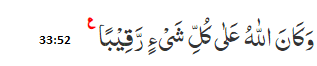
Allah says, relating the words of Jesus (peace be upon him) in the Qur’an: “I was a witness over them while I dwelt among them; when You took me up, you were Ever-Watchful over them, and You are a Witness to all things.” [Surah al-Ma’idah: 117]
Allah also says: “Allah is Ever-Watchful over all things.” [Surah al-Ahzab: 52], and: “Surely Allah is Ever-Watchful over you.” [Surah al-Nisa’: 1]
Allah watches over all of His servants, and keeps watch over all of their affairs, their secrets, and their deeds. This should make us more aware of Allah’s rights over us and of our duty towards Him.
Today’s world excels in managerial and financial oversight. Self-monitoring is regarded a great personal quality that makes a person more-productive, honest, and impervious to corruption. Nothing brings about this quality in a person like the awareness that is Ever-Watchful and knows everything we do, great and small, visible and hidden. It is strange to find an employee who dutifully observes all five prayers but then goes about cheating, embezzling, and avoiding responsibility. That employee’s prayer attests to belief in Allah and that one can commune with Allah in secret. It attests to the belief that Allah sees and hears what we do. On the other hand, how does this employee feel that it is possible to cheat other people of their rights, as if Allah is not aware of those deeds?
A genuine belief that Allah is Ever-Watchful makes us vitally aware of Allah’s supervision. It makes us feel ashamed to commit sin, knowing that He is watching over us when we commit disgraceful deeds. I have given thought to why certain civilizations around the world are so much more productive and exhibit a far better work effort than we witness in most Muslim countries. I think the reason is that self-monitoring has become firmly integrated into the personal makeup of the people living in those societies. It is a personality trait and a part of their mind-set, even before cameras are installed and oversight measured are instituted by management. What if more people in the Muslim world were to embrace this value, adding it to this their awareness – stemming from faith – that Allah is watching over us and taking account of all that we do, and that our ultimate fate in the Hereafter is tied to what we do in this world? Think of how much this would affect our productivity and development. Think of how much it would combat the corruption, graft and wastage that debilitate so many Muslim countries? Personal values – chief among them being our belief in Allah, His names and His attributes – are what it takes to build a vibrant, healthy, productive, and stable society, provided that those values are not merely held in the abstract, mere rigid concepts, but are transformed into practical expressions of our hearts and our actions.
33 The Near One (al-Qarib)


Allah says: “Ask forgiveness of Him, and turn to Him (in repentance): for my Lord is Near, the Answerer (of prayers).” [Surah Hud: 61] He also says: “Say (0 Muhammad): If I err, I err only to my own loss, and if I am rightly guided it is because of that which my Lord has revealed unto me. Lo! He is All-Hearing, Near.” [Surah Saba’: 50]
There are many connotations of Allah’s nearness. One of these is that He is near to those who beseech Him and beg of Him. Prophet Muhammad (peace be upon him) was once asked: “Is Your Lord close by, so people are to commune with Him, or remote so people should call out to Him?” In response to this question, Allah revealed the verse: “And when My servants ask you concerning Me, then surely I am Near. I answer the prayer of the suppliant when he calls on Me, so they should heed My call and believe in Me that they may walk in the right way.” [Surah al-Baqarah: 186]
Allah is near to those who beseech Him. He relents to them in kindness and relieves them of their distresses. When ‘Alib. Ab! Talib was asked: “How great is the distance between heaven and Earth?” he simply replied: “An answered prayer.” Those who are eager to attain Allah’s promise to answer their prayers and relieve them of their difficulties should heed Allah’s call, believe in Him with all of their hearts, and guard themselves from sin. They should strive to be rightly guided. This is why the verse concludes with: “so they should heed My call and believe in Me that they may walk in the right way.”
Abu Musa al-Ash ‘ad relates: We were with Allah’s Messenger (peace be upon him) on a journey. It was our habit when we descended into a valley to raise our voices in the praise and glorification of Allah’s name. The Prophet (peace be upon him) said: “Keep your voices to a reasonable volume. You do not call upon one who is deaf or absent. He is with you. He hears you and He is near.” [Sahih al-Bukhari (6610) and Sahih Muslim (2704)]
These words of the Prophet (peace be upon him) attest to the fact that Allah is near to His servants and answers their prayers. We also learn from this that a believer should address the Lord in a reverent, humble tone, and avoid shouting. Allah is also near to those who turn to Him in repentance. Allah says: “Ask forgiveness of Him, and turn to Him (in repentance): for my Lord is Near, the Answerer (of prayers).” [Surah Hud: 61]
Then we seek Allah’s forgiveness sincerely and with penitent hearts, we not only get absolution for our sins, but we also earn Allah’s blessings, since our asking forgiveness is a form of worship. Allah’s forgiveness is near at hand. Allah addresses Prophet Muhammad (peace be upon him) with the command: “Say (0 Muhammad): If I err, I err only to my own loss, and if I am rightly guided it is because of that which my Lord has revealed unto me. Lo! He is All-Hearing, Near.” [Surah Saba’: 50]
Allah informs us that the Prophet (peace be upon him) is guided because of the revelation that he receives from Allah who is All-Hearing and near to His servants. This means that the guidance that humanity receives is a result of Allah’s nearness to them. Allah grants guidance and everything else in the world to whomever He pleases. He gives the good of this world to those he loves as well as those He is displeased with. However, he grants the good of the Hereafter only to those whom He loves. These are the people He blesses with the quality of righteousness. It is from Allah’s nearness to His servants that He gives them guidance and keeps them on the right path.
Prophet Muhammad (peace be upon Him) related to us that Allah says: “if someone draws near to me a handspan, I draw near to that person a forearm’s length. If he draws near to Me a forearms length, I draw near to Him the span of two outstretched arms. If he comes to Me walking, I come to him at speed.” [Sahih al-Bukhari (7405) and Sahih Muslim (2675))
See how Allah responds to our least effort to draw near to Him by coming ever nearer to us by blessing us with guidance, stronger faith, contentment, and certitude. How far away this is from Deism, the belief that Allah set creation into motion and then left us to our own affairs. We see how near Allah is to us and to our concerns, guiding us and nurturing us if we but show the inclination to turn to Him. Allah is near to us in His attentiveness to our affairs. Allah says: “He is with you wherever you are; and Allah is the Seer of all that you do.” [Surah al-Hadid: 4]
He also says: “Do you not see that Allah knows all that is in the heavens and on Earth? There is not a secret consultation between three, but He makes the fourth among them, – nor between five but He makes the sixth, nor between fewer nor more, but He is with them, wherever they be.” [Surah al-Mujadilah: 7]
He is near to us with His knowledge. He is near to us though He is transcendent. Though He is the Most High, He is close to our lives in every way. Allah says: “Verily, we created the human being and We know what his soul whispers to him, and We are nearer to him than his jugular vein.” [Surah Qaf. 16] Allah says, speaking about the time of death: “Then why do you not intervene when (the soul of the dying man) reaches the throat, but you the while (sit) looking on? We are nearer to him than you, and yet you see it not.” [Surah al-Wdqi’ah: 85)
Yes, Allah is near to us with His knowledge and through His angels. However, His nearness should be understood to be more than metaphorical. However, we should understand His literal nearness to be such that corresponds with His divinity, not like the nearness of physical beings to one another. Allah is literally near to us is a manner that no way implies physical contact or a material presence.
Allah is also near to us in His kindness and His care for all His creatures, and in the special assistance that He gives to the believers. Allah is with the believers in a special way, particularly His prophets and messengers, as well as those who are righteous and God-fearing. He is with those who engage in good deeds, caring for them, protecting them, and blessing them with success.
Allah is near to us in that to Him we must ultimately return. This is why Allah says about a person at the verge of death: “We are nearer to him than you, and yet you see it not.” [Surah al-Wdqi’ah:85] The person at this time is closer to the Hereafter and therefore closer to returning to Allah.
Allah is near to us in our love and longing for Him. He is near to those who worship Him in the way their hearts long for Him, in the way they uphold His remembrance, and in their gratitude for Him. Their hearts enjoy a contentment and peace that comes only from their nearness to Him. So many people who live only for the world never have the experience of such comfort and joy. They know only the physical pleasures of food, drink, and indulging their lusts. Yet, the most complete pleasure is that of nearness to Allah, which comes only through keeping His remembrance alive in our hearts and minds.
We should teach our hearts to be more attached to Allah than to anything in creation. We should certainly feel close to our loved ones and friends. This is something natural and right. However, we should always remain aware of our relationship with Allah, which is beyond all of our worldly attachments. This is what brings true peace and happiness to every other aspect of our lives. Allah is with us when we remember Him, praise Him, and glorify His name. He is with us in His care and in the blessings that he showers upon us. Prophet Muhammad (peace be upon him) informed us that Allah says: “I am with someone when he remembers Me.” [Sahih’ al-Bukhari (7405) and Sahih Muslim (2675)]
When we are conscious of Allah’s nearness to us, we become acutely aware of His divinity, which in turn enhances our worship. We begin to worship Allah as though we see Him, and though we do not see Him. We see Him not with our eyes, nor do we hear Him with our ears, but we do so with our hearts minds and through the intensity of our awareness of Him.
At the same time, our worship of Allah inculcates in us the awareness of the difference between the Creator in His glory and ourselves in our weakness. We feel our need for Him and how dependent we are upon Him. Allah says: “All those who are in the heavens and the earth ask of Him; every moment He is in a state (of glory).” [Surah al-Rahman: 29]
34 The Answerer of Prayers (al-Mujib)

This name of Allah is found in the following verse of the Qur’an: “Ask forgiveness of Him, and turn to Him (in repentance): for my Lord is Near, Answerer (of prayers).” [Surah Hud: 61]
Allah answers the prayers of those who beseech Him. He relieves those who seek refuge in Him and he placates their fears. He even answers the prayers of the unbelievers and those who are heedless when, in the throes of despair, they call out to Him:
He it is Who enables you travel by land and sea; yet when you are in the ships, and they sail on with them in a pleasant breeze, and those (on the ship) rejoice, a violent wind overtakes them and the billows surge in on them from all sides, and they become certain that they are encompassed about, they pray to Allah, being sincere to Him in obedience, saying: “If You deliver us from this, we will most certainly be of the grateful ones.” But when He delivers them, behold! they transgress insolently throughout the Earth in defiance of right! [Surah YunuS’. 22-23]
Allah answered Noah (peace be upon him) in his distress, saving him and his followers in the Ark when He drowned the sinful people in the Flood: “Noah did certainly call to Us, and We are the best to answer prayers.” [Surah al-Safath. 75] Allah answered the prayers of Job (peace be upon him): “(Remember) Job, when He cried to his Lord, ‘Truly distress has seized me, but You are the Most Merciful of those who are merciful.’ Then We heard his prayer and removed the distress that was on him, and We restored his people to him, and doubled their number, a mercy from Us and a reminder to the worshippers.” [Surah al-Anbiya’: 83-84]
Allah answered the prayers of Jonah (peace be upon him) when he cried out from the belly of the whale: “And (remember) Jonah, when he went off in anger and deemed that We would not straiten him. But he cried through the depths of darkness, saying: ‘There is no god but You, Glory to You: I was indeed wrong!’ So We answered him and delivered him from grief, and thus do We deliver the believers.” [Surah al-Anbiya’: 87-88]
Likewise, Allah answered the prayers of Abraham, Zechariah, John the Baptist, Jesus, and indeed every one of His Prophets and Messengers (peace be upon them all). They beseeched their Lord with utmost humility and sincerity, so He, in His infinite grace, safeguarded them, guided them, honored them, and accepted their appeals. Allah is the one who answers the prayers of those who beseech Him and place their hopes in Him. Allah alone is the one to whom all prayers and supplications are to be made.
“And your Lord says: “Call on Me; I will answer your (prayer): but those who are too arrogant to serve Me will surely find themselves in Hell – in humiliation!”” [Surah Ghqfir. 60] Allah has enjoined supplication upon us and He has promised to answer our prayers. This is why ‘Umar used to say: “I do not worry that my supplications will be answered. I worry about my supplications themselves.”
In other words, when a person is blessed to beseech the Lord, this itself is the benefit. As for the answer, that is something which has already been granted. Allah is the one who removes our distresses. He reminds us: “It is Allah who delivers you from these and from every distress, but again you set up others (with Him).” [Surah al-An’am: 64]
Our supplications to Allah are a means to dispel calamities and hardships, and to draw blessings and opportunities to us. However, supplications are not the only cause for these desired effects. There are other causes that need to be acknowledged as well, including natural cause-and-effect relationships. Allah, in His wisdom, knows what is best. He has made our supplications one of the influences that affects our lives, and He has promised to answer our prayers. This means that sometimes He answers us with precisely what we ask for. At other times, He might prevent a calamity from befalling us that we would otherwise have been destined to suffer from.
Also, He might postpone granting us the answer to that prayer until the Day of Resurrection, and reward us with the blessings of it on that day in terms of our judgment and reward in the Hereafter, through having it weigh in our favor on that day when our deeds are weighed. This is guaranteed for all who beseech Allah with sincerity and devotion. As for the answer to our prayers coming in this world with precisely what we ask for, this is usually the case.
When we read about the lives of the prophets we witness many cases where Allah answered their prayers. Prophet Muhammad (peace be upon him) beseeched Allah on behalf of a number of his Companions. He beseeched Allah about Ibn ‘Abbas asking: “O Allah! Make him deeply knowledgeable about the religion.” He prayed Anas that b. Malik would have a long life and many children. He prayed that ‘Umar b. al-Khattab would embrace Islam and add his strength to the Muslim community. He beseeched Allah on behalf of many of the tribes he interacted with, and He beseeched Allah for all of the Muslims throughout the ages.
We find many accounts, past and present of how Allah answered people’s prayers. Wherever people believe in Allah, though they be sinful in their deeds and misguided in their religious understanding, we find them speaking about how Allah answered their prayers and removed their woes. This is something that cannot be denied, a further proof attesting to Allah’s existence and His mercy. This is the reason why we scarcely find anyone when faced with a great calamity or woe who refrains from turning to Allah to relieve his or her distress.
Etiquettes of Supplication
We should be conscious of how we conduct ourselves when we ask of Allah. There are a number of manners and etiquettes we should take heed of.
1. We should only beseech Allah for that which is lawful and good. We should also avoid beseeching Allah with anything that transgresses against other people. It is Allah who enjoined upon us to beseech Him in prayer, and it is Allah who says: “Do not transgress; for Allah does not love transgressors.” [Stirah al-Baqarah: 190]
2. The best supplications are those which are found in the Qur’an and Sunnah. Prophet Muhammad (peace be upon him) instructed us to offer personal supplications while sitting after tashahhud at the end of our formal prayers, saying: “Then he should choose from the supplications what seem appropriate and offer those supplications.” [Sahih al-Bukhari (835) and Sahih Muslim (402)]
Here the Prophet (peace be upon him) is advising us to select certain supplications and offer them while seated at the end of our prayers. These are supplications from Sunnah like: “O Allah! Give us the good of this world and the good of the Hereafter, and protect us from the punishment of Hell.” [Sahih al-Bukhari (4522) and Sahih Muslim (2688, 2690)]
Another is: “O Allah! I seek refuge with You from the punishment of the grave. I seek refuge with You from the Antichrist. I seek refuge with You from the trials of life and death. Allah! I seek Your refuge from sin and from debt.” [Sahih al-Bukhari (833) and Sahih Muslim (589)]
Still another is: “My Lord! I have greatly wronged my soul, and none forgives sins but You, so forgive me with Your clemency, and have mercy on me. Indeed, You are Oft-Forgiving, Merciful.” [Sahih al-Bukhari (834) and Sahih Muslim (2705)]
3. We should make an effort to offer the supplications which are given to us in the Qur’an and those which Prophet Muhammad (peace be upon him) used to recommend. These are certainly the best supplications. They guarantee us that our supplications will be correct in their meaning and lofty in purpose.
It is not necessary to recite these supplications verbatim in Arabic, especially for those who have difficulty doing so. However, it is good to offer supplications that convey the same meanings as those found in the Qur’an and Sunnah. The proof for this comes from the Prophet’s example. The Prophet (peace be upon him) once asked a man about what he said in prayer. The man replied that he bears witness to his faith, then asks Allah for Paradise and seeks Allah’s refuge from Hell. He then added: “By Allah! I am not good at following all those murmurings of yours, nor those of Mu’adh.” The Prophet (peace be upon him) then gently reassured him: “What we murmur is similar to what you are saying.” [Sunan Abi Ddwud (792) and Sunan Ibn MaJah (910)]
The Prophet did not take the man to task for supplicating in his own words, since what the man was saying carried the same meaning as what is found in the Qur’an and the Prophet’s supplications, like asking for Paradise, seeking refuge from the punishment of Hell, asking for the good of this life and the Hereafter, and seeking to be spared the evils of this world and the next.
We should beseech Allah in full confidence. We should never offer a supplication as a “test” to see if it will be answered. When we ask of Allah, call upon Allah, we are calling upon our Almighty Lord: “Verily, when He intends a thing, His Command is, ‘be’, and it is!” [Surah YaSin: 82] Allah loves it when we ask of Him and open ourselves up to His mercy and benevolence. It angers him when someone turns away from Him and dislikes to ask of Him. Allah is Most-Generous, Most-Bounteous. His bounty knows no limit. Therefore, when we ask of Him, we should do so with full trust and certitude.
The more certain we are that Allah will answer us, the swifter and more certain will be the answer. It is related that Prophet Muhammad (peace be upon him) said: “Ask Allah being certain that He will answer, and know that Allah will not answer the supplications of a heart which is distracted and not serious.” [Sunan al-Tirmidhi (3479)]
4. We should endeavor to derive our sustenance only from lawful means. Sa ‘d b. Abt Waqqas once asked the Prophet: “O Messenger of Allah! Ask Allah to make me someone whose prayers are always answered.”
The Prophet (peace be upon him) replied to Sa ‘d: “Make sure that what you eat is pure and lawful. Then your prayers will be answered.” [Musnad al-Tabardni al-Awsat (6495)] Likewise the Prophet (peace be upon him) tells us about a man on an arduous journey, covered in dust, his hair disheveled. He stretches his hands to the heavens, crying out to his Lord. But his food is unlawful, his drink is unlawful, his clothing is unlawful. He is a man whose whole sustenance is sinful. How then does he hope to be answered? [Sahih Muslim (1015)]
Since we wish for Allah to answer our prayers and to be with us in times of hardship and sorrow, we should show concern for how we acquire the means for the food, drink, and clothing that we provide for ourselves and our families. We should make sure that it is lawfully earned, free form fraud, bribery, usurious dealings, and injustice. Those who earn their wealth unjustly are deserving of having their supplications ignored.
5. We should not be impatient for the answer. The Prophet (peace be upon him) assured us: “Your supplications will be answered except for one who gets impatient and says: ‘I asked Allah but he did not answer me’.” [Sahih al-Bukhari (6340) and Sahih Muslim (2735)]
If Allah wished, He could answer all of humanity’s supplications at the very moment that each supplication is uttered. However, Allah’s wisdom is infinite. He knows what we do not know. Therefore, He will surely answer us as long as we do not hasten on the answer. Instead, we should offer our supplications all the more, never despair, and never tire of doing so. We should know that we are upon what is good in our doing so, and that Allah knows all about our needs. He sees and hears all things, but He wants us to turn to Him in humility and devotion.
6. We should seek out the special times when our prayers are most likely to be answered. These times include the hours of dawn before sunrise, the last daylight hour on Friday afternoon, the time when the preacher ascends the pulpit to deliver the Friday sermon, and the time at the end of each formal prayer before the taslim when we are still sitting after the tashahhud.
Another important time during our prayers for offering personal supplications is while we are in prostration. Prophet Muhammad (peace be upon him) said: “The nearest a worshipper comes to his Lord is when he is prostrating. So offer supplications at this time, for you are more certain to be answered.” [Sahih Muslim] Here we see Allah’s nearness being mentioned along with His being the Answerer of Prayers. It is due to the nearness of the worshipper to the Lord at these times that they are the best times to offer supplication.
The Benefit of Knowing this Name of Allah: Awareness that Allah is the Answerer of Prayers is a comfort and source of strength for those who are cut off from all other hope or recourse, with only Allah to turn to. At this time, they turn to Allah with the sincerest and most devoted heart, so Allah quickly relieves their burdens and removes their afflictions.
Such is the experience of those who are languishing in prison without anyone to come to their defense. Such is the experience of the person lost alone the wilderness. Such is the experience of the sailor whose ship is being tossed at sea in a violent tempest. Such is the terminally ill person whom doctors have given up hope for and who recovers after turning to Allah. Such is the oppressed who is victimized by the mighty, about whose prayers Allah says: “By my might and majesty, I will grant you victory, though it be after a time.” [Sunan al-Tirmidhi (2525) and Sunan Ibn Mqjah (1752)]
35 The All-Embracing (al-Wasi’)


This name appears for Allah nine times in the Qur’an, sometimes on its own and sometimes in connection with another of Allah’s names. Allah says: “To Allah belong the east and the west, so wherever you turn, there is Allah’s countenance. For Allah is All-Embracing, All-Knowing.” [Surah al-Baqarah: 115] And: “Allah is ever All-Embracing, Wise.” [Surah al-Nisa’: 130]
And: “Your Lord is All-Embracing in His forgiveness.” [Surah al-Nqjm: 32] Abu ‘Ubaydah, one of Prophet Muhammad’s eminent Companions, understood this name to mean that “Allah is most liberal in His giving, His generosity embracing all that is asked of Him.” Indeed, this name connotes that Allah’s grace and munificence encompass everything His creatures need, and that His management of the affairs of the universe is complete and thorough. Therefore, this name communicates to us the inter connectedness of Allah’s knowledge, His all-embracing awareness, His care, and His beneficence to everything in existence.
The name also communicates something about Allah’s essence: that He is complete in His names and attributes and His greatness and perfection are without limitation. No amount of praise can encompass Allah’s due. Allah is as He extols Himself, for no words that humans can utter will ever do Him justice.
Regarding Allah’s attributes, we have where ‘A’ishah says: “Glory be to Allah whose hearing embraces all voices. The woman came to the Prophet (peace be upon him) with her plea. She had a grievance against her husband. I was in the corner of the house and did not hear what she said. Then Allah revealed: ‘Allah has heard the plea of the woman who pleads with you .. .'” [Sunan al-Nasa’i (3460) and Sunan Ibn Majah (188, 2063)]
The vastness of Allah’s creation is but one manifestation of how Allah is All-Embracing. Allah says: “We have built the heaven with might, and We made its vast expanse. And the Earth, We have made it a wide extent; how graciously We have spread it out.” [Surah al-Dhdriyat. 47-48] Then there is all that is beyond the visible universe that our eyes can perceive, of that even our minds can conceive of. Allah’s creative power is All-Embracing; it knows no limits.
Another connotation of this name is that Allah’s Law is flexible, accommodating all contingencies and making allowances for all difficulties. Allah says: “Allah desires ease for you, and He does not desire for you difficulty.” [Surah al-Baqarah: 185] And: “Allah wishes to lighten your burdens.” [Surah al-Nisa’:28] And: “Allah burdens no soul except with what it can bear.” [Surah al-An’am: 152] Prophet Muhammad (peace be upon him) said: “This religion is easy. No one should become severe about it, for then it will overwhelming Him.” [Sahih al-Bukhari (39)]
Islam is a religion that embraces all contingencies. It makes concessions for difficulties in matters of worship, in matters of daily life, and in all its legal pronouncements. Whatever difficulties people find in practicing their religion are exceptional, either caused by the society in which the people live or by the ideological constraints that people impose upon themselves in the practice of their faith. Islam and its teachings, however, are far greater and more flexible than any culture, school of thought, or narrow set of opinions.
36 The Wise, the Judge (al-Hakim, al-Haakim)

These two names are closely related linguistically. The first is al-Hakim (the Wise) and the second is al-Haakim (the Judge). Allah is referred to in the Qur’an as “the Wise” 93 times and as “the Judge” six times (on one occasion as al-Hakam, the “Sovereign Judge”).
For instance, Allah says: “Indeed You are the All-Knowing, the Wise.” [Surah al-Baqarah:32];
“the Mighty,the Wise”[Surah al-Baqarah: 129]; “He is the Wise, the All-Aware.” [Surah al-An’am: 18];
“Allah is ever All-Embracing, Wise.” [Surah al-Nisa’: 130]
Allah refers to Himself as the Judge when He says: “Shall I then seek a Judge other than Allah? And He it is Who has revealed to you the Book (which is) made plain?” [Surah al-An’am: 114] And: “He is the Best of Judges.” [Surah al-A ‘raf. 87]
And where he says: “And Noah called upon his Lord, and said: ‘O my Lord! Surely my son is of my family! And Your promise is true, and You are the most just of Judges!”‘ [Surah Hud: 45] And: “Is not Allah the Best ofJudges?” [Surah al-Tin: 8]
Allah’s Wisdom: To be wise means to know things as they are, act towards them accordingly, and afford everything in its proper place and function. Allah says about His creation: “You see the mountains and think them firmly fixed: but they shall pass away as the clouds pass away: (such is) the handiwork of Allah, who carries out all things with utmost proficiency.” [Surah al-Nam!: 88]
Allah’s wisdom can be witnessed in His creation, and especially in the creation of the human being, with its mind and soul. Allah tells us that He created the human being in the best of forms: Indeed, We have created the human being upon the best of forms. Then we reduced him to the lowest of the low, except those who believe and do good, for they shall have an unending reward. So who henceforth will give the lie to you about the judgment? Is not Allah the best of Judges? [Surah al-Tin: 4-8]
Whether we look at the human being’s physical construction, or consider the human potential, or the human soul and mind, we get a profound glimpse of Allah’s wisdom. Consider how these two verses come together: “Indeed, We have created the human being upon the best of forms. Then we reduced him to the lowest of the low … “
One understanding of this verse is that it describes how the human being, after growing up to attain maturity and full strength, then ages and returns to a state of weakness. Then the next verse reads: “except those who believe and do good, for they shall have an unending reward.” Here Allah promises that there is an immense reward in the Hereafter for the righteous. Though all human beings are subject in this world to the laws of nature – everyone will age and die – the righteous will enjoy an eternal blissful life in the Hereafter.
Then Allah says: “So who henceforth will give the lie to you about the faith?” This is a rhetorical question. Can you not see that Allah has created the human being in such an excellent form? Aren’t there sufficient signs in this, and in everything else found in creation, to attest to Allah’s wisdom? Does this not compel us to believe in Him and worship Him?
Then Allah concludes by asking: “Is not Allah the best of Judges?” One aspect of our faith is the belief that we will return to Allah in the next life and be judged for our deeds in the life of the world. This will also be a manifestation of Allah’s wisdom. We can see another manifestation of Allah’s wisdom in His giving us language. It is miraculous how Allah has granted us the ability to speak and made our various languages the means by which we contemplate, learn, communicate, and impart knowledge. Allah says: “The Beneficent – It is He who has taught the Qur’an. He created humanity, to whom He taught the means of speech.” [Surah al-Rahman: 1-4]
We can see another manifestation of Allah’s wisdom in the sleep that we succumb to every day, which takes us from our waking lives and transports us to a state akin to death. In our dreams, we can find ourselves anywhere on Earth and encounter other people, both living and deceased. Then, when we wake from our sleep, we find ourselves rejuvenated and revitalized. This is an eloquent expression of Allah’s wisdom: “And among His signs is the sleep that you take by night and by day” [Surah al-Rum: 23]
It is also from Allah’s wisdom that He created us for a purpose. “I have only created humanity and the Jinn to worship Me. I seek no livelihood from them, nor do I ask that they should provide Me with sustenance. Lo! Allah! He is the Provider, the Lord of unbreakable might.” [Surah al-Dharjyat. 56-58] Therefore, Allah did not create us in vain, nor will he leave us without guidance or accountability: “What! Did you then think that We had created you in vain and that you shall not be returned to Us?” [Surah al-Mu’minun: 115]
The Wise Qur’an: It is from His wisdom that He sent to us the teaching revealed to Prophet Muhammad (peace be upon him) in the Qur’an. This is why Allah describes the Qur’an as being wise: “This which We recite unto you is a revelation and a wise reminder.” [Surah Al ‘Imran: 58]; and :”(I swear) by the wise Qur’an” [Surah YaSin: 2]
There is wisdom in everything that Allah wills to take place in the world – since everything happens by Allah’s decree – though quite often that wisdom escapes us. The reason we are unable to ascertain the wisdom in Allah’s decree is because we may not have the ability to see things from all the relevant angles. We are discovering new things every day, and this should make us realize there is so much we do not know. Our inability to immediately understand the wisdom behind something that befalls us in the world should not make us resistant to accepting Allah’s will.
Likewise, our inability to understand the wisdom behind why Allah commands us to do something should not make us reluctant to obey. We must accept that Allah is Most Wise, All-Knowing, and that He is the Best of Providers. Allah’s actions and His words are full of wisdom. They never err. Allah never does anything other than what is right.
The Wise Qur’an contains teachings that can help remedy many of the problems we face today, whether those problems are social, economic, or political. What the Qur’an provides us with are the general governing principles by which we will be rightly guided in all walks of life. However, not everyone will be equally effective in applying these general principles to their practical experience. For instance, scholars of Islamic jurisprudence study the Qur’an to derive from it legal principles and apply them to practical legal problems.
It is unfortunate that Muslims today have stopped trying to understand the Qur’an in how its guidance relates to their troubles and practical concerns. This is a serious problem, since understanding the Qur’an is a prerequisite for all Muslim scholars and thinkers who wish to seriously engage with today’s issues.
We cannot doubt that the Qur’an contains the essential principles for guiding humanity. This is why Allah says: “It is He Who has sent amongst the unlettered people a messenger from among themselves, to rehearse to them His Signs, to sanctify them, and to instruct them in scripture and wisdom, although they had been, before that, in manifest error.” [Surah al-]umu’ah: 2] “Wisdom” in this verse refers to the Sunnah of Prophet Muhammad (peace be upon him). It is from Allah’s wisdom that he sent Messengers to teach the people, along with the revealed scriptures. Allah says: “Now there has come to you a messenger from among yourselves: it grieves him that you should fall into distress: ardently anxious is he over you: to the Believers he is compassionate, merciful.” [Surah al-Tawbah: 128]
Allah selects the best among the people to be His Messengers, those who possess the greatest character, presence of mind, understanding, and ability, so they can convey Allah’s message and be witnesses before humanity. This is why Prophet Muhammad (peace be upon him) possessed such greatness of character, as is clear to anyone who reads about his life. It was a great blessing to humanity that Allah sent the likes of Muhammad to them as His Messenger.
Allah says: “Allah did confer a great favor on the believers when He sent among them a messenger from among themselves, rehearsing unto them the signs of Allah, sanctifying them, and instructing them in scripture and wisdom, while, before that, they had been in manifest error.” [Surah Al lmran: 164]
Human Wisdom: Allah is the Wise who bestows wisdom to those of His servants He deems fit. Allah says: “He grants wisdom to whom He pleases, and whoever is granted wisdom is indeed given a great good, but none perceive this save those possessed of understanding.” [Surah al-Baqarah: 269]
Allah grants some people an exceptional ability to look into problems and come up with workable solutions, who when faced with a crisis or difficulty can weigh every consideration in a properly and balanced way. These are the people others consult with and rely upon in various aspects of their lives. Some people have wisdom regarding social issues. Others possess wisdom when it comes to interpersonal relations. There are those who are wise when it comes to economic issues. The field of consultancy is a vital and important one today. Many successful consultants are people whom Allah has blessed with wisdom in their field to complement their knowledge, insight, and experience.
We must realize that wisdom can be specialized. A person may have profound wisdom in one or more aspects of life, without being wise in every way. A person may be wise in worldly matters without being wise in matters of faith, indeed without even being a believer.
Allah: the Sovereign Judge: Allah has sovereignty over all matters in creation. This is conveyed by the name al-Hakam, which appears in the following verse: “Shall I then seek a Judge other than Allah? And He it is Who has revealed to you the Book (which is) made plain?” [Surah al-An’am: 114]
Nothing occurs in creation except by His authority and decree. Allah says: “All those who are in the heavens and the Earth ask of Him; every moment He is in a state (of glory).” [Surah al-Rahman: 29]
Likewise, His decree can be of a legislative nature. Allah makes certain deeds lawful and other deeds sinful. He commands us to do certain things and prohibits us from doing others. His decree cannot be revoked or overturned by anyone. Allah says: “His is the creation and His is the command.” [Surah al-A ‘rqf. 54]
The Qur’an describes Allah as the “Best of Judges.” This is an affirmation of His perfect justice and immense mercy. Allah never wrongs anyone and is never oppressive. What He legislates for His servants is never burdensome and never unfair. Rather, the genuine teachings of Islam uphold the rights of all people without bias: the ruler and the ruled, the strong and the weak, the male and the female, the righteous and the sinner, the believer and the unbeliever. It upholds their rights in times of peace and times of war, and under all circumstances without exception. This is why Muslims should refer to the Qur’an and the Sunnah of the Prophet (peace be upon him) for guidance in all matters. They should do so as individuals to guide them in their personal lives, and they should do so as communities, societies, and nations for guidance in their political, social, and economic affairs.
Allah is Wise and He is the just Judge. In Islamic beliefs, no one is ever understood to bear the sin of another. No one is ever wronged by Allah. No sinner is ever punished for more than the magnitude of the sin committed and no good deed ever goes without a reward. Allah says: “As to those who believe and work righteousness, verily We shall not suffer to perish the reward of any who do a (single) righteous deed.” [Surah al-Kahf. 30]
37 The Loving (al-Wadud)


The Qur’an refers to Allah by this name in two places: “Ask pardon of your Lord and then turn unto Him in repentance, for indeed my Lord is Merciful, Loving.” [Surah Hud: 90], and: “He is Oft-Forgiving, Loving, Lord of the Glorious Throne.” [Surah al Buruj: 14-15]
Love refers to a beautiful relationship towards someone or between two beings. Allah refers to this quality as existing between the husband and wife: “And among His signs is that He created for you mates from among yourselves, that you may dwell in tranquility with them, and He has put love and mercy between your (hearts): verily in this are signs for those who reflect.” [Surah al-Rum: 21]
Allah also describes it as a quality that He is pleased with people aspiring towards in resolving their conflicts and arguments: “It may be that Allah will ordain love between you and those whom you now hold as enemies. For Allah has power (over all things); And Allah is Oft-Forgiving, Most Merciful.” [Surah al-Mumtahanah: 7]
Allah loves those who are righteous. He is pleased with them, near to them, and He accepts their good deeds. Allah describes them as: “a people whom He loves as they love Him” [Surah al-Ma’idah: 54] This is a special degree of love that is reserved for the righteous. One of its hallmarks is that Allah will place in their hearts love for humanity and will cause other people to feel love for them in turn. Then there is the love that Allah has for all humanity. This love manifests itself in His honoring humanity, granting them authority on Earth, and providing for them. It also shows itself in the patience and forbearance that He shows to all people.
This is why Allah speaks about His love for humanity in general terms, and His desire for them to engage in what is good. Allah says: “If you are ungrateful, then surely Allah is Self-Sufficient above all need of you; and He does not like ungratefulness in His servants; and if you are grateful, He likes it in you.” [Surah al-Zumar. 7]
In the Qur’an, Allah speaks about those who persecute believing men and women and then refuse to repent. He reminds even these people in general terms: “Truly your Lord’s power is immense. It is He who creates from nothingness and restores. And He is Oft-Forgiving, Loving.” [Surah al-Buruj: 12-14] Allah expresses His love here in to encourage those who are being persecuted to be patient and steadfast in faith. Yet, He does so in general terms, so He is also encouraging the persecutors to relent and turn to Him in repentance. His love embraces them as well. This verse is best understood in the context of the preceding verse: “Indeed, those who persecute believing men and women and then do not repent … ” [Surah al-Buruj: 10] Allah reminds them that the doors to repentance are open to them, out of His mercy and compassion for them, and that no sin, however great it may be, is greater than His mercy.
Yet, we see that Allah says in the Qur’an: “Allah does not love the treacherous.” [Surah al-Anfal: 58] and: “Surely Allah does not love any self-conceited boaster” [Surah Luqmdn: 18] By stating that Allah does not love people who possess these qualities, these verses communicate how hateful these qualities are. They give a stern warning to us against our behaving in such a way.
Benefits of Our Faith that Allah is the Loving: Knowing that this is one of Allah’s names calls us to show love to others. It encourages us to cultivate an atmosphere of love among our fellow human beings. We must especially show love with those whom we have close dealings with, like our spouses, families, neighbors, colleagues, and co-workers. We must keep our hearts pure, free from enmity and rancor. We should shun opposing qualities like envy, spitefulness, and resentment.
Finally, Allah’s name al-Wadud not only means “the Loving”, it also conveys the meaning of “Beloved”. Allah is loved by the believers and is the object of their ultimate longing and of their utmost hopes.
38 The Glorious (al-Majid)


Allah says: “The mercy of Allah and His blessings be on you, 0 people of the house; surely He is Praiseworthy, Glorious.” [Surah Hud: 73] Allah also says: “And he is Oft-Forgiving, Loving, Lord of the Glorious Throne.” [Surah al-Buruj: 14-15]
This name conveys the idea of one who is in possession of every praiseworthy quality to the utmost extreme. Allah excels all limitations in everything worthy of praise. He is perfect in every way, in all of His attributes. He possesses perfect knowledge, complete power, supreme wisdom, unfathomable mercy, total self-sufficiency, and every other laudable attribute in its most absolute sense. All worldly glory stems from His glory, even that of the Prophets. Prophet Muhammad’s Companions once asked him: We know how to greet you with peace, but how do we salute you?”
The Prophet (peace be upon him) replied: “Say: 0 Allah! Bestow Your salutations upon Muhammad and His family as You have bestowed Your salutations upon Abraham and his family. Indeed You (0 Allah) are Praiseworthy, Glorious.” [Sahih al-Bukhari (4797) and Sahih Muslim (406)]
Allah’s words are the best and most eminent of all words. This is why Allah refers to His Book as “the Glorious Qur’an” [Surah Qaf 1] The Qur’an extols Allah’s glory. It does so most eloquently in the Verse of the Throne (Ayah al-Kursi) which is the greatest verse of the Qur’an:
Allah, there is no God but He, the Living and Self-Sustaining. Neither slumber nor sleep overtakes him. Unto Him belongs all that is in the heavens and on Earth. Who is there who can intercede with Him save by His leave? He knows what is in front of them and what is behind them, while they encompass nothing of His knowledge except what He wills. His throne extends over the heavens and the Earth, and He is never weary of preserving them. He is the Most High, the Magnificent. [Surah al-Baqarah: 255]
Likewise, it does so in the short chapter entitled “Purity of Faith” (Surah al-Ikhlds), which Prophet Muhammad (peace be upon him) described as being “equivalent to one third of the Qur’an.” [Sahzn Muslim (811)] It reads: “Say: He is Allah, the One. Allah, the Self-Subsisting. He begets not, nor is He begotten, and there is none like unto Him.” [Surah al-Ikhlds-. 1-4] We should hold fast to the Qur’an, meditate on its meanings, instill humility in our hearts to its message, understand it, implement it in our lives, and strengthen our moral character with it. This is the way to experience something of the sense of glory in this world.
When ‘Umar, the eminent Companion of the Prophet, was Caliph of the Muslims, he met with Nafi’ b. ‘Abd al-Harith, whom he had appointed as his deputy in Mecca. ‘Umar asked him: “Who have you appointed to govern the inhabitants of the ‘Ustan Valley?”
Nafi’ replied: “Ibn Abzi.”
‘Umar asked: “And who is lbn Abzi?”
Nafi’ replied: “One of our emancipated slaves.”
‘Umar said in surprise: “You appointed an emancipated slave as governor?”
Nafi’ said: “He is well versed in the Qur’an and an authority in the laws of inheritance.”
‘Umar then concurred: “Indeed, our Prophet had said: ‘With this Book, Allah elevates some people and debases others’.” [Sahih Muslim (817)]
We implore Allah to elevate us with the Qur’an and to make us enjoy honor that emanates from His glory.
39 The Witness (al-Shahid)


The Qur’an refers to Allah by this name eighteen times. In one verse, Jesus (peace be upon him) addresses Allah by this name: “I was a witness over them while I dwelt among them; when You took me up, you were Ever-Watchful over them, and You are a Witness to all things.” [Surah al-Ma’idah: 117]
We also read verses like: “Allah is Witness over all things.” [Surah al-MuJadilah: 6] and: “Allah is sufficient as Witness.” [Stirah al-Nisa’: 79]
Allah is the Witness for whom nothing escapes His sight and nothing eludes His knowledge. And he is the just Witness, a Witness for truth. He is the Witness for the oppressed and downtrodden against those who wrong them. This name reminds us that what may go unseen by human eyes is still witnessed by Allah. Allah says: “So wait patiently for your Lord’s decree, for surely you are in Our sight.” [Surah al-Tur. 48]
Another meaning of this name is that Allah is a Witness to faith. Allah says: “Allah (Himself) is Witness that there is no god save Him. And the angels and the people of knowledge (too are witnesses).” [Surah AI lmran: 18]
Belief that Allah is the Witness makes us more aware that Allah witnesses whatever we do. Allah says: “And you are not engaged in any affair, nor do you recite concerning it any portion of the Quran, nor do you do any work but We are witnesses over you when you enter in to it.” [Surah Yasin us-. 61]
40 The Evident (al-Mubin)


That which is evident is clear and manifest. It is something about which there is no doubt. In speech, being evident means that it is eloquent and understood without any difficulty. The name al-Mubin, the Evident, is a name of Allah that applies both to Allah’s essence as well as the fact that He has conveyed His Message to humanity in a clear, complete manner.
This name appears with reference to Allah in the following verse: “On that day Allah will pay them in full their just reward, and they shall know that Allah is the Evident Truth.” [Surah al-Nur. 25]
This verse states that Allah is the Truth. On the Day of Resurrection, this will become manifest to all humanity. The truth of Allah’s promise of reward and punishment that He had revealed to humanity will become patently clear to everyone on that Day. Those who harbored suspicion and hypocrisy in their hearts during their worldly lives will, in the Hereafter, no longer have any doubts. Even in this world, Allah is most certainly Evident. It is clear from the signs in creation that He is the Lord and that He has no partner.
The One Who Makes Things Clear: The name al-Mubin also connotes that Allah makes things clear. He explains to people the path to right guidance and makes clear to them the evil deeds that will incur His wrath. Allah has shown us the path to salvation and the path to damnation. He has clearly informed us of what it takes to attain Paradise. We are to believe in Him alone without associating with Him false gods. Allah has made monotheism part of our innate nature, and He has sent His Messenger to re-emphasize this truth to us.
Allah says: “We sent aforetime our Messengers with evident proofs and sent down with them the Book.” [Surah al-Hadid: 25] Indeed, Allah describes Prophet Muhammad (peace be upon him) with the same epithet: “Do they not reflect? Their companion is not seized with madness: he is but an evident warner.” [Surah al- A’raf. 184] Allah also says: “And say (0 Muhammad): Surely I am the evident warner.” [Surah al-Hijr: 89]
In the same way, Allah describes the Qur’an: “Indeed, there has come to you light and an evident Book from Allah.” [Surah al- Md’idah: 15] Allah is Evident in Himself, and He makes evident to His creatures what will benefit them in their worldly lives and the life to come.
41 The Truth (al-Haqq)

The Qur’an attributes this name to Allah ten times. For instance: “On that day Allah will pay them in full their just reward, and they shall know that Allah is the Evident Truth.” [Surah al-Nur. 25] And: “Then they shall be sent back to Allah, their Patron, the True One.” [Surah al-An’am: 62]
And: “So exalted be Allah, the True King!” [Surah TaHa: 114] And: “So that is your Lord in Truth” [Surah Yunus 32]
It follows that Allah loves the truth and those who are truthful. He enjoins honesty upon us and exhorts us be honest. Prophet Muhammad (peace be upon him) used to say while standing late at night in the observance of prayer:
Allah! You set to rights the heavens and the Earth and all they contain, and Yours is the praise. Yours is the dominion of the heavens and the Earth and all they contain, and Yours is the praise. You are the light of the heavens and the Earth and all they contain, and Yours is the praise. You are the King of the heavens and the Earth and all they contain, and Yours is the praise. You are the Truth, Your promise is true, the meeting with You is true, Heaven is true, Hell is true, the prophets are true, Muhammad is true, and the Final Hour is true. [Sahih al-Bukhari (1120, 6317) and Sahih Muslim (769)]
The truth can be defined as that which is established with certainty about which there can be no legitimate doubt. Allah is the Truth in His enduring essence which shall never perish or diminish. His nature is the truth that shall never be supplanted. Hs teachings are the truth, never mixed with falsehood. His promise is true and it will never be broken. He guides us to the truth, decrees the truth, and speaks the truth.
No matter what changes may take place in the world, no matter what challenges, difficulties, or discoveries we might encounter, the Truth that is Allah will never change. It is the one thing that can always be relied upon. Muslims today, in the age of Globalization, are wondering what principles are immutable and what principles are subject to adaptation and change. Understanding this name of Allah should help us to deal with this question. Allah’s light is the truth, and what is illuminated by His light will be true.
42 The Disposer of Affairs (al-Wakil)


The Qur’an refers to Allah by this name fourteen times. For instance: “Say: Allah is Sufficient for us! Most Excellent is He in whom we trust as Disposer of our Affairs!” [Surah Al Imran: 173]
Also: “Allah is sufficient as Disposer of Affairs.” [Surah al- Nisa’: 81], and: “He is the Disposer of All Affairs” [Surah al-An’am: 102], and: “As to what we say, Allah is the Disposer of Affairs.” [Surah al Qasas. 28]
Allah, in His infinite knowledge, power and wisdom, governs the affairs of His creation. This care of Allah is general for all things, living and nonliving, believer and unbeliever, the pious and the heedless, the grateful and the ungrateful.
There is, however, a special sense of this name, a sense that applies to those who are Allah’s beloved devotees. Allah makes matters easy for them and wards off hardship from them. This is what the eminent Companion, IBn ‘Abbas was referring to when he said:
Allah is sufficient for us. Most Excellent is He in whom we trust as Disposer of our Affairs! This is what Abraham (peace be upon him) said when he was cast into the bonfire. It is also what Muhammad (peace be upon him) said when the people said: “‘They have gathered against you, so fear them.’ However, it only increased the believers in faith, and they said: ‘Say: Allah is Sufficient for us! Most Excellent is He in whom we trust as Disposer of our affairs!”‘ [Surah Al Imran: 173]
Allah takes particular care of the believers, their well-being and their sustenance. He shows particular concern for their affairs, especially those who put their full trust in Him. Allah says: “And whosoever puts his trust in Allah, He will suffice him.” [Surah al-Talaq: 3]
Prophet Muhammad (peace be upon him) said: “If they would only put their trust in Allah as they should, He would provide for them like he provides for the birds who fly out in the morning hungry and return fully satiated.” [Sunan al-Tirmidhi (2344), Sunan Ibn Majah (4164)]
When we have a proper awareness that Allah is the Disposer of Affairs, we entrust our Lord with our concerns. We become accepting of His decree and seek after His bounty and grace. One of the greatest expressions of faith and devotion is to take all practical steps to achieve our goals while at the same time placing our complete reliance upon Allah for the outcome.
Allah enjoins this upon us, saying: “(He is) Lord of the East and the West. There is no god but He. Take Him therefore as Disposer of your Affairs.” [Surah al-Muzammil: 9] Likewise, Allah forbids us to place our true reliance in anything other than Him: “We gave Moses the Book, and made it a Guide to the Children of Israel, (commanding): ‘Take not other than Me as Disposer of (your) affairs’.” [Surah al-Isra’: 2]
Together, these two verses show us that putting our trust in Allah is an act of worship. Through our devoted trust and reliance, we express our monotheistic belief, and therefore these are things we should direct towards Allah alone.
43 The Bringer into Existence (al-Fatir)


The Qur’an mentions this name six times in connection with the creation of the heavens and the Earth; for instance: “Shall I take for my protector any other than Allah, the Bringer into Existence of the heavens and the Earth? – He who gives sustenance and is never given sustenance?” [Surah al-An’am: 14]
This name conveys the meaning of bringing into existence from nonexistence – of Allah creating the heavens and the Earth from absolute nothingness. The Qur’an invokes this meaning when it says: “Then will they say: ‘Who will cause us to return?’ Say: ‘He who brought you into existence in the first place!”‘ [Surah al-Isra’: 51]
Here, the Qur’an counters the skepticism of those who doubt the resurrection with the argument that since Allah created you the first time when you never before existed, He can surely create you again.
Another connotation of the name al-Fatir is that of bringing something forth by cleaving something asunder, like plants from seeds and rain from storm clouds. This idea is expressed in the following verse: “Do not the unbelievers see that the heavens and the Earth were joined together (as one unit of creation), before we clove them asunder? We made from water every living thing. Will they not then believe?” [Surah al-Anbiya’: 30]
Prophet Muhammad (peace be upon him) used to beseech Allah by this name in his supplications. He would say: “O Allah! Lord of Gabriel, Michael, and Raphael, Bringer into Existence of the heavens and the Earth, Knower of the seen and unseen! You shall judge between Your servants in what they disagree about. Guide me to the truth in these disagreements, by Your leave, for You guide whom You please to the straight way. ” [Sahih Muslim (770)]
Likewise, among the supplications we offer at the commencement of our formal prayers is the following: “I turn my face with sincere faith to the One who brought the heavens and the Earth into existence. I am not a polytheist.” [Sahih Muslim (771)]
This name seems to point to the very moment of creation, when the universe first came into existence. It inspires the heart to dwell on Allah’s might, power and wisdom, in His bringing the universe into being and then His determining how everything in it is to be. He created existence as we know it in an absolute sense, yet He also created this sky and this Earth, this specific tree, that individual person, and that particular stone.
44 The Strong, the Unyielding in Strength (al-Qawiy, al-Matin)


The name al-Qawiy (the Strong) appears nine times in the Qur’an, like in: “Allah is Strong, severe in punishment.” [Surah al-Anfal: 52] and: “Indeed, your Lord is the Strong, the Mighty” [Surah Hud: 66] and: “Lo! Allah! He is the Provider, the Possessor of Unyielding Strength.” [Surah al-Dhariyat. 58]
This name conveys the idea of Allah’s unlimited capability, that nothing is outside of His power and nothing can triumph over Him. Allah is Strong; nothing can stand as an obstacle to His will. This is why we often see this name in conjunction with His name al- ‘Aziz (the Mighty), especially in the context of His giving support to the believers and the downtrodden against the tyrannical and unjust.
For instance, Allah says: “Allah will certainly aid those who aid His (cause), for verily Allah is Strong, Mighty.” [Surah al-Hqjj: 40] Likewise, He says: “And Allah repulsed the disbelievers in their wrath; they gained no good. Allah averted their attack from the believers. Allah is ever Strong, Mighty.” [Surah al-Ahzab: 25]
Allah loves for the believers to possess this quality as well: in the strength of their faith, resolve, commitment, integrity, and character. This is what Prophet Muhammad (peace be upon him) meant when he said: A strong believer is better and more beloved to Allah than a weak believer, though both are good. Hasten to what benefits you, seeking Allah’s help, and do not feel defeated. If some misfortune befalls you, do not say: “If only I had done such-and-such … ” but say: “It is what Allah decreed, and He does as He wills.” The words “If only … ” open the doors for Satan’s machinations. [Sahih Muslim (2664)]
At the same time, Allah detests strength that is built upon violence and tyranny. Prophet Muhammad (peace be upon him) said: “No nation is blessed unless its weakest members can demand their rights without hesitation.” [Sunan Ibn MaJah (2426)]
The strength of justice and equality keeps the strength of the individual within reasonable bounds. Strength, therefore, is like other qualities of Allah which He loves to see manifested among His servants. Allah expresses those qualities in the most perfect and complete way. He is All-Knowing and He loves us to be knowledgeable. He is Just and He loves us to be just in our dealings. He is Merciful and He loves it for us to show mercy. He is Patient and patience is a virtue we are called upon to embrace. He is Beautiful and He loves for us to be beautiful. Therefore, Allah does not love it for us to be wealthy in a manner that is covetous and miserly, nor does He love it for us to be strong in a violent or domineering way, nor to exhibit a crass and immodest form of beauty. His attributes are pure and noble and He loves us to exhibit pure and noble qualities as well.
Allah’s strength is irresistible. There is no limit to His strength, and nothing presents Him with even the least difficulty. He says: “Lo! Allah! He is the Provider, the Possessor of Unyielding Strength.” [Surah al-Dhariyat. 58]
When we refer to Allah by the name al-Qawi (the Strong), we are expressing the completeness and perfection of His might. When we refer to Allah as al-Matin (the Possessor of Unyielding Strength), we are expressing the irresistible and unrelenting nature of His might. Indeed, Allah has promised the believers that He will aid them and grant them victory. He says: “Allah will certainly aid those who aid His (cause), for verily Allah is Strong, Mighty.” [Surah al-Hqjj: 40]
And: “Allah has decreed: ‘I will most certainly prevail, I and My Messengers’. Surely Allah is Strong, Mighty.” [Surah al-Mujadilah: 21]
45 The Patron (al-Wali, al-Mawla)


The Qur’an refers to Allah as the Patron numerous times; for instance: “He is the Praiseworthy Patron.” [Surah al-Shura: 28] and: “Allah is the Patron of those who believe. He brings them out of the darkness into the light.” [Surah al Baqarah: 257] and: “Your Patron can be only Allah; and (then) His messenger and those who believe, who establish worship and pay the poor due, and bow down (in prayer).” [Surah al-Ma’idah: 55]
This name brings together many meanings: that Allah is our Lord, our Benefactor, our Helper, and the One who truly loves us. Consider these verses of the Qur’an: “You are our Patron; Help us against those who stand against faith.” [Surah al-Baqarah: 286] “But Allah is your Patron, and He is the best of helpers.” [Surah AI ‘Imran: 150] “Then they shall be sent back to Allah, their Patron, the True one.” [Surah al-An’am: 62] “Hold fast to Allah. He is your Patron. A most blessed Patron and a most blessed Helper!” [Surah al-Hajj: 78]
The concept of patronage in Arabic (wilayah) is related to the idea of closeness and loyalty as well as to that of authority. This is why the word is used for guardianship, since a minor’s legal guardian is most often a close relative. Guardians are also those who are responsible for the people under their care. They provide help, support, companionship, and love. Loyalty has a strong relationship with the idea of closeness. People show loyalty to one another on account of a number of close relationships: kinship ties, geographic proximity, friendship, shared religious beliefs, common values, etc …
Allah’s patronage embraces all of creation. He cares for all of His creatures, whether human or non-human. He accounts for everyone’s needs, whether they be righteous or sinful, and whether they believe in Him or deny His existence. In this context, Allah says: “Then they shall be sent back to Allah, their Patron, the True one.” [Surah al-An ‘am: 62]
Allah is also Patron in a special sense for the believers, protecting them, helping them, and guiding them aright. Allah says: “Allah is the Patron of those who believe. He brings them out of the darkness into the light.” [Surah al-Baqarah: 257] He also says: “That is because Allah is Patron of those who believe, and because the disbelievers have no patron.” [Surah Muhammad: 11] and: “But Allah is your Patron, and He is the best of helpers.” [SurahAl ‘Imran: 150]
Prophet Muhammad (peace be upon him) informed us that Allah says: “Nothing that my servant draws near to me with is more beloved to me than what I have commanded. Then, my servant continues to draw near to me with voluntary worship until I love him, and when I love him, I become his hearing that he hears with, his sight that he sees with, his hand by which he grasps, and his feet by which he walks.” [Sahih al-Bukhari (6502)]
Here, Prophet Muhammad (peace be upon him) relates to us some aspects of the special patronage Allah shows to those who are extra-devoted in worship. He is also telling us that Allah is our source of inspiration and right-guidance so that we can successfully live in a manner that best pleases Him. We need Allah to set our thoughts aright, to bless us to listen to and regard the right things, and to guide us in what we say and do. Our drawing nearer to Allah is a reason for us to be blessed with the wisdom and insight to live better, more upright lives.
This is why Allah says: “Allah is the Patron of those who believe. He brings them out of the darkness into the light.” [Surah al-Baqarah: 257] When Abu Sufyan led the attack against the Muslim community at the Battle of Uhud, he boasted: ”We are mighty and you have no might.” After hearing this, Prophet Muhammad (peace be upon him) instructed his Companions to say: “Allah is our Patron and you have no patron.” [Sahih al-Bukhari (3039)]
Allah’s special patronage is something the believers earn through their efforts and piety. Allah says: “Those who enjoy Allah’s patronage have no fear on them, nor shall they grieve. (They are) those who believe and are God-fearing.” [Surah Yunus-. 62-63] Allah says about the Sacred Mosque: “None can be its patrons except the righteous.” [Surah al-Anfal. 34] Our awareness that Allah is our Patron gives us a sense of Allah’s closeness as well as a sense of His mercy and kindness. There is no better feeling than this.
Consider what a person feels who seeks the favor of a prince, dignitary, president, or some other important person. If he were to win that important person’s confidence, be drawn into his inner circle, and enjoy his friendship, this would be seen as the utmost success. How then is it to feel that we have attained this closeness with the Creator in whose hand is everything in the heavens and on Earth?
This gives our lives a fullness that cannot be quantified and fills our hearts with contentment and certainty. As Allah says: “What Allah bestows on humankind of His mercy, none can withhold.” [Surah Fatir. 2]
46 The Praiseworthy (al-Hamid)

This name is mentioned seventeen times in the Qur’an. Llkewise, we invoke Allah by this name at the closing of each of our formal prayers when we say: “Indeed, You are Praiseworthy, Glorious.”
Allah is sometimes referred to by this name alone, as in: “And they are guided to goodly words, and they are guided to the path of One who is Praiseworthy.” [Surah al-Hqjj: 24] Often, this name appears in conjunction with other names of Allah, as in: “Know that Allah is Self-Sufficient, Praiseworthy” [Surah al-Baqarah: 267]
And: “The mercy of Allah and His blessings be on you, 0 people of the house; surely He is Praiseworthy, Glorious.” [Surah HUd: 73] And: “He is the Praiseworthy Patron.” [Surah al-Shura: 28] And: “They abused them for no other reason than that they believed in Allah, the Mighty, the Praiseworthy!” [Surah al-Buruj: 8]
Allah is al-Hamid – the One who is praised by His creatures in the heavens and on Earth. And as we say in our daily prayers: “Allah hears those who praise Him.” He would be worthy of praise even if no one existed to praise Him. Allah is worthy of every possible praise on account of His very existence, as well as for His generosity, mercy, and all of His other noble qualities. This is why one of the best supplications we utter in remembrance of Allah is: “Glory and praise be to Allah to the number of His creations, and to the degree that He Himself is pleased with, and to the weight of His throne, and to the extent of His words.” [Sahih Muslim (2726)]
Mentioning Allah’s praise is one of the best ways to remember Allah. It has a great impact upon the heart, especially when the one who mentions it brings to mind what this praise entails.
Another recommended supplication is: “Glory and praise be to Allah! There is no god but Allah. Allah is the greatest.” [Sahih Muslim (2137)] The word “praise” is the first word of the Qur’an: “Praise be to Allah, the Lord of the Worlds.” [Surah al-Fatihah: 2] It is also what the denizens of Paradise will say: “Praise be to Allah who guided us to this.” [Surah al-A ‘raf. 43] and: “It shall be said: Praise be to Allah, the Lord of the Worlds.” [Surah al-Zumar. 75]
Prophet Muhammad informed us that: “Purity is half of faith, and the praise of Allah fills the scales (in our favor).” [Sahih Muslim (223)] Everything and everyone in creation extols Allah’s praises, even if some people might do so unwillingly. The believers praise Allah happily of their own free will. Even those who deny Allah praise Him. They do so by merely existing, since their very existence testifies to His creative power, magnanimity, grace, and forbearance. All the praises that the angels, prophets, and the rest of creation offer up to Allah is nothing compared to the praise that Allah deserves. This is why Prophet Muhammad used to say in his supplications: “I am unable to extol all of Your praises. You are as You have extolled Yourself.” [Sahih Muslim (486)]
On the Day of Judgment, Prophet (peace be upon him) will prostrate before Allah’s Throne and Allah will reveal to him words of praise that will have not been known to him before. With these words, he will praise his Lord and then Allah will say to him: “O Muhammad, raise your head. Ask and you will be given. Say and it will be heard. Intercede for them and your intercession will be accepted.” [Sahih al-Bukhari (4476) and Sahih Muslim (193)]
Those who praise Allah – who make it their habit to do so with every new blessing and every relief from hardship – will surely be the inheritors of Heaven.
47 The Living (al-Hayy)


The Qur’an refers to Allah as “the Living” on five occasions.
They are: “Allah, there is no God but He, the Living and Self-Sustaining.” [Surah Al ‘Imran: 2] “Faces shall be humbled before the Living, the Self-Sustaining. Hopeless indeed will be those who carry a burden of injustice.” [Surah TaHa: 111]
“And rely on the Living who does not die, and celebrate His praise.” [Surah al-Furqan: 58] “He is the Living. There is no God save Him. So call upon Him, making the religion sincerely for Him (alone).” [Surah Ghafir. 65]
“Allah, there is no God but He, the Living and Self-Sustaining. Neither slumber nor sleep overtakes him. Unto Him belongs all that is in the heavens and on Earth. Who is there who can intercede with Him save by His leave? He knows what is in front of them and what is behind them, while they encompass nothing of His knowledge except what He wills. His throne extends over the heavens and the Earth, and He is never weary of preserving them. He is the Most High, the Magnificent.” [Surah al-Baqarah: 255]
The last of these verses – verse 255 of Surah al-Baqarah – is known as “the Verse of the Throne”. This is because it declares: “His throne extends over the heavens and the Earth”. Prophet Muhammad (peace be upon him) confirmed that whoever reads this verse before going to bed at night will be appointed an angel by Allah for protection and Satan will be unable to approach throughout the night’s sleep.
The Verse of the Throne mentions a number of Allah’s names and attributes. It refers to His divinity and to monotheism by declaring: “there is no God but He.” It mentions that He is “Living” and “Self-Sustaining” and immediately follows this with that fact that He is not beset by sleep or fatigue. It reminds us of His dominion over the heavens and the Earth, and that the intercession some of His servants will be privileged to make on behalf of others on the Day of Resurrection will take place by His permission. The verse then goes on to mention His unlimited knowledge, of which we have only what He grants us. As Allah says elsewhere in the Qur’an: “He knows what is before them and behind them, but they cannot compass it in knowledge.” [Surah TaHa: 11] Specifically, we know about our Lord only what he reveals to us about Himself, of which this verse is an example.
Then the verse declares: “His throne extends over the heavens and the Earth.” This is a declaration of Allah’s greatness, not to mention the greatness of the Throne itself, the vastness of which more than rivals the Earth and all of the heavens put together. Moreover, the preservation of the heavens and the Earth and everything else within Allah’s creation is for Allah an effortless matter.
The verse, after mentioning all of these qualities, concludes by declaring that He is “the Most High, the Magnificent”. This is an encouragement for us to beseech His protection and ask of Him His bounty. It is Allah who possesses everything and it is He who maintains it all. It is He who attends to each and every one of us and to everything that we acquire. This verse encourages us to worship Allah and beseech Him, reminding us of many of His noble names and attributes. This is why Prophet Muhammad (peace be upon him) encouraged us to read it every day.
Allah’s Name: The Living: Allah’s life is the most complete and perfect life without deficiency or weakness of any kind. “Neither slumber nor sleep overtakes him.” Life is an attribute of Allah’s essence. It is intrinsic to His existence. This is in contrast to created beings, whose lives are something that Allah grants them from His favor. Their existence and their sustenance are fully dependent upon Him.
Allah is the Living who confers life upon others. He creates and sustains all living things in their mortal lives in this world. Then, in the Hereafter, He confers eternal life upon the denizens of Paradise.
It is one of the signs of Allah’s creative power that He imbues inert matter with life. Consider a stone and then compare it with an animate living thing, something which has sensory power, is aware of its surroundings, and is able to interact with other things in its environment. Consider the human being, a living thing with the power to reason and to articulate its thoughts through speech.
When we consider how far removed this is from the inert matter of the stone, we can see why Allah challenges humanity with the example of life, and cites it as proof of our resurrection in the Hereafter. We see this where Allah says about the unbeliever: “He strikes out a likeness for Us, but forgets his own creation. He says: ‘Who will give life to the bones when they have rotten away?’ Say: He will give them life who created them the first time – for He well-knows every creation – the same who produces for you fire out of the green tree, and behold! you kindle therewith (your own fires)! [Surah YaSin: 78-80]
This verse was revealed after a group of Arab polytheists came forward with some old rotting bones, crumbling them between their fingers and saying: “Who will give life to the bones when they have rotten away?” This is a rhetorical question, spoken in derision. They asked this question to express their disbelief and disdain of the idea of a resurrection in the Hereafter.
Allah replies that the disputant: “forgets his own creation.” This is a concise but sufficient reply to the question of “Who will give life to the bones when they have rotten away?” Allah simply reminds the disputant of his being created in the first place. The second creation could be nothing if not easier. In any case, it is no different to Allah whether it is the first or second creation. However, considering the question of creating something from a human perspective on the matter, the second would be perceived as easier than the first. This is why Allah says: “As We began the first creation, We shall repeat it. It is a promise We have undertaken; truly We shall fulfill it.” [Surah al-Anbiya’: 104]
Both creations are the same to Allah. Allah but says “Be!” and it is. However, He gives this example to address human experience. People who believe that Allah created them in the first place accept the fact that Allah gave the properties of life, sensory faculties, and mental powers to the inert matter from which they are made. Consequently, they can easily accept the idea that Allah can bring them to life again after they have died and their bones have turned to dust.
48 The Sustainer, the Self-Sustaining (al-Qayyum)

Allah is referred to by this name in three verses of the Qur’an: “Allah, there is no God but He, the Living and Self-Sustaining.” [Surah Al ‘Imran: 2] and: “Faces shall be humbled before the Living,the Self-Sustaining. Hopeless indeed will be those who carry a burden of injustice.” [Surah TaHa: 111] and: “Allah, there is no God but He, the Living and Self-Sustaining.” [Surah al-Baqarah: 255]
We should observe that in all three cases, this name is linked with Allah’s name “the Living”. This means that al-Qayyum is never once mentioned on its own. This name connotes that Allah is completely self-sustaining in His essence and existence. He is completely independent, unlike created things which depend on Him to create and sustain them.
Indeed, this name also connotes that Allah is the Sustainer of everything in existence. He watches and governs over all of their affairs from every possible angle. He is also the Assessor of the actions His creatures carry out of their own free will and the one to recompense those actions in this world and the Hereafter. All of these meanings are expressed by Allah’s name al-Qayyum.
This is because the Arabic word qayyum is an emphatic form of the word qa’im, which has among its means the idea of being in charge of affairs, responsible for an undertaking. Allah in charge of the affairs of our souls and what they earn. We read in the Qur’an: “Is He who watches (qa’im) over every soul as to what it earns (like any other)?” [Surah Al Ra’d: 33]
Allah is watchful over everything that transpires in creation, especially the deeds of human beings. Allah says: “And the Book will be set down, and you will see the guilty fearful of that which is therein, and they will say: ‘What kind of a Book is this that omits nothing small or great, but has counted it all!’ And they find all that they did confronting them, and your Lord wrongs no-one.” [Surah al-Kahf 49]
Allah is also the Sustainer of all things. Every aspect of our lives is maintained, sustained, and made possible by His decree. In a sense, all of Allah’s names can be seen to pivot upon these two: “the living, the Self-Sustaining”. As for “the Living”, it implies all of the names that express Allah’s perfection in His being, whereas “the Self-Sustaining” implies all of the names that express Allah’s independence, power, and lordship over creation. For this reason, some people have suggested that “the Living, the Self-Sustaining”, mentioned together, constitute Allah’s greatest name, or at least part of it.
This idea finds support in the hadith related by Anas that a man offered the following supplication: “O Allah! I beseech You by affirming that Yours is the praise, there is no god besides You, the Bestower, Originator of the Heavens and the Earth, the Lord of Bounty and Honor, the Living, the Self-Subsisting.”
To this, Prophet Muhammad (peace be upon him) said: “I swear by Him in whose hand is my soul, this man has beseeched Allah with His greatest name, which if anyone supplicates with it, that supplication will be accepted, and if anyone asks by it, it will be granted.” [Sunan al-Tirmidhi (3544), Sunan Abi Ddwud (1495), and Sunan al-Nasa’i (1300)]
It is also related that Prophet Muhammad (peace be upon him) said: “Say: ‘I seek the forgiveness of Allah, apart from whom there is no God, the Living, the Self-Sustaining, and I repent my sins to Him’, for whoever says this, Allah will forgive him.” [Sunan al-Tirmidhi (3577) and Sunan Abi Ddwud (1517)] In some narrations it reads: “Whoever says this thrice, Allah will forgive him.” We should memorize this supplication and make it a part of our daily remembrances.
49 The One (al-Ahad, al-Wahid)


Allah says: “And your God is One God; there is no god save Him, the Beneficent, the Merciful.” [Surah al-Baqarah: 163]
Allah also says: “Say: He is Allah, the One.” [Surah al-Ikhlas. 1] In the first of these verses, Allah is referred to as al-Wahid (the One), whereas in the second verse, He is referred to as al-Ahad (the One). What is the difference between these two names?
Both names share a common etymological origin, and both refer to “oneness”. The word wdhid is simply the Arabic word for the number “one”. As a name of Allah, it refers to His being the one and only true God. It also refers to His being the First, before whom nothing existed. This in turn, communicates that no one deserves to be worshipped besides Allah, and that He has no partner in divinity.
As for the name al-Ahad, it is more exclusive in its meaning, referring specifically to Allah’s essence, communicating that Allah is absolutely singular in His essence and utterly unique in His attributes. No one is like Him in any way. As Allah says elsewhere in the Qur’an: “There is nothing like unto Him, and He is the Seeing, the Hearing.” [Surah al-Shura-. 11]
Allah’s name al-Wahid (the One) appears in twenty-two verses of the Qur’an. The name al-Ahad appears only once, in the short chapter of the Qur’an entitled al-Ikhlas. Say: He is Allah, the One. Allah, the Self-Subsisting. He begets not, nor is He begotten, and there is none like unto Him. [Surah al-Ikhlas 1-4]
This chapter is called al-Ikhlas, which literally means “sincerity” or “purity” since it affirms the purity of faith uncorrupted by polytheism, and sincerity of worship to Allah alone without partner. It affirms in the most emphatic terms that Allah is One, the only true God. It affirms that He is wholly Self-Subsisting, and negates any claim that He was born of another or that He has a child. It then concludes by affirming His absolute uniqueness.
Much can be said about the importance of this short chapter of Qur’an the. Prophet Muhammad (peace be upon him) used to recite this chapter in the second unit of the Morning Prayer. He would also recite it in the Witt prayer at night and in the prayer that he would offer after completing the circummbulation of the Ka ‘bah.
Al ikhlas was revealed to Prophet Muhammad (peace be uponhim) during the early days of Islam when the Muslims were still living in Mecca. The pagans of Mecca one day approached him and challenged: “Give us the genealogy of your Lord.” It was then that Allah revealed to His prophet: “Say: He is Allah, the One. Allah, the Self-Subsisting. He begets not, nor is He begotten, and there is none like unto Him.”
The pagan Arabs understood Islam’s position on their question. Nothing is born except that it dies, and nothing dies except that its legacy is inherited by others. Allah neither dies, nor does anyone inherit His divinity. Moreover, nothing is comparable to Allah in any way.
Prophet Muhammad (peace be upon him) honored al-Ikhlas more than any other chapter of the Qur’an. Abu Hurayrah relates the following: Prophet Muhammad (peace be upon him) once announced to his Companions: “Assemble in my presence, for I will recite to you one-third of the Qur’an.”
When they had assembled, Prophet Muhammad (peace be upon him) came out to them and recited: “Say: He is Allah, the One. Allah, the Self-Subsisting. He begets not, nor is He begotten, and there is none like unto Him.” Then he returned to his home. The Companions began speaking to one another about it. Someone said: “I think a revelation has just come to Him from the heavens. That is why he went back inside.”
Then the Prophet (peace be upon him) emerged from his home again: “I had told you that I would recite to you a third of the Qur’an. That is indeed a third of the Qur’an.” [Sahih Muslim (812)]
There are a number of reasons why al-Ikhltis may be regarded as being equal to a third of the Qur’an. The Qur’an addresses three matters: (1) reports of past and future events, (2) commandments, prohibitions and other injunctions, and (3) issues of faith and religious belief. This chapter covers in .comprehensive, though concise, terms the Islamic concept of God, therefore it addresses matters of faith. Also, it could be that Prophet Muhammad (peace be upon him) asserted that al-Ikhltis equals one third of the Qur’an as an indication of the chapter’s importance and inherent virtue.
Another account from Prophet Muhammad’s time illustrates the importance of this chapter: A man from the original inhabitants of Madinah was appointed to lead prayers in the Quba’ Mosque. In every unit of prayer, he would recite al-Ikhlas followed by another chapter of the Qur’an. He used to do this this in every unit of every prayer. His congregation confronted him about his practice, saying: “You recite this chapter, and then it is as if you feel it is not enough so you recite another one after it. Either recite it on its own or recite some other chapter.”
He told them: “I will not stop reciting it this way. If you like me to lead you in prayer like this, then I will do so. Otherwise, I will stop leading you in prayer.”
Now, the congregation of the Quba’ Mosque regarded him as the best of their number, and they did not like the idea of anyone else leading prayer at that mosque. Therefore, when Prophet Muhammad (peace be upon him) paid a visit to the mosque, they approached him with their concerns.
The Prophet (peace be upon him) approached the man and said: “What prevents you from complying with the demands of your congregation? Why do you insist on reading this chapter in every unit of prayer?” The man replied: “O Messenger of Allah! It is because I love it so.” To this, the Prophet (peace be upon him) replied: “Your love of it will admit you into Paradise.” [Sunan al-Tirmidhi (2901)]
On another occasion, Prophet Muhammad (peace be upon him) sent a man out at the head of an expedition. During their travels, the man led his party in prayers and always recited al-Ikhlds. When the expedition returned they told the Prophet about it, and he told them to ask the man why he did so. The man replied: “It is because it describes the Beneficent, and therefore I love to recite it.” Upon hearing this man’s reply, Prophet Muhammad (peace be upon him) said: “Tell that man that Allah loves him.” [Sahih al-Bukhari (7375) and Sahih Muslim (813)]
We should notice that al-Ikhlas begins with the command to “Say”. There are 320 verses of the Qur’an that begin with this command, but only five chapters that do so. If we investigate these 320 instances, we find that in most cases those verses were revealed in response to some question posed to Prophet Muhammad (peace be upon him). This is the case with al-Ikhlas. The question came from the pagans of Mecca who, in their myopic understanding, assumed that Allah was like the idols they worshipped. This is why they demanded: “Give us the genealogy of your Lord.” They wanted to know the origin of Allah, from whence He derived; or alternatively, from what substance He was made, like the stone, wood and clay of their idols.
Then Allah commanded His messenger with: “Say: He is Allah, the One … ” By revealing these verses in this manner, Allah makes it clear that we take our beliefs from Him. Allah is the one who teaches us about Himself, through His revelations to His Messenger. It is not for our minds and our intellects to concoct beliefs about Allah. Though our minds are able to reach a number of sound conclusions about Allah, it is not possible for the mind to successfully do so on its own, independently of Allah’s guidance. This is why Allah says: “And thus did We reveal to you an inspired book by Our command. You did not know what the Book was, nor what the faith was, but We made it a light, guiding thereby whomever We please of Our servants.” [Surah al-Shuara: 52]
Otherwise, the mind will get carried away in the most obstinate and convoluted of philosophical discourses. Allah knew all along that philosophy would lead some people astray to the point of denying the distinction between creator and creation. Allah warns us: “O humankind! You are in the dearest need of Allah, and Allah is the Self-Sufficient, the Praiseworthy.” [Surah Fatir. 15]
He also knew that some people would bring themselves to the idea that Allah is imminent in creation, contained in all created things in a pantheistic manner. Allah makes it clear that this is not the case: “Lo! Your Lord is Allah Who created the heavens and the Earth in six Days, then mounted He the Throne.” [Surah al-A ‘raf 54]
Allah’s Oneness: As we have already explained, the name al-Ahad that appears in the chapter entitled al-Ikhlds is more emphatic and eloquent in expressing the concept of “oneness” than the name al-Wahid, though both names convey essentially the same meaning: “the One”. Allah is the One and only Lord, the One and only Creator, the One and only Provider. He alone lives without dying. He alone gives life and causes death.
He is the One (al-Wahid) who has no partner. He is the One (al-Ahad) who is unique and incomparable in His attributes and His actions and in every way. Allah alone is worthy of worship. All other worship is false. Our hearts should turn to Him alone in reverence and devotion, and in hope.
Allah is One in His names and attributes. Some names belong to Him alone, like the name Allah and the name al-Rahman (the Beneficent). Other names might be used to describe human beings as well, like “merciful” and “kind”. However, there is no comparison between the application of these names on the human level and their meaning with respect to Allah. No one is comparable to Allah. This is why Allah says: “He begets not, nor is He begotten, and there is none like unto Him.” [Surah al-Ikhlas 3-4]
Allah also says: “Do you know of any who is worthy of His name?” [Surah Maryam: 65]
“He begets not, nor is He begotten”
When we consider how Allah describes Himself in the Qur’an, and how Prophet Muhammad (peace be upon him) describes Allah in the Sunnah, we find that it is always by way of asserting the specific and negating the general. What is asserted of Allah’s attributes or actions are always specific and given in detail, describing Allah’s perfection and greatness. When it comes to negating what is deficient or demeaning, this is usually expressed in general terms. This is befitting our faith, and the reverence we have for Allah. We do not mention Allah’s name in connection with particular degrading acts and qualities, even when we are negating those base meanings.
Consider how it would be received if you were to praise some person by saying: “You are not a miser.” or “You are not an imbecile.” or “You are not a slut.” Your praise would not be well-received. There are a few instances where the Qur’an pinpoints a particular meaning and declares it as being inapplicable to Allah, but these instances are rare. This occurs only in cases where some people, in their religious doctrines, have attributed a particular unsuitable meaning to Allah. An example of this is the idea that Allah is touched by fatigue and that He “rested”.
The Qur’an negates this deficiency by declaring: “Indeed We created the heavens and Earth and everything between them in six days, and We were not touched by any fatigue.” [Surah Qaf 38]
Another example of an inappropriate meaning is the idea that Allah has children. The Qur’an addresses this matter directly: “The Jews say Ezra is a son of Allah and the Christians say Christ is the son of Allah.” [Surah al-Tawbah: 30]
The Qur’an also declares: “Never did Allah take to Himself a son, and never was there with him any other god.” [Surah al Mu ‘minun 91] And it says: “He begets not, nor is He begotten” [Surah al- Ikhlas 3]
Here, the Qur’an, in specific terms, negates these qualities that are inappropriate for Allah, since many people throughout history have, in one way or another, attributed these qualities to Him. Al-Ikhlas is one of the shortest chapters of the Qur’an, yet it is one of the richest and most profound in meaning. It is a chapter devoted to propounding a Muslim’s faith in Allah, and in its doing this so thoroughly, it is equal to a third of the Qur’an.
50 The Self-Subsisting (al-Samad)


This name of Allah appears only once in the Qur’an, in the second verse of the chapter entitled al-Ikhlas-. “Allah, the Self-Subsisting.” [Surah al-Ikhlas’. 2]
It appears in the Prophet’s Sunnah on a number of occasions, particularly in the aforementioned tradition pertaining to Allah’s greatest name, where Buraydah b. al-Husayb relates that the Prophet (peace be upon him) heard a man beseeching his Lord in the following words: “O Allah! I beseech You by affirming that You are Allah, there is no god besides You, the One, the Self-Subsisting, who begets not and is not begotten, and who no one else resembles in any way.”
After the Prophet (peace be upon him) heard this, he said: “I swear by Him in whose hand is my soul, this man has beseeched Allah with His greatest name, which if anyone supplicates with it, that supplication will be accepted, and if anyone asks by it, it will be granted.” [Sunan al-Tirmidhi (3475), Sunan Abi Dawud (1493) and Sunan Ibn MaJah (3857)]
The name al-Samad has many aspects to its meaning. It refers to one who is Lord, who possesses and disposes of all affairs, one whom people come to with their needs, but who at the same time is complete and self-sufficient, needing and depending upon no one else.
lbn ‘Abbas, the eminent companion, defined the word samad as follows: “A chieftain whose chieftaincy and pre-eminence is absolute; a noble whose nobility is complete and impeccable; someone who is mighty, possessing absolute power, but clement in the utmost; someone who is wealthy without limit, able to compel at will; with full knowledge and wisdom. It is only Allah who has complete nobility and dominion, and this attribute – samad – belongs to Him alone. No one else is worthy of it.” The word samad is also defined as: “one whom everyone depends to fulfill their needs, but who needs no one and depends upon no one else.”
Allah says: “Shall I take for my protector any other than Allah, the Bringer into Existence of the heavens and the Earth? – He who gives sustenance and is never given sustenance?” [Surah al-An’am: 14]
Allah provides everything for His creatures, but He is not dependent on them for anything: “I have only created humanity and the Jinn to worship Me. I seek no livelihood from them, nor do I ask that they should provide Me with sustenance.” [Surah al-Dhariyat. 56-57]
Allah did not create us to enrich Him or empower Him. He created us merely to worship Him. He is free from all deficiency and dependency. “Neither slumber nor sleep overtakes him.” [Surah al-Baqarah: 255] “Her begets not, nor is He begotten.” [Surah al-Ikhlas- 3]
Benefits of knowing this name of Allah: When we believe in our hearts that Allah is Self-Subsisting, needing no one but able to fulfill the needs of all, it becomes natural for us to turn to Him and pin our hopes in Him alone.
lbn ‘Abbas relates: I was with the Allah’s Messenger one day, when he said you me: ”Young man, I will teach you something: Remember Allah and He will remember you. Keep Him in your heart and you will find Him with you. If you beg of someone, beg of Allah. If your rely on someone, rely on Allah. Know that if the whole world united in order to provide you with some benefit, they could only benefit you with what Allah has already decreed for you. And know that if the whole world united in order to bring you harm, they could only harm you with what Allah had already decreed to befall you. The pens have been lifted from the pages and the ink has dried.” [Sunan al-Tirmidhi (2516)]
Prophet Muhammad (peace be upon him) gave this advice to a young man who was at the brink of adulthood, but it is good advice for anyone. Whatever need we have, we should turn to Allah to fulfill that need, beseeching Him in our prayers and supplications. We should turn to Him with our hopes and fears, with our worldly concerns as well as our spiritual aspirations, in all matters great and small.
“And there are some among them who say: ‘Our Lord! Grant us good in this world and good in the hereafter, and save us from the chastisement of the Fire’.” [Surah al-Baqarah: 201]
Such faith should at the same time provide a vitality to our efforts and embolden us with confidence when we actively strive to reach our goals. It should make us more productive – as well as more patient – in realizing the things in life we are trying to achieve. It should make it easier for us to weather the difficulties that we face and surmount the obstacles that come our way. It should keep us from despair when we have done everything that we practically can do, but more is still required. Our faith in Allah’s names and attributes should not be reduced to some rote recital of words, but must be something that actively informs and shapes our approach to life. When this is the case, we become empowered by our faith and more independent in our outlook.
There can be no doubt that we need other people, just as each of us is needed by others. People in society assist each other and serve each other’s needs, even in ways that we are often unaware of. However, there difference is a great between helping one another in a dignified manner as part of the natural course of social existence – the best manifestation of which is to help one another in righteousness and piety – and the ignoble state of debasing oneself before other than Allah in an unseemly fashion where one’s dignity is compromised. A believer who is assured that Allah is Self-Subsisting, upon who all others depend for their existence and their needs, will be safe guarded such from ignobility.
When misfortune befalls us and we cry out to Allah by this name, al-Samad, the Self-Subsisting, we know with certainty and assurance that we call upon one who will not fail us. When we appeal to other people, they may or may not be willing or able to help us. We know they are people like ourselves. Allah calls upon us to ask of Him. He wants us to turn to Him with our needs, and to submit ourselves to His greatness and His honor.
We need to contemplate on the fact that Allah is Self-Subsisting. We are unlike other animals. Many of them have been given strength and sensory perception far exceeding our own. However, we have been blessed with the faculty of reason. We have been made accountable for our beliefs and our actions. One thing our minds can discern is the awareness of Allah. We can come to know our own weakness and discern our limitations. We recognize our own smallness and insignificance before the vastness of Allah’s creation, and realize the greatness of Allah. When we have this awareness of Allah, believe in Him, and recite His scriptures, we keep the remembrance of Allah alive. This is a great honor that Allah has blessed us with. This is why Allah says: “In houses where Allah has permitted His name to be often invoked and remembered.” [Surah al-Nur. 36] It is indeed a great honor that Allah has permitted us to be aware of Him and to remember Him.
51 The All-Powerful, the Able (al-Qadir, al-Qadair)


The name al-Qadir (the Able) derives from the Arabic verb (qadara) that has two connotations, one being that of strength and ability, the other being that of giving measure and making determinations. The verb qadara is used in this latter sense in the verse: “No just estimate have they made of Allah, such as is due to Him.” [Surah al-Zumar. 67]
Allah’s name al-Qadir, which appears in the Qur’an twelve times, comes with both of these meanings. For instance, the following verses cite this name with respect to Allah’s ability and power:
“Say: He is able to send punishment upon you from above you or from beneath your feet, or to bewilder you with dissension and make you taste the tyranny one of another. See how We present the signs so that they may understand.” [Surah al-An’am: 65]
“And most surely We are Able to show you that which We have promised them.” [Surah al-Mu’minun: 95]
“Is not He Who created the heavens and the Earth able to create the like of them? Yea! and He is the Creator of All Things, the All-Knowing.” [Surah YaSin: 81]
The following verse cites the name while discussing Allah’s decree and Hid determination of what takes place in creation: “Thus We determine. How excellent is Our determining!” [Surah al-Mursalat. 23]
These two meanings are interrelated. Allah is capable of all things. Nothing that He intends fails to take place. Therefore, whatever he determines and decrees must come to pass precisely according to His determination. The name al-Qadir (the All-Powerful) also derives from the verb qadara, but is more emphatic. This name appears for Allah forty-five times in the Qur’an. For instance:
“Wherever you are, Allah will bring you all together; surely Allah has power over all things.” [Surah al-Baqarah: 148]
“If you do good openly or keep it secret, or pardon a wrong, then surely Allah is Pardoning, All-Powerful.” [Surah al-Nisa’: 149]
“Do you not know that to Allah (alone) belongs the dominion of the heavens and the Earth? He punishes whom He pleases, and He forgives whom He pleases, and Allah has power over all things.” [Surah al-Ma’idah: 40]
“Surely Allah is Able to assist them.” [Surah al-Hqjj: 39] Allah is the one who carries out His will, by His deliberate actions. Allah connects His will with being capable of all things in the following verse: “If Allah had pleased· He would certainly have taken away their hearing and their sight; surely Allah has power over all things.” [Surah al-Baqarah: 20]
In this verse, Allah is addressing the hypocrites, warning them that He is capable of all things and that His will is inescapable. Allah cites His power while asserting that He abrogates of the scriptures whatever He pleases, and replaces them with other scriptures that He wishes. He says: “None of Our revelations do We abrogate or cause to be forgotten, but We substitute for it something better or similar: Do you not know that Allah has power over all things?” [Surah al-Baqarah: 106]
Allah can replace certain legal rulings and religious teachings with those that are better for His Messenger Muhammad (peace be upon him) and those who follow him. Allah’s power is total and comprehensive. With it, He brought the heavens and Earth into existence. By His power, all of creation is maintained, the cycle life and death unfold, and hearts are turned to the truth. By His power, He recompenses His servants.
52 The Expediter and Deferrer (al-Muqaddim and al-Mu’akhkhir)


Prophet Muhammad (peace be upon him) used to offer the following supplication to Allah: Allah! Forgive me what I do mistakenly and out of ignorance, the excesses in my conduct, and every (shortcoming of mine) which you know about far better than me. 0 Allah, forgive me what I commit in earnest or in jest, deliberately or inadvertently, all of which occurs. 0 Allah, forgive me what I send forward and what I hold back, what I keep secret and what I openly proclaim, and every (shortcoming of mine) which you know about far better than me. You are the Expediter and the Deferrer, and You have power over all things. [Sahih al-Bukhari (6398) and Sahih Muslim (2719)]
Allah expedites what He wills, and He defers what He wills. This encompasses everything that Allah decrees. It applies to the provisions that He apportions to His creatures. It applies to the events that take place in history. It applies to the various manifestations of the Divine Law that He had enjoined upon the nations of old. It applies to all of the legal rulings that have appointed times set for them, or that have a precise order to them; for instance, the way that performing ablutions comes before prayer, and also the way that, during Hajj, circumbulating the Sacred House comes before performing the pilgrimage rites at Mount Safa’ and Mount Marwah.
It also encompasses the affairs of people. Allah makes some people to excel others in various ways. No one can challenge Allah’s decree. Allah says: “It is We who portion out between them their livelihood in the life of this world: and We raise some of them above others in rank.” [Surah al-Zukhruf 32]
These names also communicate that Allah sets some people forward through their worship of Him and their seeking His pleasure, as He sets some people behind through their disobedience and by His punishment. This is why Allah says: “To any of you that chooses to press forward or lag behind.” [Surah al-Mudaththir. 37]
When we know these to be names of Allah, we appreciate how important it is to give careful consideration to matters. We realize that we need to ensure that we prioritize that which is more important, worthier, and more virtuous when it comes to our actions, our statements, and our observances, as well as when it comes to choosing people for various positions of responsibility.
These two names of Allah always .appear together. Their meanings are complimentary, and are not fully expressed in isolation from one another.
53 The First and the Last (al-Awwal and al-Akhir)


Allah says: “He is the First and the Last, the Manifest and the Hidden, and He is the Knower of all things.” [Surah al-Hadid: 3]
Allah precedes all things; He has no beginning. He abides after all things without ever coming to an end. Prophet Muhammad (peace be upon him) said, addressing Allah in supplication: “You are the First, so nothing precedes You. You are the Last, so nothing comes after You. You are the Manifest, so nothing comes above You. You are the Hidden, so nothing comes below you. Fulfill our debts for us and enrich us so we will not be poor.” [Sahih Muslim (2713)]
The human mind has limitations, and our human perspective is deficient. Because of this, some people fall into misgivings with respect to Allah’s pre-existence. We need to realize that we are dealing here with a matter of faith; in other words, a matter which transcends the limitations of human reason. We accept what Allah reveals in His Book as we accept the Messengers He sent.
Prophet Muhammad (peace be upon him) was referring to the limits of human reason when he said:
People will keep asking questions until they come to asking: “Allah created the universe, but who created Allah?” Whoever has thoughts like this should simply declare: “I believe in Allah.” Seek Allah’s help and desist from such thoughts. [Sahih Muslim (134)]
In some narrations of this statement, it is mentioned that Prophet Muhammad (peace be upon him) advised reciting the chapter of the Qur’an entitled “Purity of Faith” (Surah al-Ikhlas):
“Say: He is Allah, the One. Allah, the Self-Subsisting. He begets not, nor is He begotten, and there is none like unto Him.” [Surah af-Ikhlas-. 1-4]
The crucial verse here is “He begets not, nor is He begotten”. It shows that Allah’s perfection and Self-Subsistence transcend the limits of human reason. Everything in our limited experience must have a beginning and end. We ourselves are born and we ultimately die. This is the case with our parents and forefathers as well as with our children and descendants. Such relationships permeate creation. Some people, due to intellectual weakness or simplicity, assume that everything must be comparable to their past experience. They rely on the imagination, which is really only capable of visualizing that which has in one way or another already been experienced. This is why the imagination is incapable of grappling with absolutes and with universal concepts.
So Allah says: “Allah, the Self-Subsisting. He begets not, nor is He begotten” and immediately follows it with: “and there is none like unto Him.” We cannot compare Allah with anything in our experience. Likewise, we find that Allah commands us: “Do not give likenesses to Allah.” [Surah al-Nahl: 74] This is the way our faith in Allah should be.
Some people are plagued with doubts. Their minds are nagged by questions like: “Who created Allah?” Prophet Muhammad (peace be upon him) advised such people to: “Seek Allah’s help and desist from such thoughts.” Nothing can be gained from pursuing the line of thinking as to “Who created Allah?” Allah’s nature cannot be compared to created existence, nor can it be compassed by the limitations of human reason. The human mind, however, can conceive of Allah’s existence and acknowledge that He is the Creator of all things. In fact, the human mind resists any attempt to compel it to deny Allah’s existence.
Communist regimes of the 20th century tried to compel their subjects to embrace atheism. They employed every forceful means at their disposal, but the people refused to deny Allah. They resisted the most authoritarian attempts to crush their belief in Allah’s existence.
The human mind acknowledges the existence of a Creator. Reason cannot escape from such an acknowledgment. The mind, consequently brings us to seek guidance About Allah and gives us a natural inclination to worship Him. We are receptive to Allah’s Messengers, and Allah would not leave His creatures without guiding them to the wisdom as to why they were created. Indeed, Allah says: “I have only created humanity and the Jinn to worship Me.” [Surah al-Dhariyat. 56]
The intellect certainly recognizes Allah, but it is not capable of comprehending all of His attributes. The role of Allah’s Prophets and Messengers is to teach people what they need to know about their Lord and how Allah wishes them to worship Him. This protects people from concocting all sorts of rituals and rites from their own imaginings that have no basis in revelation from Allah. Allah is the First who is not preceded by anything else. This is a concept that cannot be fully grasped by the imagination, but it can certainly be accepted by the mind and heart. Our awareness of the limitations that our minds have is a crucial awareness.
Likewise, Allah is the Last, whose existence persists without end. As such, Allah is truly the Inheritor: “And remember Zechariah, when he cried unto his Lord: ‘My Lord! Leave me not childless, though You are the Best of inheritors.” [Surah al-Anbiya’: 89]
Allah is timeless and eternal, without beginning or end. By contrast, all created things have a beginning and end. Allah says about the Sun: “And the Sun runs its course to a point determined.” [Surah YaSin: 38] The Sun and other celestial bodies are far older than. the living things on Earth. But just like the fleeting lives of terrestrial beings, the stars are bornthey and die. All things in the universe must come to an end.
Allah cannot be understood according to the terms of material existence. He is not bound by the laws of physics which are themselves part of the nature of what He created. It is no surprise that the mind cannot fully grasp the Creator, since the mind is itself created and subject to the limitations of its created nature. The mind can only fall into confusion and self-deception if it tries to rationalize that which is beyond its powers. Rather, we should apply our mental efforts to matters our minds are capable of engaging with – like the universe that Allah created and the vast horizons of knowledge that it presents. Allah has given us the ability to uncover the physical laws of nature, and we can harness such knowledge to benefit humanity in ways that please Allah.
Benefits of Knowing these Names: Knowing that Allah is the First and the Last, we realize that the best things we can invest in for ourselves in this world and the next is that which pleases Allah. What we do for Allah’s sake of is what shall endure. Allah says: “All that is on Earth will perish: and there shall remain the countenance of your Lord, the Lord of Bounty and Honor.” [Surah al-Rahman: 26-27]
This world will come to an end. However, we shall return to our Lord, and the deeds we did in our worldly lives seeking His pleasure will avail us at that time. This is one of the points the verse makes when it says “and there shall remain the countenance of your Lord, the Lord of Bounty and Honor.” Our words and deeds that Allah will reward us for, in His infinite bounty, will remain for us when everything else is gone.
We should endeavor to keep Allah’s pleasure in the forefront of our minds and be mindful of the Hereafter as we go about our daily lives. We should not simply strive for material gain, but make the Hereafter our priority. Allah says: “Nay, they prefer the life of this world, when the Hereafter is better and more enduring.” [Surah al-A’la: 16-17]
Knowing that Allah is the First and the Last also helps us to face up to our own demise, and also that every state that we experience in life will come to an end. We enjoy a period of youth. If we do not die while we are young, then we will certainly suffer the loss of our youth. We will grow old, and then we will die. There is no escape from death in either case. This is the end that Allah has ordained for all people. He alone never dies. He alone is eternal, without beginning or end.
However, in His infinite grace, He has promised the believers who are sincere and true an eternal life in paradise that He will bestow: “Lo! the righteous will dwell among gardens and rivers, in the seat of honor with a Mighty King.” [Surah al Qamar. 54-55] May Allah bless us to be among the righteous.
54 The Manifest and the Hidden (al-Dhair and al-Batin)
Allah says: “He is the First and the Last, the Manifest and the Hidden, and He is the Knower of all things.” [Surah al-Hadid: 3]
Prophet Muhammad (peace be upon him) said, addressing Allah in supplication: Allah, Lord of the heavens, the Earth, and the Mighty Throne! Our Lord and the Lord of all things; who splits the seed and the kernel, who sent down the Torah, the Gospel, and the Criterion. I seek refuge with You from the evil in everything, all of which you grasp by the forelock. 0 Allah! You are the First, so nothing precedes You. You are the Last, so nothing comes after You. You are the Manifest, so nothing comes above You. You are the Hidden, so nothing comes below you. Fulfill our debts for us and enrich us so we will not be poor. [Sahih Muslim (2713)]
Allah is the Manifest who is transcendent above all things. He is such in His essence and attributes, as well as in His power, might, and authority. Allah declares Himself to be above the Throne in seven places in the Qur’an. For instance, he says: “The Beneficent is established on the Throne.” [Surah TaHa: 5] and: “Lo! Your Lord is Allah Who created the heavens and the Earth in six Days, then mounted He the Throne.” [Surah al-A ‘raf. 54]
Allah also says: “Are you secure from Him who is in the heavens?” [Surah al-Mulk: 16] and says: “They all revere their Lord, high above them, and they do all that they are commanded.” [Surah al-Nahl: 50] The angels fear their Lord who is above them. Likewise, we are instructed to say while prostrating in prayer: “Glory be to Allah, the Most High.” Therefore, when we are in the most humble state of worship, with our foreheads to the ground, we exalt Allah and glorify His transcendence above all deficiency and imperfection.
Another meaning of “the Manifest” is that Allah’s existence is manifest to the human mind with clear proofs and arguments. The signs of Allah’s Lordship are evident in creation.
Yet another meaning of “the Manifest” is that Allah supports His righteous servants with His might and His assistance, and establishes the truth, no matter how much those who are opposed to it strive in enmity. Allah says: “We strengthened those who believed against their enemies, and they became the ones who prevailed.” [Surah al-Saff. 14] and He says: “He it is who sent His Messenger with guidance and the religion of truth, that He might cause it to prevail over all religions.” [Surah al-Tawbah: 33]
Allah’s religion is manifest. Its truth is evident, supported by sound arguments and proofs. It is also manifest by way of Allah’s will and decree, in accordance with His wisdom. Allah says: “Most surely We help Our Messengers and those who believe, in this world’s life and on the day when the witnesses shall stand.” [Surah Ghafir. 51]
Allah’s support comes in many ways. It also comes when Allah wills it to come. People should not expect instant success for their efforts. They should not grow impatient and hasty. Allah’s support, as well as everything else that unfolds in our worldly experience, has its norms and patterns, though this support can come in ways that are subtle or utterly unexpected.
At the same time we should know that Allah never breaks His promise, so when Allah says: “Most surely We help Our Messengers and those who believe, in this world’s life … ” we know it to be true. A believer can be strong and manifest in the world without necessarily being in a position of prominence.
The crisis that many countries of the Muslim world suffer from today is primarily on account of internal problems. The external threats to Muslim countries are but echoes of more fundamental internal weaknesses. Yet, in spite of all the problems that Muslims around the world are facing, Islam is spreading. People are embracing it every day. We can see the statistics of the numbers of people who are embracing Islam and read the accounts of new converts. They are not accepting Islam for any worldly gain, but because they recognize it to be the truth.
Certain interest groups in the media make a lot out of the few individuals who leave Islam, though there are often clear worldly incentives that could account for their doing so, like status, fame, wealth, citizenship, or a political career. At the same time, there are thousands of academics, scientists, and open-minded people who freely accept Islam without any worldly incentive. They often have to overcome great obstacles in order to openly profess their faith: that they believe in the Lord of the Worlds, the Lord of Moses, Aaron, Abraham, Jesus, Muhammad, and all the other Messengers of Allah.
Allah is the Hidden: Allah is the Hidden who cannot be perceived by our physical senses. Allah says: “No vision can grasp Him, but His grasp is over all vision: He is the Knower of Subtleties, the All-Aware.” [Surah al-An ‘am: 103]
Allah cannot be grasped by our imaginations. No matter how impressive we might believe our imaginative powers to be, we cannot imagine Allah. Whatever image we might concoct in our minds will be nothing at all like Allah. Understanding this will free a lot of sincere people from their nusgivmgs, worries, misapprehensions, and doubts which put them ill at ease. A believer should know that whatever suspicions or images their minds might present to them, they cannot possibly be Allah. Allah cannot be grasped by the imagination nor fully comprehended by the mind. We cannot hope to grasp an image of Him. Any image some of us might have in our minds are the false products of our thoughts. They have no value, no matter how beautiful or dreadful they might be.
Allah’s existence is certainly manifest. This is something our minds can readily grasp and the dictates of reason compel us to accept. Yet, at the same time He is the Hidden when it comes to the true nature of His essence and attributes. He cannot be seen by our eyes, and He is not subject to the laws that govern our material existence and by which we understand our world.
Among the meanings that we understand from this name is that Allah knows all things, no matter how hidden, how subtle, or how obscure they might be. Though Allah is exalted above the Throne, beyond the heavens, He is at the same time ever near to His servants. Allah says: “Verily, we created the human being and We know what his soul whispers to him, and We are nearer to him than his jugular vein.” [Surah Qaf. 16] and He says: “And if you speak aloud, then lo! He knows the secret (thought) and that which is yet more hidden.” [Surah TaHa-. 7]
Though He is the Most High, He comprehends all of His creation. He is near to everything, intimately aware of all that transpires. Consider how Allah mentions these two meanings together in the following verses:
First, He says: “We have not revealed the Qur’an to you (0 Muhammad) to distress you, but as a reminder to those who fear (Allah), a revelation from Him who created the Earth and the high heavens. The Beneficent is established on the Throne.” [Surah TaHa. 2-5] Then, immediately after mentioning His transcendence and loftiness, He says: “And if you speak aloud, then lo! He knows the secret (thought) andis that which yet more hidden. Allah! There is no god but He! To Him belong the most beautiful names.” [Surah TaHa: 7-8]
This name of Allah also has significance in how Allah relates to the visible world. Everything that we see is Allah’s direct possession and under His power. Wherever we turn our faces, we gaze upon His dominion. Indeed, these two names – The Manifest and the Hidden – are rich in meaning, though Allah only refers to Himself by these names in one verse of the Qur’an, where He says: “He is the First and the Last, the Manifest and the Hidden, and He is the Knower of all things.” [Surah al-Hadid: 3]
It enriches our faith to contemplate on these names. We feel nearer to Him, closer to Him, and less attached to created, material things. We realize that our knowledge, our abilities, our intellects, and our perceptions have limits. Even when we apply our minds to understand certain phenomena in the created world, we sometimes come away from that attempt confused and frustrated. When it comes to Allah, our minds can quickly come to sure knowledge that He exists, because of the signs of His existence that He has placed in creation. We can believe in Him with absolute certainty. Yet those same minds can never hope to comprehend His essence or define Him precisely.
Allah has revealed to us through His Book and through what He has revealed to His Messenger what inspires us to worship, praise, glorify, and thank Him. Allah has taught us many of His names and attributes by which we can draw ever nearer to Him, without ever falling into the error of likening Him to created things, or falling victim to the caprice of our imaginations. “There is nothing like unto Him, and He is the Seeing, the Hearing.” [Surah Shura: 11]
55 The Benevolent (al-Barr)


Allah says: “Truly, we did call unto Him from of old: truly it is He, the Benevolent, the Merciful.” [Surah al-Tur 28]
This name is closely related to the Arabic word for piety, bar (with an z), which also refers to every form of charity, generosity, and kindness. The name al-Barr (with an a instead of z) is a name of Allah, and it conveys the meaning that everything in existence benefits from Allah’s generosity and goodness. He is both Merciful and Generous, rewarding the least of our good deeds with a tenfold reward. He never punishes a misdeed with anything more than its merit, and He often simply pardons it Allah is the Giver of Good.
Since Allah is the Benevolent, He loves us to be benevolent as well. The close relationship between benevolence and piety can be seen in the fact that part of our obedience to Allah is to be kind to our parents, relatives, and everyone we have dealings with. Indeed, Allah has made honesty the hallmark of piety, and piety the path to Paradise. He has made the hearts of those who are honest sensitive to what is kind and to what is generous, so that the heart becomes itself a guide to what Allah wants from us. This is why the Prophet (peace be upon him) said: “Piety is what the heart feels comfortable with, while sin is what disquiets the heart and makes it hesitate, even if people say that it is alright.” [Musnad Ahmad (18035) and Sunan al-Darimi (2523)]
A pure, honest heart is like a mirror, accept that what it reflects is truth through the light of knowledge and understanding. A corrupted heart, by contrast, gets nothing from good advice or instruction, because it is unreceptive. It is the benevolent heart that Allah loves, and the pious actions that such a heart inspires its possessor to perform.
56 The Accepter of Repentance (al-Tawwab)

The Qur’an refers to Allah as the Acceptor of Repentance eleven times. The Qur’an relates the supplication of Abraham and Ishmael as follows: “Our Lord! Make us both submissive to You and (raise) from our offspring a nation submitting to You, and show us our ways of devotion and accept our repentance. Surely You are the Accepter of Repentance, the Merciful.” [Surah al- Baqarah: 128]
A significant implication of Allah being the Accepter of Repentance is that He enjoins repentance upon His servants. This is from His grace upon us and His generosity. It is certainly not necessary, according to the dictates of reason, that when we commit a sin and then decide to abstain from it, that the sin will be pardoned and forgiven. But this is how Allah, in His infinite grace, decided it to be, even if we had persisted in committing that sin for years. Allah has promised us that He will readily forgive us if we desist from sin and turn to Him in repentance.
Indeed, Allah’s grace goes much further than that. He has promised those who are truly penitent that He will exchange their evil deeds for good deeds. Prophet Muhammad (peace be upon him) has informed us of what one man will experience on the Day of Judgment: It will be proclaimed: “Present to him his minor sins and exempt him of his major sins.” His minor sins will be presented to him. It will be said: “You did such-and-such a misdeed on such-and such a day, and you did this at another time and that on another occasion … ” He will concur with it all. He will have no other choice. All the while, he will be in a state of dread thinking about when he will be confronted with his major sins. But before that, it will be said to him: “In place of each of those sins, you will be given the credit of one good deed.” Then this man himself will say: “My Lord, I also committed other things that I have not seen mentioned here!” [Sahih Muslim (190)]
Allah is the Accepter of Repentance who inspires our hearts to be penitent. He instills in us the desire to repent. No one would repent were it not for Allah’s guidance. Allah helps us to turn to Him and He corrects us of our faults and gives us the sincere resolve to reform ourselves and become upright in our conduct.
Likewise, Allah fortifies us with the resolve to remain steadfast after repenting. It is easy to relapse into old sins. It is easy to vacillate between a desire to do right and the lure of temptation and remain in a state of anxiety. It is from Allah’s grace that He blesses us with firmness in our repentance and constancy in our decision to abstain from sin. Allah says: “And be not like one who unravels her yarn, disintegrating it into pieces after having spun it strongly.” [Surah al-Nahl: 92]
The most obvious meaning of the name al-Tawwab is that Allah readily accepts the repentance of His servants when they turn to Him. Allah says: “He is the One who accepts repentance from His Servants.” [Surah al-Shura. 25]
Moreover, Allah rewards us for the act of devotion that our repentance entails. He honors those who are truly penitent and raises their status in this world and the Hereafter. In the Qur’an, we most often find this name of Allah associated with His mercy. This is because Allah’s accepting of our repentance is an aspect of His mercy. It is one example of that mercy. For instance, Allah says: “Indeed, He is the Accepter of Repentance, the Merciful.” [Surah al-Baqarah: 37] and: “Surely You are the Accepter of Repentance, the Merciful.” and: “I am the Accepter of Repentance, the Merciful.” [Surah al-Baqarah: 160] and We find our act of repentance connected with purification, as in the following verse: “Truly, Allah loves those who turn often to Him in repentance, and He loves those who purify themselves.” [Surah al-Baqarah: 222]
This is because repentance purifies our hearts of sin and disposes our hearts to the purifying light of faith, so that they reflect the truth. Repentance is for our inner selves what bathing and ablutions – required for many prescribed forms of worship – are for our outer beings. Observing our daily worship, in turn, helps us to become more penitent. Therefore, it is appropriate that when Allah mentions our outward forms of purification, He reminds us that acts of worship like our ritual ablutions, prayers, fasting, and the pilgrimage are prescribed to purify our inner beings and fill our hearts with faith.
Allah says: “Prayer restrains from shameful and unjust deeds.” [Surah al- ‘Ankabut. 45] This is, of course, only the case when the heart is involved in the prayer as well as the tongue and the limbs. Likewise, Allah says about fasting: “Perchance, you will fear Allah.” [Surah al-Baqarah: 21] And He says about charity: “Take alms from their wealth; thereby you would cleanse and purify them.” [Surah al-Tawbah: 103] Charity purifies those who give it from the taint of covetousness, greed, and envy.
All acts of worship are prescribed to purify the heart. This is why Allah mentions repentance in conjunction with outward forms of purification. The very act of repentance is itself a form of worship which purifies us of sin and heals the diseases of the heart.
Repentance and Worship: Allah says: “When the help of Allah and the victory comes, and you see the people entering Allah’s religion in crowds, then glorify the praises of your Lord and ask His forgiveness. Truly, He is the Accepter of Repentance.” [Surah al-Nasr. 1-3]
These verses stress the importance of repentance and of seeking Allah’s forgiveness, even at times when we are actively engaged in worship, or when we have just completed our prayers. This shows us that our being allowed to repent for our sins and shortcomings is one of Allah’s greatest blessings. It is also an admission of our shortcomings in the acts of worship that we offer. Allah tells us: “By no means has the human being fulfilled what Allah has commanded him.” [Surah ‘Abasa: 23]
It also shows us how much we need to have Allah accept our worship from us. We also need Allah to help us to be constant and sincere in our worship, and to never become over-satisfied with ourselves because of the worship that we do. It is for this reason that, after offering his prayer, Prophet Muhammad (peace be upon him) used to beseech Allah’s forgiveness three times and then say: “O Allah! You are Peace and from You is peace. Blessed be You, possessor of glory and honor.” [Sahih Muslim (592)]
Ibn ‘Umar, one of the Prophet’s most eminent Companion, said: “Nothing in life would be dearer to me than knowing that Allah has accepted from me a single deed – even if only a single prostration or my spending in charity a single silver coin – because Allah says: “Allah only accepts from those who are God-fearing.” [Surah al-Ma’idah: 27]
Allah tells us to remember His name after completing our pilgrimage rites: “So when you have accomplished your pilgrimage rites, celebrate the praises of Allah, as you used to celebrate the praises of your fathers, indeed, with far more heart and soul.” [Surah al-Baqarah: 200]
It is important to conclude our acts of worship by glorifying Allah’s name and beseeching His forgiveness. Allah commanded Prophet Muhammad (peace be upon him) to conclude his life in this way, in spite of the fact that the Prophet (peace be upon him) spent his life in worship and striving for the faith. Nevertheless, Allah commanded him, at the end of his life to: “. . . glorify the praises of your Lord and ask His forgiveness.” When we consider this, we should realize how much more we need to beseech Allah’s forgiveness when completing our acts of worship.
In the Qur’an, Allah praises those God-fearing people who seek His forgiveness in the early morning hours, though they spent their nights in prayer and the recitation of the Qur’an: “They were in the habit of sleeping but little by night, and in the hour of early dawn, they (were found) praying for forgiveness” [Surah al-Dhariyat 17-18) These people had not been spending their nights in sin, but in devotion to Allah, yet, when completing their nightly worship, they would beseech Allah to forgive them. If it is this important to seek Allah’s forgiveness after engaging in acts of worship, how much more important is it for us to ask forgiveness after committing sins?
The Conditions of True Repentance: For our repentance to be genuine and sincere, it has to fulfill the following conditions:
- To refrain from the sinful deed. A person cannot seriously ask forgiveness or claim that he or she has repented for committing a sin while still actively engaging in it.
- To feel regret for having perpetrated the sin.
- To have a firm resolve in the heart never to commit the sin again.
This third condition does not mean that the person’s repentance becomes invalid if he or she falls weak and succumbs to the sin again. What it does mean, is that each time the person falls victim to the sin, he or she must feel true regret and have a serious resolve not to return to it again. Repentance is, after all, to regret what you have done. Prophet Muhammad (peace be upon him) said: “To feel regret is to be repentant.” [Musnad Ahmad (3568, 4012), Sunan Ibn M4Jah (176), and Sahih Ibn Hibbdn (612)]
There is a big difference between someone who commits a sin and afterwards feels sorrow, shame, and true regret for having done so, and someone else who commits the sin with an easy conscience as if it was no big deal. Prophet Muhammad (peace be upon him) said: “If your sins make you grieve and your good deeds make you happy, then you are a believer.” [Musnad Ahmad (5/251) and Sahih Ibn Hibbdn (176)]
To ask Allah for His forgiveness. It is good to say: “O Allah! I have sinned, so forgive me and have mercy on me. Indeed, you are the Oft-Forgiving, the Merciful.” We find in the Qur’an: “There is no god but You, Glory to You: I was indeed wrong!” [Surah al-Anbiya’: 87]
If the sin violated the rights of another person, it is necessary to make amends and beseech the wronged party’s pardon. This is the case with sins like backbiting, slander, and theft. If it is not possible to make amends, or if it is feared that attempting to do so will bring about enmity or other evil consequences, then the penitent wrongdoer should offer prayers for the wronged party. If the sin was backbiting, then the penitent backbiter should mention the other person in a good light, especially among those who formerly heard the bad things from the backbiter. Allah forgives our sins, no matter how great those sins might be, as long as we are sincere in our repentance. No sin is too great for His pardon, and no fault too shameful for Him to erase.
57 The Lord (al-Rabb)

This name appears numerous times in the Qur’an, starting with the first chapter, al-Fatihah: “Praise be to Allah, the Lord of the Worlds.” [Surah al-Fatihah: 2]
Allah is the Lord who created, possesses, and governs all that exists. He takes care of His creatures and ensures their welfare. Allah’s Lordship has a general and particular sense. The general sense encompasses His being the Creator, Sustainer, and Owner of all things, who manages the affairs of His creation and to whom all turn with their needs. The specific sense of His Lordship pertains to those who worship Him. He is the Lord of the righteous, Lord of the believers. He protects those who believe, guides them, assists them in righteousness, and forgives them their sins.
Because it encompasses these meanings, it is frequently invoked in supplication. We always beseech Allah as “My Lord!” It expresses a sense of our closeness to Allah when we call upon him in this way. Those in need, those who are in difficulty, and those who are seeking communion with their Creator stretch out their hands and call out: “My Lord! 0 my Lord!” In this way, it is as if they first appeal to Allah with the favor and the blessings that He has already shown them before beseeching Him with their present needs.
It is as if to say: Our Lord! As You have created us in the best of forms, provided for us, spared us, and covered our past faults, then complete your favor upon us and increase your blessings to us. Let us remain in Your favor and good grace. Repel every evil from us, and let us rejoice in this world and the next.
58 The Pardoner (al-‘Afuww)


The Qur’an refers to Allah as the Pardoner five times, among which are: “Surely, Allah is Pardoning, Most-Forgiving.” [Surah al-Nisa’: 43] and:”If you do good openly or keep it secret, or pardon a wrong, then surely Allah is Pardoning, All-Powerful.” [Surah al-Nisa’: 149]
People are sinners. They are neglectful in their duty to Allah. They enrich themselves in unlawful ways, speak falsehoods, and engage in illicit relationships, spurred on by their base desires, their passions, and the suggestions of Satan. They stray from right conduct and behave in ways that earn Allah’s displeasure. In spite of all of this, Allah pardons His servants in so many ways and exempts them from punishment. We will consider the following:
1. Allah’s Mercy: Allah is the Most Merciful of those who show mercy. His mercy is all-embracing. Whoever is bereft of Allah’s mercy is most truly lost. It is only by Allah’s mercy that anyone attains Paradise. It is by His mercy alone that sins are pardoned and that anyone is assured of salvation. Allah is worthy of our fear, and He is worthy to be the one to show us mercy: “He is worthy to be feared and worthy to forgive.” [Surah al-Mudaththir. 56]
It is right for us to fear Allah. We should shun sinful deeds and show obedience to our Creator. Likewise, Allah is worthy to show mercy to those who strive to obey Him and who return to Him whenever they might stray. Allah says: “And those who, when they do an evil thing or wrong themselves, remember Allah and implore forgiveness for their sins – and who forgives sins besides Allah – and then do not knowingly persist in the wrong that they did.” [Surah Al ‘Imran: 135] In this verse, Allah is describing the God-fearing people, those whom He has promised salvation. Nevertheless, he describes them as people who at times: “do an evil thing or wrong themselves”.
Therefore, believers should never doubt Allah’s mercy or that He can pardon their sins. To despair of Allah’s mercy is a greater crime than the sin that brought on the despair. If such despair and doubt settles in the heart, it is a manifestation of disbelief. This is why Allah says: “Surely none despairs of Allah’s mercy except people who disbelieve.” [Surah Yusuf. 87]
Allah’s mercy is far too great to yield to our narrow assessments of cause-and-effect. It is simply something that we believe in and rely upon. Our faith in Allah’s mercy and our reliance upon it must be far greater than our confidence in the good deeds we do. Prophet Muhammad (peace be upon him) has told us: “No one’s good deeds will get them admittance into Paradise.” The people who heard this asked: “Messenger of Allah, not even you?” He said: “Not even me, unless Allah showers me with his grace and mercy.” [Sahih al-Bukhari (5673) and Sahih Muslim (2816)]
This is Prophet Muhammad (peace be upon him), who used to stand in prayer at night so long that his feet would swell up. ‘A’ishah asked him: “Messenger of Allah! Why do you do this, when Allah has forgiven you your past and future sins?” He replied: “Should I not, therefore, be a thankful servant?” [Sahih al-Bukhari (4837) and Sahih Muslim (2820)]
In spite of his peerless and constant devotion to worship, and in spite of his unfaltering gratitude to his Lord, Prophet Muhammad (peace be upon him) made it clear that his deeds, on their own, would not be enough to gain him admittance into Paradise. Nevertheless, our deeds are vitally important. They draw us closer to Allah and make us more worthy of receiving His mercy. Allah says: “Allah’s mercy is always near to those who do good.” [Surah al-A ‘raf. 56]
2. Good Deeds: Through our good deeds, we counteract many of the evil deeds that we commit. Allah says: “And those who do not call upon another god with Allah nor take the life which Allah has made sacred save in due course of justice, nor commits adultery – and whoever does such has fallen into sin: the punishment shall be doubled to him on the day of resurrection, and he shall abide therein in abasement except for those who repent and believe and do righteous work for such, Allah will change their evil deeds to good deeds. Allah is Forgiving, Merciful.” [Surah al-Furqan: 68-70]
In the very next verse Allah says: “And whoever repents and does good has repented to Allah with true repentance.” [Surah al-Furqan: 71] Here, Allah’s forgiveness is placed in the context of our repentance and good works.
This is also the case with the verse: “Except those who repent and make amends and openly declare (the truth); I accept their repentance; for I am the Accepter of Repentance, the Merciful.” [Surah al-Baqarah: 160] Again, we see it with the verse: “except for those who believe and work righteous deeds.” [Surah al-Inshiqaq: 25]
Our good deeds are among the important factors that will tip the scales in our favor on the Day of Judgment. Good deeds are also an excellent cure for those who are addicted to committing a particular sin, which is the case with a good many people. Prophet Muhammad (peace be upon him) said: Each believer is beset by a habitual sin that he perpetrates every so often, or a sin that he is constantly engaged in until he departs this world. A believer is created susceptible to temptation, forgetful, and penitent. If he is reminded, then he remembers. [Musnad ‘Abd b. Humayd (674), Muam al-Tabardni al-Kabir (11810, 12457) and Muam al-Tabardni al-Awsat (5884), al-Bayhaqi’s Shu’ab al-lman (7124) and authenticated by al-Albani]
Therefore, it is imperative for a worshipper to perform as many good deeds as possible, so that those deeds might be a means to ameliorate the sins committed throughout one’s lifetime and to ensure that one’s good deeds outweigh one’s sins when the deeds are placed in the balance on the Day ofJudgment.
3. Asking Allah’s Forgiveness: We read in the Qur’an: “Ask forgiveness of your Lord, surely He is the Most Forgiving. He will send rain to you in abundance, give you increase in wealth and sons, and bestow on you gardens and bestow on you rivers.” [Surah Nuh: 10-12]
Prophet Muhammad (peace be upon him) said: “For those who are constant in beseeching Allah’s forgiveness, Allah will give them a way out of every problem and difficulty, and He will provide for them in ways that they could never expect.” [Sunan Abi Dawud (1518) and Sunan Ibn Mqjah (3819)]
A Man once came to the eminent scholar al-Hasan al-Basri complaining about being poor. Al-Hasan al-Basri instructed him to beseech Allah’s forgiveness. Another man came to him complaining about his family being childless, and he instructed him to beseech Allah’s forgiveness. A third man came to him complaining about the failure of the rains to come, and al-Hasan al-Basri gave him the same advice. In each case, he cited the above-mentioned verse as evidence that beseeching forgiveness is a means by which we attain from Allah what we want in both this world and the next.
We should keep our tongues busy by asking Allah to forgive us. We should never neglect doing so, morning and night. We should be as constant in beseeching His forgiveness as we are in praising Him and glorifying His name.
The famous jurist Ibn al-Jawzi was once asked if it was better to extol Allah’s glory or ask His forgiveness. lbn al-Jawzi replied: “A soiled shirt needs soap more than it needs perfume.”
4. Repentance: Allah forgives those who sincerely repent their sins, who feel genuine regret for doing wrong and desist from their sinful ways. Allah is the Accepter of Repentance, and He is Most-Merciful.
5. Offering Prayers for the Believers: Allah encourages the believers to have feelings of love, mercy, and brotherhood for one another. Believers are supposed to pray for each other, and Prophet Muhammad (peace be upon him) informed us that the supplication that a believer makes secretly on behalf of another believer is a supplication that gets answered. [Sahih Muslim (2733)]
In the Qur’an, Allah commands His Messenger to supplicate on behalf of the believers: “Ask forgiveness (0 Muhammad) for your sins and for the believing men and women.” [Surah Muhammad: 19] When you ask Allah to forgive someone else, you should know this that is a good reason for Allah to forgive you at the same time. Therefore, pray for your brothers and sisters in faith and include them in your supplications for forgiveness.
6. Hardships: The hardships that we suffer in life are means by which our sins are pardoned. These difficulties can take many forms, like sickness, financial misfortune, or the loss of loved ones. Through these trials, Allah grants us atonement for our sins and raises our spiritual status. Allah tries those of His servants He deems best to test. Consider prophet Job (peace be upon him) about whom Allah says: “(Remember) Job, when He cried to his Lord, ‘Truly distress has seized me, but You are the Most Merciful of those who are merciful’.” [Surah al-Anbiya’: 83] In this way, Job became for later generations the ideal representation of patience and gracious resignation.
Allah has made His prophets and messengers exemplars and role-models for the believers to follow, and all of them were severely tested. Some of them suffered from extreme poverty. Some of them had to endure serious illness or tragic sorrow. Some were imprisoned or endured one form of persecution or another. Allah, in his wisdom decreed this to be the case. Prophet Muhammad (peace be upon him) said: “The prophets were the most severely tested of people.” [Sunan al-Tirmidhi (2397) and Sunan Ibn Mi!Jah (4023, 4024)]
Therefore, when believers are beset with hardships, they should turn to their Lord. They should know that enduring these difficulties might be a way for them to atone for their sins and bring them closer to Allah. It might be a means by which their status in the Hereafter will be elevated. Even the mere prick of a thorn can be a means for the forgiveness of sins.
Believers should never ask why Allah decrees what He does. They should know that they are the needy, dependent ones and place their hopes in their Lord who is their Creator, and who is All-Knowing and Wise: “He cannot be questioned about what He does, but they shall be questioned.” [Surah al-Anbiya’: 23]
At the same time, believers can discern various aspects of Allah’s wisdom and mercy in the difficulties of life. Sickness, weakness, and poverty are among the common trials of life, but a discerning mind can often find wisdom in their existence. Nevertheless, the life of this world should not be considered in isolation. No assessment of life will be balanced unless it is considered in connection with the Hereafter – with the fact that our ultimate return is to our Lord. This is what gives contentment and composure to the believer’s heart, and acceptance of what must be endured in life. It is only this consideration that provides a balanced view of life, and through which much of the wisdom of what takes place in the world becomes evident.
7. The Agonies of Death: The pain experienced at the moment of death is but one of the many difficulties experienced in the course of human life, but it is a special case. This is why Prophet Muhammad (peace be upon him) singled it out for mention, saying: “There is no God but Allah. Indeed death has its agonies.” [Sahih al-Bukhari (4449)]
Allah, in His wisdom, has placed in the moment of transition from this life to the next a degree of severity that He makes a means of atonement for a believer’s sins.
8. The Horrors of the Day of Resurrection: The circumstances on that Day, some of which are described in the Qur’an and Sunnah, will be severe, frightening, and dreadful. These will also be a means of atonement for a believer’s sins.
9. Intercession: Allah will permit those of His servants He pleases – from among the prophets, messengers, and the righteous – to intercede on behalf of the believers. Allah says: “And they offer no intercession except for those whom He approves.” [Surah al-Anbiya’: 28]
59 The Compassionate (al-Ra’uf)


This name appears ten times in the Qur’an. For instance: “Allah is to all people Compassionate, Most Merciful.” [Surah al-Baqarah: 143] and: “Allah is Compassionate, Merciful.” [Surah al-Nur. 20] and: “Allah is Compassionate to His servants.” [Surah al-Baqarah: 207]
In most cases, this name is mentioned along with Allah’s mercy, which highlights the fact that each of these two closely-related names has its own distinct meaning. The scholar Abu ‘Ubaydah says regarding the meaning of these two words: “Compassion is more delicate a disposition than mercy.”
Compassion is an acute manifestation of mercy which is always invested with a sense of pity and sympathy. By contrast, in some cases one may need to be stern when showing mercy, in cases where that sternness has something good as its consequence.
The prescribed legal punishments are an example of this. Allah says regarding a prescribed punishment: “Let not compassion move you in their case, in a matter prescribed by Allah, if you believe in Allah and the Last Day.” [Surah al-Nur. 2]
Allah mentions “compassion” here. He does not tell them not to be moved by mercy, since the punishment is only prescribed out of mercy for what its implementation achieves.
Likewise, we might say about someone who is afflicted with some hardship in this world that perhaps Allah wants to show His mercy to that person by atoning for that person’s sins in this world. The word compassion would not be used here. It would be used when describing Allah’s bestowing good upon a person in this life and the next. Mercy generally precedes a sense of compassion. Compassion follows afterwards, as the final sentiment brought on by mercy.
The Qur’an describes Prophet Muhammad (peace be upon him) as follows: “There has certainly come to you a Messenger from among yourselves. Grievous to him is what you suffer; [he is] concerned over you and to the believers is kind and merciful..” [Surah al-Tawbah: 128]
60 The Lord of Bounty and Honor (Dhu al-Jalal wa al-Ikram)


This name appears twice in the Qur’an: “Blessed be the name of your Lord, the Lord of Bounty and Honor.” [Surah al-Rahman: 78] and: “All that is on Earth will perish: and there shall remain the countenance of your Lord, the Lord of Bounty and Honor.” [Surah Rahman: 26-27]
The second verse could also be translated: “All that is on Earth will perish: and there shall remain the countenance of your Lord with Bounty and Honor.” [Surah al-Rahman: 26-27] The language of this verse allows the name to be understood as an attribute of Allah’s countenance. In this way, it conveys the idea that Allah is worthy of being extolled and honored, and that His essence, attributes, commands, and everything of His is worthy of our reverence.
This name also communicates that Allah bestows honor upon His believing servants through His grace, mercy, and forgiveness, and then by admitting them into Paradise in the Hereafter. Prophet Muhammad (peace be upon him) used to offer supplication for these things and then say: “Make it so, 0 Lord of Bounty and Honor.” [Sunan al-Tirmidhl (3524) and Sunan al-Nasa’i al-Kubra (7716)]
It was also the Prophet’s established practice after each formal prayer to beseech Allah’s forgiveness three times and then say: “”O Allah! You are Peace and from You is peace. Blessed be You, 0 Lord of Bounty and Honor.” [Sahih Muslim (592)]
This name also appears with reference to Allah’s greatest name where Anas relates that a man offered the following supplication: “O Allah! I beseech You by affirming that Yours is the praise, there is no god besides You, the Bes tower, Originator of the Heavens and the Earth, the Lord of Bounty and Honor, the Living, the Self-Subsisting.”
To this, the Prophet said: “I swear by Him in whose hand is my soul, this man has beseeched Allah with His greatest name, which if anyone supplicates with it, that supplication will be accepted, and if anyone asks by it, it will be granted.” [Sunan al-Tirmidhl (3544), Sunan Abu Ddwud (1495), Sunan al-Nasa’i (1300), and Sunan Ibn MaJah (3858)]
61 The Self-Sufficient (al-Ghani)


Allah is referred to in the Qur’an as “the Self-Sufficient” on eighteen occasions, in various contexts, sometimes on its own, and sometimes in connection with one of Allah’s other names. Consider the following: “Kind speech and forgiveness are better than charity followed by injury; and Allah is Self-Sufficient, Forbearing.” [Surah al-Baqarah: 263]
“Your Lord is Self-Sufficient, full of mercy.” [Surah al-An ‘am: 133]
“They say: ‘Allah has begotten a son!’ Glory be to Him! He is Self-Sufficient! His are all things in the heavens and on Earth! You have no authority for this! Do you say about Allah what you do not know?” [Surah Yunus: 68]
“Indeed, Allah is Self-Sufficient, Praiseworthy” [Surah Ibrahim: 8]
“Truly, my Lord is Self-Sufficient, Generous.” [Surah al-Naml: 40]
“Most surely Allah is Self-Sufficient, free from all need of creation.” [Surah al- Ankabut. 6]
It is significant that Allah’s self-sufficiency is mentioned in these numerous and varied contexts. These verses communicate that Allah has no need of those who turn away from Him, nor does He need those who praise Him. Allah is not dependent upon anyone in any way. Rather, every created thing depends upon Allah. This dependency is necessary for created things. It is unavoidable that cannot be overcome. However, we can, through our knowledge and faith, choose to freely admit to our inherent neediness and graciously accept our dependency upon Allah.
Allah is in no need of us, but we need Him: “O humankind! You are in the dearest need of Allah, and Allah is the Self-Sufficient, the Praiseworthy.” [Surah Fatir. 15]
The greatest independence and self-sufficiency that we can attain is to admit our dependence upon our Lord and to submit to Him humbly, admitting our limitations. The Prophet (peace be upon him) relates that Allah says: “None of you has the power to bring me any harm or benefit.” [Sahih Muslim (2577)]
62 The Light (al-Nur)
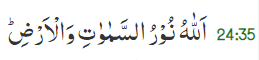
We read in the Qur’an: “Allah is the Light of the heavens and the Earth; a likeness of His light is as a niche in which is a lamp, the lamp is in a glass, (and) the glass is as it were a brightly shining star, lit from a blessed olive-tree, neither eastern nor western, the oil whereof almost gives light though fire touch it not– light upon light– Allah guides to His light whom He pleases, and Allah sets forth parables for people, and Allah is the Knower of all things.” Surah al-Nur. 35]
Allah is the Light. This is both a name and attribute of Allah. He is the Light of the heavens and the Earth and the light illuminating the hearts of the believers. Prophet Muhammad (peace be upon him) said: “His veil is of light. If He were to lift it, the glory of His countenance would ignite everything in creation as it is touched by His gaze.” [Sahih Muslim (179)]
Allah’s Light & Created Light: Created light is of two kinds. First there is physical light, like the light of the Sun and stars. Then there is abstract light, like the light of knowledge and the light of faith which illuminates the heart. Prophet Muhammad (peace be upon him) used to offer the following supplication: “O Allah! Place light in my heart, my sight, and my hearing. Surround me with light to my right and my left, above and below me, before me and behind me. Intensify the light that I have.” [Sahih al-Bukhari (6316) and Sahih Muslim (763)]
Some commentators of the Qur’an have interpreted “Allah is the Light of the heavens and the Earth” to mean that Allah is the Creator and Originator of the light. However, the best approach is to interpret the verse literally as establishing a name and attribute of Allah. This is confirmed by the fact that Prophet Muhammad (peace be upon him) used to say in supplication: “You are the light of the heavens and the Earth and all they contain, and Yours is the praise.” [Sahih al-Bukhari (1120) and Sahih Muslim (769)]
63 The Indivisible (al-Witr)


The Arabic word witr refers to a single, indivisible entity. It also refers to a number that cannot be divided by two. The word is found with this second meaning in the verse: “(I swear) by the even number and the odd.” [Surah al-Fajr. 3]
Prophet Muhammad (peace be upon him) called Allah by this name when he said: “Allah has ninety-nine names, one hundred less one, whoever comprehends them all will enter Paradise, and He is Indivisible and loves that which is indivisible.” [Sahih al-Bukhari (6410) and Sahih Muslim (2677)]
Allah is the Indivisible whose essence cannot be divided. He has no partner, and there is no one who can compare with or rival Him in any way. He is One, unique in His names, attributes and actions. “There is nothing like unto Him, and He is the Seeing, the Hearing.” [Surah al-Shurd: 11] and: “Do you know of any who is worthy of His name?” [Surah Maryam: 65]
Allah is Indivisible, and He loves it for us to observe our devotions an odd number of times. Prophet Muhammad (peace be upon him) said: “Followers of the Qur’an, observe (devotions) an odd number of times, for Allah is Indivisible and loves that which is indivisible.” [Sunan al-Tirmidhi (453), Sunan Abi Dawud (1416), Sunan al-Nasa’i (1675), and Sunan Ibn MaJah (1169))
What this means is that Allah loves all that He prescribed for us to observe in odd numbers. He loves these things because He commanded us to observe them and determined them to be carried out in their particular forms in accordance with the dictates of His wisdom. What devotions are being referred to here? Scholars have differed in answering this question. Some say that the Prophet (peace be upon him) is speaking about the Friday prayer, or the Day of ‘Arafah during the Pilgrimage, or to the Maghrib prayer which is three units long, or to the Witr prayer at the end of the day which is always observed as an odd number of prayer units. However, the best approach is to understand it as general in meaning, applicable to all prescribed acts of devotion that are observed an odd number of times.
I also believe that it refers to the worshippers who are foremost in doing good deeds, since they stand alone in excellence by doing far more than others are willing to do. Allah praises them by saying: “The foremost are the foremost.” [Surah al-Wdqi’ah: 10] and by saying: “Be foremost in seeking forgiveness from your Lord.” [Surah al-Hadid: 21]
Likewise, Prophet Muhammad (peace be upon him) “Those who strive in competition (for excellence) stand peerless.” When he was asked who he was referring to, he said: “They are the men and women who remember Allah often.” [Sahin Muslim (2676)]
Allah loves those who stand out ahead of the rest through their devotion and their good deeds, especially when they strive to help others. Allah says: “For this, those who strive with each other should strive.” [Surah al-Mutaffifin: 26] By contrast, Allah hates those who strive with one another in stinginess, sin, iniquity and misappropriating the rights of others.
Allah is alone, separate and distinct from His creation. He is the Indivisible who has created His creatures in pairs. We find numerous examples of this. Rarely do we find things that are indivisible into pairs. Allah says: “And everything We have created in pairs, so that perchance you might reflect.” [Surah al-Dhariyat. 49]
There is a supplication associated with this meaning. Once, Prophet Muhammad (peace be upon him) entered the mosque and saw a man who was sitting and completing his prayer. The man was supplicating with the following words: “O Allah! I ask You by Your being the One, Alone, the Self-Subsisting who neither begets nor is begotten, and who none is like unto Him. I ask You to forgive me my sins, for you are the Forgiving and Merciful.”
Upon hearing this, Prophet Muhammad (peace be upon him) said three times: “Allah has forgiven him.” [Sunan Abu Ddwud (985) and Sunan al-Nasd’i(1301)]
64 The Guide (al-Hadi)


Allah is the Guide who shows people the path of faith, who guides them to believe in Him and affirm His divinity. Likewise, it is Allah who guides all creatures to what they need to live their lives. Even the birds and beasts know what they need to know to sustain their daily existence and avoid harm by His grace.
When ‘Ali asked Prophet Muhammad (peace be upon him) to recommend to him some words to use in supplication, the Prophet advised him to say: “O Allah! Guide me and set my affairs aright.” [Sahih Muslim (2725)]
The Qur’an refers to Allah by this name in the verse: “Your Lord is sufficient as a Guide and a Helper.” [Surah al-Furqan: 31] and in the verse: “Allah is the Guide of those who believe to a way that is straight.” [Surah al-Hqjj: 54]
Levels of Guidance: The Qur’an refers to Allah’s guiding all living creatures through the instincts He has instilled in them when it says: “Our Lord is He who gave to everything its creation, then guided it.” [Surah TaHa: 50] This is the first level of guidance.
The second level of guidance is what Allah has revealed to humanity by way of revelation to His prophets and messengers. “We appointed from among them leaders who guided by Our command.” [Surah al-Sqjdah: 24]
The third level of guidance is His inspiring our hearts and minds to what pleases Him and protecting us through His grace. Allah promises the believers in the Qur’an as follows: “Those who believe and work righteousness, their Lord will guide them because of their faith.” [Surah Yunus”. 9] and: ” … and whoever believes in Allah, then Allah guides their hearts aright.” [Surah Taghabun: 11] and: “Those who strive in Our (cause), We will certainly guide them to our paths: For verily Allah is with those who do right.” [Surah al- ‘Ankabut. 69]
The final level of guidance is realized in the Hereafter, when Allah guides the denizens of Paradise to their abodes and to pleasures that they had not even imagined during their worldly lives. Allah says: “He will guide them and improve their condition, and admit them to the Garden which He has made known to them.” [Surah Muhammad: 5-6] and: “Praise be to Allah who guided us to this. Never could we have found guidance, had it not been for the guidance of Allah.” [Surah al-A ‘raf. 43]
65 The Originator (al-Badi’)


Allah is referred to by this name in the Qur’an in two places. The first is: “The Originator of the heavens and the Earth! When He decrees a thing, He but says of it: ‘Be!’ and it is.” [Surah al-Baqarah: 117]
The second place is: “The Originator of the heavens and the Earth! How can He have a child, when there is for Him no consort, when He created all things and is Knower of all things?” [Surah al- An’am: 101]
Allah created the heavens and Earth from nothingness, without relying upon any pre-existing pattern. This is very different from human creativity. When we wish to produce something – for instance, a small house – we need to rely upon some pre-existing example or pattern. We might make some modifications to it, choosing things to suit our taste or adapting the general idea to our particular needs and circumstances, but our imaginative powers remain confined to that which we have already experienced. This is one of our human weaknesses, one of the many limitations upon our creative powers.
Allah, on the other hand, is the Creator and Originator who has brought into existence the heavens and Earth and all that they contain without any pre-existing pattern or template. He originates the very idea and pattern of all things as well as the things themselves. We should consider the bewildering diversity of Allah’s creation: things as different as the stars, the air, water, light, and stone; as wellplantsas living and animals, and that unique creation, the human being who can acknowledge Allah as the Creator and praise Him for originating everything in existence.
Consider something as commonplace as water. If we had never experienced it before – never seen it, touched it, tasted it, or felt it – how could someone explain it to us? What could they say? We would probably consider any explanation given of it something too fantastic to believe.
Now consider trying to describe light: something by which things are exposed to sight, but which itself seems to have no form or tangible substance and which cannot be grasped or contained. Then consider trying to explain the difference between light and fire. What can we say? We might say that fire combusts things while light does not do so, since light is the quality of exposing things to vision. This would be a confusing explanation at best.
Consider trying to describe the air we breathe and its affect on us. Air is essential to life and to many of the processes that take place in our world, processes that we can plainly see. But air itself is invisible. It cannot be grasped by the hand. We can see from these examples how difficult it would be to imagine such common place things had they not already been part of our experience. Human imagination cannot originate a new pattern. Our familiarity with these things makes us heedless of their originality, but if we contemplate on them, we realize how varied and wonderfully original Allah’s creation is.
In a number of verses, the Qur’an makes mention of Allah’s signs in the universe, signs which attest to His greatness and to the fact that the universe has a Creator, and even that there will be a life after death:
Have they not then observed the sky above them, how We have constructed it and beautified it, and how there are no rifts therein? And the earth- We have spread it out, and set thereon mountains standing firm, and produced therein every kind of beautiful growth, a vision and a reminder for every penitent devotee. And We send down from the sky blessed rain by which We produce gardens and grain for harvests, and lofty date-palms with ranged clusters of fruit, as sustenance for (Allah’s) Servants. And We give (new) life therewith to land that is dead. Thus will be the Resurrection. [Surah Qaf. 6-11]
These verses speak about the proof of Allah’s greatness, His absolute power, and the reality of the resurrection after death. Consider the red blood cells that perform the essential function of transporting oxygen throughout the body. They are too small for the eyes to see, but they are so numerous that if they were stretched out in a single line, they would circle the Earth five times. There are roughly five million red blood cells in every cubic millimeter of blood. When one of these cells circulates through the body, it travels an astonishing 1150 kilometers, a journey that we are not even aware is taking place right within ourselves.
Likewise, the heart which pumps this blood does so non-stop for the seventy, eighty or more years of the human life. If the average lifespan is between sixty or seventy years, this means that the average heart will pump over 56 million liters of blood. In spite of this, the heart does not require any calibration, maintenance or down-time the way that instruments of human manufacture do. The heart goes on performing its vital function while we remain blissfully unaware.
Every day, science reveals wonders further that attest to Allah’s originality and creative powers. Science has been making rapid strides in recent years, and we might think that our scientific knowledge is mature. The truth is that science is still very young. The knowledge that science has uncovered is a mere fraction of what we still need to explore.
Human beings can be creative and innovative, but within limits. Our creativity takes place within the context of what Allah has created. Human beings should certainly celebrate and exercise their creative abilities, which are themselves a further testament to Allah’s greatness, since it is He who gave us the abilities that we have. For instance, we use language to produce amazing works of literature, but it is Allah who gives us the aptitude for language. If we pause to consider how it is that we can communicate with each other with sounds and signs, and how diverse our languages are, we will be humbled by the wonder of it.
Whatever we fashion through language, or through the arts, or by means of modern technology, it is from what Allah has bestowed upon us. The horizons of human creative potential that Allah has afforded us are vast, and if we utilize our inventiveness in ways that are lawful and good, it pleases Allah. There is, however, one area of life where human innovation is not desired, and that is in essential matters of faith and religious practice which must be defined for us by Allah alone. We are not supposed to concoct for ourselves rituals by which to worship Allah and draw near to Him. Allah knows how He wishes for us to worship Him, and He has revealed this to us through His prophets and messengers.
This is also from Allah’s greatness and His mercy upon us. By closing this door, Allah protects us from turning our lives into a confusing mass of contrived rituals, mystical experiences, and superstitions “about which Allah has revealed no sanction.” [Surah Yusuf 40] Allah, in this way, frees us and our creative potential. He has given us broad scope to be inventive and creative, inspiring us to employ our minds, gifts, skills, and ingenuity to develop that which will enhance and improve human life.
66 The Inheritor (al-Warith)


To inherit is to receive something left by someone else. With respect to human beings, it is the transfer of wealth and property from a prior party to a later party. Generally, those who remain after others have gone are inheritors.
Allah is referred to as the Inheritor in the following verses: “It is We who will inherit the Earth and all who are on it.” [Surah Maryam: 40]
“Indeed, it is We who give life, and who cause to die, and it is We who are the Inheritors.” [Surah al-Hijr. 23]
“And remember Zechariah, when he cried unto his Lord: ‘My Lord! Leave me not childless, though You are the Best of inheritors.” [Surah al-Anbiya’: 89]
“And how many a town have We destroyed which exulted in its means of subsistence, so these are their abodes, they have not been dwelt in after them except a little, and We are the Inheritors.” [Surah al Qasas. 58]
Allah is the Inheritor who will inherit the Earth and all that is upon it. Everything and everyone will perish and nothing will remain but Him. Allah is the Inheritor of creation, because He will remain when everything else is gone: “It is We who will inherit the Earth and all who are on it, and to Us they shall be returned.” [Surah Maryam: 40]
Allah is also the Inheritor who possesses all things and bequeaths them on whom He pleases from among His creatures, one after another. This name of Allah expresses that Allah is the true owner of all things. He possesses us and all that we might claim to possess. Those people who fancy that they are the true owners of their property should remember that one day they shall die and they will be forced to relinquish what they possess. Allah’s possession of all things is the only true, enduring ownership.
Consider what the Qur’an says about the Day of Judgment: “The Day whereon they will (all) come forth: not a single thing concerning them is hidden from Allah. Whose is the dominion this day? It is Allah’s, the One, the Subduer (of all)!” [Surah Ghafir. 16]
Allah will ask on that Day: “Whose is the dominion?” He will, Himself, give the answer: “It is Allah’s, the One, the Subduer (of all)!”
Benefits of Knowing this Name: Knowing that Allah is the Inheritor is a warning to those who would enrich themselves by oppressing others, as well as those who live in comfort and security without giving thanks to Allah.
Allah says: “And how many towns have We destroyed which exulted in its means of subsistence, so these are their abodes, they have not been dwelt in after them except a little, and We are the Inheritors.” [Surah a!Qasas-. 58]
Allah is their Inheritor. He may choose to replace those people with others who will occupy their homes and their lands, or He may leave them without successors from among humankind. Ultimately, this will be the case for all people and all things: “It is We who will inherit the Earth and all who are on it.” [Surah Maryam: 40]
Knowing this name of Allah should inspire us to spend in charity seeking Allah’s pleasure. It makes us realize that we have been given the wealth we are merely as trustees. Allah says: “Believe in Allah and His Messenger, and spend in charity out of what He has made you trustees.” [Surah al-Hadid: 7]
Likewise, Allah reminds us that what we spend for His sake would return to Him anyway, since it is He who will inherit the heavens and the Earth: “And what cause have you not to spend for Allah’s sake, when to Allah belongs the inheritance of the heavens and the Earth?” [Surah al-Hadid: 10]
67 The Good ( al-Tayyib)

Prophet Muhammad (peace be upon him) referred to Allah as the Good when he said, as related in Sahih Muslim (1015): People! Allah is Good and He only accepts what is good. He has commanded the believers as He has commanded the Messengers: “O Messengers! Eat of the good things and do righteous deeds.” [Surah al-Mu’minun: 51] And He says: “O you who believe! Eat of the good things that We have provided for you, and be grateful to Allah, if it is Him you worship.” [Surah al-Baqarah: 172]
Allah is Good. He is not tainted with evil, corruption, or deficiency in any way. On the surface, this name is very similar in meaning to Al-Quddis (The Holy One). However, this name also communicates the idea that we can only draw near to Allah with what is good. The deeds that we perform, the words that we utter, and the wealth that we spend seeking Allah’s pleasure must be good and pure. Allah says: “Unto Him ascends the good word and the good deeds He elevates.” [Surah Fatir. 10]
Likewise, we say in our daily prayers while seated in tashahhud: “Our greetings are for Allah, and our salutations and all good things.”
Whatever is good we dedicate to Allah. He loves that which is good and He loves good people. He guides those He loves to that which is good: “And they are guided to goodly words, and they are guided to the path of One who is Praiseworthy.” [Surah al-Hqjj: 24] He has prepared Paradise to be the abode of good people: “”Peace be upon you! You have done good! Enter here, to dwell therein.”” [Surah al-Zumar. 73]
Likewise, He describes Paradise as being a place of goodness: “Allah has promised to the believing men and the believing women gardens, beneath which rivers flow, to abide in them, and goodly dwellings in eternal gardens; and best of all is Allah’s good pleasure; that is the grand achievement.” [Surah al-Tawbah: 72] The lives of the true believers in this world are good lives, full of sanctity and acceptance, blessed by Allah’s grace and mercy.
68 The Exalter of Status (Rafi’ al-Darajat)

This name appears in the Qur’an in two places: “Possessor of the Highest Rank, Lord of the Throne.” [Surah Ghafir 15] and: “… Allah, the Lord of the Ways of Ascent.” [Surah al-Ma’arij: 3] This name communicates a number of meanings:
* Allah is the one who created the seven heavens and continues to maintain them.
* Allah’s names and attributes are endowed with the most elevated meanings, and He is perfect and complete in His power and in His being worthy of all glory and praise.
* Allah raises by degrees His devoted, pious servants in this world through the success, sanctity and grace that they experience, and in the Hereafter by their being admitted into Paradise.
In this regard, Allah says: “Allah raises up by degrees those among you who believe and are given knowledge.” [Surah al-MuJadilah: 11] Allah has made knowledge and faith means by which He raises the status of the believers.
Allah also says: “He it is who has placed you as viceroys on the Earth and has exalted some of you in rank above others.” [Surah al-An ‘am: 165] In this verse, common measures of Earthly status -like wealth, prestige, skill, and authority – are addressed. These are the things which people are degrees given in different and by which they are tested in this world.
69 The Benefactor (Al-Mannan)


This name appears in the hadith about Allah’s greatest name where Anas relates that a man offered the following supplication: Allah! I beseech You by affirming that Yours is the praise, there is no god besides You, the Bestower, Originator of the Heavens and the Earth, the Lord of Bounty and Honor, the Living, the Self-Subsisting.
To this, the Prophet said: ” I swear by Him in whose hand is my soul, this man has beseeched Allah with His greatest name, which if anyone supplicates with it, that supplication will be accepted, and if anyone asks by it, it will be granted.” [Sunan al-Tirmidhi (3544), Sunan Abi Ddwud (1495), Sunan al-Nasa’i (1300), and Sunan Ibn Mqjah (3858)]
There are many verses in the Qur’an which establish that Allah confers His favor upon His creatures (using the verb manna “to confer favor” from which this name derives). Allah says: “Allah did confer a great favor on the believers when He sent among them a messenger from among themselves, rehearsing unto them the signs of Allah, sanctifying them, and instructing them in scripture and wisdom, while, before that, they had been in manifest error.” [Surah Al ‘Imran: 164]
“And We had bestowed Our favor upon Moses and Aaron.” [Surah al-Safat. 114]
“Nay, it was Allah who bestowed His favor upon you by giving you faith, if indeed you are truthful.” [Surah al-Hujrat. 17]
“And We desired to bestow a favor upon those who were deemed weak in the land, and to make them the leaders, and to make them the heirs.” [Surah al Qasas-. 5]
… but Allah has bestowed favor on us, and has delivered us from the punishment of the scorching wind.” [Surah al-Tur. 27]
“You too were in such a state before, until Allah bestowed His favor on you.” [Surah al-Nisa’: 94]
“And certainly We bestowed on you a favor at another time.” [Surah TaHa: 37]
Allah is the Benefactor who bestows that which is good. He confers His blessings on us, grants us health, security, and prosperity. He blesses us with reason and knowledge, and He gives us the greatest blessing of faith. At times, Allah might confer His favor upon us by tryinginus with difficulty our lives, or our wealth, or our loved ones, since by doing so we might be guided to repent, beseech His forgiveness, and return to a good way of life.
Allah loves it for us to be charitable to one another, but He disapproves of our reminding those we have done good for that we are their benefactors. It is not right for us to constantly remind people of the good we have done for them. Allah says: “Those who spend their substance in the cause of Allah, and follow not up their gifts with reminders of their generosity or with injury, for them their reward is with their Lord.” [Surah al-Baqarah: 262]
70 The Helper (al-Nasir, al-Naasir)

Allah is referred to in the Qur’an as “the Helper” by the name al-Nasir and by the more emphatic form al-Naasir.
The name al-Nasir appears in the following verses: “Your Lord is sufficient as a Guide and a Helper.” [Surah al-Furqan: 31] and: “He is the most excellent Patron and the most excellent Helper.” [Surah al-Anfal: 40] and: “Allah is sufficient as Patron and Allah is sufficient as a Helper.” [Surah al-Nisa’: 45] and: “Hold fast to Allah. He is your Patron. A most blessed Patron and a most blessed Helper!” [Surah al-Hajj: 78]
The name al-Nasir appears, in the plural form, in the following verse: “But Allah is your Patron, and He is the best of helpers.” [ Surah Al ‘Imran: 150 ]
Furthermore, Allah’s help is mentioned a number of times. For instance: “If you help Allah, He will help you.” [Surah Muhammad: 7] and: “Most surely We help Our Messengers and those who believe, in this world’s life and on the day when the witnesses shall stand.” [Surah Ghafir 51] and: “On that day, the believers will rejoice on account of Allah’s help. He helps whom He pleases.” [Surah al-Rum: 4-5]
Allah commands us to be His helpers: “O you who believe! Be helpers of Allah.” [Surah al-Sqff. 14] and: “so that Allah may know him who will help Him and His messengers, though unseen.” [Surah al-Hadid: 25]
One of the ways that Allah helps the believers is by making it easy for them to obey Him and by protecting them from going astray. He helps them to be sincere to Him, pure in their intentions , and free from baseness of character.
Allah also helps the believers by protecting them from those who show them enmity, and from those who wish to cause them harm on account of their faith. Prophet Muhammad (peace be upon him) related to us that Allah says: “Whoever shows enmity to one of My devotees should know that I, Myself, declare war upon them.” [Sahih al-Bukhari (6502)]
Allah also helps them to realize their lawful and wholesome dreams and goals that they strive through their efforts to attain. Allah enjoins upon us to take the practical steps we need to take in order to reach our goals. Then Allah promises His help in bringing those goals to fruition. This is why Allah says to His Prophet: “When the help of Allah and the victory comes, and you see the people entering Allah’s religion in crowds, then glorify the praises of your Lord and ask His forgiveness. Truly, He is the Accepter of Repentance.” [Surah al-Nasr. 1-3]
Allah’s help is not to be taken as an excuse to be lazy and unproductive. It is rather an incentive and reward for the industrious. Prophet Muhammad (peace be upon him) used to strive as hard as he could to achieve his goals, making every sincere effort, taking every practical and lawful step available, all the while exhibiting impeccable moral character. Then he would say: “O Allah, you are my Supporter and You are my Helper. By Your grace I set out, by Your grace I advance, and by your grace I strive.” [Sunan al-Tirmidhi(3584) and Sunan Abi Dawud (2632)]
Allah’s help comes to those who show patience. Prophet Muhammad (peace be upon him) said: “Know that Allah’s help comes with patience.” [Musnad Ahmad (2666) and Mustadrak al-Hakim (3/541-542)]
Believers are inspired by Allah’s name “the Helper” to persist in their efforts, rise up to challenges, and avoid succumbing to resignation. Likewise, they understand from Allah’s name “the Guide” that they need to employ the practical means that Allah has guided them to so that they can achieve their goals.
Even Allah’s prophets and messengers had to work to achieve their goals. They were not given free and easy victories. People rejected and abused them, and they had to bear this patiently until Allah granted them success.
It is a grave mistake for Muslims to derive from Allah’s names a sense of resignation – the idea that they can sit down and be indolent and wait for Allah to give them what they want. A proper contemplation of Allah’s names should inspire us to turn our minds to positive action, and to be confident in utilizing the abilities and gifts that Allah has blessed us with, while placing our reliance in Allah. Those who have such an attitude can achieve in one year what it takes others years to accomplish, due to the blessings of Allah’s grace and favor, and from the way true faith can unlock a person’s hidden potential.
71 The Possessor of Munificence (Dhu al-Tul)

This name of Allah is mentioned in the following verse of the Qur’an: “The Forgiver of Sin, the Accepter of Repentance, the Stern in Punishment, the Possessor of Munificence – There is no god save Him. Unto Him is the final destination.” [Surah Ghafir. 3]
This verse is an eloquent expression of Allah’s grace and mercy. It begins by mentioning the forgiveness of sin and the acceptance of repentance. It goes on to remind us of Allah’s punishment for those who persist in rebelliousness. Then it returns again to an affirmation of Allah’s grace and munificence. Allah is the Possessor of Munificence: His gifts are boundless, His generosity limitless, and His favor never-ending.
This name is an affirmation of Allah’s omnipotent power. He is not limited in His ability to give and to bestow His favor and grace on whom He pleases. Allah says: “If you were to count Allah’s favors, you would not be able to number them; most surely humanity is very unjust, very ungrateful.” [Surah Ibrahim: 34]
72 The One Whose Help is Sought (al-Musta‘an)


Many people overlook this name of Allah, though it appears twice in the Qur’an: “He said: Nay, but your minds have beguiled you into something. (My course is) goodly patience, and Allah it is whose help is to be sought in that (predicament) which you describe.” [Surah Yusuf. 18]
And: “Our Lord is the Beneficent, whose help is to be sought.” [Surah al-Anbiya’: 112]
Of course, there is also the verse of Surah al-Fatihah where we declare: ”You alone we worship, and from You alone we seek help.” [Surah al-Fatihah: 5]
We also have the following account related by Abu Musa al-Ash ‘ari: Once ‘Uthman paid a visit to Prophet Muhammad (peace be upon him) and sought permission to enter. The Prophet said to me: “Bid him enter and give him glad tidings of Paradise on account of a calamity that shall befall him.” I went and admitted him and informed him of what Allah’s Messenger told me. Upon hearing it, ‘Uthman praised Allah and then said: “Allah is the One Whose Help is Sought.” [Sahih al-Bukhari (3693) and Sahih Muslim (2403)]
Allah is the one from whom we must seek assistance, the one we must rely upon for support. Prophet Muhammad (peace be upon him) used to beseech Allah with the following supplication: “O Allah! Help me to keep up Your remembrance, to thank You, and to worship You in the best of ways.” [Sunan al-Tirmidhi (3407), Sunan Abi Dawud (1522), and Sunan al-Nasa’i (1303)]
This name is significant in that it is not only a name of Allah, but also a confirmation of the qualities of initiative, motivation, and capability which Allah has placed within the human being. This is because it implies the that person first embarks upon an enterprise, takes the initiative to act, and then seeks Allah’s help to complete it. The name also affirms that human beings are not self-sufficient in their efforts, but are dependent upon Allah for their success.
It is related that the Prophet’s Companion Abu Musa al-Ash ‘ari used to say in supplication: “O Allah! Yours is the praise. To You we appeal with our grievances, and You are the one we beseech for help and relief. Upon You we rely. There is no might and power except with You.” This is one of the most comprehensive of remembrances.
Allah’s help is sought in worldly matters related to our life’s needs, like marriage, family, health, and finances. Likewise, it is sought with regard to spiritual matters, like our God-consciousness, worship, and gratitude towards Allah. Allah says: “And you do not will except that it is the will of Allah, the Lord of the Worlds.” [Surah al-Takwir. 29]
73 The All-Encompassing (al-Muhit)


The Qur’an refers to Allah by this name on eight occasions. For instance:
“Or like abundant rain from the cloud in which is utter darkness and thunder and lightning; they put their
fingers into their ears because of the thunder peal, for fear of death, and Allah encompasses the unbelievers.” [Surah al-Baqarah: 19]
“Allah encompasses them on every side.” [Surah al-Buruj: 20]
“Allah encompasses all things.” [Surah al-Nisa’: 126]
“Allah encompasses round all that they do.” [Surah Al ‘Imran: 120]
Allah encompasses His creation in many ways. He encompasses all things with His knowledge, power, authority, and decree. Because of this, we can discern both a general and specific application for this name. The general application applies to believers and unbelievers alike. The specific application is a warning to those who are disobedient to Allah or stubbornly refuse to believe in Him. This name tells them that Allah is aware of their actions, schemes, and deceptions. Allah encompasses them in their machinations. He is heedful of all they do, and their ultimate return is to Him. Where do they hope to escape to?
Allah encompasses the unbelievers by thwarting their designs in this world and by helping the believers. In this context, Allah says: “And other gains (there are), which are not within your power, but Allah has surely encompassed them, and Allah has power over all things.” [Surah al-Fath: 21] and: “If you are constant and do right, not the least harm will their cunning do to you; for Allah encompasses round all that they do.” [Surah Al ‘Imran: 120]
Allah says: “If you are constant and do right … ” This tells us our belief that Allah is All-Encompassing should strengthen our resolve as believers and inspire us live positively. We should feel responsible for what we do in life and know that there is no excuse for simply resigning ourselves to fate. We should not blame our circumstances or our opponents for our failures, or come up with various excuses to justify our indolence and negligence. We should always strive to better ourselves and our world.
74 The God (al-Ilah)

Allah is the one and only true God who alone deserves to be worshipped. Our declaration: “There is no god but Allah” is an affirmation of this meaning. It asserts that Allah alone possesses divinity, and thereby asserts that He alone has complete and perfect knowledge, power, mercy, and wisdom.
This name appears in many verses of the Qur’an in various contexts. For example: “He it is who is the God in the heavens and the God on Earth, and He is Wise, All-Knowing.” [Surah al-Zukhruf 84]
“They surely disbelieve who say: Lo! Allah is the third of three; when there is no god save the One God.” [Surah al-Maidah: 73]
“Were you witnesses when death came to Jacob? He said to his sons: ‘What will you worship after me?’ They said: ‘We shall worship Your god and the god of your fathers Abraham, Ishmael and Isaac – the one true God, to Him we submit ourselves.'”‘ [Surah al-Baqarah: 133]
“Indeed your God is One God.” [Surah al-Safat. 4]
“And your God is One God; there is no god save Him, the Beneficent, the Merciful.” [Surah al-Baqarah: 163]
“Say: I seek refuge with the Lord of humanity, the King of humanity, the God of humanity.” [Surah al-Nas: 1-3]
This name also appears in the Prophet’s Sunnah. For instance, Prophet Muhammad (peace be upon him) used to offer the following supplication in his night prayers: “O Allah! Yours is the praise. You are the Lord of the heavens and the Earth … You are my God, I have no God besides You.” [Sahih al-Bukhari(7385) and Sahih Muslim (769)]
The Qur’an relates that Jonah (peace be upon him) appealed to Allah by this name. “And (remember) Jonah, when he went off in anger and deemed that We would not straiten him. But he cried through the depths of darkness, saying: ‘There is no God but You, Glory to You: I was indeed wrong!”‘ [Surah al-Anbiya’: 87]
Prophet Muhammad (peace be upon him) affirmed: “This was Jonah’s supplication when he was in the belly of the whale: ‘There is no God but You, Glory to You: I was indeed wrong!'” [Sunan al-Tirmidhi (3505)and Sunan al-Nasa’i al-Kubra (10492)]
Prophet Muhammad (peace be upon him) invoked Allah as the “God of humanity” when he supplicated Allah for healing: “Remove this illness, 0 Lord of humanity, God of humanity!” [Sunan Ibn Majah (3473)]
When we refer to Allah as “the God”, we invoke a name that comprehends all of the divine epithets in their full perfection. Every other name of Allah is implied in this name. Indeed, most etymologists agree that the name Allah is derived from al-Ilah “the God”. Allah is Our God and Our Lord and Our King. There is none other who relieves us of our burdens or to whom we seek refuge. There is no object of worship besides Him. We do not beseech anyone or anything else in prayer. We do not offer ourselves in devotion, reverence, and humility to anyone else. He is the true God – the only true God for all humanity. He is Lord their and Creator.
No one should seek their success and salvation in anyone or anything else. Allah is sufficient a Helper and Protector for all humanity. He governs all affairs.
75 The Magnanimous (al-Jawad)
To be magnanimous is to show generosity through liberal and gracious giving. If all the magnanimous behavior ever exhibited by human beings were placed in comparison to Allah’s magnanimity, it would be as speck of dust to all the mountains of the Earth. When Allah commands and prohibits things, He does so out of mercy for us. He has no need for what He commands us to perform, and He does not prohibit us from things for His own sake. What He commands and forbids is for our own welfare.
Among the greatest recipients of Allah’s magnanimity are the sinners. Allah lets them continue living their lives, sleeping contentedly in their beds as if they had never disobeyed Him. Allah continues to protect, maintain, and provide for them. He continues to answer their prayers when they turn to Him. Allah is the Magnanimous for whom all human magnanimity depends. He is the Generous by whose generosity human acts of generosity are possible. He is the one who gives to those who ask of Him, and even to those who disdain to ask.
Allah makes Himself known to us and shows His love, though He has no need of us. It is from His grace that He lets us know Him. Prophet Muhammad (peace be upon him) said: “Allah’s hands are full, and that fullness is not diminished by His giving day and night … Do you consider what He has given since He created the heavens and the Earth? It has not in any way reduced what He possesses.” [Sahih al-Bukhari (7411) and Sahih Muslim (993)]
Prophet Muhammad (peace be upon him) referred to Allah by this name on many occasions. For instance, he related that Allah says: My servants! All of you are astray except for those I guide, so ask Me for guidance and I will guide you … 0 My servants! If the first of you and the last of you, human of you and jinn of you, were to stand as one and ask of Me and I were to give each person what he asked for, it would not diminish what I have, any more than the ocean would be diminished if a needle were dipped into it. For indeed I am the Magnanimous, the Glorious, the Doer of what I please … ” [Sunan al-Tirmidhi (2495) and Sunan Ibn Majah (4258)]
Prophet Muhammad (peace be upon him) also said: “Allah is Good and He loves goodness. He is Pure and He loves cleanliness. He is Generous and He loves generosity. He is Magnanimous and He loves magnanimity.” [Sunan al-Tirmidhi (2799)]
And he said: “Allah is Magnanimous and He loves magnanimity. He loves excellent moral character and detests meanness.” [Musnad Ibn Abi Shaybah (26617) and al-Bayhaqi in Shu’ab al-iman (10840)]
Our awareness that Allah is Magnanimous should inspire us to spend of what we have for Allah’s sake. This is why Prophet Muhammad (peace be upon him) was the most magnanimous of men. The Prophet’s Companion lbn ‘Abbas relates: “When it came to doing good, Allah’s Messenger (peace be upon him) was the most magnanimous of people, and he was at his most magnanimous during the month of Ramadan.” [Sahih al-Bukhari (1902) and Sahih Muslim (2308)]
Human magnanimity can be summarized as follows:
To be magnanimous with of one’s life in the service of others.
To be magnanimous with one’s authority in fulfilling the needs of others.
To be magnanimous with one’s leisure in working for the benefit of others.
To be magnanimous with one’s knowledge by imparting it.
To be magnanimous with one’s prestige by interceding to help people.
To be magnanimous with one’s limbs, for every king gesture is a form of charity.
To be magnanimous through tolerance by pardoning other people’s insults.
To be magnanimous through patience by bearing other people’s wrongs.
To be magnanimous by exhibiting gracious manners.
To be magnanimous by not coveting what other people possess.
These expressions of magnanimity are limited to what created beings can accomplish. By knowing ourselves, we can get a better understanding of our Lord. When we realize how we fall short in our generosity, we come to better appreciate the extent of Allah’s magnanimity, for truly it knows no bounds.
Allah loves for us to place our hopes in Him and to ask Him of His bounty. Since He is Magnanimous, He loves to be asked and He loves to give. Prophet Muhammad (peace be upon him) said: “Allah is displeased with those who disdain to ask of Him.” [Sunan al-Tirmidhi (3373))
Allah’s bounty does not diminish by His imparting it to His creatures. When He withholds something, it is due to His wisdom. It does not in any way contradict with His magnanimity. Allah provides everything at the proper time and place, in accordance with His knowledge and wisdom. Allah says: “And if Allah were to enlarge the provision of His servants, they would certainly revolt in the Earth; but He sends it down according to a measure as He pleases; surely He is Well-Aware of His servants, All-Seeing.” [Surah al-Shura: 27]
76 The Possessor of Modesty (al-Hayiyy)

Modesty, or a sense of shame, is a character trait that describes someone who shuns what which is base and ignoble. For people, this could be with respect to matters of morality, religious law, reason, good taste, or custom. Prophet Muhammad (peace be upon him) describes Allah as being the Possessor of Modesty. We understand this to apply to Allah in a manner that is appropriate for His Majesty. For instance, Prophet Muhammad (peace be upon him) said: ”Your Lord Allah is the Possessor of Modesty, and He is Generous. When His servant reaches out to Him with outstretched hands, He feels ashamed to leave that servant with nothing.” [Sunan al-Tirmidhi (3556), Sunan Abi Ddwud (1488), and Sunan Ibn Majah (3865))
Also, Prophet Muhammad (peace be upon him) once saw a man who was bathing outside without using a waist cloth. Later, to address the issue, the Prophet (peace be upon him) ascended the mosque’s pulpit and spoke the congregation, saying: “Allah is the Possessor of Modesty, the Coverer of people’s faults, and He loves those who exhibit modesty and cover themselves.” [Sunan Abi Ddwud (4012) and Sunan al-Nasa’i(406)] At the same time, the Prophet (peace be upon him) informed us: “Allah is never ashamed of the truth.” [Sahih al-Bukhari (130) and Sahih Muslim (313))
Allah is the Possessor of Modesty who does not expose His servants when they sin and engage in shameful deeds, but conceals their faults and forgives them. Allah’s modesty is not like that of created beings. People have a sense of modesty and shame in that they fear being disgraced and fear losing their reputation. Allah, by contrast, refrains by His very nature from doing anything that goes contrary to His attributes of mercy, pardon, and magnanimity. Glory be to Allah who feels ashamed to leave His servant’s outstretched hands with nothing. Allah is described as exhibiting modesty and a sense of shame before His servant, and also that He is never ashamed of the truth.
Our knowledge that Allah is the Possessor of Modesty should make us feel our sense of shame before Allah all the more acutely. That sense of shame brings nothing but good. It preserves us from disobeying Allah when we are alone as well as when we are in the public eye. We should remind ourselves: “I know that Allah is watching me, and that makes me ashamed to let Him see me engaging an act of disobedience to Him.” Our sense of shame before Allah safeguards our thoughts from baseness and falsehood, our bodies from unlawful sustenance and sinful desires, and helps us not to be beguiled from the enticements of the world. Such a sense of shame and modesty can only exist in a heart that believes in the meeting with the Lord in the Hereafter and prefers the Hereafter to the life of this world. Allah says: “And as for those who fear the meeting with their Lord and restrain themselves from vain desires, Paradise is their destination.” [Surah al-Naziyat. 40-41]
77 The Possessor of Grace (Dhu al-Fadl)

This name is mentioned in the Qur’an twelve times. For example: “But Allah chooses for His mercy whom He wills, and Allah is the Possessor of Abounding Grace.” [Surah al-Baqarah: 105] “O you who believe! If you fear Allah, He will grant you a criterion (to judge between right and wrong), remove from you (all) evil (that may afflict) you, and forgive you, for Allah is the Possessor of Abounding Grace.” [Surah al-Anfal 29]
“Be foremost in seeking forgiveness from your Lord, and a garden the width whereof is as the width of heaven and Earth, prepared for those who believe in Allah and His messengers. That is the Grace of Allah, which He bestows on whom he pleases, and Allah is the Possessor of Abounding Grace.” [Surah al-Hadid: 21] “Surely grace is in the hand of Allah; He gives it to whom He pleases, and Allah is the Possessor of Abounding Grace.” [Surah al- Hadid: 29]
Every instance of worldly or spiritual good that we experience in our lives is purely from Allah’s grace. Nothing of it is our right or entitlement. This applies even to Allah’s prophets and messengers. Allah says: “But Allah chooses for His mercy whom He wills, and Allah is the Possessor of Abounding Grace.” [Surah al-Baqarah: 105] In this verse, Allah addresses His revelation and His choosing Muhammad (peace be upon him) as the one to receive the Qur’an. This was not something earned by the Prophet (peace be upon him). It was Allah’s gift that Allah chose for whom He pleased.
Allah is the Possessor of Grace, so noting can prevent Allah’s benevolence and bounty from reaching those of His creatures He wishes to favor. Allah says: “If He intends good to you there is none to repel His grace” [Surah Yunus-. 107] and: “Surely grace is in the hand of Allah; He gives it to whom He pleases.” [Surah Al Imran: 73] and: “That the People of the Scripture may know thatthey control naught of the bounty of Allah. Surely grace is in the hand of Allah; He gives it to whom He pleases, and Allah is the Possessor of Abounding Grace.” [Siirah al-Hadid: 29]
One aspect of Allah’s grace upon those who worship Him is that He protects them and safeguards them from those who would cause them harm. When people taunted the Muslims to fear the polytheists who had assembled against them, they said “Allah is Sufficient for us! Most Excellent is He in whom we trust as Disposer of our affairs!” As a result, Allah blessed them and … they returned with favor from Allah and (His) grace. No evil touched them and they followed the pleasure of Allah; and Allah is the Possessor of Abounding Grace.” [Surah Al Imran: 173-174]
Another aspect of Allah’s grace upon His servants is that He strengthens their hearts upon faith and safeguards them from going astray. Allah says: “And were it not for Allah’s grace upon you and His mercy, all but a few of you would have followed Satan.” [Surah al-Nisa’: 83] It is from Allah’s favor and grace that He defers punishing the sinners and hypocrites, and gives them a period of respite in the world. Allah says: “And what will those who invent a lie concerning Allah think on the Day of Resurrection? Lo! Allah truly is the Possessor of Grace toward humankind, but most of them do not give thanks.” [Surah Yunus- 60] This includes those who slandered the Prophet’s wife ‘A’ishah. Allah addresses the slanderers saying: “And were it not for Allah’s grace upon you and His mercy in this world and the Hereafter, a grievous chastisement would certainly have touched you on account of the discourse which you had entered into.” [Surah al-Nur 14] So glory be to Allah who possesses all favor, grace, and blessings.
78 The Lord of the Ways of Ascent (Dhu al-Ma’arij)
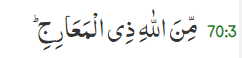
This name of Allah appears in the following verse of the Qur’an: “A questioner questioned concerning the doom about to fall the unbelievers there is none to avert it – from Allah, the Lord of the Ways of Ascent.” [Surah al-Ma’arij: 1-3]
This is a name of Allah and an attribute of His, because the angels ascend to Him and because He attributes this name to Himself. Allah is the Most High, the most lofty and sublime Lord to whom the deeds of His servants ascend. Allah says: “Unto Him ascends the good word and the good deeds He elevates.” [Surah Fatir. 10]
Allah also says: “To Him ascend the angels and the Spirit in a day, the measure of which is fifty thousand years.” [Surah al-Ma ‘arij: 4] It is related in the Sunnah that the angels attending to the daylight hours ascend with the record of the deeds performed by humanity during the day, and the angels attending to the night ascend with record of the deeds performed throughout the night. It therefore behooves us to endeavor to beautify the record of our deeds be being constant and persistent in performing acts of righteousness.
Prophet Muhammad (peace be upon him) said: Angels take turns in attending to you by day and by night. They meet together at the time of the dawn prayer and the time of the afternoon prayer, whereupon those who had been attending to you ascend and Allah asks them, though He is more aware of the answer than they are: “How have you left My servants?” They answer: “We left them while they were in prayer and we had come to them while they were in prayer.” [Sahih al-Bukhari-(555) and Sahih Muslim (632)]
79 The Gentle (al-Rafiq)

This name is established in the Prophet’s Sunnah. Once, a group of unbelievers approached the Prophet. Instead of saying the traditional greeting of peace “al-Salam ‘alaykum”, they purposely mispronounced the word for peace (al-salam) with a word for death (al-samm), so their greeting came out as “death be upon you”. The Prophet’s wife ‘A’ishah was incensed, and she retorted with: “Nay! Upon you be death and Allah’s curse!” The Prophet (peace be upon him) advised her to show restraint, saying: “O A ‘ishah, Allah is Gentle and He loves gentleness in all things.” [Sahih al-Bukhari (6927) and Sahih Muslim (2165)]
Also, at the time of his death, the Prophet (peace be upon him) declared his readiness to return: “to the Highest, Gentle Companion.” [Sahih al-Bukhari (4437,4438) and Sahih Muslim (2444)] Allah is Gentle in every way that conforms with His greatness and magnificence. He makes easy for His servants the path of righteousness and the means to do good. Allah says: “He will dispose of your affair towards comfort and ease.” [Surah al-Kahf 16]
One aspect of this facilitation to what is good is that Allah has made the Qur’an easy to learn and memorize. Another is that Allah gives His servants respite when they make mistakes and He does not hasten on their punishment. He gives them many chances to repent and make amends. Allah is not hasty. Hastiness is an attribute of those who fear missing out on an opportunity. One who possesses all things has no need for haste.
Allah is Gentle to His servants, and He is near to them. Therefore, he loves for us to be gentle in our dealings with one another. He wants us to be tolerant and to make things easy for each other. Prophet Muhammad (peace be upon him) said to ‘A’ishah on the same occasion mentioned above: “He gives to those who exhibit kindness what He does not give to those who show aggression. He gives us through our kindness what He gives through no other means.”
Prophet Muhammad (peace be upon him) also said: “Gentleness does not enter into something without beautifying it. Its absence from something makes that thing despicable.” [Sahih Muslim (2594)]
He also said: “Whoever is devoid of gentleness is devoid of good.” [Sahih Muslim (2592)]
Muslims should be gentle in all of their dealings. They should not be hasty with people or exhibit impatience. They should be cognizant of the fact that Allah is gentle and they should also be cognizant of the example of the Prophet’s gentle character. Those who wish to call other people to righteousness people and prohibit from wrongdoing should pay the greatest heed to this quality. Our faith in Allah should make us more gentle, tolerant, and merciful as people.
80 The Giver of Good (al-Mohsin)

Allah says: “To those who do good is a goodly reward – even more (than in measure)!” [Surah Yunus-. 26]
In this verse, the goodly reward is Paradise and what is more is the pleasure that the denizens of Paradise will have in gazing upon the countenance of the Lord. [Sahih Muslim (181)] Allah is the Giver of Good. This name was mentioned by Prophet Muhammad (peace be upon him) when he said: “Allah is the Giver of Good, and He loves those who exhibit goodness.” [ al-Tabardni al-Awsat (5735) and al-Silsilah al-Sahihah (469)]
Though the wording “the Giver of Good” does not appear in the Qur’an as name, its meaning appears on as a verb. For instance, Allah says, relating the words of Joseph (peace be upon him): “He has indeed been good to me when He took me out of prison and brought you all here out of the desert.” [Surah Yusuf 100] Allah has shown goodness to us by bringing us into existence from nothingness and then conferring upon us our human dignity. Allah says: “Had there not been a time when the human being was not a thing to be mentioned?” [Surah al-Insdn: 1]
Allah has shown goodness to us by creating humanity in the best of forms: “It is Allah Who has made for you the earth as a resting place, and the sky as a canopy, and has given you shape, and made your shapes beautiful, and has provided for you sustenance, of things pure and good. Such is Allah, your Lord. So glory be to Allah, the Lord of the Worlds!” [Surah Ghafir. 64] Furthermore, He has blessed us with the faculty of reason which sets us apart from other creatures. Allah says: “Lo! We have shown him the way, whether he be grateful or disbelieving.” [Surah al-Insan: 3] and: “We showed Him the two ways.” [Surah al-Balad: 10] and: “Allah brought you forth from the wombs of your mothers knowing nothing, and gave you hearing and sight and hearts that perhaps you might give thanks.” [Surah al-Nahl: 78]
Allah has given humanity the greatest good in guiding them to Islam and in preserving the Qur’an from loss and corruption. Allah says: “Say: ‘Inthe bounty of Allah. And in His Mercy – in that let them rejoice’.” [Surah Yunus: 58] Ibn ‘Abbas, the Prophet’s eminent Companion, said that this verse refers to the Qur’an. It is from Allah’s goodness to humanity that He has made the Earth an abode for them, made them its masters, and provided for them all manner of good things. As Allah is the Giver of Good, He loves for us to exhibit goodness. Allah says: “Allah does not waste the reward of those who do good.” [Surah al-Tawbah: 120] Allah also says: “He it is who created death and life to try you as to which of you will be best in deeds.” [Surah al-Mulk: 2] This verse shows us that we are not being judged simply regarding the amount of deeds that we do, but what matters most is the goodness of those deeds.
81 The Most Glorified ( al-Subbuh)

When we say subhan Allah (Glory be to Allah), we are glorifying Allah above any imperfection or deficiency. It is a declaration of His transcendence. Allah is al-Subbuh, the Most Glorified, who has no partner or rival, who possesses every aspect of perfection, and whose actions are all holy and free from evil. He is not subject to the capricious and transient qualities of temporal, created beings.
Prophet Muhammad (peace be upon him) used to call upon Allah by this name while bowing and prostrating in prayer: “Most Glorified, Most Holy, Lord of the angels and the Spirit.” [Sahih Muslim (487)] The Qur’an addresses Allah’s glory in numerous ways and in various contexts. Allah declares His glory, saying: “Glorify the name of your Lord, the Most High.” [Surah al-A ‘Ia: 1] In this verse, Allah’s glory is mentioned in conjunction with His transcendence. Allah also says: “Everything in the heavens and on Earth glorifies Allah.” [Surah al-Jumu’ah: 1] and: “All that is in the heavens and on Earth glorify Allah.” [Surah al-Hashr. 1] and: “The seven heavens and the Earth and all they contain glorify Him, and there is not a thing but extols His glory; but you do not understand how they glorify Him.” [Surah al-Isra’: 44]
One of the Best of All Remembrances: One day, Prophet Muhammad (peace be upon him) departed from his home at dawn to go to the mosque for the Morning Prayer. His wife was offering her prayers in the area of her home where she used to pray. He returned home after sunrise and found her still seated in her prayer area. He asked: “have you been like this since I left you?” She said that she had. He said: “I have uttered four phrases since I left you and uttered them three times. If they were weighed against everything that you have said in supplication since the start of the day, they would equal it: ‘Glory and praise be to Allah to the number of His creations, and to the degree that He Himself is pleased with, and to the weight of His throne, and to the extent of His words’.” [Sahih Muslim (2726)]
This is one of the best of all remembrances. We should consider its words carefully. The supplication begins with “Glory and praise be to Allah… ” establishing that the glorification and praise of Allah are interrelated. Then we say “… to the number of His creations … “thereby acknowledging that our glorifying and praising Allah is also from His grace and favor upon us. Then we say ”… and to the degree that He Himself is pleased with … ” affirming that we hope to attain Allah’s pleasure through our glorification of Him. The greatest thing that we can attain is Allah’s pleasure. By saying “Glory and praise be to Allah to the degree that He Himself is pleased with”, it is like saying: “Glory be to You, my Lord, until it attains Your pleasure.” This is indeed a great invocation, that we would glorify Allah until, by that alone, we attain His pleasure.
Then we say: “… and to the weight of His throne … ” The extent of Allah’s throne is known only to Allah. Its weight and dimensions are beyond human knowledge. If we were to glorify Allah to the weight of His throne, we would be doing so to an incalculable extent and the virtue of our doing so would be equally incalculable.
Finally, we say: ” … and to the extent of His words.” Here we express our hope to glorify Allah to the extent of all of His words. We must understand that Allah’s words are of two kinds:
Scriptural words: These include all the commands and prohibition, and all of the teachings that Allah has revealed to His various prophets and messengers throughout time, including the Torah, the Psalms, the Gospel, and the Qur’an.
Existential words: These are the words by which Allah creates, sustains and provides for all things, by which He brings life and causes death, and by which He maintains all existence. Allah says: “All those who are in the heavens and the earth ask of Him; every moment He is in a state (of glory).” [Surah al-Rahman: 29] He says: “Verily, when He intends a thing, His Command is, ‘be’, and it is!” [Surah YaSin: 82]
And He says: “If all the trees in the earth were pens, and the sea, with seven more seas to help it, (were ink), the words of Allah could not be exhausted.” [Surah Luqman: 27]
And He says: “Say: If the ocean were ink (wherewith to write out) the words of my Lord, the ocean would be used up before the words of my Lord would be exhausted, even if we added another ocean like it to help us.” [Surah al-Kahf 109]
Therefore, if we say “Glory and praise be to Allah to the extent of His words” we are aspiring to infinity, since Allah’s words cannot be enumerated. Indeed, this returns us to the very first phrase we say in this supplication, which also aspires to infinity: “Glory and praise be to Allah to the number of His creations … “, since everything that Allah has created is beyond any limit we can imagine. If we consider that we are not only aspiring to praise Allah for every object in the heavens and Earth that we discern, but also for every living cell, and beyond that, every atom from which they are composed, then we can begin to appreciate the magnitude of what we are saying. This is why this supplication that Allah revealed to His Messenger is one of the most comprehensive of all praises.
How Creation Glorifies Allah: There are two ways in which Allah is glorified in creation. First, all things extol Allah’s glory by virtue of their very existence. Secondly, some of Allah’s creatures glorify their Lord of their own free will.
Allah says: “The seven heavens and the Earth and all they contain glorify Him, and there is not a thing but extols His glory; but you do not understand how they glorify Him.” [Surah al-Isra’: 44]
This verse speaks about is the glorification of Allah that all creation participates in by its very nature. This includes every inanimate object in the heavens and the Earth, as well as every living thing. We also participate in this glorification. Each limb of our physical bodies extols Allah’s praises, as does every cell and atom from which they are composed. This glorification is inherent in the very nature of created things.
Some scholars have explained this glorification of Allah as being how everything in creation obeys the physical laws Allah has subjected them to. For example, the Sun and the stars glorify Allah by giving off light and heat, and the Moon does so by reflecting the Sun’s light and orbiting the Earth. The Earth, the Sun, and Moon glorify Allah through their motions that provide us with the phenomena of night and day, the months, and the seasons.
This is one way to understand how all things in creation glorify Allah. It is certainly true that Allah’s glory is manifest in the obedience of all things to the natural laws that He created and subjected them to. However, this does not rule out the possibility that these things glorify Allah in other ways that we are unaware of, for Allah says: “but you do not understand how they glorify Him.” Allah also says: “And assuredly We gave David grace from Us, (saying): 0 ye hills and birds, echo his psalms of praise!” [Surah Saba’: 10]
And Allah says: “Do you not see that all things that are in the heavens and on Earth bow down in worship to Allah – the Sun, the Moon, the stars; the hills, the trees, the animals, and a great number of human beings? But a great number are (also) such as are fit for punishment. And those whom Allah shall disgrace none can raise to honor, for Allah carries out all that He wills.” [Surah al-Hajj: 18]
The second way Allah is glorified in creation is through the willing act of those who believe in Him. The believers extol Allah’s praises and glorify Him through His names and attributes. We glorify Allah in our five daily prayers. While bowing we say: “Glory be to Allah the Magnificent.” And while prostrating, we say: “Glory be to Allah, the Most High.” In doing so, we exalt Allah’s magnificence with our bodies and our words, by invoking Allah’s transcendent glory while we are ourselves in positions of utmost humility and subservience to our Lord. We glorify Allah when we offer our daily prayers, when we read the Qur’an, and when we beseech Him with the words of praise and supplication that we have learned from Prophet Muhammad (peace be upon him). Allah says: “So glory be to Allah when you enter upon the night and when you enter upon the morning – unto Him be praise in the heavens and on Earth! – and at the Sun’s decline and at midday.” [Surah al-Rum: 17-18]
82 The Coverer [of People’s Faults] (al-Sittir)

Allah is the one who covers the faults of His creatures. He does not expose them to shame for their shortcomings, but gives them respite and covers them with His forgiveness and mercy. Many people refer to this name as al-Sattar, instead of al-Sittir. The two names express essentially the same meaning, but the word al-Sittir is what is established in the Sunnah of the Prophet.
The name al-Sittir was mentioned by Prophet Muhammad (peace be upon him) while addressing the Muslims from the mosque’s pulpit. The occasion was that the Prophet Muhammad (peace be upon him) saw a man bathing outside without using a waistcloth. He later addressed the issue by ascended the mosque’s pulpit and speaking to the congregation, saying: “Allah is the Possessor of Modesty, the Coverer of people’s faults, and He loves those who exhibit modesty and cover themselves.” [Sunan Abi Dawud (4012) and Sunan al-Nasa’i (406))
lbn ‘Abbas, the Prophet’s Companion, echoed these words when answering a question. Some people came to him and asked him why the Qur’an requires the members of a household to seek permission before entering each other’s rooms at certain times during the day. He replied: Allah is the Coverer of people’s faults, and He loves those who cover themselves. People’s houses used to not have partitions or curtains in their doorways. It was quite possible for a man’s servant, child, or ward to accidentally walk into his room while he was having an intimate time with his wife. Therefore, Allah ordered the members of the household to seek permission before entering one another’s rooms during the times of the day when this was likely to happen.
Since that time, Allah has blessed the people with greater wealth and prosperity and now they have curtains and doors dividing their rooms. Many people today think that this suffices them from the need to seek permission before passing by each other’s rooms as commanded in the Qur’an. [Sunan Abi Dawud (5192)]
Prophet Muhammad (peace be upon him), used to beseech Allah’s forgiveness morning and night with the following supplication wherein he used to appeal to Allah to cover his faults: “O Allah! I ask You for Your pardon and for well-being in this world and the next. I ask You for Your pardon and for well-being in my faith, my worldly life, my family, and my wealth. 0 Allah, cover my shortcomings and placate my fears. Provide me with Your protection from before me and behind me, to my right, my left, and above me, and I seek refuge with You from being beset from below.” [Sunan Abi Ddwud (5074) Sunan al-Nasa’i al-Kubra (10401) and Sunan Ibn Majah (3871)]
Allah is the Coverer of our faults who shields our mistakes and errors from public view. Likewise, He commands us to conceal one another’s shortcomings and to refrain from exposing each other to scandal. Allah says: “Surely, those who love that scandal should circulate respecting those who believe, they shall have a grievous chastisement in this world and the Hereafter; and Allah knows, while you do not know.” [Surah al-Nur. 19]
Allah does not like scandal-mongers who pursue other people’s shameful deeds, hoping to expose them. Prophet Muhammad (peace be upon him) said: “Those of you who profess faith with your tongues when it has yet to enter your hearts, do not slander the Muslims. Do not pursue their shortcomings. Those who pursue the faults of others will have Allah pursue their faults, and when Allah pursues someone’s faults, their shame will be exposed in their own homes.” [Sunan Abi Dawud (4880) and Sunan al-Tirmidhi(2032)]
Prophet Muhammad (peace be upon him) said: “Whoever conceals a Muslim’s shortcomings, Allah will cover his shortcomings on the Day of Judgment.” [Sahih al-Bukhari (2442) and Sahih Muslim (2580)]
Allah also hates those who publicly boast of their sins. Prophet Muhammad (peace be upon him) said: “All of my followers will find pardon except for those who broadcast their sins, like a man who commits a sin at night and, though Allah had kept his sin secret, says the next day: ‘I did this and that last night.’ Allah had covered his fault of the previous night but he exposed what Allah had covered.” [Sahih al-Bukhari (6069) and Sahih Muslim (2990)]
It is best for a believer who commits a sin, or falls short in fulfilling his or her obligations, to conceal that shortcoming. Among the earliest generation of Muslims were those who, if they went out to the mosque to offer congregational prayer and saw the people emerging from the mosque, would hide their faces and return home so as not to make their lateness to prayer a public matter. Allah will say on the Day of Judgment to some of those who had sinned “I had covered your sin during your life in the world, and this day I am forgiving you of it.” [Sahih al-Bukhari (6070) and Sahih Muslim (2768)].
83 The Noble One (al-Sayyid)

Prophet Muhammad (peace be upon him) referred to Allah by this name when he received a delegation from the tribe of Banu ‘Amir. They addressed him by calling him “our noble liege”, to which the Prophet replied: “The Noble One is Allah, blessed and most-high.” [Sunan Abi Dawud (4806) and Sunan al-Nasa’i al-Kubra (10076)]
True nobility belongs to Allah alone. All created beings are His humble servants. They are dependent upon Him for their every need. He is their Lord and Master, the Creator and Owner of all things. His nobility is perfect and complete, as is His greatness, clemency, self-sufficiency, and wisdom.
True nobility is Allah’s. Nevertheless, we find in the Qur’an that Allah describes His servant John (peace be upon him) as being: “noble, chaste, and a prophet” [Surah Al ‘Imran: 39] This nobility refers to his leadership in virtue among his fellow people.
In traditional Arabic culture, it was common to refer to a leader as “my noble liege.” Prophet Muhammad, as we have seen, disliked being referred to in this way. This is merely because of his humility and due to the fact that he never liked to be praised to his face. In fact, he did use the term on occasion with reference to people. Once, he instructed Sa’d Mu’adh’s people to: “stand before your noble leader.” In this case, he was referring to Sa’d Mu’adh. [Sunan al-Tirmidhi (3148) and Sunan Ibn MaJah (4308)]
He also said about himself: “On the Day of Judgment, I will be the noble leader of all the children of Adam, and this is no boast.” [Sahih Muslim (2278)]
84 The Healer (al-Shafi)

Allah relates in the Qur’an that Abraham said: “When I fall sick, it is He who heals me.” [Surah al-Shu’ara’: 80]
Prophet Muhammad (peace be upon him) would beseech Allah with the following prayer when he prayed on behalf of a sick person: “Cure this disease, Lord of humanity. Heal this person, as you are the Healer. There is no healing except from You. Provide a cure that will not be followed by illness.” [Sahih al-Bukhari (5743) and Sahih Muslim (2191)]
In this supplication, Prophet Muhammad (peace be upon him) declares: “There is no healing except from You,” expressing the fact that all healing is ultimately in Allah’s hands. Allah cures the maladies of the heart as well as the body. Allah has made the Qur’an a source of healing: “And We reveal of the Quran that which is a healing and a mercy to the believers.” [Surah al-Isra’: 82]
Regarding our physical ailments, Prophet Muhammad (peace be upon him) has informed us: “Allah has not send down any malady without also sending down its cure.” [Sahih al-Bukhari (5678)] He also said: “Every illness has a cure. If the cure is applied, the patient will recover by the permission of Allah.” [Sahih Muslim (2204)]
And he said: “Allah has send down no illness without also sending down its cure, though some people might know the cure and others might be unaware of it.” [Sunan Ibn MaJah (3438)]
85 The Most Gracious (al-Hafi)

We read in the Qur’an: “Abraham said: ‘Peace be upon you: I will pray to my Lord for your forgiveness, for He is to me Most Gracious.” [Surah Maryam: 47]
Allah is Most Gracious. This name combines between the connotations of two other names: al-Barr (the Benevolent) and al-Latif (the Most Kind). Therefore, in the above verse, Abraham (peace be upon him) is saying that Allah shows benevolence towards him and is kind to him by answering his prayers whenever he prays.
We should note in this verse that Abraham invokes this name of Allah with specific reference to himself. He says: “He is to me Most Gracious.” This graciousness manifests itself in nearness to Allah, receiving Allah’s favor, mercy, attention, and care. The prophets and the righteous believers are the ones who are most aware of Allah’s graciousness towards them. They feel it acutely and acknowledge it openly. They are aware of it when they are faced with difficulties in their lives and find no practical recourse to solve their problems. When Abraham declares: “He is to me Most Gracious” it means that he feels Allah’s graciousness and witnesses it firsthand. Because of this, he looks forward to it expectantly. This is the consciousness that a believer should have. It fills the heart with contentment and the willingness to accept Allah’s decree.
We should be aware of Allah’s graciousness at all times, but especially during good times. Prophet Muhammad (peace be upon him) said: “Keep Allah in mind in times of prosperity, and He will be mindful of you in times of adversity.” [Musnad Ahmad (2666) and Mustadrak al-Hakim (3/541-542)]
Conclusion
Allah has names and attributes He has not informed us of. He has reserved knowledge of them for Himself.
As for the names that Allah has taught us, it behooves us as believers to dedicate them to memory and learn their meanings. Prophet Muhammad (peace be upon him) said: “Allah has ninety-nine names, one hundred less one, whoever comprehends them all will enter Paradise.” [Sahih al-Bukhari (2737) and Sahih Muslim (2677)] [Sahih al-Bukhari(2736) and Sahih Muslim (2677)]
To comprehend these names means not only to memorize them and understand their meanings, but also to believe in them with our hearts and invoke them in our prayers and supplications and when we extol the praises of our Lord. It also means to have an awareness of their meanings with respect to the various activities of our lives. To the extent that we know and understand Allah’s names, our lives become blessed and our deeds become endowed with righteousness.
A true appreciation of Allah’s names should lead us to living more ethical lives. It should inspire us to show kindness to others, and behave towards them with genuine good will and respect. It should help us to be sincere in our devotion to Allahto and express this sincerity in our daily lives as members of society. Such is the closest possible approximation to harmony on Earth, with the promise always before us of attaining Paradise in the Hereafter. This is for those who know their Lord and seek nearness to Him; those who turn to Him in times of distress and seek His forgiveness at all times.
Therefore, we should commit these names to our hearts and teach them to our children, paying attention to the relevance that their meanings have for our lives. Our home libraries should contain at least one book explaining the meanings of Allah’s names, and such books should be made available at our mosques, Islamic schools, and social venues, to ensure that the blessings of such knowledge is widely available for the benefit of our hearts and minds.
Praise be to Allah, the Lord of the Worlds. And may Allah’s peace and blessings be upon our Prophet Muhammad, his family, and Companions.
…..
–
–
–
–
–
–
–
–
–
–
–
–
–
–
–
–
—
–
–
–
–
 Books of Muslims
One thought on “Beauty of Allah’s Names and Attributes”